Table of Contents
- Why Fire Equipment Maintenance Matters for Your Business
- Understanding AS 1851 Fire Equipment Maintenance Standards
- Fire Extinguisher Inspection Frequency and Testing Schedule
- Fire Equipment Maintenance Checklist for Your Premises
- Maintaining Fire Equipment Service Records and Documentation
- Common Maintenance Mistakes to Avoid
- Treating the annual service as the whole program
- Letting the equipment register drift out of date
- Relying on verbal or informal records
- Missing the interdependencies between systems
- Assuming a failed item can be repaired indefinitely
- Scheduling by memory instead of by calendar
- Ignoring the human side of maintenance
- Choosing a Qualified Fire Equipment Service Provider
- Frequently Asked Questions
Last Updated: October 6, 2026
Why Fire Equipment Maintenance Matters for Your Business
Fire safety isn’t optional, it’s a legal and moral requirement. Your business needs working fire equipment when an emergency strikes, not equipment that fails because nobody checked it.
Most businesses treat fire safety as a compliance box to tick: install equipment, get a certificate, forget about it.
Fire equipment maintenance isn’t just about passing inspections.
Regular maintenance prevents these surprises.
Here’s what you need to know: schedules vary by equipment type, AS 1851 sets the legal testing standard, and your records become critical evidence if something happens.
Understanding AS 1851 Fire Equipment Maintenance Standards
AS 1851 is the Australian standard governing fire equipment servicing and inspection. It’s not optional, it’s the legal requirement for maintaining fire safety equipment across Australia. Fail to meet it and your insurance may not cover a fire loss, and you could face penalties.
What AS 1851 Requires in Practice
AS 1851 requires different maintenance frequencies depending on the type of equipment:
- Fire extinguishers: Visual checks monthly, professional servicing annually, hydrostatic testing every 5 years
- Fire hoses and reels: Annual inspection and testing
- Fire hydrants: Annual inspection and testing
The standard also requires a trained technician to perform servicing, not untrained staff or a DIY check.
One common mistake: thinking annual servicing is enough. Monthly visual checks catch early problems, a dented extinguisher, corroded valve, or gauge in the red zone, that can make equipment unusable in an emergency.
Who Can Service Your Equipment
Not everyone can legally service fire equipment. Technicians need specific training and qualifications, and Australian providers typically hold certifications specific to fire safety work.
Fyrepower’s fully insured, QBSA-licensed team knows AS 1851 inside out, services equipment to standard, and provides audit-ready reports.
Fire Extinguisher Inspection Frequency and Testing Schedule
Getting the inspection schedule right is critical. Different equipment needs different frequencies, and mixing them up is a common source of non-compliance.
Monthly Visual Checks
Monthly checks are quick but essential. Walk past your extinguishers and check:
- Pressure gauge in the green zone, not in the red or yellow
- No visible damage, dents, corrosion, or cracks on the cylinder
- Tamper seal intact, the pin and tag haven’t been removed
These checks take minutes, need no technician, and a trained staff member can do them. Document what you checked and the date, this log becomes part of your compliance record.
Annual Professional Servicing
Once a year, a qualified technician services each extinguisher, far more thorough than a visual check.
The technician will:
- Remove the extinguisher from its bracket
- Check internal components for corrosion or damage
- Test the pressure mechanism
This is where most businesses discover problems, a partially discharged unit, corroded valve, or faulty gauge. Catching them at annual service means the equipment works when you need it.
Hydrostatic Testing and Replacement Cycles
Hydrostatic testing is the deep dive: pressurising the cylinder to check for microscopic cracks or weaknesses. Frequency depends on the type:
- Water and foam extinguishers: Every 5 years
- CO₂ extinguishers: Every 5 years
- Powder extinguishers: Every 10 years
If a cylinder fails hydrostatic testing, it must be replaced. There’s no repair option, a failed pressure vessel is a safety hazard.
Track when equipment was last tested. If unsure, ask your provider to check the tag or cylinder markings, a missing or illegible tag is a red flag.
Fire Equipment Maintenance Checklist for Your Premises
A checklist makes maintenance systematic: you know what to check, when, and have a record to prove it.
Pre-Service Inspection Checklist
Before your annual service appointment, run through this:
- All extinguishers are accessible and not blocked by boxes or furniture
- Pressure gauges show green zone readings
- No visible dents, rust, or damage on cylinders
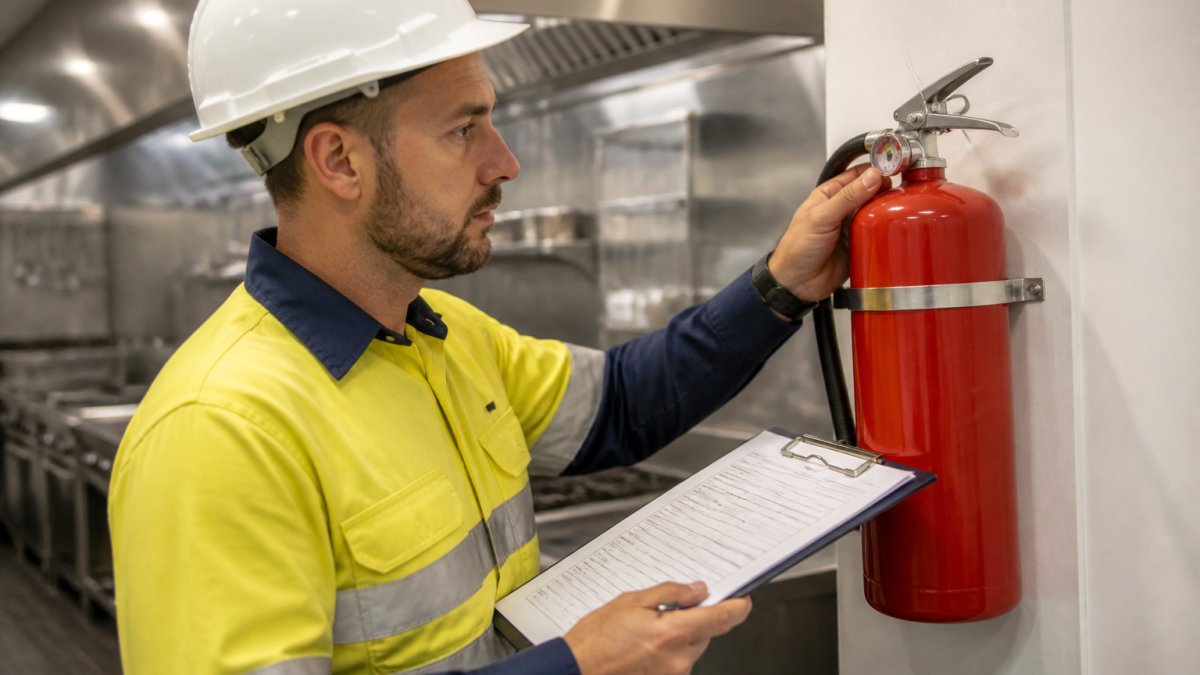
Regular verification of fire suppression systems often reveals underlying hazards that necessitate a comprehensive approach to commercial electrical maintenance to ensure the total integrity of your building infrastructure.
Equipment-Specific Maintenance Tasks
Different equipment needs different attention:
Fire extinguishers:
- Monthly visual checks (pressure, damage, accessibility)
- Annual professional servicing
- Hydrostatic testing every 5-10 years depending on type
Fire hoses and reels:
- Annual inspection by qualified technician
- Check for cracks, rot, or blockages in hose
- Test reel mechanism and water pressure
Fire hydrants:
- Annual inspection and flow testing
- Check access, signage, and valve operation
- Verify water pressure meets requirements
Suppression systems (kitchen, sprinklers):
- Quarterly or annual inspection depending on type
- Professional testing and certification required
- Document all maintenance and any repairs
Maintaining Fire Equipment Service Records and Documentation
Your records are proof. When an audit or fire occurs, documentation shows you took maintenance seriously and followed the standard.
What Records You Must Keep
Keep these documents for every piece of equipment:
- Service tags, attached to the equipment showing date, technician name, and next service due
- Service reports, detailed documentation of what was checked, tested, and any faults found
- Inspection logs, monthly visual checks, even if nothing was wrong
Fyrepower provides detailed service reports listing exactly what was inspected, the results, and corrective actions taken.
Audit-Ready Documentation
When an auditor or inspector arrives, they’ll want to see:
- A complete record of all equipment on site
- Service history for the last 12 months minimum (preferably longer)
- Evidence of monthly checks
Vague records like “serviced” with no date or technician name won’t cut it. Auditors need specifics: who did the work, what was checked, the result, and the next service due date.
Store records digitally and in hard copy, if a fire happens, digital records might not survive. Keep an off-site or cloud backup.
Common Maintenance Mistakes to Avoid
Most compliance failures come from small, repeated shortcuts that compound until an audit or incident exposes them.
Treating the annual service as the whole program
Annual servicing is the backbone of AS 1851 compliance, but not the only obligation. Monthly visual checks catch a gauge drifted into the red, a broken tamper seal, or an extinguisher moved behind stock. If the yearly visit is your only activity, you’re blind for eleven months.
Letting the equipment register drift out of date
An equipment register is only useful if it matches what’s on site. Equipment gets added after a fit-out, relocated during a refurbishment, or removed when a tenant vacates, and the register is rarely updated. A mismatch between list and physical equipment is one of the fastest ways to lose credibility with an auditor or insurer.
Relying on verbal or informal records
“The technician said it was fine” is not a record. Auditors and insurers want who attended, what was inspected and tested, the result, any faults, and the next service due date. If your provider hands you only a handwritten tag, ask for a written service report.
Missing the interdependencies between systems
Fire equipment doesn’t operate in isolation. A suppression system that discharges correctly is of limited value if the detection circuit triggering it hasn’t been tested, or the cooking-equipment shutdown that should accompany activation hasn’t been verified. When reviewing service reports, check the technician confirmed the interfaces between systems, not just individual components.
Assuming a failed item can be repaired indefinitely
Pressure vessels aren’t repairable once they fail hydrostatic testing. A failed cylinder must be condemned and replaced, keeping it on the wall, even with a tag, creates a direct safety and insurance exposure. The same applies to perished hoses or reels that no longer operate smoothly.
Scheduling by memory instead of by calendar
Different equipment runs on different cycles: monthly visual checks, annual servicing, and hydrostatic testing at five or ten years depending on extinguisher type. Holding all that in your head guarantees something slips. A simple maintenance calendar, spreadsheet, wall chart, or provider reminder system, is the cheapest compliance tool you can have.
If you cannot produce a dated record for a monthly check, treat that month as unverified. In an audit, an unverified month is treated the same as a missed check.
Ignoring the human side of maintenance
Equipment staff can’t find, reach, or use is only partly maintained. Include equipment locations and basic operating instructions in staff inductions, and re-brief when layouts change. A well-serviced extinguisher behind a locked door is still a failure on the night it’s needed.
Choosing a Qualified Fire Equipment Service Provider
Your provider is the biggest variable in whether your maintenance program holds up. A good one keeps you ahead of deadlines, documents to an auditor’s standard, and flags problems before they become incidents. A poor one leaves vague tags, missed cycles, and no defensible record when it matters.
What to verify before you engage anyone
Work through these checks before signing anything:
- Licensing and registration. Confirm the business holds the relevant Queensland building and plumbing licensing for the fire protection work it performs, and that the licence is current. Ask for the licence number and verify it.
- Insurance. Request a certificate of currency for public liability and professional indemnity. A provider without current cover exposes you to risk if something goes wrong on site.
- Technician competence. Ask what training and competency the attending technicians hold for the specific equipment they will service. Fire equipment servicing is not a general handyman task.
Questions that separate a real provider from a box-ticker
These questions reveal how a provider actually operates:
- How do you handle a fault found during service? Can they repair or replace on the spot, or will you need a separate contractor and a second visit?
- What is your process for notifying me of upcoming service dates? A provider who relies on you to remember is a provider who will let a cycle lapse.
- How are records delivered? Digital reports, portal access, hard copy, and how long are they retained?
- What happens if equipment fails hydrostatic testing? Do they quote replacement, and how quickly can it be installed?
- Who is my point of contact if an inspector attends? A provider who can speak to their own records is worth more than one who disappears after invoicing.
- Can you service multiple sites on a coordinated schedule? If you manage more than one premises, consolidated scheduling reduces the risk of one site falling behind.
Understanding what “audit-ready” actually means
Audit-ready doesn’t mean the work was done, it means the work can be demonstrated. Your records must show, for each item of equipment:
- A unique identifier and location
- The date and nature of each service or check
- The technician who performed it
If any field is missing, your documentation is weaker than it looks. When reviewing a provider’s sample report, check for all six.
Matching provider scope to your premises
Different premises carry different equipment profiles, and a provider strong on one may be thin on another:
- Hospitality and food service typically need kitchen suppression systems, extinguishers, and fire blankets, with grease-laden environments that demand attention to detection and suppression interfaces.
- Retail and office tend to centre on extinguishers, hose reels, detection, emergency lighting, and exit signage.
- Industrial and warehouse often involve hydrants, larger suppression systems, and equipment exposed to dust, vibration, or corrosive conditions.
Ask a prospective provider about their experience with your premises type, and for the name of a comparable site they currently service.
The cost conversation
Pricing is usually built from the equipment register: number and type of items, locations, and service frequency. A provider who quotes without seeing your register is guessing. Ask for a quote structured by equipment type and frequency so you can see what you’re paying for, and what’s included in a call-out versus charged extra.
A provider who cannot show you a sample report, a current licence, and a certificate of insurance before you engage them is unlikely to produce the records you will need when an inspector or insurer asks questions.
Keeping the relationship working
Once a provider is in place, the relationship still needs managing. Confirm service dates in advance, review each report rather than filing it unread, act on flagged defects promptly, and reconcile your equipment register against the report at least annually. A provider can only maintain what they can see and what you tell them about, if equipment has been added, moved, or removed, say so before the next visit.
Frequently Asked Questions
How often should fire equipment be serviced?
Fire extinguishers require visual inspection monthly and professional servicing annually under AS 1851. Hydrants need annual testing, and suppression systems require six-monthly inspection. The exact schedule depends on your equipment type and business classification. Fyrepower can assess your specific requirements and create a maintenance calendar tailored to your premises.
What should a fire equipment maintenance checklist include?
Your checklist must cover pressure gauge readings, physical damage, accessibility, signage visibility, pin and tamper seals on extinguishers, hose condition on hydrants, and system activation indicators. It should also track dates of last professional service, technician details, and any defects found. Keeping a detailed fire equipment maintenance checklist ensures nothing is overlooked and provides evidence of compliance during audits.
Is AS 1851 mandatory in Queensland?
Yes, AS 1851 is the mandatory standard for the inspection and maintenance of fire protection equipment across Queensland. It specifies testing intervals, qualified personnel requirements, and documentation standards. Compliance is legally required for all commercial premises, and failure to maintain AS 1851 standards can result in penalties and loss of insurance cover in the event of a fire.
What records should a business keep after fire equipment servicing?
Keep the service report detailing work performed, defects identified, corrective actions taken, next service date, and the technician’s credentials. Store fire equipment service records for a minimum of five years and maintain them in a format that survives audits. Detailed records prove compliance, support insurance claims, and help identify recurring maintenance patterns across your equipment fleet.
Fire equipment maintenance isn’t complicated, but it is non-negotiable. Monthly checks, annual servicing, proper records, and a qualified service provider cover your legal obligations and keep your team safe. Get in touch with Fyrepower now to discuss a maintenance program that fits your business size and schedule. We’ll handle the testing, provide the documentation, and help you stay compliant.