Last Updated: November 17, 2026
Quick Summary
The fire extinguisher recharge cost in Australia is not a single line item but a bundle of labour, call-out fees, travel, parts and compliance checks, so totals vary by unit type, size and site. A 2026 Australian cost review puts six-monthly servicing at AUD $8 to $30 per extinguisher, with AUD $15 typical, and recharging sits on top of that.
- A recharge restores the extinguishing agent, while a service inspects, tests and tags the unit.
- Labour is usually the largest slice of any recharge bill, followed by parts and consumables.
- CO2 cylinders need high-pressure handling and specialised refilling, which affects price.
- Pressure testing is a separate charge from a routine recharge and runs on a five-yearly cycle.
- Ask whether GST, call-out, travel and pressure testing are included before comparing quotes.
Table of Contents
- How Fire Extinguisher Recharge Costs Are Built
- Fire Extinguisher Servicing Cost Across Australia
- What Changes the Price by Extinguisher Type and Size
- Fire Extinguisher Pressure Testing Cost and What It Involves
- Fire Extinguisher Service Intervals You Must Meet
- Fire Extinguisher Recharge vs Replacement: Which Makes Sense
- What to Check on a Recharge Quote Before You Approve It
- Book Your Extinguisher Service and Get a Clear Quote
- Frequently Asked Questions
How Fire Extinguisher Recharge Costs Are Built
The fire extinguisher recharge cost in Australia is not a single line item. It is a bundle of labour, travel, parts and compliance checks, and each one moves the total.
Here is the first thing most building managers get wrong: a recharge is not the same as a service. A recharge restores the extinguishing agent inside the cylinder.
Fire extinguisher servicing is the scheduled inspection, testing and tagging of a unit to confirm it will work when needed.
A 2026 Australian cost review reports six-monthly servicing at AUD $8 to $30 per extinguisher, with AUD $15 described as a typical figure (fire safety compliance cost review).
Labour, call-out fees and travel charges
Labour is usually the largest slice of any recharge bill. A technician’s time, the call-out fee to attend your site, and travel to regional or remote locations all add up. Providers often advertise a per-unit price that assumes a minimum asset count on one visit. Below that threshold, the call-out fee is spread across fewer units, so the per-unit figure climbs.
Parts, recharging agent and cylinder condition
Parts and consumables are the second big variable. A recharge may involve fresh recharging agent, a replacement valve, hose, gauge or seal, and a new tamper seal and tag. Cylinder condition matters too. A corroded or damaged cylinder may fail inspection and cannot simply be refilled.
Watch out: a quote that lists only “recharge” with no mention of parts or cylinder inspection is incomplete. If the cylinder fails a pressure test, that cost lands later.
Fire Extinguisher Servicing Cost Across Australia
Pricing depends on quantity, dates and site access, and the biggest source of confusion is scope. Two quotes can both say “recharge” and mean different things. The table below sets out what each cost component covers, so you can compare line by line rather than by headline total.
| Cost component | What it covers | Typical pricing basis |
|---|---|---|
| Six-monthly service | Inspection, testing, tagging | Per extinguisher, AUD $8-$30 (2026 review) |
| Call-out fee | Technician attendance | Per visit, varies by provider |
| Travel charge | Distance to site | Per kilometre or flat regional fee |
| Recharge labour | Technician time to refill | Per unit, often bundled |
| Parts | Valve, hose, gauge, seal | Per part replaced |
| Pressure test | Hydrostatic testing | Per cylinder, five-yearly |
What the figures do and do not include
Pricing depends on quantity, dates and site access. Before you compare two quotes, confirm whether GST is included, whether labour and call-out are bundled, whether travel is charged separately, and whether any pressure test is in scope.
A Queensland provider advertises testing from AUD $130 plus GST for up to three assets (Queensland fire extinguisher testing prices). That is a testing price, not a recharge price, and it illustrates the base-fee-plus-asset-count structure that shapes most totals. Read it as a floor for attendance, not a recharge benchmark.
Sample totals by site size
To make the per-unit effect concrete, here are indicative scenarios using the component logic above. These are illustrative, not quotes, and assume a metropolitan visit with no parts replaced and no pressure test due.
Attendance costs are spread across more units as a site grows, so the per-unit figure generally falls with scale.
If your site has units spread across multiple buildings or levels, ask whether travel between them is charged.
Watch out: a low headline price that excludes call-out, travel and GST can cost more than an all-inclusive quote once the invoice is totalled.
What Changes the Price by Extinguisher Type and Size
The type of extinguisher and its kilogram capacity drive the recharge price more than anything else. Bigger cylinders hold more agent, and some agents cost more to replace than others.
Dry chemical powder and ABE powder units
Dry chemical powder and ABE powder units are among the most common portable extinguishers in commercial buildings. Size still matters: a 4.5 kg unit takes more agent and time than a 1 kg unit.
CO2, foam, water and wet chemical units
CO2, foam, water and wet chemical units sit at different price points. CO2 cylinders involve high-pressure handling and specialised refilling. Wet chemical units, common in commercial kitchens, need the correct agent and careful handling. Foam and water units are usually straightforward but still carry a per-unit service cost.
A common mistake is assuming every extinguisher on site takes the same recharge. A mixed building, with powder in corridors and wet chemical in the kitchen, will have a mixed quote.
Fire Extinguisher Pressure Testing Cost and What It Involves
Pressure testing, also called hydrostatic testing, is a separate charge from a routine recharge. It verifies that a cylinder can safely hold pressure, and it is required on a set cycle rather than every service.
The test involves emptying the cylinder, inspecting it internally for corrosion and damage, and subjecting it to pressure. Units that pass are refilled and returned to service. Units that fail are condemned and must be replaced.
Because it is a distinct procedure, pressure testing carries its own labour and handling cost. Ask your provider whether a quoted recharge includes any pressure test, or whether that is billed separately. The answer changes the true total.
Fire Extinguisher Service Intervals You Must Meet
Service intervals are set by Australian Standard AS 1851, and missing them creates a compliance problem, not just a cost one. The standard sets out six-monthly inspections, annual checks and five-yearly pressure testing for portable extinguishers.
For a fuller breakdown, see our guide on how often to test fire extinguishers in Australia, which walks through each AS 1851 milestone. If you are new to tagging and record-keeping, our fire extinguisher testing and tagging guide explains what each tag and service record should show.
Staying on schedule also controls cost. A unit serviced on time rarely needs more than a routine recharge. A unit left overdue can fail inspection and require replacement instead.
Fire Extinguisher Recharge vs Replacement: Which Makes Sense
Recharging is usually the cheaper path, but not always the right one. The decision comes down to the unit’s age, condition and whether the cylinder still passes inspection, and to whether the recharge bill is closing in on the price of a new unit with a fresh warranty.
Labour and warranty costs can affect whether refilling is financially viable, and a cheap recharge on a cylinder nearing the end of its life can cost more over time than a new unit with a fresh warranty.
A practical comparison by age, condition and type
Use the unit’s age and condition as the first filter, then compare the recharge cost against replacement.
- New unit, within service life, no corrosion: recharge. The cylinder has plenty of test cycles left and parts are readily available.
- Mid-life unit, sound cylinder, minor parts wear: recharge, but ask for the parts cost separately. A valve or hose replacement can push the total up.
- Unit approaching its pressure-test cycle: compare the recharge plus the upcoming hydrostatic test against a new unit. The test is a separate charge, and on an older cylinder it can tip the economics.
- Corroded, damaged or failed cylinder: replace. A failed cylinder cannot simply be refilled, and condemning it is the correct outcome.
- Obsolete unit or unsupported agent: replace. Parts and agent availability drive long-term cost more than the recharge price itself.
Type matters too. CO2 cylinders involve high-pressure handling and specialised refilling, and wet chemical units common in commercial kitchens need the correct agent and careful handling.
The break-even rule of thumb
When weighing a recharge, compare the all-in recharge cost, including labour, parts, any pressure test and the call-out share, against a comparable new unit. The exact crossover depends on the unit type and size, so ask your provider for both figures on the same quote.
Use this decision guide:
- Cylinder passes pressure test and shows no corrosion → recharge
- Unit is within its service life and parts are sound → recharge
- Cylinder fails inspection or is damaged → replace
- Recharge plus parts approaches the cost of a new unit → compare carefully
- Unit is obsolete or the agent is no longer supported → replace
- Pressure test is due and the cylinder is near end of life → price replacement alongside the test
If a failed unit needs emergency repair, our guide to emergency fire system repair costs sets out what to expect.
What to Check on a Recharge Quote Before You Approve It
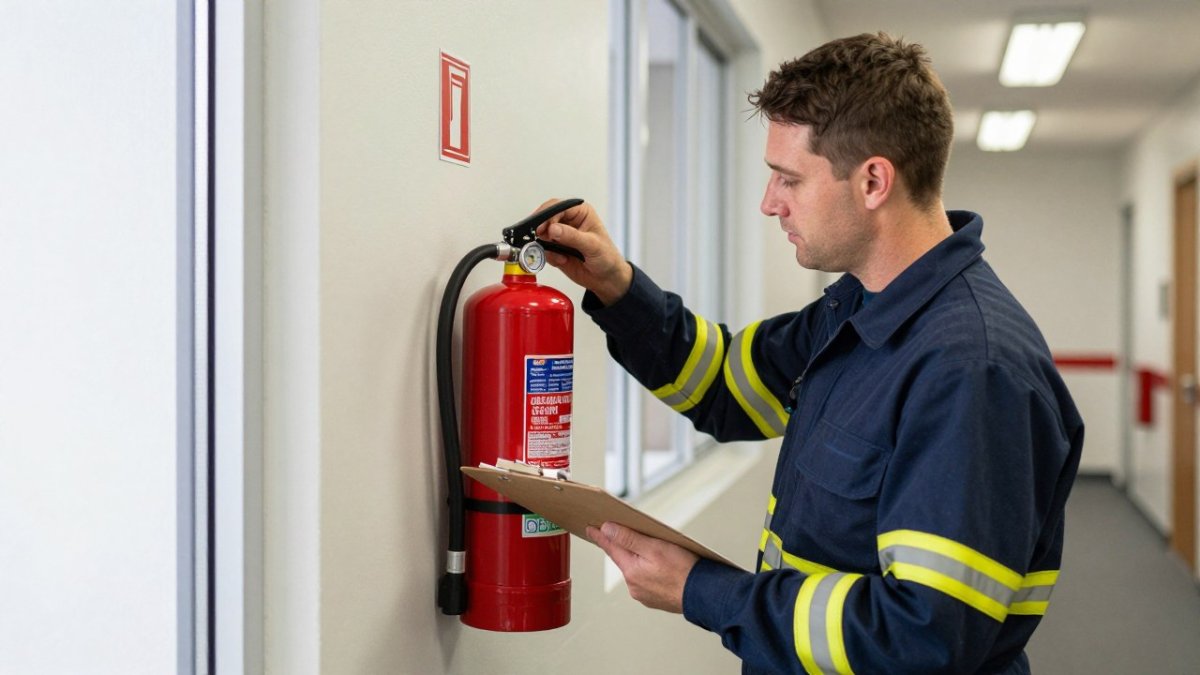
A clear quote is itemised. It separates labour, call-out, travel, parts and testing, and it states the GST and any warranty terms. Anything vague deserves a question before you sign.
Run through this checklist:
- Is each extinguisher listed by type and size?
- Are labour, call-out and travel shown separately?
- Are parts itemised, with prices?
- Is pressure testing included or quoted separately?
- Is GST shown clearly?
- Is the warranty stated in writing?
- Will you receive a detailed service record and tag per unit?
To avoid the surprise charges that blow out budgets, our guide on how to avoid surprise fire service charges explains the fees to watch for. Confirming your extinguisher placement against the AS2444 standard is also worth doing, and our AS2444 placement guide covers it.
Book Your Extinguisher Service and Get a Clear Quote
Recharge costs are manageable when you know what you are paying for and keep units on schedule. The alternative, an overdue unit that fails inspection, costs more than a routine service every time.
Fyrepower is a fully insured, QBSA-licensed fire protection specialist serving the Gold Coast, South Brisbane and Northern New South Wales. We provide a range of fire safety equipment, installation and professional testing services, including on and offsite fire training, aligned to Australian standards including AS 2444 and AS 1851. Our 55-month warranty backs the equipment we supply.
Get in touch with us now!
Frequently Asked Questions
How much does it cost to recharge a fire extinguisher?
There is no single national figure. Fire extinguisher recharge costs depend on unit type, size, cylinder condition, parts needed and travel to your site. For pricing on your units, get in touch with Fyrepower for an itemised quote rather than a headline rate.
Is it cheaper to recharge or replace a fire extinguisher?
It depends on the unit. Labour and warranty costs can affect whether refilling is financially worthwhile. A sound cylinder with a current pressure test is usually the cheaper path, and once corrosion, dents, a failed hydrostatic test or a damaged valve is involved, replacement is often the more practical choice. Compare the itemised recharge quote against the cost of a new unit of the same type and capacity before deciding.
How often does a fire extinguisher need to be recharged?
Recharging is triggered by use, not by the calendar. An extinguisher that has been discharged, even partly, needs recharging before it goes back on the wall. Alongside that, Australian Standard AS 1851 sets routine servicing intervals for portable extinguishers. Get in touch with Fyrepower to confirm the schedule that applies to your units.
Does fire extinguisher servicing include pressure testing?
Not always, and that is where quotes diverge. Pressure testing, also called hydrostatic testing, is a separate procedure at set intervals. Ask whether any quote includes hydrostatic testing or lists it as an extra, and confirm the test date on the cylinder stamp. A quote that separates these line items is easier to compare and less likely to produce surprise charges later.