Table of Contents
- What Is Hydrostatic Pressure Testing?
- AS 1851 Fire Hydrant Testing Standards
- Fire Hydrant Maintenance Frequency and Testing Schedules
- Fire Hydrant Flow Testing Requirements
- Step-by-Step Hydrostatic Pressure Testing Process
- Documentation and Compliance Reporting
- Safety Checklist for Hydrostatic Testing
- Conclusion
- Frequently Asked Questions
Last Updated: August 28, 2026
What Is Hydrostatic Pressure Testing?
Hydrostatic pressure testing is the process of applying water pressure to a fire protection system to verify its structural integrity and confirm it can safely contain pressurised water without leaks. The test works by filling the system with water and gradually increasing pressure to a specified level, typically 1.5 times the system’s maximum operating pressure, then holding it steady for a defined period. Technicians monitor for visible leaks, seepage, or pressure drops that would indicate a fault. If the system maintains pressure without loss, it passes; if pressure drops or leaks appear, the system fails and requires repair before retesting.
Hydrostatic pressure testing is fundamentally different from flow testing. While flow testing measures the volume and velocity of water moving through the system using tools like pitot tubes, hydrostatic pressure testing is static, the water sits inside the system under pressure. Flow testing checks firefighting capacity; hydrostatic pressure testing checks structural integrity. Both are essential for comprehensive fire hydrant compliance.
AS 1851 Fire Hydrant Testing Standards
The AS 1851 standard is Australia’s primary framework governing the maintenance and testing of fire protection systems, including fire hydrants. It sets out the frequency, methodology, and documentation requirements that property managers and facility owners must follow to remain compliant.
AS 1851 requires fire hydrant systems to undergo hydrostatic pressure testing at five-yearly intervals, a statutory requirement, not a recommendation. Between five-yearly tests, annual inspections must verify that visible components show no signs of damage, corrosion, or deterioration.
The standard specifies test pressure as typically 1.5 times the maximum static pressure the system is designed to handle, usually between 7 and 10 bar (standards.org.au). The test must be held for at least 10 minutes without pressure loss exceeding 0.5 bar (standards.org.au). Any greater loss indicates a leak or structural fault requiring investigation and repair.
AS 1851 mandates detailed documentation: date, pressure applied, duration, pass/fail result, and the name and credentials of the technician. These records form your compliance evidence and must be retained for audit purposes. If a regulator or insurer requests proof that your system meets fire safety standards, your AS 1851 test reports are your primary defence.
Fire Hydrant Maintenance Frequency and Testing Schedules
Fire hydrant systems require two distinct maintenance schedules: annual visual inspections and five-yearly hydrostatic pressure testing.
Annual inspections happen every 12 months. A trained technician visually examines the hydrant head, valve, pipework, and all visible fittings for signs of corrosion, damage, or deterioration. The hydrant is also operated briefly to confirm the valve moves freely and water flows. Annual inspections catch surface-level problems early before they escalate into structural failures.
Five-yearly hydrostatic pressure testing is the deeper structural check, where the system is pressurised and held under load to verify the integrity of all internal pipework and sealed connections. The five-year interval balances regulatory safety requirements with practical maintenance logistics. A system that passes hydrostatic testing once every five years, combined with annual visual checks, provides reasonable assurance that the pipework will perform in an actual fire emergency.
The five-yearly schedule is not flexible, it is a statutory requirement under AS 1851. Missing a deadline creates a compliance gap that exposes the property to regulatory action and voids insurance coverage if a fire occurs. Some property managers implement additional testing on a three-yearly cycle for high-risk facilities or regions with aggressive water chemistry, providing extra assurance above the minimum requirement.
Fire Hydrant Flow Testing Requirements
Flow testing measures the volume and velocity of water the system can deliver under pressure, distinct from but equally important as hydrostatic pressure testing for fire safety compliance.
Flow testing uses a pitot tube and gauge to measure velocity pressure at the hydrant outlet. The pitot tube is inserted into the water stream exiting the hydrant, and the gauge records the dynamic pressure. From this reading, technicians calculate the flow rate in litres per minute. Most fire hydrants are designed to deliver between 500 and 1,500 litres per minute, depending on water main capacity and system design. Fire hydrant flow considerations
Flow testing confirms the system can deliver sufficient water volume to firefighting equipment. A hydrant that passes hydrostatic pressure testing might still fail flow testing if the underlying water main is undersized or if internal deposits have accumulated inside the pipework, restricting flow.
AS 1851 requires flow testing at commissioning and as part of the five-yearly testing cycle. Results must be recorded and compared against the design specification. If actual flow falls below the design target, the water main may need upgrading or internal cleaning of the pipework may be necessary.
Fyrepower conducts both hydrostatic pressure testing and flow testing as part of comprehensive fire hydrant compliance programs. Understanding the difference between the two tests helps facility managers appreciate why both are necessary: hydrostatic testing proves the system won’t leak; flow testing proves it can deliver the water volume firefighters need.
Step-by-Step Hydrostatic Pressure Testing Process
Hydrostatic pressure testing follows a structured methodology to ensure safety, accuracy, and compliance documentation.
What You’ll Need Before Testing
Before any test begins, several prerequisites must be in place:
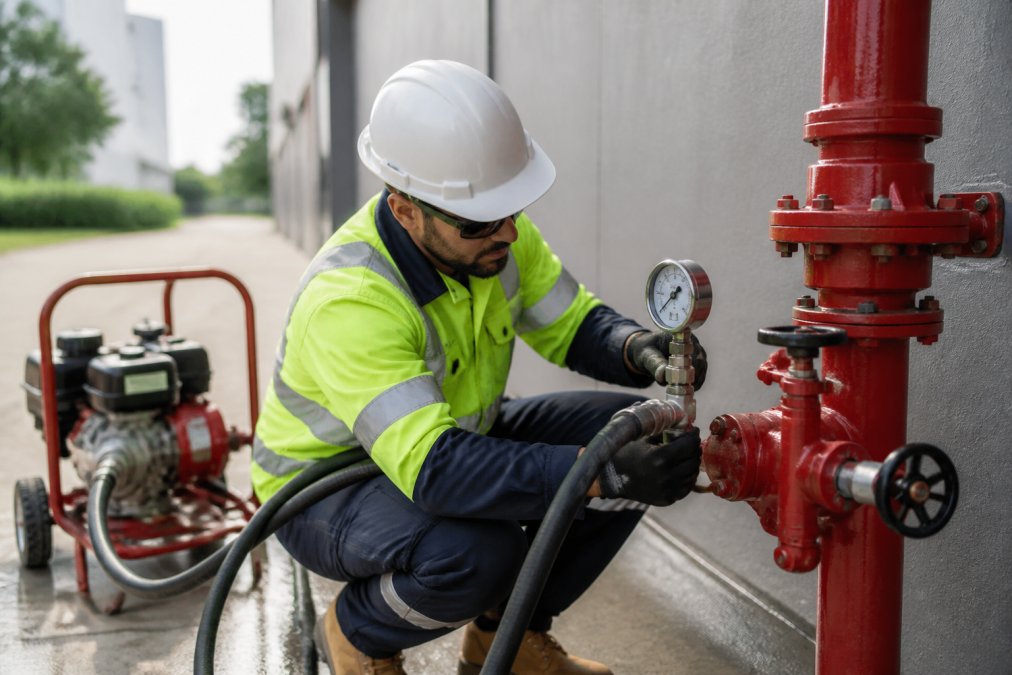
- Pressure testing equipment: A hand pump or motorised pump capable of pressurising the system to the required level, with a pressure gauge accurate to ±0.5 bar
- Water supply: A clean water source, typically a water truck or mains connection
- Isolation and venting: The ability to isolate the section being tested and vent air from high points to prevent air locks
- Personal protective equipment: Safety glasses, gloves, and appropriate footwear
- Documentation forms: Pre-prepared test certificates with space for date, time, pressure readings, duration, pass/fail result, and technician signature
- Pressure relief valve: A safety valve set slightly above the test pressure
Before testing begins, confirm the area is clear of unauthorised personnel and that all isolation valves are in the correct position. Brief everyone present on what will happen and where they should stand, as pressurised water can escape forcefully if a fitting fails.
The Testing Procedure
Step 1: System Preparation and Filling
Close all isolation valves on the section to be tested. Open vent valves at high points to allow air to escape as water fills the system. Connect the pressure pump to the test point. Begin filling slowly with clean water, monitoring for leaks as pressure rises.
Step 2: Pressure Ramp-Up
Once the system is full and air-free, increase pressure gradually, typically at 0.5 bar per minute, until reaching the target test pressure. This slow ramp prevents shock loads that could damage the system. Watch the pressure gauge continuously and listen for unusual sounds indicating a leak.
Step 3: Visual Inspection Under Pressure
With the system at full test pressure, conduct a thorough visual inspection of all visible joints, fittings, and connections. Look for water spray, seepage, or moisture. Check the pipework surface for cracks or deformation.
Step 4: Pressure Hold and Monitoring
Maintain the test pressure for the required duration, typically 10 minutes. Monitor the pressure gauge at regular intervals (every 1-2 minutes) and record readings. If pressure drops more than 0.5 bar over the 10-minute period, the test fails.
Step 5: Documentation and Release
Record the final pressure reading. If the test passed, note this on the test certificate. Slowly release the pressure by opening vent and isolation valves. Do not depressurise rapidly.
Step 6: Post-Test Inspection
After depressurisation, inspect the system for any damage caused by the test. Drain the test water and return the system to normal operation.
Common Test Failures and Troubleshooting
Pressure drops during the hold period are the most common failure. A drop exceeding 0.5 bar over 10 minutes indicates a leak. If the leak is visible, the fix is straightforward: tighten the connection or replace a faulty fitting. If no visible leak appears, the fault is internal, possibly a hairline crack or defective valve seal, requiring isolating sections to pinpoint the problem.
Air locks prevent proper pressurisation and can cause false failures. Ensure all vent valves are open and allow more time for air to escape. Some systems benefit from a secondary fill cycle: depressurise, re-open vent valves, refill, and pressurise again.
Gauge accuracy issues can produce unreliable readings. Before testing, verify that the pressure gauge is calibrated and functioning correctly.
Fitting corrosion is common in older systems. Corroded fittings may weep slightly under pressure and should be replaced before retesting. Surface rust on the hydrant body is cosmetic, but heavy corrosion that has eaten into the metal wall thickness is a structural concern.
Valve seals degradation can cause slow leaks at isolation or relief valves, usually requiring replacement rather than repair.
When a test fails, the system must be repaired and retested before it can be certified as compliant.
Documentation and Compliance Reporting
Every hydrostatic pressure test must generate a detailed report. This documentation is your proof of compliance and is essential if your property is audited or if a fire occurs and insurers question whether the system was properly maintained.
The test certificate must include:
- Property address and system identification
- Test date and time
- Name and credentials of the technician
- Test pressure applied and the basis for that pressure
- Pressure readings at the start and at regular intervals during the hold period
- Duration of the pressure hold
- Pass or fail result, with clear statement of whether pressure loss exceeded acceptable limits
- Details of any visible leaks or defects observed
- Any remedial work recommended or completed
- Signature and date from the testing technician
This level of detail is required by AS 1851 and is what regulators and insurers expect to see. Vague reports that simply state “tested and passed” without specific pressure readings or duration are not sufficient for compliance purposes.
Store test certificates for at least seven years. If your property changes hands, provide copies to the new owner so the compliance history is continuous. When preparing for a compliance audit or insurance renewal, compile all test certificates from the past five years into a single file to demonstrate consistent adherence to the five-yearly testing requirement.
Safety Checklist for Hydrostatic Testing
Hydrostatic pressure testing involves pressurised water and carries inherent risks. A structured safety checklist prevents accidents and ensures responsible testing.
Before Testing Begins:
- Confirm all personnel on site understand what the test involves and where they should stand
- Verify the area is clear of unauthorised people
- Check that the pressure relief valve is installed and set correctly
- Inspect the pump, hoses, and gauge for damage or wear
- Ensure personal protective equipment is available and worn
- Confirm the water supply is clean and free from contaminants
- Verify isolation valves are in the correct position
During Pressurisation:
- Increase pressure slowly, never rapid pressurisation
- Keep bystanders at least 2 metres away from the test section
- Watch for signs of unusual stress: deformation, cracking sounds, or water spray
- Never stand directly in line with a joint or fitting during pressurisation
During the Pressure Hold:
- Monitor the gauge at regular intervals and record readings
- Continue visual inspection for any new leaks or seepage
- Keep the area clear of unnecessary personnel
Depressurisation:
- Open vent and isolation valves slowly
- Allow the system to depressurise fully before disconnecting test equipment
After Testing:
- Inspect the system for any damage caused by the test
- Return the system to normal operation only after confirming it is safe
- Complete and sign the test certificate while details are fresh
- Store the certificate securely
Conclusion
Hydrostatic pressure testing is a non-negotiable part of fire safety compliance in Australia. The AS 1851 standard requires it every five years because pressurised water systems degrade over time through corrosion, vibration, and material fatigue. A system that passed testing five years ago may not pass today. Regular testing catches these problems before they become emergencies.
The testing process is straightforward: pressurise the system, hold pressure, monitor for leaks, and document the result. But execution matters. A test conducted thoroughly, with careful pressure ramp-up, precise pressure monitoring, detailed visual inspection, and comprehensive reporting, gives you genuine confidence that your fire hydrant system will perform when needed.
At Fyrepower, we conduct hydrostatic pressure testing to the full requirements of AS 1851, with detailed pressure readings, certified technicians, and comprehensive test certificates that stand up to regulatory scrutiny. Our team across the Gold Coast, South Brisbane, and Northern New South Wales understands the compliance landscape and the consequences of getting it wrong. Get in touch with us now! to schedule your five-yearly hydrostatic pressure test or to discuss a maintenance program that keeps your fire protection systems compliant and reliable.
Frequently Asked Questions
What are the Australian standard requirements for fire hydrant testing?
Fire hydrants must comply with AS 1851, which mandates hydrostatic pressure testing every five years. The test verifies that pipework, fittings, and the entire hydrant system can withstand rated pressure without leaks. Annual visual inspections are also required to check for corrosion, damage, and proper function. These requirements ensure your system maintains firefighting capacity and structural integrity for emergency response.
How often should fire hydrants undergo hydrostatic pressure testing?
Hydrostatic pressure testing must be conducted every five years under AS 1851 compliance standards. However, annual visual inspections are mandatory to detect issues like corrosion, blockages, or physical damage. If your system fails a test or shows significant wear, additional testing may be needed sooner. Establish a maintenance schedule that includes both five-yearly hydrostatic tests and annual inspections to maintain compliance and system reliability.
What’s the difference between flow testing and hydrostatic pressure testing?
Hydrostatic pressure testing measures whether the system can hold rated pressure without leaking, using static (non-flowing) water under pressure. Flow testing, by contrast, measures the volume and velocity of water delivered by the hydrant using a pitot tube to assess firefighting capacity. Both are important: hydrostatic testing ensures structural integrity and leak detection, while flow testing verifies the system can deliver adequate water volume during an actual fire emergency.
What documentation do I need after hydrostatic pressure testing?
Maintain detailed test reports that record the test date, pressure applied, test duration, any leaks detected, repairs made, and the technician’s certification. Include visual inspection findings, pressure gauge readings, and static/residual pressure measurements. These records prove compliance with statutory requirements and are essential if your property undergoes a fire safety audit. Vague or incomplete reports won’t satisfy regulators or insurance claims.
Fire hydrant systems protect lives. Hydrostatic pressure testing verifies they’re ready to do that job. Don’t leave it to chance, partner with a fully insured, QBSA-licensed provider who treats compliance as non-negotiable.
This article was written using GrandRanker