Last Updated: November 2, 2026
Quick Summary
A fire door inspection checks that each fire door in your office self-closes, latches and remains intact. In Queensland, fire doors must be self-closing and latching, so inspections should be done by a qualified person and recorded in writing. Inspection frequency is set by your building’s approval conditions and fire safety documents.
- Fire doors must self-close and latch to protect people in a fire.
- Inspection frequency is set by your building’s approval conditions and fire safety documents, not a single fixed number.
- A licensed carpenter alone cannot certify or test fire doors; they need passive-fire qualifications.
- Out-of-cycle inspections should follow building works, damage, hardware replacement or a failed audit.
- Track every defect until it is fixed and verified, because audits ask what was done.
Table of Contents
- Why Office Fire Door Inspections Matter for Compliance
- How Often Fire Doors Should Be Inspected
- Who Is Qualified to Inspect and Certify Fire Doors
- Room-by-Room Fire Door Inspection Checklist
- Common Office Fire Door Defects and How to Rectify Them
- Writing a Fire Door Inspection Report That Holds Up at Audit
- Booking Your Next Fire Door Inspection with Fyrepower
- Frequently Asked Questions
Why Office Fire Door Inspections Matter for Compliance
Fire doors only protect people when they close and latch on their own. In Queensland, fire doors must be self-closing and latching, according to the Queensland Fire Department (Queensland Fire Department guidance on fire doors and fire-resistant door sets). At Fyrepower, we see many office fire doors that have quietly stopped doing this job.
Office managers often treat fire doors as background fixtures. Over time, hinges loosen, closers weaken and seals wear out. A door that is propped open, or that won’t latch, can let smoke and fire spread through a floor much faster than it should.
Inspections give you a clear record of what was checked, what was found and what was fixed. That record matters during a compliance audit. It also shows that your business takes its duty of care seriously.
- Fire doors must self-close and latch.
- Damage often builds up slowly and goes unnoticed.
- Written inspection records help prove compliance.
A door that closes most of the time is not the same as one that closes every time. Test it, don’t assume it.
How Often Fire Doors Should Be Inspected
Inspection frequency is not a single number you can apply to every door. It is set by the documents that apply to your building, and those documents should be your first reference point. For most office buildings the relevant sources are the building’s fire safety schedule and approval conditions, the annual fire safety statement (AFSS) process administered by the local government, and the maintenance requirements in the Building Code of Australia and the referenced Australian Standards for fire-resistant door sets.
A common pattern among Queensland property managers is a two-tier schedule: a formal inspection of every fire door on a regular cycle, plus a quick visual and self-closing check by staff between those visits. The formal cycle is often set at six or twelve months depending on the building’s approval conditions and the door’s role in the fire compartmentation strategy. Do not assume a cycle from another building applies to yours; confirm it in writing with your fire safety contractor and record the agreed interval in your maintenance schedule. Integrating these specific fire door intervals into a broader commercial building inspection ensures that every safety component remains compliant with evolving regulatory standards.
Out-of-cycle inspections should be triggered by any of the following events:
- Building works, office fit-outs or refurbishments that affect a fire door, its frame or its hardware
- A door that has been damaged, forced, wedged open or struck by trolleys or equipment
- Replacement of a door leaf, frame, closer, latch or seals
- A failed audit, a fire safety notice or a change to the building’s approval conditions
- A change of tenant or a change of use that alters how a door is used
Watch out: a door that passes an inspection today can fail tomorrow if a fit-out contractor removes a closer to run cabling or props the door open for deliveries. Build a post-works check into your contractor induction so the door is re-inspected before the area is handed back.
Your fire safety contractor should confirm the right interval in writing and note it in the inspection record.
Who Is Qualified to Inspect and Certify Fire Doors
Not everyone can sign off a fire door. Use this guide to selecting a certified fire safety inspector to check the right qualifications before you engage anyone. The Queensland guidance says a licensed carpenter or joiner may install and repair fire doors. However, that licence alone does not allow them to certify, inspect or test fire doors. They also need the relevant passive-fire qualification (Queensland Fire Department guidance on who may certify, inspect and test fire doors).
This split matters. A builder who fixes a door has not necessarily confirmed it still meets fire-rating requirements. Ask any contractor for proof of their qualifications before you engage them.
A qualified inspector can give you a report that holds up if you are audited.
Room-by-Room Fire Door Inspection Checklist
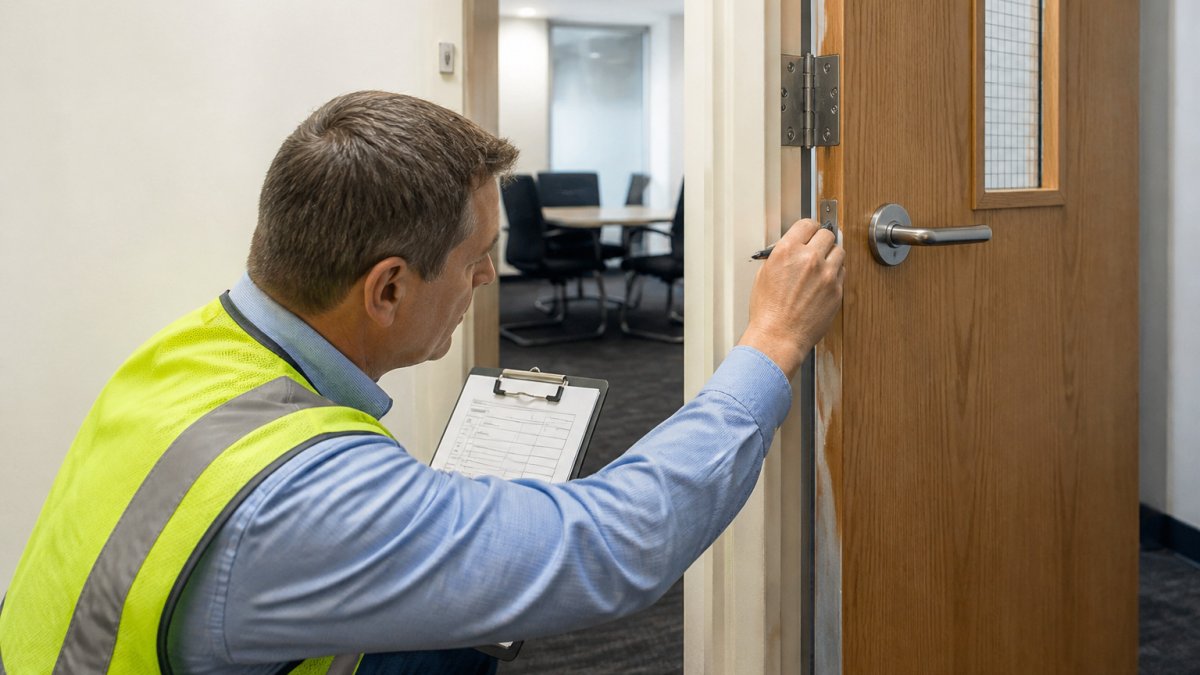
A room-by-room walk-through keeps the inspection organised and makes it easy to spot gaps. Work through each floor, and note the location of every fire door on a floor plan.
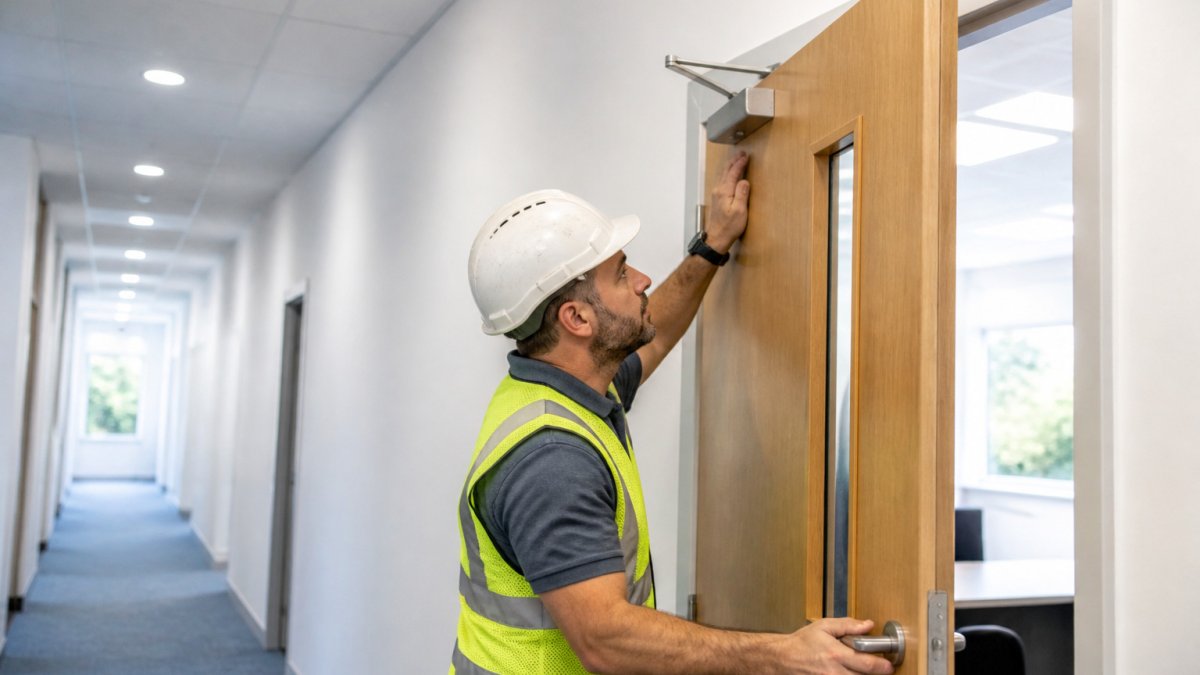
For each door, check the following:
- Door leaf: no cracks, holes, warping or damage
- Frame: secure, undamaged and free of gaps
- Gaps: even clearance around the door, not excessive
- Hinges: firmly fixed, with no missing or loose screws
- Latch: engages positively when the door closes
- Door closer: closes the door fully from any open position
- Seals: intumescent and smoke seals intact along the edges
- Glazing: no cracks, and fire-rated glass still in place
- Signage: present and readable, and matching approval requirements
- Obstructions: nothing blocking or propping the door open
Staff can do a quick visual and self-closing check between formal inspections. They should not adjust hardware or certify the door. Anything they find should go into the maintenance log for a qualified person to review.
Common Office Fire Door Defects and How to Rectify Them
Most office fire door problems come from wear, misuse or poor repair work, and the office environment produces a recognisable set of failure scenarios. The list below goes beyond the generic defects to the situations facility teams actually encounter, and it adds the prioritisation and verification steps that a report needs to be useful.
Office-specific failure scenarios
- Doors wedged or propped open: Wedges, kick-down stops and furniture are common in offices where a door is inconvenient. Remove the obstruction and, where the building approval allows it, fit an approved hold-open device that releases on the fire alarm signal. A door held open by an unapproved device is a defect even if the door itself is undamaged.
- Access-control hardware interfering with latching: Electronic strikes, maglocks and card readers can prevent a door from latching positively or can hold a door open. The hardware must be compatible with the door’s fire rating and must fail safe in a way that preserves the door’s self-closing and latching function. This is a specialist check, not a general maintenance task.
- Fit-out changes: New partitions, ceiling grids, cabling and signage are often installed without regard to a fire door. Cables run through a door frame, a closer removed to fit a cabinet, or a new sign covering a vision panel are all defects that appear after a fit-out and are easily missed.
- Door won’t latch: The latch may be misaligned or the strike plate worn. A qualified person should adjust or replace the hardware.
- Door doesn’t close fully: The closer may need adjustment or replacement, or the door may be binding on the frame.
- Excessive gaps: The frame or door may have shifted. Realigning or repairing the frame usually solves this.
- Damaged or missing seals: Replace intumescent and smoke seals with approved products.
- Missing or faded signage: Replace it so it matches your building’s approval requirements.
Prioritising defects
Not every defect carries the same risk. A practical way to prioritise is:
- Critical: The door will not self-close or latch, or it is wedged open in a required fire separation. Treat as an immediate fix.
- Major: Damaged seals, excessive gaps, failed glazing or incompatible hardware. Schedule repair promptly and record the interim control.
- Minor: Faded signage, cosmetic damage or a loose screw. Fold into the next maintenance visit.
Verifying repairs
Every repair should be done with approved parts, and the invoice and updated inspection record should be kept together. Closing out a defect means more than receiving an invoice: the door should be re-tested for self-closing and positive latching, the repair should be photographed, and the inspection record should show who verified the fix and when. Track every open item until it is fixed and verified, because an audit will ask not just what was found but what was done about it.
Staff can report defects they notice, but they should not adjust hardware or certify a door. Anything they find should go into the maintenance log for a qualified person to review.
Writing a Fire Door Inspection Report That Holds Up at Audit
A good report is specific, dated and easy to follow. Vague notes such as “door checked, fine” will not help you during an audit. Each entry should name the door, the location, what was tested and the result.
Include these details for every door:
- Door location, using your floor plan reference
- Date, inspector name and qualification
- Each item checked, with pass or fail
- Photos of any defects found
- Recommended repair and its priority
- Date the defect was closed out, with proof of repair
Closing out defects matters as much as finding them. Track every open item until it is fixed and verified.
Booking Your Next Fire Door Inspection with Fyrepower
Regular inspections protect your people, your building and your compliance record. Fyrepower is a QBSA-licensed and fully insured fire protection specialist.
Get in touch with us now to discuss your fire safety needs.
Frequently Asked Questions
How often should fire doors be inspected in an office?
Fire doors in commercial buildings should be inspected at intervals set by the applicable Queensland fire safety requirements and the building’s maintenance plan, with six-monthly inspection commonly used as the benchmark for many commercial sites. Certain Australian compliance guidance also refers to six-monthly inspection and tagging. Confirm the interval with a qualified inspector and your building’s fire safety documentation, then keep the schedule on record.
What is checked during a fire door compliance inspection?
A compliance inspection checks the door leaf, frame, gaps and clearances, hinges, locks and latches, the self-closing device, intumescent and smoke seals, glazing, signage and any visible damage or modifications. The inspector confirms the door closes fully and latches positively. Items that cannot be verified by visual check may require testing by a qualified person.
Who can inspect fire doors in a commercial building?
Under Queensland fire safety guidance, a licensed carpenter or joiner may install and repair fire doors, but certification, inspection and testing require the relevant passive-fire qualification. Office staff can carry out basic visual checks, such as confirming a door closes and latches, but formal compliance inspection should be performed by a qualified professional.
What records should be kept after a fire door inspection?
Keep a dated inspection report that lists each door location, the items checked, the result, any defects found and the corrective action taken. Store records with your building’s fire safety documentation so they can be produced at audit. Vague reports that cannot show what was tested are a common reason compliance claims fail scrutiny.