Quick Summary
To choose a fire alarm service provider in Brisbane, first confirm their licence on the QBCC register and check they hold current public liability and workers’ compensation insurance. Then confirm their technicians are trained to AS 1851, compare itemised quotes, and review the service agreement and compliance report before signing.
- Check the provider’s licence number yourself on the QBCC public register.
- Confirm the licence class covers the specific fire protection work you need.
- Ask for public liability and workers’ compensation certificates and check their expiry dates.
- Ask for the name and licence details of the technician who will attend your site.
- Request a sample compliance report before signing to see what it includes.
Table of Contents
- Why Your Choice of Fire Alarm Service Provider Matters
- Verify Licensing and Insurance Before You Engage Anyone
- Confirm Technicians Are Trained to AS 1851 Standards
- Understand Installation Versus Ongoing Maintenance Services
- Compare Itemised Quotes and Understand the Cost of Fire Alarm Servicing in Brisbane
- Review Service Agreements, Response Times and Compliance Reporting
- Booking Your Fire Alarm Service Provider Assessment
- Frequently Asked Questions
Why Your Choice of Fire Alarm Service Provider Matters
Last Updated: November 4, 2026
Choosing the right fire alarm service provider in Brisbane decides whether your property stays compliant and your people stay safe. A poor choice of provider can lead to missed inspections, vague reports and costly repairs.
The Australian Standard AS 1851 sets out how fire protection systems should be maintained, including testing and record keeping. Your provider’s job is to follow it, and you need a way to check that they do. Standards Australia AS 1851 maintenance of fire protection systems
This guide walks through the steps we recommend before you sign anything. Read on for a checklist you can use with any provider, including us.
Verify Licensing and Insurance Before You Engage Anyone
Start with the paperwork. A licensed, insured provider protects you if something goes wrong during testing or repair. Ask for proof of both before any work begins.
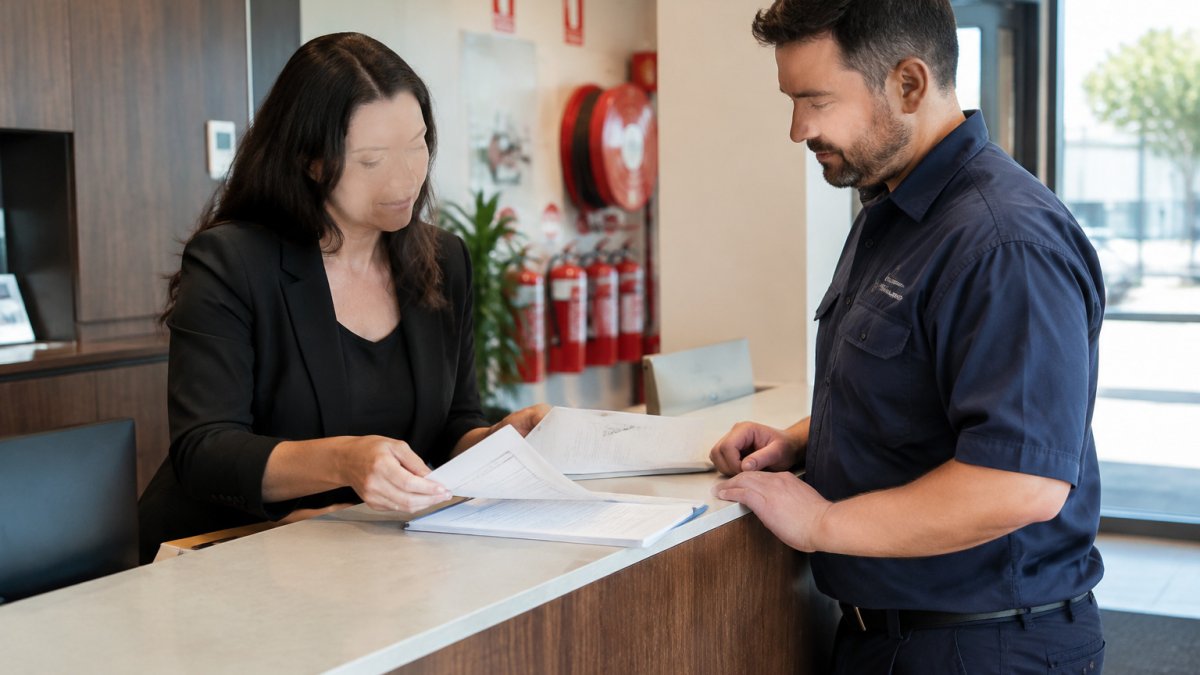
Check these items first:
- Current licence details, with the licence class and scope
- Public liability insurance certificate
- Workers’ compensation cover for all staff on site
- Name of the licensed individual who will sign off your work
Watch out: a business name on a website does not prove a licence. Always ask for the licence number and check it yourself.
Checking QBCC Licence Class and Scope
In Queensland, fire protection work is regulated by the Queensland Building and Construction Commission (QBCC). Look up the provider’s licence on the QBCC’s public register and confirm the licence class covers the work you need, such as installation, testing or maintenance. A licence that covers building work does not automatically cover every fire protection task. QBCC licence search and register
Also check that the licence is current and that the holder is listed. Our guide on verifying a QBSA fire licence explains each step of the register check.
Confirming Public Liability and Workers’ Compensation Cover
Public liability insurance covers damage or injury caused to others during the work. Workers’ compensation covers injuries to the provider’s own staff. Ask for certificates for both and confirm the expiry dates.
Confirm Technicians Are Trained to AS 1851 Standards
Licensing tells you the business is permitted to carry out fire protection work. It does not, on its own, prove that the individual technician arriving on your site knows how to test your specific system.
Ask the provider to explain, in plain terms, how they confirm technician competency. A credible answer usually covers four things:
- The relevant standard for the work. For fire alarm and detection systems, technicians should be working to AS 1851 and the relevant installation and commissioning standards for the system type. For portable equipment such as extinguishers and hose reels, AS 2444 applies.
- The qualification behind the competency. Ask whether the technician holds a formal qualification in fire protection or electrical work, and whether that qualification is current. A business licence number on a website does not tell you who is turning up.
- Manufacturer training for your panel. Fire indicator panels and detection devices vary between manufacturers. A technician who has never worked on your panel model may still be competent in AS 1851, but they will be slower and more likely to misread fault codes. Ask which manufacturers they are trained on and whether that matches your installed equipment.
- How skills are kept current. Standards are revised, and panel firmware changes. Ask how often technicians complete refresher training and whether the provider records it.
Watch out: a provider may hold a broad QBCC licence and still send an apprentice or a subcontractor to your site unsupervised.
Our team works to AS 1851 and AS 2444, and our article on why licensed fire safety technicians matter explains what that training covers in more detail.
Understand Installation Versus Ongoing Maintenance Services
Many providers do both installation and maintenance, but the skills and contracts differ. Installation is a one-off project. Maintenance is a repeated service that keeps the system compliant over time.
Ask yourself which you need:
- New system or upgrade: you need an installation provider with design and commissioning skills.
- Existing system: you need a maintenance provider who can test, service and report on it.
- Both: choose a provider who can handle the project and then take over ongoing servicing.
Check how the provider will handle future maintenance once installation is complete. Our guide to commercial fire alarm maintenance covers testing frequency and logbook requirements in detail.
Compare Itemised Quotes and Understand the Cost of Fire Alarm Servicing in Brisbane
Cost is where many property managers get caught out. An itemised quote also makes it easier to check whether the proposed work accounts for fire suppression compliance standards where they apply.
When you compare quotes, look for:
- A clear scope of work, with what is and is not included
- Call-out or after-hours fees
- Parts charged at cost or with a markup
- Compliance report fees
- Any exclusions that could add cost later
Pricing depends on the size and type of system, how often it needs servicing and how quickly you need a response. For a realistic benchmark, read our pricing guide for emergency fire system repairs and servicing.
Watch out: a quote that is much lower than the others may leave out testing, reporting or call-out costs. Ask what the difference is before you decide.
Review Service Agreements, Response Times and Compliance Reporting
The service agreement is where the real differences between providers show up, and it is the part most property managers skim. Two quotes can look identical on price and still commit you to very different obligations once a defect is found, a visit is missed or an after-hours fault occurs. Read the agreement as a set of promises you can hold the provider to, not as paperwork to file.
Compare response times on a like-for-like basis
Response time means different things to different providers. Before you compare, ask each one to define:
- What counts as an emergency. A fault that disables detection on a occupied floor is not the same as a single faulty detector in a plant room. Get the provider’s definition in writing.
- The clock start point. Does the response time run from your call, from the provider’s acknowledgement, or from when a technician is dispatched?
- Attendance versus resolution. A fast attendance time is not the same as a fast fix. Ask what happens if the fault cannot be resolved on the first visit.
- After-hours and weekend coverage. Confirm whether out-of-hours attendance is included, charged at a premium, or excluded entirely.
- Geographic coverage. Ask how the provider staffs your area and whether response commitments apply across all of it.
The agreement should state the categories, the hours and any exclusions explicitly.
Check maintenance frequency and missed-visit responsibility
AS 1851 sets routine servicing intervals by system type, and your agreement should reflect those intervals rather than a generic annual visit. Confirm:
- The scheduled frequency for each system on your site, and whether it matches the applicable AS 1851 interval.
- Who books the visit, who confirms access, and how much notice is given.
- What happens if your site cannot provide access on the scheduled date, who bears the cost of a return visit.
- What happens if the provider misses a scheduled visit, and whether that is recorded and remedied at no charge.
- Whether the provider notifies you of defects and in what timeframe, and whether rectification is included or quoted separately.
Specify what the compliance report must contain
Ask for a sample report before you sign, then check it against these points:
- Each device or system tested, identified individually rather than grouped.
- The test method and the result for each item.
- Any defects found, with a severity or priority rating.
- The date of the visit and the name and licence details of the technician who attended.
- A clear statement of what was not tested and why.
A report that lists only “system tested, pass” is not useful at audit and will not help you plan rectification.
Identify exclusions and recurring fees before signing
Look specifically for:
- Parts and consumables charged at cost versus with a markup.
- Call-out fees, and whether they apply to routine visits as well as faults.
- Report or administration fees charged separately from the service visit.
- Exclusions for specific system types, panel brands or building areas.
- Termination terms, notice periods and any automatic renewal clause.
Watch out: an agreement that is silent on missed visits, after-hours attendance or defect rectification is not neutral, it usually means the provider decides those terms later, at your cost. Ask for the gaps to be filled in writing before you sign.
For emergency repair options in the region, see our guide to emergency fire alarm repair services.
The table below summarises the key points to check in a service agreement before you sign.
| Item | What to check | Why it matters |
|---|---|---|
| Emergency definition | Get the provider’s definition in writing | Sets what triggers a fast response |
| Clock start point | Call, acknowledgement or dispatch | Changes how response times compare |
| Attendance vs resolution | Ask what happens if not fixed on first visit | A fast visit is not a fast fix |
| After-hours coverage | Included, premium or excluded | Affects out-of-hours faults |
| Maintenance frequency | Matches AS 1851 intervals for each system | Keeps the system compliant |
| Missed visits | Who pays and how it is remedied | Prevents hidden return-visit costs |
| Compliance report | Device-level results, defects and technician details | Needed for audits and rectification |
| Exclusions and fees | Parts, call-out, report and renewal terms | Reveals costs outside the headline price |
Booking Your Fire Alarm Service Provider Assessment
Use this checklist before you choose a provider:
- Licence checked on the QBCC register
- Public liability and workers’ compensation certificates received
- Technicians confirmed as trained to AS 1851
- Installation and maintenance needs clearly separated
- Itemised quotes compared side by side
- Service agreement and response times reviewed
- Sample compliance report requested
If you want a second opinion on your current provider or your next steps, contact Fyrepower for a fire alarm service assessment. We will review your system, check your current paperwork and give you a clear list of what needs attention.
Frequently Asked Questions
What qualifications should a fire alarm technician have in Queensland?
A fire alarm technician working in Queensland should hold the relevant licence issued through the Queensland Building and Construction Commission (QBCC), which governs fire protection licensing. Ask the provider which licence class covers the work being done and whether the individual technicians are trained to AS 1851 for routine inspection and maintenance of fire protection systems. Verify these details directly on the QBCC licence search rather than relying on a printed certificate alone, and confirm that the technician attending your site is covered by the company’s licence.
How often must fire alarms be tested in commercial buildings?
Testing frequency for fire alarm systems in commercial buildings is set out in the applicable Australian standards, and your provider should confirm the schedule that applies to your building. Your provider should confirm the schedule that applies to your building, document each visit, and provide reports that show exactly which components were tested.
What is the difference between a fire alarm installer and a maintenance provider?
An installer designs and fits a new system or upgrades an existing one, while a maintenance provider inspects, tests and services that system over time. Some companies do both, but it is worth confirming which service you need before you request quotes. Ongoing maintenance is what keeps your system compliant between installations, so ask how the provider handles scheduled visits, callouts and records of each service.
How do I verify if a fire protection company is insured?
Ask the company for a certificate of currency for public liability and workers’ compensation insurance, and check that the policy is current and covers the work you are engaging them to do. A reputable provider will supply this without hesitation. Confirm the insurer’s name and policy period, and keep a copy on file with your property records in case of an incident during testing or installation.