Last Updated: October 29, 2026
Quick Summary
Licensed fire safety technicians are essential because they test, tag and report on fire equipment to the relevant Australian standard, giving property managers evidence of compliance that audits and insurers accept. Their item-level reports separate immediate life-safety defects from work that can be scheduled, so nothing is left to guesswork.
- Ask for a sample report before booking; it should show item-level results, defect priorities and next-due dates.
- Verify a QBSA fire licence using the QBCC licensee register before any visit.
- Ask for the licence number and scope, insurance certificate, and which Australian standards govern the test.
- Unlicensed servicing can invalidate records, complicate insurance claims and leave the property manager explaining gaps.
- A proper visit covers extinguishers, hose reels, hydrants, alarms, exit signs and emergency lighting, with defects logged by priority.
Table of Contents
- Why Licensed Fire Safety Technicians Matter for Every Building
- What a Licensed Fire Safety Technician Does, Step by Step
- Fire Safety Technician Qualifications and How to Verify Them
- The Risks of Hiring an Unlicensed Fire Safety Provider
- Your Fire Safety Inspection Checklist: What a Proper Visit Covers
- Fire Extinguisher Testing and Servicing: Why It Cannot Be Skipped
- Choosing a Licensed Fire Safety Partner and Keeping Records
- Frequently Asked Questions
Why Licensed Fire Safety Technicians Matter for Every Building
A fire extinguisher that has never been tested is a guess, not a safeguard. That is the uncomfortable truth behind the importance of licensed fire safety technicians.
Licensed technicians exist to remove that guesswork.
The stakes are real. Building occupants, staff, and residents rely on fire safety systems.
What a Licensed Fire Safety Technician Does, Step by Step
Fire safety testing and maintenance can help support compliance with applicable Australian standards.
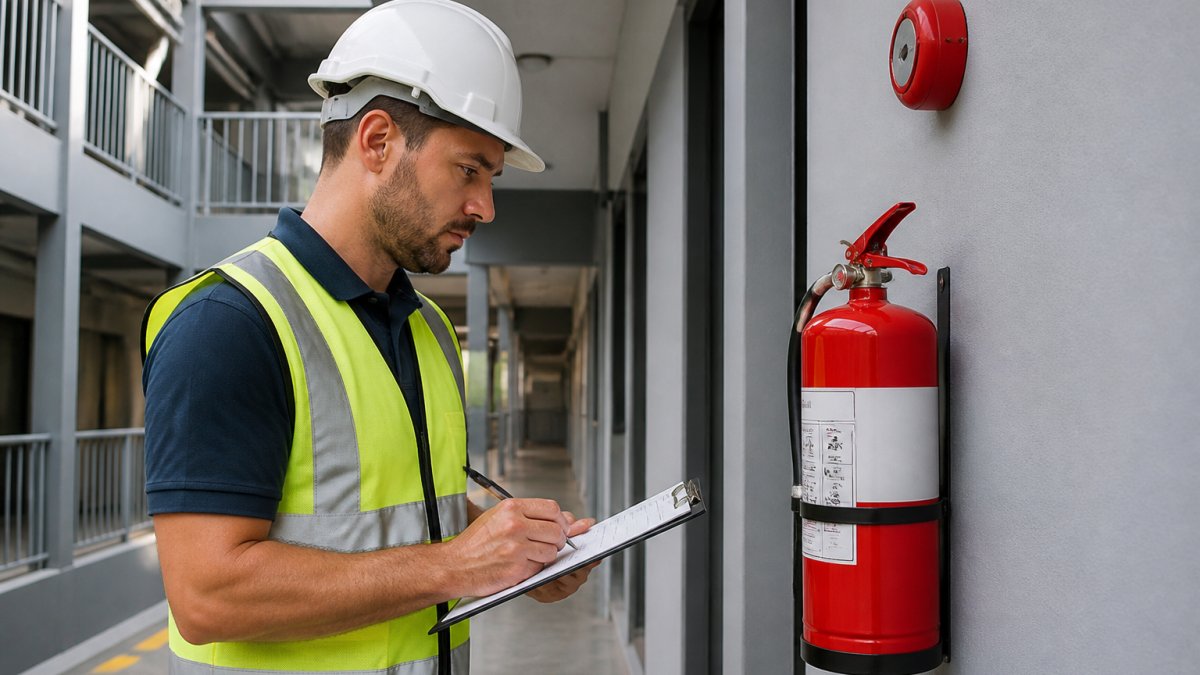
Rigorous attention to detail during these inspections serves as a critical foundation for verifying safety licences, a process that remains equally vital when managing hazardous material remediation.
- Pre-visit review. The technician reads the site’s fire safety plan, the previous service report, and the defect log. Any open corrective actions from the last visit are checked first, so recurring faults are not simply re-tagged and forgotten.
- Site walk and hazard check. Before touching equipment, the technician scans for blocked exits, obstructed extinguishers, missing signage, and items past their service life. These observations go into the report even when they fall outside the formal test scope.
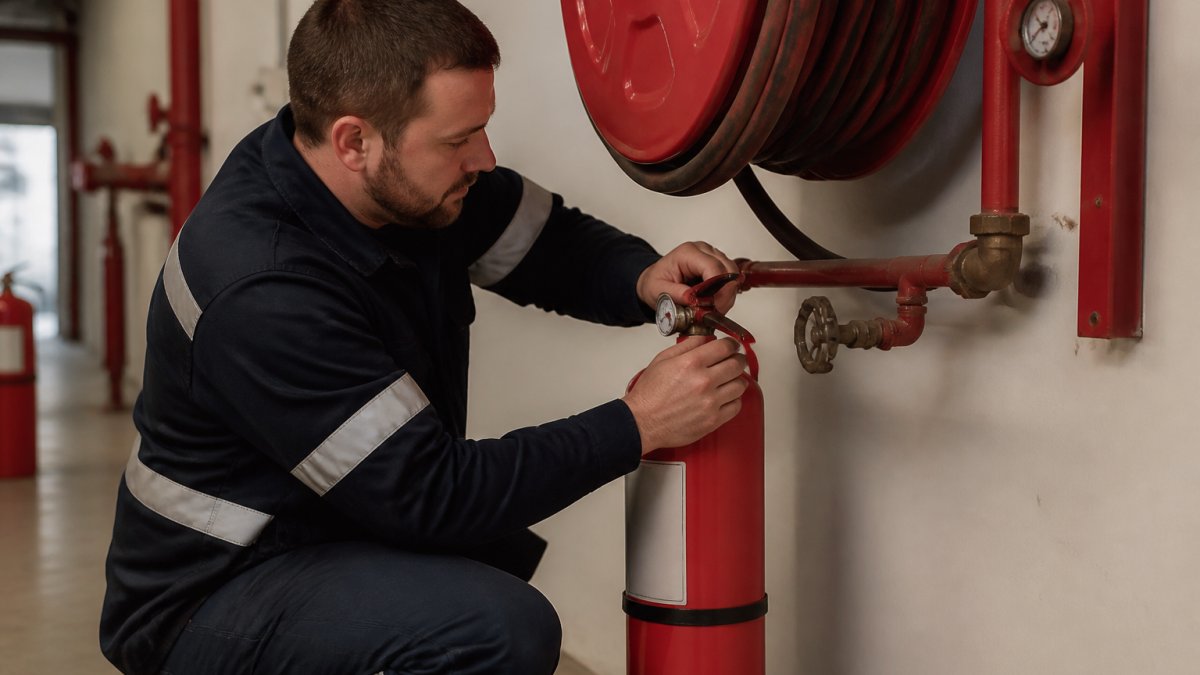
- Equipment inspection. Extinguishers are checked for pressure gauge reading, safety seal, hose condition, and corrosion. Hose reels and hydrants are inspected for physical damage and, where the standard requires it, flow-tested. Smoke alarms and detection systems are tested with the appropriate method for the device type.
- Testing at the correct interval. Each item is tested against its scheduled interval, monthly, six-monthly, yearly, or as set by the relevant Australian standard and the manufacturer’s instructions. The technician records the actual result, not just a pass/fail tick.
- Tagging. Every item receives a tag showing the service date, the next due date, and the technician’s details. A tag without a matching report entry is a warning sign.
- Defect logging and prioritisation. Defects are recorded with a description, location, and priority. A common pattern is to separate immediate life-safety defects (for example, a failed exit sign or a depressurised extinguisher) from items that can be scheduled, so the property manager knows what must be fixed now and what can wait for the next budget cycle.
- Reporting and follow-up. The technician issues a written report the property manager can file and produce in an audit. The report should list every item tested, every defect found, the recommended corrective action, and the date the next service is due.
Ask your provider for a sample report before you book. If it does not show item-level results, defect priorities, and next-due dates, the workflow behind it is probably thin.
Here is the sequence a licensed technician follows on a proper visit.
| Step | What happens |
|---|---|
| Pre-visit review | Reads fire safety plan, previous report, defect log |
| Site walk and hazard check | Scans for blocked exits, obstructed extinguishers, missing signage |
| Equipment inspection | Checks pressure gauge, seal, hose, corrosion; tests alarms |
| Testing at correct interval | Monthly, six-monthly, yearly, or per Australian standard |
| Tagging | Tag shows service date, next due date, technician details |
| Defect logging | Records description, location, priority; separates life-safety defects |
| Reporting and follow-up | Written report lists items tested, defects, actions, next due date |
Fire Safety Technician Qualifications and How to Verify Them
When choosing a fire safety technician, ask what qualifications and credentials are relevant to the work.
Verification is simpler than most people think. You can verify a QBSA fire licence using the QBCC licensee register with a step-by-step guide for property managers.
Ask three questions before any visit:
- What is your licence number, and which scope does it cover?
- Are you insured, and can I see the certificate?
- Which Australian standards govern this test?
The Risks of Hiring an Unlicensed Fire Safety Provider
- Compliance exposure. An audit or a fire safety notice will ask for evidence that servicing was done to the relevant Australian standard by a competent person. Vague or missing reports fail that test. In practice, the property manager is the one left explaining why the records do not stack up, even though the work was outsourced.
- Invalid records. A report is only as good as the person who signed it. If the technician cannot show the licence and scope for the work performed, the report may not be accepted as proof of compliance, and the property may need to re-service equipment to close the gap.
- Insurance trouble. Insurers can question claims when servicing was not done to standard or when the provider cannot demonstrate competency. The dispute often surfaces after a loss, when the property most needs the claim to be paid.
- Life safety. Faulty equipment endangers occupants and staff. A depressurised extinguisher or a failed exit sign does not announce itself until it is needed.
- False confidence. A sticker on the wall is not proof of readiness. The psychological risk is real: staff and occupants assume the system works because someone has been paid to look at it.
When choosing a provider, ask about relevant credentials and insurance.
Your Fire Safety Inspection Checklist: What a Proper Visit Covers
When reviewing fire safety inspection documentation, consider whether it covers equipment condition, test results, defect logging, and clear documentation.
- Every extinguisher checked for pressure, seal, and damage
- Hose reels and hydrants inspected and flow-tested where required
- Smoke alarms and detection systems tested
- Exit signs and emergency lighting verified
- Defects logged with a clear priority and fix
- Tags updated with date and technician details
- A written report issued for your records
You can also check what a fire equipment inspection should cover to compare against your own last visit.
Fire Extinguisher Testing and Servicing: Why It Cannot Be Skipped
For the full picture on frequencies and tagging, read our fire extinguisher testing and tagging guide.
Choosing a Licensed Fire Safety Partner and Keeping Records
When choosing a fire safety provider, consider the credentials and insurance relevant to the work. Our guide on how to select a certified fire safety inspector sets out practical criteria for when you are ready to hire.
- Clear, itemised reports that hold up under scrutiny
- A schedule that keeps every test on time
- Transparent quotes with no surprise charges
- Real staff training, not just box-ticking
Keep relevant fire safety records where you can find them.
Frequently Asked Questions
Why should you use a licensed fire safety technician?
Fyrepower is QBSA-licensed and fully insured, and its expertise includes Australian safety standards such as AS1851 and AS2444.
How can I check whether a fire safety technician is qualified?
Fyrepower is QBSA-licensed and fully insured. Ask the company about its credentials and insurance.
What are the risks of using an unqualified fire safety provider?
Unqualified providers can miss defects in extinguishers, hydrants, alarms and suppression systems, leaving equipment unready in an emergency. Their reports are often too vague to prove compliance during an audit, and without insurance you may carry the liability for any failure. In strata and commercial settings, inadequate servicing can also void warranties and expose the body corporate or property manager to penalties under state fire safety regulations.
What records should a fire safety technician provide after an inspection?
Keep relevant fire safety records, including inspection dates and applicable standards.
Fire safety fails quietly when nobody qualified is checking. Fyrepower is fully insured and QBSA-licensed, and we test, service, and document fire equipment to Australian standards including AS1851 and AS2444. Our team covers extinguishers, hydrants, and suppression systems, backed by a 55-month warranty and on and offsite fire training. Get started with Fyrepower and keep your property safe, compliant, and audit-ready.