Table of Contents
- Why Professional Fire Protection Services Matter for Your Business
- Compliance with Legal Obligations and Fire Safety Regulations
- AS 1851 Standards Compliance and Professional Testing
- Fire Extinguisher Testing Requirements and Maintenance
- Fire Safety Inspection Checklist for Property Managers
- Insurance Coverage and Risk Mitigation Through Professional Services
- Staff Training and Emergency Preparedness
- Preventative Maintenance vs. Reactive Repairs: The Cost-Benefit Analysis
- Frequently Asked Questions
Last Updated: September 30, 2026
Why Professional Fire Protection Services Matter for Your Business
When a fire emergency strikes, the difference between chaos and control comes down to preparation. Professional fire protection services aren’t just about having equipment on site, they’re about ensuring that equipment works, your team knows how to use it, and your business meets every legal requirement that protects both people and property.
At Fyrepower, we work with commercial property managers across the region to ensure their fire safety setup is compliant and well-maintained. We help businesses avoid critical gaps that can be flagged during compliance audits, such as missing documentation, expired testing certificates, or improperly maintained equipment. Addressing these issues proactively through professional services can prevent the higher costs associated with retroactive fixes.
This guide covers the core benefits of professional fire protection services, from regulatory compliance to emergency preparedness, and explains why outsourcing this responsibility to qualified specialists delivers measurable peace of mind.
Compliance with Legal Obligations and Fire Safety Regulations
Every commercial property must comply with fire safety regulations, and the specific legal framework varies by state. In Queensland, fire safety obligations are primarily governed by legislation such as the Building Fire Safety Regulation, which sets mandatory requirements for building owners, occupiers, and managers. These regulations are enforced by the Queensland Building and Construction Commission (QBCC) and local fire authorities, with penalties for non-compliance.
Unlike generic national standards, Queensland’s legislation places explicit responsibility on building occupiers to maintain fire safety systems and keep detailed records. The Building Fire Safety Standard requires that all fire safety equipment be maintained in accordance with Australian Standards (particularly AS 1851 for portable extinguishers and AS 1668.1 for smoke hazard management). Failure to maintain these records, even if equipment itself is functional, is treated as a separate compliance breach.
The regulatory landscape in Queensland can shift. A professional fire protection service provider stays current with these updates and adjusts maintenance schedules accordingly. You don’t have to monitor regulatory changes yourself; the service provider tracks legislative updates and ensures your property remains compliant as standards evolve.
Professional services also manage the documentation burden. Queensland regulators expect building owners to produce maintenance logs, testing certificates, and compliance declarations on demand. These documents must be specific, generic records won’t satisfy an audit. A qualified fire protection service provider maintains records in a format that directly satisfies Queensland regulatory requirements, eliminating the most common compliance failure: having work done but being unable to prove it to an auditor.
Queensland’s Building Fire Safety Standard places joint responsibility on both building owners and occupiers. If you lease a commercial space, you share compliance obligations with your landlord. Clarifying who is responsible for which maintenance tasks, and ensuring professional services are engaged to cover all gaps, is essential to avoid liability exposure.
AS 1851 Standards Compliance and Professional Testing
AS 1851 is the Australian Standard that governs the inspection, maintenance, and testing of portable fire extinguishers and other fire safety equipment. Compliance with AS 1851 isn’t optional, it’s a legal requirement for any business with fire safety equipment on site.
The standard specifies exact testing intervals, documentation requirements, and the qualifications required to perform testing. For example, fire extinguishers must be visually inspected monthly, serviced annually, and hydrostatically tested at intervals determined by the extinguisher type. Missing even one of these steps creates a compliance gap that an auditor will identify immediately.
Professional fire protection services handle all AS 1851 compliance requirements as a matter of routine. The service provider maintains detailed records of every inspection and test performed, creates compliance documentation, and schedules follow-up work before deadlines are missed. This systematic approach eliminates the most common compliance failures: forgotten inspections and lost paperwork.
AS 1851 compliance isn’t just a regulatory box to tick, it directly affects equipment reliability. Regular testing catches problems before they become emergencies. A fire extinguisher that hasn’t been serviced may fail when needed most.
Fire Extinguisher Testing Requirements and Maintenance
Fire extinguishers are the first line of defence in a small fire, but only if they’re properly maintained. Many business owners assume that purchasing an extinguisher and mounting it on a wall is sufficient. In reality, extinguishers require regular testing and servicing to remain effective.
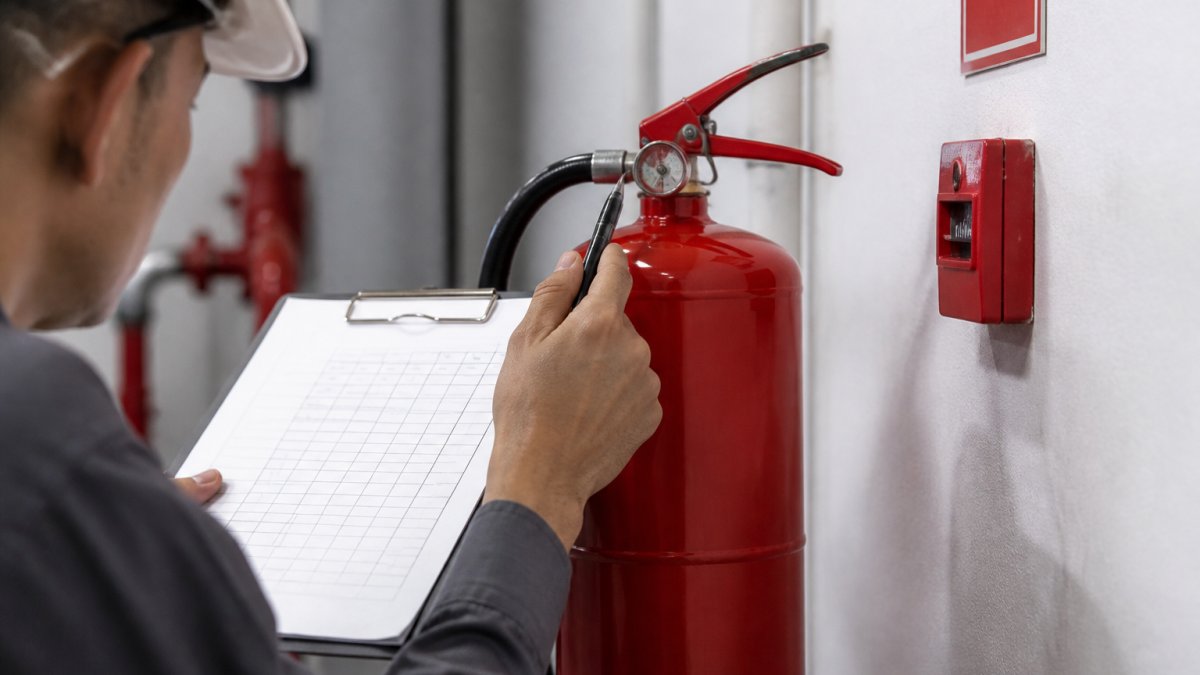
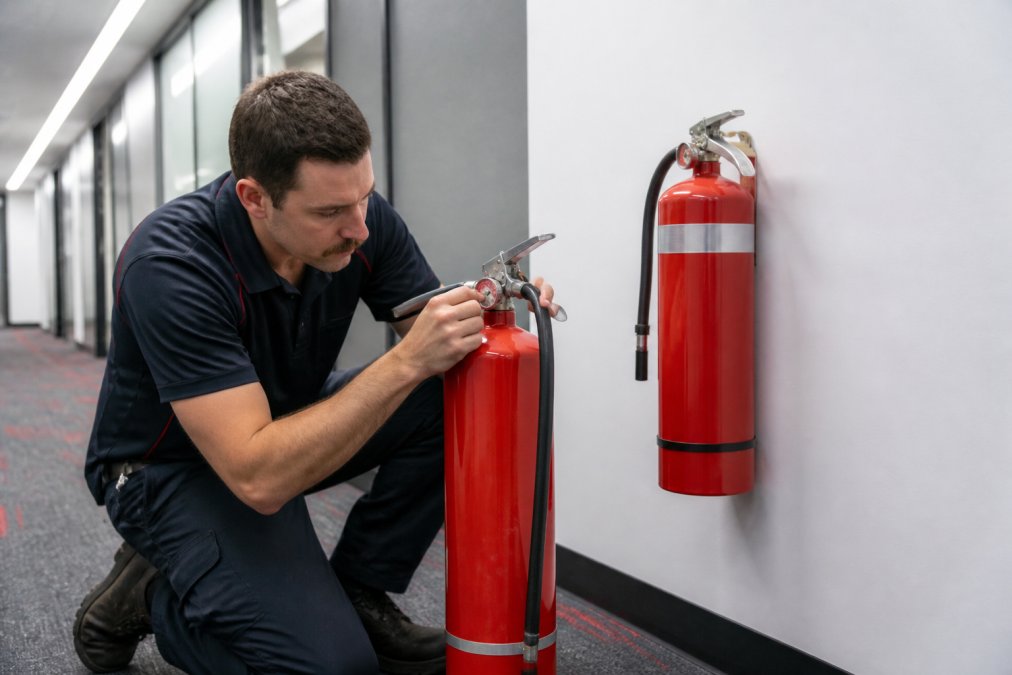
Annual servicing is the minimum requirement under AS 1851. During servicing, a qualified technician inspects the extinguisher for damage, checks the pressure gauge, verifies the discharge mechanism works, and recharges or replaces the contents as needed. This annual work is documented with a tag attached to the extinguisher.
Beyond annual servicing, extinguishers also require hydrostatic testing at set intervals, typically every 5 to 10 years depending on the extinguisher type. This test involves pressurising the cylinder to verify it can safely contain the contents. Failing hydrostatic testing means the extinguisher must be replaced.
Professional fire protection services manage both routine servicing and hydrostatic testing schedules, ensuring nothing is missed. They also advise on extinguisher placement, type selection for different hazards, and replacement when equipment reaches end of life. This comprehensive approach means your extinguishers are always compliant and ready to function in an emergency.
Fire Safety Inspection Checklist for Property Managers
A structured fire safety inspection checklist helps property managers identify hazards and compliance gaps before they become problems. Regular inspections catch issues like blocked emergency exits, damaged fire doors, non-functional exit lighting, or obstructed fire hose reels, all of which create liability exposure. Maintaining these rigorous standards serves as the foundation for broader property management compliance, ensuring that every operational detail aligns with the overarching commitment to occupant safety.
A comprehensive fire safety inspection typically covers:
- Exit routes and signage: All emergency exits are unobstructed and clearly marked with illuminated exit signs
- Fire doors: Doors function properly, close completely, and are not held open with wedges or props
- Fire extinguishers: Mounted securely, accessible, and tagged with current servicing records
- Fire hose reels: Accessible, tested, and with adequate hose length for the space
- Emergency lighting: Exit lights and pathway lighting function correctly
- Fire detection systems: Smoke alarms and heat detectors are operational and tested
- Evacuation diagrams: Posted at key locations and current with any building changes
- Maintenance records: Documentation of all testing, servicing, and repairs is complete and accessible
Professional fire protection services conduct these inspections systematically and document findings in a format that satisfies regulatory requirements. More importantly, they identify corrective actions before an auditor finds them, giving you time to address issues without penalties.
Skipping regular inspections is a common mistake that creates compounding problems. A small issue like a blocked fire hose reel becomes a serious compliance violation if left unaddressed for months. By then, you may face fines or mandatory remedial work at higher cost.
Insurance Coverage and Risk Mitigation Through Professional Services
Most commercial property insurance policies include conditions related to fire safety compliance. If your property doesn’t meet required standards at the time of a fire incident, your insurer may deny a claim or reduce coverage. This is a catastrophic outcome, you face both property loss and no financial recovery.
Professional fire protection services directly support your insurance coverage by maintaining documented compliance with all applicable standards. Insurance companies recognise that properties with professional maintenance and testing records present lower risk. Some insurers even offer premium discounts for businesses that engage professional fire safety services, recognising the reduced likelihood of fire incidents and faster emergency response.
Beyond insurance, professional services reduce your overall risk profile. Properly maintained equipment is more likely to function in an emergency. Well-trained staff respond faster and more effectively. Clear evacuation plans and regular drills reduce panic and injury. These factors combine to reduce both the likelihood of a serious fire incident and the severity of consequences if one occurs.
Staff Training and Emergency Preparedness
Equipment is only effective if staff know how to use it. A fire extinguisher mounted on a wall is useless if no one knows how to operate it under pressure. Similarly, an evacuation plan is ineffective if staff haven’t practised it and don’t know their assigned roles.
Professional fire protection services include staff training that covers fire extinguisher operation, evacuation procedures, and emergency communication.
Preventative Maintenance vs. Reactive Repairs: The Cost-Benefit Analysis
Many businesses approach fire safety reactively, addressing problems only after they’re discovered during an audit or after an incident. This reactive approach is almost always more expensive and creates unnecessary regulatory and financial risk.
Beyond direct equipment costs, reactive compliance creates hidden expenses:
- Audit fines and remedial orders: Queensland regulators typically impose fines of $500-$5,000 for first-time compliance breaches, with escalating penalties for repeat violations. Remedial orders may require immediate work at premium rates.
- Insurance claim complications: If a fire incident occurs and your insurer discovers you were non-compliant at the time of the incident, they may deny the claim entirely or reduce coverage. For a commercial property, this could mean a loss of $100,000-$500,000+ with no financial recovery.
- Increased regulatory scrutiny: Properties that fail audits face more frequent follow-up inspections and stricter enforcement. This creates ongoing compliance costs and operational disruption.
- Staff downtime: Reactive repairs often require building evacuation or service interruption. Preventative maintenance is typically scheduled during off-hours or low-traffic periods.
Frequently Asked Questions
How often should fire extinguishers be tested in Queensland?
Fire extinguishers must be professionally tested and tagged annually under AS 1851 standards. For high-risk environments or those with heavy use, six-monthly testing may be required. Professional fire protection services track these schedules and provide compliance documentation to satisfy regulatory obligations and insurance requirements.
What is included in a fire safety inspection checklist?
A comprehensive fire safety inspection checklist covers fire extinguishers, hose reels, exit signs, emergency lighting, fire doors, evacuation diagrams, and alarm systems. Professional inspectors verify all equipment functions correctly, document findings in maintenance logs, and identify any hazards. This documentation proves compliance during audits and supports your annual fire safety statement.
Why is professional fire system maintenance critical for insurance?
Insurance providers require proof of regular maintenance and compliance with Australian fire safety standards. Professional fire protection services maintain detailed records, conduct testing to AS 1851 standards, and provide certification. Without this documentation, insurers may deny claims or refuse coverage. Professional maintenance also reduces your property’s fire risk, which can lower insurance premiums.
What happens if my business fails to meet fire safety compliance requirements?
Non-compliance can result in regulatory penalties, fines, and legal liability. More critically, if a fire occurs and your equipment has not been professionally maintained, your insurance may not cover losses. Professional fire protection services eliminate this risk by ensuring your equipment, staff training, and documentation meet all Australian safety standards and regulatory requirements.