Last Updated: October 23, 2026
Quick Summary
How to choose fire exit signs for retail starts by understanding your store layout, local fire safety rules, and Australian standards like AS2444 and AS1851. Select illuminated signs with battery backup for visibility during power failures, position them at every exit and along escape routes, and ensure both primary and secondary escape routes are clearly marked with directional and non-directional signage.
- Illuminated exit signs with battery backup are standard for retail stores and stay lit for 1-3 hours if power fails.
- Install directional signs in hallways and aisles, and non-directional EXIT signs directly above every exit door.
- Exit signs must be visible from all areas of your retail space and comply with Australian safety standards.
- Test sign visibility by walking through your store at different times and add more signs if any areas lack clear exit markers.
- Conduct monthly inspections of all signs and have annual servicing by a qualified technician to maintain compliance.
Table of Contents
- What You’ll Need Before Choosing Fire Exit Signs for Retail
- Understanding Types of Fire Exit Signs and Emergency Signs
- Australian Exit Sign Requirements for Retail Premises
- Exit Sign Placement in Retail Stores: A Step-by-Step Approach
- Illuminated Exit Signs and Emergency Lighting for Retail
- Sign Visibility, Legibility, and Viewing Distance
- Common Mistakes to Avoid When Selecting Fire Exit Signs
- Inspection, Testing, and Ongoing Maintenance
- Frequently Asked Questions
What You’ll Need Before Choosing Fire Exit Signs for Retail
Before you select fire exit signs for your retail space, learning how to choose fire exit signs for retail starts by gathering the basics.
Start by measuring your retail space and identifying all potential exit routes. You should also consult AS2444 and AS1851 safety standards to confirm the specific requirements for your retail environment.
At Fyrepower, we help retail owners navigate these requirements across the Gold Coast and South Brisbane.
Before you shop for signs, document your store’s layout on paper. Mark all doors, windows, and potential escape routes. This simple step prevents costly mistakes later.
Understanding Types of Fire Exit Signs and Emergency Signs
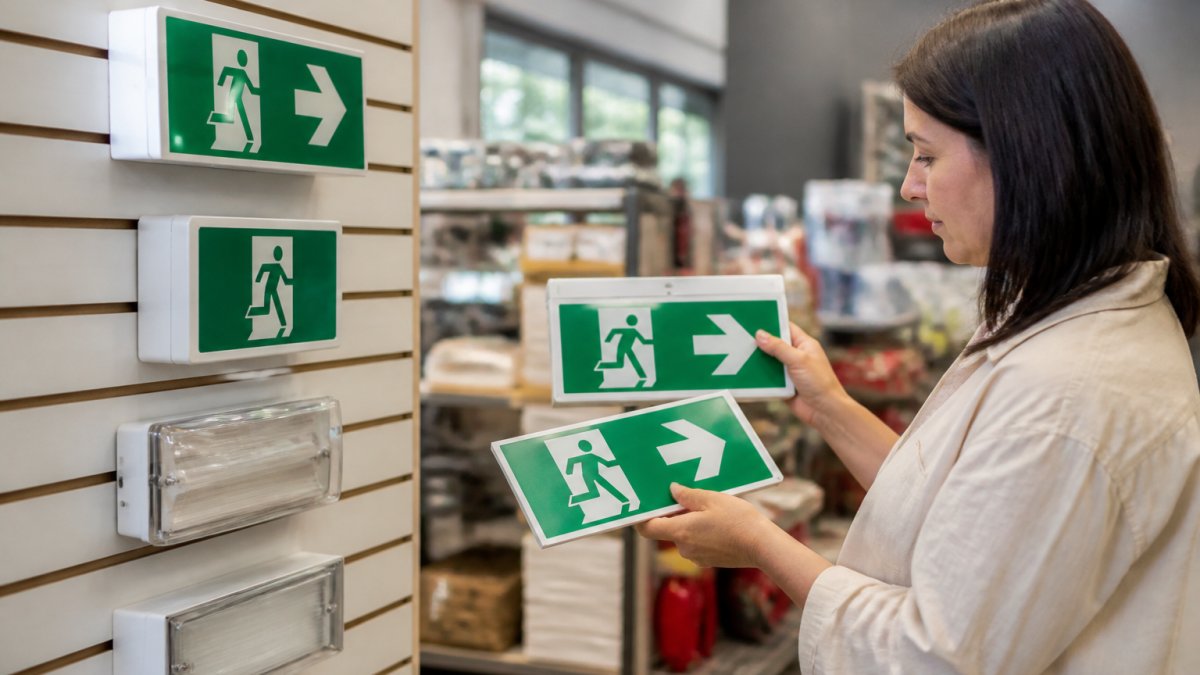
Fire exit signs fall into two categories: illuminated (electric power, often with battery backup) and non-illuminated (reflective materials and ambient light).
Illuminated exit signs glow continuously or during emergencies and stay visible when power fails if they have battery backup. Non-illuminated signs use reflective tape and paint, showing up when a torch or emergency light hits them.
Emergency signs include directional arrows, fire extinguisher markers, and first aid labels. They work with exit signage to guide people out safely, and all must meet Australian safety standards.
Directional versus Non-Directional Signs
Directional signs show the way to an exit with arrows; non-directional signs simply say “EXIT”. In retail, you’ll typically need both.
Use directional signs in hallways, aisles, and corridors, and non-directional signs directly above exit doors, so anyone in your store can find their way out quickly.
Primary and Secondary Escape Routes
Every retail premises must have at least two separate escape routes: the primary escape route (usually the main customer entrance) and the secondary escape route (a back door, side exit, or emergency exit). Both must be clearly marked.
Your primary route should be the safest, most direct path out; your secondary route provides an alternative if the primary is blocked by fire, smoke, or other hazards.
Both routes must have illuminated or clearly visible exit signs, stay clear of obstacles, and be guided by emergency lighting.
Australian Exit Sign Requirements for Retail Premises
Exit signs in retail premises must comply with Australian safety standards. The National Construction Code and fire safety regulations set the minimum requirements. Your state or territory may have additional rules, so check with your local fire authority.
Exit signs must be:
- Clearly visible from all areas of your retail space
- Illuminated or reflective so they show up in low light
- Positioned at every exit door and along escape routes
- Marked with the international exit symbol (a running figure and arrow)
- Regularly tested and maintained to ensure they work
Sign size and brightness depend on viewing distance: a sign 30 metres away needs to be larger and brighter than one 5 metres away.
Australian standards require exit signs to be visible, illuminated or reflective, and positioned at every exit. Non-compliance puts your staff and customers at risk and can result in penalties.
Exit Sign Placement in Retail Stores: A Step-by-Step Approach
When learning how to choose fire exit signs for retail, proper placement matters as much as choosing the right signs. Follow these steps.

Step 2: Mark the primary escape route. Install exit signs along this route (usually the main customer entrance), using directional signs in hallways and aisles.
Step 6: Ensure emergency lighting illuminates all signs. Exit signs must be visible even if the main lights fail.
Identifying Primary and Secondary Escape Routes
Your primary escape route is the path most people will use in an emergency, usually the main customer entrance. It should be the quickest, safest route out.
Your secondary escape route provides an alternative if the primary is blocked, a staff exit, loading dock door, or emergency exit on the opposite side. Both must be equally accessible and clearly marked.
Accounting for Customer Flow and Store Layout
Your retail layout affects how people move, so exit sign placement must account for this flow. Aisles customers naturally move down need directional signs pointing toward exits.
Consider these factors:
- Aisle layout: Long aisles need directional signs at regular intervals. People in the middle of a long aisle shouldn’t have to guess which way to go.
- Customer density: High-traffic areas need more visible signage. A crowded shop floor requires clear, obvious exit markers.
- Changing displays: If you move shelving or displays, you may need to adjust sign placement. Keep exit routes clear and well-marked no matter how you arrange your merchandise.
- Blind spots: Areas hidden behind shelves or displays need additional signage. People in these spots must be able to see an exit sign or directional arrow.
- Multiple levels: If your retail space has a mezzanine or upper floor, each level needs its own exit signs and escape routes.
Walk through your store at different times of day and imagine an emergency during your busiest hour. If everyone couldn’t find the exits, adjust your signage.
Illuminated Exit Signs and Emergency Lighting for Retail
Illuminated exit signs are bright, visible, and reliable, working when the main power is on and, with battery backup, when it fails, giving the best visibility and safety in a busy retail environment.
Illuminated signs use one of three power sources:
- Mains power only: The sign goes dark if the power fails. Not recommended for retail.
- Mains power with battery backup: The sign stays lit for 1-3 hours if the power fails. This is the standard for most retail stores.
- Battery only: The sign runs on batteries and charges when mains power is available. Useful for areas where mains power is difficult to install.
Battery backup is essential: if a fire causes a power outage, your exit signs must still guide people to safety. A sign that goes dark in an emergency is useless.
Never install illuminated exit signs without battery backup in a retail space. A power failure during a fire emergency means your signs will go dark when people need them most. This puts your staff and customers at serious risk.
Emergency Lighting for Retail Environments
Emergency lighting works with exit signs to guide people safely out of your building. It activates automatically if the main power fails, illuminating escape routes so people can see where they’re going.
Emergency lighting should:
- Activate within 5 seconds of a power failure
- Remain lit for at least 1 hour
- Illuminate all escape routes, not just the exits
- Be positioned so light reaches the floor (not just the ceiling)
- Be tested monthly to ensure it works
In a retail store, emergency lighting should illuminate:
- All aisles and corridors
- The area around exit doors
- Stairs (if your store has multiple levels)
- Storage areas and staff rooms
- The customer service counter Integrating these essential safety markers into your floor plan provides a foundation for cohesive custom business signage that maintains a professional aesthetic while ensuring compliance throughout the premises.
Together, illuminated exit signs and emergency lighting keep your retail space safe and navigable during a power failure or fire emergency. You can view and purchase emergency and exit light products designed for retail environments.
Illuminated exit signs use three different power sources, each with distinct advantages and limitations for retail environments.
| Power Source | How It Works | Best For |
|---|---|---|
| Mains power only | Sign goes dark if power fails | Not recommended for retail |
| Mains power with battery backup | Stays lit 1-3 hours if power fails | Standard for most retail stores |
| Battery only | Runs on batteries, charges when mains available | Areas where mains power is difficult to install |
Sign Visibility, Legibility, and Viewing Distance
An exit sign is only useful if people can see and read it.
Use this simple rule: for every 3 metres of viewing distance, the text should be at least 1 metre tall. A sign 30 metres away needs 10-metre-tall letters. That’s impractical, so instead, use multiple smaller signs positioned closer together.
Brightness matters too: too dim and the sign is invisible in a bright retail space; too bright and it’s distracting or hard to read.
Reflective non-illuminated signs rely on light from torches or emergency lighting. These signs work well in smaller spaces or areas close to emergency lights.
Test your signs’ visibility by walking through your retail space at different times of day.
Common Mistakes to Avoid When Selecting Fire Exit Signs
Many retail owners make preventable mistakes when choosing and installing exit signs.
Mistake 2: Installing signs but not testing them. Exit signs must be tested regularly to ensure they work.
Mistake 4: Using too few signs. One exit sign above the door isn’t enough.
Mistake 5: Ignoring secondary escape routes. Many retail owners focus only on the main entrance.
Mistake 6: Forgetting about staff areas. Stockrooms, staff break rooms, and storage areas need exit signs too.
Inspection, Testing, and Ongoing Maintenance
Fire exit signs aren’t a one-time purchase. Fire Safety Audits for Retail: A Complete How-To provides comprehensive guidance on conducting thorough fire safety audits that include exit sign compliance.
Monthly checks:
- Inspect all signs for damage or fading
- Test illuminated signs to ensure they’re bright
- Verify that battery backup systems are functioning
- Check that no merchandise or displays obstruct any signs
Annual servicing:
- Have a qualified technician inspect and test all systems
- Replace batteries in backup systems
- Clean signs to remove dust and improve visibility
- Update documentation of all inspections and tests
After any incident:
- Inspect all signs for damage
- Test all systems to ensure they still work
- Replace any damaged signs immediately
- Review your evacuation procedures and update signage if needed
Fire Safety Audits for Retail: A Complete How-To provides comprehensive guidance on conducting thorough fire safety audits that include exit sign compliance.
Keeping detailed records of all inspections and maintenance is essential.
Fyrepower can handle this for you. We provide regular inspection and testing services, keeping your exit signs and emergency lighting in perfect working order.
Choosing the right fire exit signs for your retail space is one of the most important fire safety decisions you’ll make.
Frequently Asked Questions
What colour should fire exit signs be in retail stores?
Fire exit signs must display green backgrounds with white text or pictograms. This colour combination is mandated by Australian safety standards and ensures immediate recognition during emergencies. The green-and-white scheme is universally understood as the signal for safe passage and evacuation routes, making it instantly recognisable to staff, customers, and emergency responders.
Where should exit signs be placed in a retail store?
Exit signs must be positioned directly above or adjacent to every exit route, including emergency exits, stairwells, and external doors. They should be placed at a consistent height (typically 2 metres) and spaced to ensure visibility from any point in the retail space. Signs must be unobstructed and clearly visible, even in low-light conditions. Consider your store layout, customer flow patterns, and sightlines when determining exact placement.
Do retail exit signs need emergency lighting?
Yes. Emergency lighting must illuminate all fire exit signs and evacuation routes so they remain visible during power failures. Illuminated exit signs with battery backup or connected emergency lighting systems ensure orderly evacuation in darkness. For retail premises, this is a legal requirement under Australian workplace health and safety standards. The lighting must activate automatically and maintain visibility for the duration of an evacuation.
How often should fire exit signs be inspected in a retail environment?
Fire exit signs and emergency lighting should be tested and inspected at least every 6 months as part of your fire safety compliance obligations. Inspections verify that signs are visible, illumination works correctly, batteries are functional, and there are no obstructions. Many retailers benefit from quarterly visual checks between formal inspections to catch damage or blockages early. Detailed records of all inspections must be maintained for audit purposes.