Table of Contents
- What You’ll Need Before Starting Your Fire Safety Audit
- Fire Safety Audits for Retail: Step-by-Step Process
- AS 1851 Compliance Requirements for Retail Fire Safety
- Fire Safety Checklist for Retail Stores
- Fire Extinguisher Testing Frequency and Maintenance
- Post-Audit Remediation and Documentation
- Common Mistakes to Avoid During Fire Safety Audits
- Frequently Asked Questions
Last Updated: August 30, 2026
What You’ll Need Before Starting Your Fire Safety Audit
Gather essential documentation before your audit: building plans, previous audit reports, maintenance records for all fire safety equipment, and a retail-specific checklist. At Fyrepower, we recommend having a qualified fire safety auditor trained in Australian fire safety standards who understands retail-specific risks.
Collect manufacturer specifications for fire extinguishers, sprinkler systems, emergency lighting, and fire suppression systems. Gather documentation showing when equipment was last serviced, tested, and certified. If your space has undergone renovations, ensure you have updated floor plans showing emergency exit routes, fire door locations, and equipment placement. Review your evacuation plan for gaps and verify that all emergency contact numbers are current and fire safety signage is compliant with Australian standards.
Fire Safety Audits for Retail: Step-by-Step Process
A fire safety audit for retail businesses follows a structured methodology to identify risks, verify compliance, and document findings.
Step 1: Identify Fire Hazards and Risk Assessment
Conduct a thorough walkthrough documenting every potential fire hazard: combustible materials near heat sources, blocked emergency exits, overloaded electrical outlets, and improper storage of flammable goods.
Pay particular attention to high fire-load areas: stockrooms, storage areas, and display zones with concentrated merchandise. Retail environments have unique risks related to seasonal displays, promotional materials, and customer density. Evaluate building structural features affecting fire safety: check fire doors close properly and aren’t propped open, examine walls and ceilings for deterioration that could compromise fire compartmentalisation, and document emergency exit layout to ensure compliance with Australian building codes.
Step 2: Inspect Fire Safety Equipment and Suppression Systems
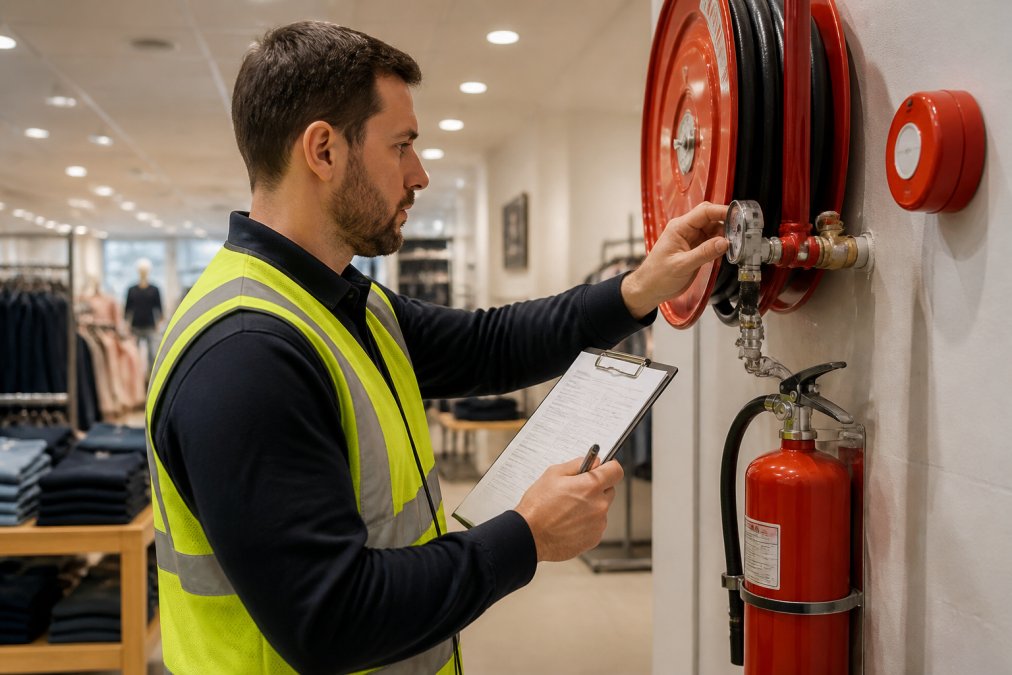
Examine all fire safety equipment: fire extinguishers, sprinkler systems, fire hoses, emergency lighting, and fire alarm systems. Verify that all equipment displays current inspection tags and certification labels showing AS 1851 compliance (standards.org.au).
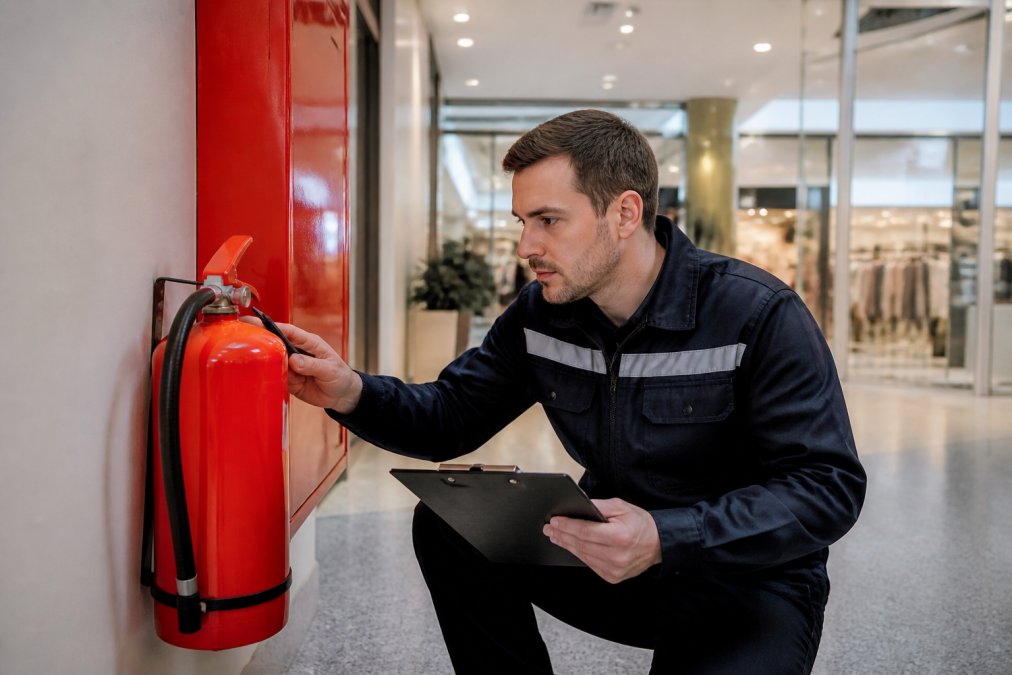
For fire extinguishers, check the pressure gauge sits in the green zone, inspect the nozzle and hose for damage, and verify mounting height between 0.8 and 1.5 metres. Confirm staff can identify which extinguisher type to use for different fire classes.
For sprinkler systems, check that all heads are unobstructed and free from paint, dust, or merchandise. Verify the main water supply valve is accessible and properly labelled. Test the alarm system to ensure it functions correctly and notification devices are audible throughout the space. Inspect emergency lighting to confirm all exit signs are illuminated and functioning, and verify backup batteries are in place and recently tested.
Step 3: Check Emergency Exit Routes and Signage
Measure the width of all exit routes to confirm they meet minimum requirements, typically 1.1 metres for retail spaces (abcb.gov.au). Ensure exit routes are clear of obstructions, merchandise, or equipment that could impede evacuation.
Walk each exit route from the furthest point to the final exit door and time the traverse to assess realistic evacuation speed. Verify that all exit signs are clearly visible, properly illuminated, and positioned above every exit door. Check that directional signage clearly indicates the path to exits, particularly in areas where the route isn’t obvious.
Confirm that exit doors open easily from the inside without requiring a key or special knowledge. Doors should not be locked, chained, or blocked during business hours, and door closers must function properly.
Step 4: Review Evacuation Plans and Fire Warden Roles
Your evacuation plan must be documented, communicated to all staff, and regularly practised. Ensure it includes assembly points, accountability procedures, and communication protocols. Assembly points should be located at least 100 metres from the building (worksafe.vic.gov.au).
Identify all designated fire wardens and verify they have received appropriate training. Conduct a mock evacuation drill to test your plan in practice, timing how long it takes for all staff and customers to evacuate. Document drill results, noting any issues and corrective actions taken.
AS 1851 Compliance Requirements for Retail Fire Safety
AS 1851 is the mandatory Australian Standard specifying maintenance of fire protection systems and equipment. Fire extinguishers must be inspected and tagged annually by a qualified technician, checking pressure, cylinder condition, and safety seals. Every five years, extinguishers must undergo thorough examination including hydrostatic testing.
Sprinkler systems require inspection every six months to ensure all heads are clear and the system is ready to function. Annual testing of alarm systems and water flow switches is mandatory. Emergency lighting systems must be tested monthly to confirm all exit signs illuminate and maintain adequate brightness. Fire alarm systems require professional inspection and testing at least annually.
Maintaining AS 1851 compliance is a legal requirement that protects your business from liability and ensures equipment functions when needed. Non-compliance can result in regulatory penalties and may invalidate insurance coverage.
Fire Safety Checklist for Retail Stores
Use this comprehensive checklist during your fire safety audit to ensure no critical items are overlooked:
| Item | Inspection Frequency | Compliance Status | Notes |
|---|---|---|---|
| Fire extinguishers | Annual inspection + 5-yearly hydrostatic test | Pass / Fail | Check pressure, condition, accessibility |
| Sprinkler systems | 6-monthly inspection | Pass / Fail | Verify all heads clear, water supply accessible |
| Emergency lighting | Monthly test | Pass / Fail | Confirm exit signs illuminate, battery backup functional |
| Fire alarm system | Annual professional test | Pass / Fail | All detectors functional, notification devices audible |
| Emergency exits | Monthly visual check | Pass / Fail | Clear of obstructions, doors function properly |
| Exit signage | Monthly visual check | Pass / Fail | Illuminated, visible, directional signage in place |
| Fire doors | Monthly visual check | Pass / Fail | Close properly, not propped open, seals intact |
| Evacuation plan | Annual review + practice drill | Pass / Fail | Updated, communicated to staff, tested |
| Fire warden training | Annual refresher | Pass / Fail | All designated wardens trained and current |
| Hazard identification | Quarterly review | Pass / Fail | Document all fire risks, corrective actions |
Retain this checklist as documentation of your compliance efforts and use it as a baseline for monthly and quarterly inspections between professional audits.
Fire Extinguisher Testing Frequency and Maintenance
Annual visual inspections are mandatory for all fire extinguishers, verifying that the pressure gauge reads normally, the safety pin is intact, the tamper seal hasn’t been broken, and there’s no visible damage. Any extinguisher that fails inspection must be removed from service immediately.
Every five years, most extinguishers require thorough internal examination. For steel cylinders, this typically involves hydrostatic testing. After this examination, the cylinder must be certified with a new test date recorded. If an extinguisher has been used, it must be professionally recharged and inspected before returning to service.
Fyrepower recommends maintaining a register of all extinguishers, recording location, type, serial number, purchase date, and all inspection and testing dates. This documentation proves compliance and helps you schedule maintenance before deadlines are missed. Store extinguishers in easily accessible, clearly marked locations mounted at 0.8 to 1.5 metres height, and ensure staff know their locations and have received usage training.
Post-Audit Remediation and Documentation
After your audit is complete, you’ll receive a detailed report identifying non-compliances or areas requiring improvement. Prioritise remediation based on severity: critical issues must be addressed immediately, medium-priority issues within 30 days, and lower-priority recommendations within 90 days.
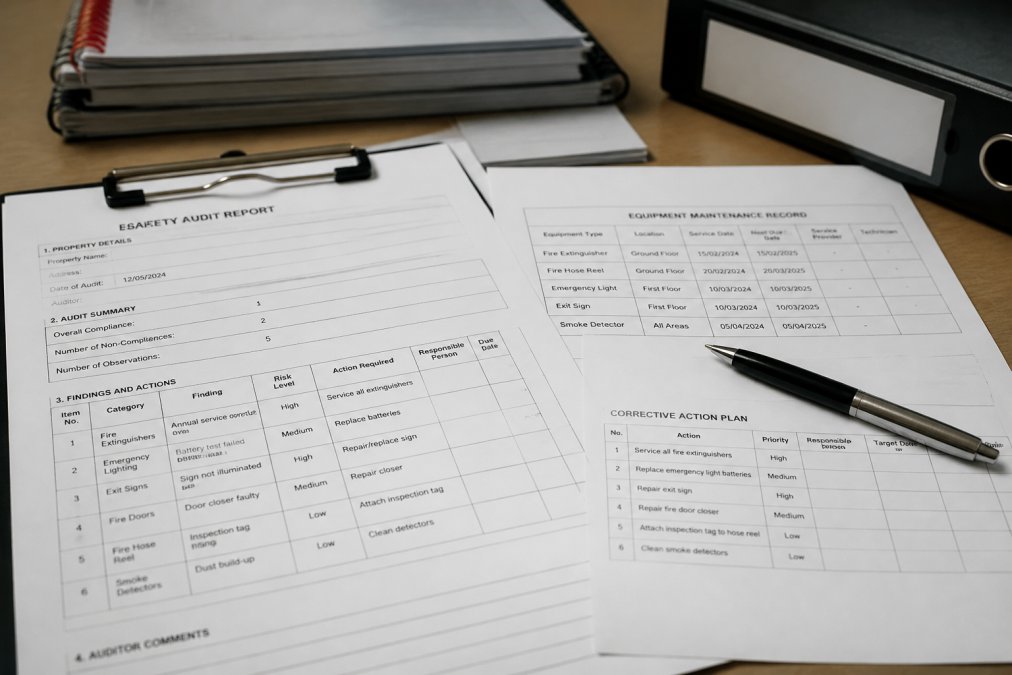
Document all remediation work as it’s completed, recording what was wrong, what corrective action was taken, who performed the work, when it was completed, and the cost. Maintain all audit reports, inspection records, and remediation documentation for a minimum of five years. Schedule your next audit before the current one expires; most retail businesses require audits every 12 months.
Common Mistakes to Avoid During Fire Safety Audits
Treat the audit as a genuine assessment of fire safety, not simply a box-ticking exercise. Involve staff in the audit process, your employees often notice hazards an auditor might miss and can identify practical challenges with evacuation procedures.
Assess seasonal risks carefully. During peak trading periods, your fire load may increase dramatically with additional stock, temporary displays, and increased customer density. Test evacuation procedures regularly; a written plan means nothing if staff don’t know how to execute it. Maintain proper documentation to prove compliance if questioned by regulators. Avoid waiting too long between audits; regular assessments keep fire safety front-of-mind and ensure new risks are identified promptly.
Fire safety audits are a critical investment in protecting your staff, customers, and business assets. By conducting audits at least annually, you’ll maintain compliance with Australian fire safety standards and demonstrate genuine commitment to safety. Fyrepower provides comprehensive fire safety audit services, professional equipment testing, and staff training to ensure your retail business meets all statutory requirements. Get in touch with us now to schedule your audit and receive a detailed compliance assessment tailored to your specific retail environment.
Frequently Asked Questions
How often should a retail business undergo a fire safety audit?
Retail businesses should conduct fire safety audits regularly to maintain compliance with Australian fire safety legislation. This frequency ensures that all fire safety equipment, emergency exits, evacuation procedures, and hazard controls remain effective. More frequent audits may be required if your store has high fire load from stock or if previous audits identified significant risks. Your audit schedule should be documented and tracked to demonstrate compliance during regulatory inspections.
What does AS 1851 compliance requirements mean for my retail store?
AS 1851 is the Australian standard that sets out the requirements for maintenance of fire protection systems and equipment. For retail stores, this means fire extinguishers, emergency lighting, fire doors, and sprinkler systems must be inspected, tested, and maintained according to strict schedules. AS 1851 compliance is mandatory and ensures your fire safety equipment will function properly in an emergency. Non-compliance can result in regulatory penalties and may affect your insurance coverage if a fire occurs.
Who is responsible for conducting fire safety audits in a leased retail space?
Responsibility depends on your lease agreement, but typically the building owner or landlord is responsible for maintaining the building’s fire safety systems, while the tenant (your business) is responsible for managing hazards within your leased space, staff training, and evacuation procedures. You should clarify these responsibilities in your lease and work with your landlord to ensure all fire safety requirements are met. Both parties share liability if compliance gaps are discovered during an audit or inspection.
What are the most common fire hazards found in retail environments?
Retail stores typically face hazards including high fire load from stored stock, blocked emergency exits due to merchandise or displays, faulty or outdated electrical wiring, inadequate fire suppression systems, and insufficient emergency lighting. Seasonal decorations, flammable materials in stockrooms, and poor housekeeping also increase risk. A comprehensive fire risk assessment during your audit will identify hazards specific to your store layout and operations, allowing you to implement targeted risk mitigation measures before they become compliance issues.
This article was written using GrandRanker