Quick Summary
To read fire safety inspection reports, check the header and scope first, then the result terms, then each finding’s location, item, observation and action. Confirm every fail or impairment has a matching action and a named owner.
- Check the date, property address and inspector details against your own records before reading further.
- Treat an impairment as more urgent than a defect, because the system is not protecting anyone right now.
- A skipped or excluded item on a building with that equipment is a gap that should be recorded as an open item.
- Every finding should state the location, item, observation and recommended action; if one is missing, return the report.
- Close each finding in a register with an owner, due date and evidence such as a service record.
Table of Contents
- Step-by-Step: Reading a Fire Inspection Report Section by Section
- Fire Safety Inspection Checklist: What Should Be Covered
- Fire Inspection Report Example: Annotated Walkthrough
- Prioritising Defects and Planning Corrective Actions
- Inspection and Testing Frequency: Checking the Report’s Timelines
- Booking Your Next Inspection and Closing Out Findings with Fyrepower
- Frequently Asked Questions
What a Fire Safety Inspection Report Contains
Fire safety inspection reports are the paper trail that proves your building was checked, what was found, and what still needs fixing. If you manage commercial property on the Gold Coast or in South Brisbane, this document is what you show an auditor, insurer or body corporate committee.
Most reports follow a similar structure. According to Inspect Point (2026), reliable inspection reports should show the date of service, the inspector’s details, every component checked, and a clear pass or fail result for each item. 2026 Fire and Life Safety Industry Report
A complete report usually contains:
- Service overview: the date, the inspector, and the property details
- Asset register: the systems and equipment inspected
- Checklist results: a pass, fail or defect result for each item
- Findings: a description of each defect or impairment
- Recommended actions: the work needed to fix each finding
Industry guidance for 2026 also stresses that each result should be specific, not a vague tick. Fire inspection report guide
Step-by-Step: Reading a Fire Inspection Report Section by Section
Most people read a fire inspection report from the front and stop when they reach the findings. That habit misses the context that decides whether a finding is serious, so work through the report in the order it was written, checking each section against the one before it.
Reading the Header and Scope
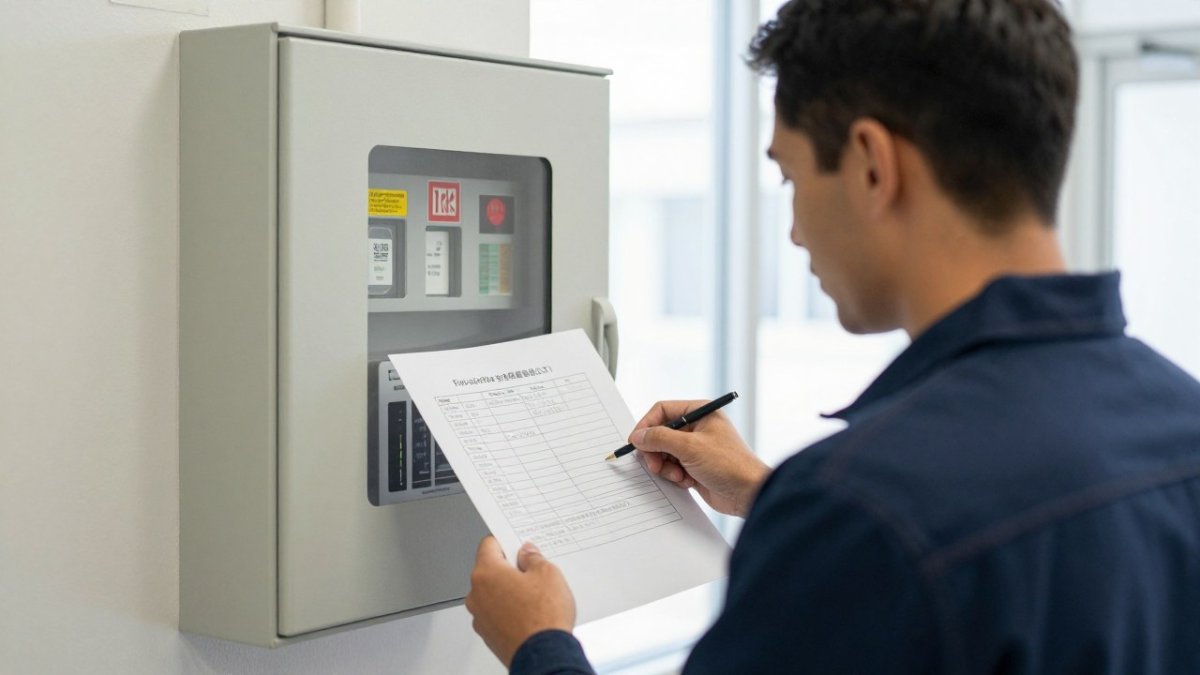
The header should state the date of service, the property address, the building classification if one is shown, and the name and licence number of the inspector. Check the address against your own records first. A report for the wrong building, or one that lists a different number of floors, cannot be relied on as evidence of compliance.
Next, read the scope statement. It describes which systems were inspected and, importantly, which were excluded. If the scope says sprinklers were not tested because access was not available, that exclusion is itself a finding, and you should record it as an open item rather than assume the system was fine.
Understanding the Result Terms
Inspection reports use a small set of result terms, and they are not interchangeable:
- Pass or compliant: the item was tested or observed and met the requirement at the time of inspection.
- Fail or non-compliant: the item was tested or observed and did not meet the requirement. It usually needs corrective work.
- Defect: a fault in the item itself, such as a damaged detector or a cracked extinguisher body.
- Impairment: a condition where a system is not performing its protective function right now, such as a valve left closed or a detector disconnected. Impairments are generally treated as more urgent than defects because the protection is not available.
- Not inspected or not applicable: the item was skipped or does not apply. Ask why, because a skipped item on a building that has the equipment is a gap.
A result that says only ‘OK’ or ‘noted’ without reference to what was tested does not tell you what was verified. Ask the provider to state the test performed for any item that matters to life safety.
Reading the Findings Entry by Entry
Each finding should contain four pieces of information: the location, the item, what was observed, and the recommended action. Take a finding such as ‘Hose reel 2, Level 3 stairwell: nozzle seized, unable to open fully. Repair or replace nozzle.’ The location tells you where to go, the item tells you what to inspect, the observation tells you the fault, and the action tells you the fix. If any of those four is missing, return the report for clarification before you schedule work.
Check whether the findings match the checklist results. A checklist that shows a fail for a system but no matching finding entry is a common drafting error, and it can leave a real defect untracked.
Checking the Recommended Actions and Dates
The final part of the report lists actions and, often, a next inspection date. Confirm that every fail and impairment has a corresponding action. Note whether the report distinguishes between work that must be done before reoccupation and work that can be scheduled as routine maintenance. That distinction drives your priorities, which is covered in the next section.
Watch out: a report that says ‘monitor’ or ‘review at next visit’ against an impaired life-safety system is not a closed finding, and it should be treated as open until someone confirms the system is working. Ensuring these critical repairs are completed remains a fundamental obligation for the building owner as outlined by the Kent and Sussex FRA, which clarifies the legal scope of Responsible Person Fire Safety Duties Explained.
The result terms in an inspection report are not interchangeable, so this summary sets out what each one means.
| Term | Meaning | Action |
|---|---|---|
| Pass or compliant | Met the requirement at inspection | No corrective work needed |
| Fail or non-compliant | Did not meet the requirement | Corrective work usually needed |
| Defect | Fault in the item itself | Repair or replace the item |
| Impairment | System not performing its protective function now | Treat as more urgent than a defect |
| Not inspected or not applicable | Item skipped or does not apply | Ask why; a skipped item may be a gap |
Fire Safety Inspection Checklist: What Should Be Covered
A fire safety inspection checklist should cover every system the building relies on in an emergency. Use this list to check that nothing was skipped:
- Fire extinguishers: present, charged and correctly placed
- Fire hose reels and hydrants: accessible and tested
- Fire alarm panel and detectors: operating with no active faults
- Sprinkler system: valves open and pressure recorded
- Emergency exits and stairwells: unobstructed and signed
- Emergency lighting: operating during a test interruption
- Fire safety signage: visible and correct
For a deeper look at equipment-level checks, see our guide on what should you check in a fire equipment inspection?
Fire Inspection Report Example: Annotated Walkthrough
Here is how a typical finding reads. Suppose the report says:
“Extinguisher 3, Level 2 corridor: pressure gauge in the red zone. Replace unit.”
Break it down. The item is identified by location, the result is a fail, and the action is a replacement. The fix is clear, so the work can be scheduled. Compare this with a finding that says only “extinguisher issue.” That entry gives you nothing to act on.
Prioritising Defects and Planning Corrective Actions
A report can list dozens of findings, and treating them all equally wastes money and leaves dangerous items waiting. Some upgrades can also help reduce future fire service fees once priority defects are dealt with. The aim is to sort each finding by how much it reduces the building’s ability to protect people, then attach an owner and a deadline to each one.
A Working Severity Test
Ask three questions of each finding:
- Does this item protect people directly, such as an alarm, sprinkler, exit or emergency light? If the protection is impaired, treat it as urgent.
- Is the item unavailable right now, or only deteriorated? An unavailable system outranks one that is still working but worn.
- Would the fault affect escape or firefighting if a fire started today? If yes, it belongs in the top tier.
Using these questions, most findings fall into three bands:
- Urgent: impaired alarms, sprinklers or exits, and any blocked escape route. These are usually fixed or made safe within days, with temporary measures if the repair takes longer.
- High: failed extinguishers, hydrants or hose reels, and defects in emergency lighting. These should be scheduled within a short, defined period.
- Routine: signage, labelling, minor documentation gaps and cosmetic damage that does not affect operation. These can go into the normal maintenance cycle.
Where a finding sits between bands, place it in the higher band and note the reason. It is easier to downgrade later than to discover that an urgent item was delayed.
Turning Each Finding into a Dated Action
For every finding, record four things in a simple register: the report reference, the assigned owner, the due date, and the evidence that will close it. The owner should be a named person, not a department. The due date should follow the band: urgent items in days, high items in weeks, routine items within the next cycle.
The closing evidence matters most. For a repaired extinguisher, that is a service tag or a service record. For a sprinkler valve, it is a record that the valve was reopened and the system tested. For a signage fault, it is a photograph and an updated asset entry.
Closing Out and Confirming Reinspection
Once the work is complete, retain the service records, update the register, and note whether a reinspection is required. Some repairs to alarm or sprinkler systems need to be witnessed or retested before the finding can be marked closed. Keep the closed register with the original report so an auditor can trace each finding from detection to resolution.
A common pattern is that the most serious items are fixed, but the paperwork is never updated, so the next inspection finds the same fault listed as open. Closing the loop in the register prevents this.
Inspection and Testing Frequency: Checking the Report’s Timelines
Check the next inspection date on the report. For guidance on managing fire safety deadlines, including inspection schedules and documentation requirements, review the full timeline. Testing frequency depends on the system and the applicable standard, so confirm the interval against the relevant Australian Standards.
For a full breakdown of testing intervals, see our fire safety compliance testing guide.
Booking Your Next Inspection and Closing Out Findings with Fyrepower
Once every finding has a fix and a record, book the next inspection before the current cycle ends. Fyrepower can be contacted for testing and reporting; pricing depends on the scope of work and the property, so request a quote for current details.
Get in touch with Fyrepower to book your next inspection and close out open findings.
Frequently Asked Questions
What information is included in a fire safety inspection report?
A fire safety inspection report usually records the date of service, the name and licence details of the inspector, the building or asset inspected, and a list of each system and component checked. For each item it should show a pass or fail result, along with a description of any defect found. Good reports also state the standard or procedure used for testing. If any of these elements is missing, the report may be hard to verify during an audit, so check for them before filing the document.
How do you prioritise defects listed in a fire inspection report?
Start with defects that affect active protection systems, such as fire alarms, sprinklers, and emergency lighting, because these directly affect occupant safety. Next, address blocked exits, missing or damaged extinguishers, and impaired fire doors. Cosmetic or documentation issues usually come last. Assign each defect a deadline based on its severity, and record who is responsible for closing it out.
What should you do after receiving a fire safety inspection report?
Review the report to confirm it is complete and that every finding is clearly described. Sort the defects by severity, then arrange repairs with a licensed contractor. Keep written evidence of each repair, such as a service record or updated tag, so you can show the item was corrected. Once the work is done, confirm closure with the inspector or service provider and file the updated documentation with the building’s fire safety records.
How often should fire safety equipment be inspected and tested?
Inspection and testing frequency depends on the equipment type and the applicable Australian standards, including AS 1851 for routine service of fire protection systems and AS 2444 for portable fire extinguishers. Check the report’s stated test dates and compare them against the intervals required for each system. Where a report does not state the frequency, ask the service provider to confirm it in writing.