Last Updated: October 25, 2026
Quick Summary
Fire safety regulations for commercial property managers in Australia require compliance with state-specific legislation, the National Construction Code, and AS 1851 standards for equipment testing and maintenance. Responsibility is shared across owners, landlords, property managers, tenants, and occupiers, with property managers acting as compliance coordinators to schedule inspections, manage contractors, and maintain documentation.
- Fire extinguishers require servicing every six months and pressure testing or replacement every five years under AS 1851.
- Fire detection systems must be tested quarterly, emergency lighting monthly and annually, and hose reels annually.
- Property managers must maintain detailed test records including date, technician credentials, equipment tested, results, and repairs for audit evidence.
- Audits typically request all fire safety records; missing documentation results in automatic defects and failed audits.
- Common defects include untested fire detection systems, unserviced extinguishers, blocked exits, and incomplete test documentation.
Table of Contents
- Understanding Fire Safety Regulations for Commercial Property Managers
- Commercial Property Fire Safety Responsibilities: Who Is Responsible
- Fire Safety Responsibilities in Commercial Leases
- State and Territory Legislation and the National Construction Code
- AS 1851 Fire Protection Equipment Maintenance and Testing
- Commercial Fire Safety Inspection Checklist and Compliance Calendar
- Documentation, Audits and Defect Management
- AS 1851 Fire Protection Equipment Maintenance and Testing
- Establishing Your Fire Safety Compliance Program
- Frequently Asked Questions
Understanding Fire Safety Regulations for Commercial Property Managers
Fire safety regulations for commercial property managers in Australia protect occupants, preserve assets, and ensure legal compliance. Responsibility is shared across owners, landlords, property managers, tenants, and occupiers, so knowing who does what separates a compliant property from one facing penalties or audit failures.
According to IBISWorld’s Fire Protection Services industry analysis, the Australian fire protection services sector comprises 2,950 businesses and has grown at 2.7% annually from 2021 to 2026. That growth reflects rising demand for compliance support, testing, and maintenance.
The challenge isn’t knowing the rules exist, it’s knowing which apply to your building, in your state or territory, and proving compliance when an auditor arrives. This guide covers the framework, responsibilities, standards, and calendar you need.
Commercial Property Fire Safety Responsibilities: Who Is Responsible
Fire safety responsibility is distributed across multiple parties, and the law holds each accountable for their piece.
Building owners hold ultimate responsibility for fire safety systems.
Landlords in leased commercial properties share responsibility with tenants for common areas, shared systems, and structural fire safety, maintaining fire detection, emergency lighting, exits, and suppression equipment in shared spaces.
Property managers act as compliance coordinator: scheduling inspections, managing contractors, maintaining documentation, and meeting testing deadlines.
Occupiers must follow emergency procedures, participate in evacuation drills, and report hazards. They must not block exits, tamper with fire safety equipment, or ignore alarm signals.
Body corporates in strata schemes hold collective responsibility for common property fire safety. They must fund maintenance, coordinate testing, and ensure all lot owners comply with fire safety obligations.
Fire Safety Responsibilities in Commercial Leases
Commercial leases must specify fire safety obligations clearly. Vague leases lead to disputes, missed maintenance, and compliance failures.
A well-drafted lease also requires the tenant to comply with all fire safety legislation, cooperate with drills and evacuations, and refrain from altering, disabling, or obstructing any fire safety installation without written consent.
Watch out: leases saying “tenant is responsible for all fire safety” are unenforceable in most jurisdictions.
Best practice is to attach a fire safety schedule to the lease listing all systems, testing frequencies, and responsible parties. It removes ambiguity and becomes your audit evidence when an inspector asks who maintains the fire alarms.
State and Territory Legislation and the National Construction Code
Fire safety regulations vary by state and territory.
Queensland, where Fyrepower operates, applies the Building Fire Safety Regulation 2008 and the Building Code of Australia (which incorporates the National Construction Code).
New South Wales uses the Environmental Planning and Assessment Act and the Building Code of Australia, and each state has a fire commissioner’s office publishing compliance guidance.
Victoria, South Australia, Western Australia, and other territories each have equivalent legislation and enforcement bodies.
The National Construction Code defines building classification (Class 2 through Class 9 for commercial buildings), occupancy type, and fire-safety system requirements. A Class 5 office building has different detection and sprinkler requirements than a Class 6 retail space or Class 7 carpark, so your classification determines which standards apply. Beyond structural fire safety, these classifications often intersect with broader electrical safety obligations, necessitating a clear understanding of EICR certificate requirements to ensure full building compliance.
The National Construction Code standards specify fire detection, alarm, and suppression requirements based on building height, use, and occupancy. Property managers must know their building’s classification and the corresponding code requirements.
Because the landscape is jurisdiction-specific, property managers with properties across multiple states must keep separate compliance calendars and documentation for each location.
AS 1851 Fire Protection Equipment Maintenance and Testing
AS 1851 is the Australian Standard governing maintenance and testing of fire protection equipment.
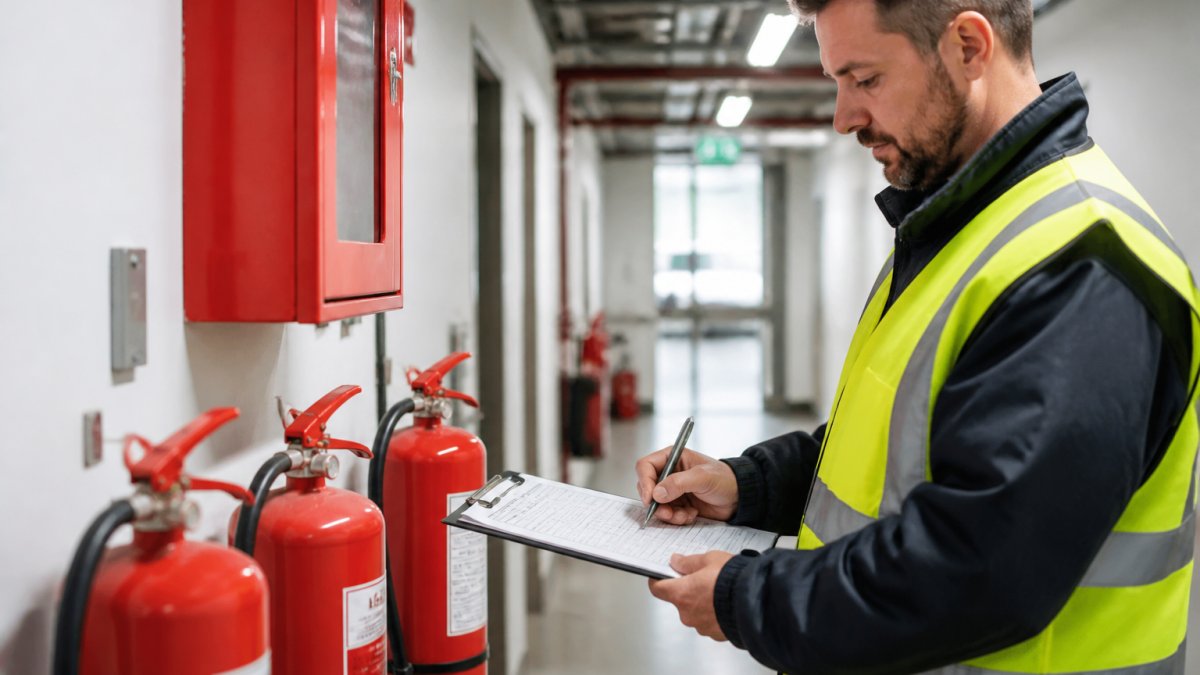
AS 1851 specifies testing frequencies for fire extinguishers, hose reels, fire detection systems, emergency lighting, and fire suppression equipment. Compliance Services’ 2026 fire safety checklist confirms that fire extinguishers require servicing every six months and pressure testing or replacement every five years.
The standard defines “servicing”: a qualified technician must inspect the equipment, test its function, replace failed components, and document the work.
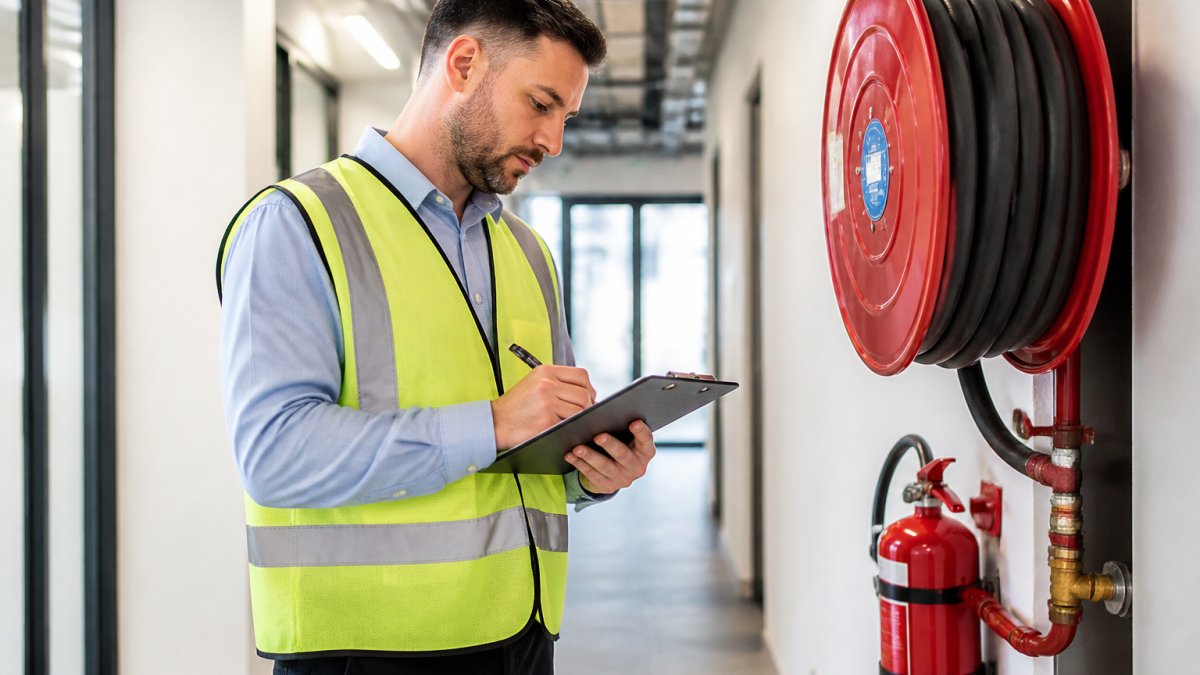
Fire detection systems must be tested quarterly to ensure sensors respond to smoke and heat. Hose reels must be tested annually to confirm water pressure and nozzle function.
The cost of non-compliance is high.
Property managers must maintain detailed AS 1851 records: the date of each test, the technician’s name and credentials, the equipment tested, the result, and any repairs.
Commercial Fire Safety Inspection Checklist and Compliance Calendar
A systematic inspection checklist and compliance calendar are non-negotiable. Without them, testing deadlines slip, defects go undetected, and audits fail.
Your checklist should cover all fire safety systems in the building: What should you check in a fire equipment inspection?
- Fire detection and alarm systems (smoke detectors, heat sensors, alarm panels)
- Fire suppression equipment (sprinklers, foam systems, gas systems)
- Portable fire extinguishers and hose reels
- Emergency lighting and exit signage
- Fire doors, compartmentation, and structural fire rating
- Evacuation routes and assembly points
- Fire safety documentation and records
For each item, record the last test date, the next due date, the responsible party (owner, manager, tenant, contractor), and the result.
Your compliance calendar should map testing frequencies across the year:
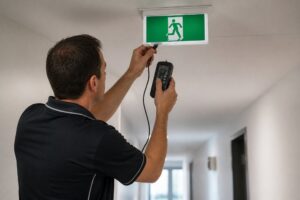
- Monthly: emergency lighting tests
- Quarterly: fire detection system tests
- Six-monthly: fire extinguisher servicing and hose reel tests
- Annually: fire door inspections, evacuation drills, comprehensive system audits
- Five-yearly: fire extinguisher replacement or pressure testing
A property manager coordinating multiple buildings should use a shared calendar or compliance software with alerts when tests are due; missing a deadline by even one day creates an audit vulnerability.
The detailed fire equipment inspection checklist from Fyrepower provides a practical template aligned with AS 1851 and state regulations.
Watch out: a checklist is only useful if reviewed regularly and updated when systems change. If you install a new fire alarm panel or add a sprinkler zone, update it immediately.
Fire safety systems must be tested on specific schedules to maintain compliance with AS 1851.
| System | Testing Frequency | Notes |
|---|---|---|
| Emergency lighting | Monthly and annually | Battery backup and illumination levels confirmed |
| Fire detection systems | Quarterly | Sensors tested to ensure response to smoke and heat |
| Fire extinguishers | Six-monthly servicing | Pressure testing or replacement every five years |
| Hose reels | Annually | Water pressure and nozzle function verified |
| Fire doors | Annually | Inspections to confirm proper function |
| Evacuation drills | Annually | Participation documented |
| Comprehensive system audits | Annually | Full review of all fire safety systems |
Documentation, Audits and Defect Management
An audit typically begins with a request for all fire safety records: maintenance logs, test certificates, inspection reports, evacuation drill records, and any previous audit findings.
Your documentation must be clear, complete, and current. Learn about annual fire safety statement compliance requirements to ensure your audit documentation meets regulatory standards.
Defects are non-compliance findings. Common defects include:
- Fire extinguishers not serviced within six months
- Fire detection systems not tested within three months
- Emergency lighting not tested within 12 months
- Fire doors propped open or painted shut
- Exit routes blocked or unclear
- Missing or incomplete test documentation
When an auditor identifies a defect, you have a specified timeframe (typically 30 days) to rectify it and provide evidence of correction.
The fire safety audit failure guide explains why audits fail and how to prevent defects.
Defect management requires a structured process: log the defect, assign responsibility and a deadline, execute the correction, document the fix, and report completion to the auditor.
AS 1851 Fire Protection Equipment Maintenance and Testing
AS 1851 compliance is not a one-time task, it’s an ongoing program. The standard requires that all fire protection equipment be maintained in working order at all times.
Testing intervals are non-negotiable. A fire extinguisher due for servicing is non-compliant the day after the deadline passes. An untested fire alarm is a defect. The standard allows no grace period and no exceptions for “we were waiting for the contractor to call back.”
Our fully insured and QBSA-licensed team ensures every test is performed to standard and documented comprehensively.
Property managers should engage a qualified fire protection contractor early and establish a service agreement specifying testing frequencies, reporting requirements, and response times for emergency repairs. A contractor who understands AS 1851 and your building’s specific systems is worth the investment.
Establishing Your Fire Safety Compliance Program
A fire safety compliance program is a documented system that defines roles, responsibilities, testing schedules, documentation processes, and escalation procedures.
Start by mapping your building: identify every fire safety system, its location, its age, and its last service date.
Next, establish a testing calendar aligned with AS 1851 and your state’s specific regulations.
Set up a documentation system: a folder (physical or digital) containing all test certificates, maintenance logs, inspection reports, and audit correspondence.
Engage Fyrepower or a similar qualified contractor to support your program.
The investment in a structured program pays for itself by preventing audit failures, avoiding fines, and ensuring occupant safety.
Fire safety regulations for commercial property managers in Australia are complex, jurisdiction-specific, and non-negotiable.
Frequently Asked Questions
Who is responsible for fire safety in commercial premises?
Responsibility depends on the lease and property structure. Building owners typically hold primary duty to maintain fire safety installations and systems. Property managers must ensure compliance on behalf of owners. Tenants and occupiers are responsible for safe use of equipment and evacuation procedures. In strata schemes, the body corporate manages common-area fire safety while individual lot owners manage their own spaces. Clarify roles in your commercial lease to avoid gaps in compliance.
What fire safety regulations apply to commercial properties?
Commercial properties must comply with state and territory fire safety legislation, the National Construction Code, and Australian Standards including AS 1851 for equipment maintenance and AS 2444 for portable fire extinguishers. Each state has specific requirements: Queensland’s Building Fire Safety Regulation 2008 sets mandatory standards, with penalties up to 30 penalty units for non-compliance. Check your state’s legislation and your building’s classification to determine which standards apply.
How often should fire safety equipment be inspected in a commercial property?
Fire extinguishers and most fire safety equipment require professional servicing every six months under current compliance guidance. Pressure testing and replacement typically occur every five years. Fire detection systems, sprinklers and hose reels have their own schedules defined by AS 1851. Document all testing with detailed reports showing what was inspected, tested, serviced or replaced. Keep records for at least seven years to demonstrate compliance during audits.
What should a commercial fire safety inspection checklist include?
A comprehensive checklist covers fire detection and alarm systems, sprinklers and suppression equipment, fire extinguishers and hose reels, emergency exits and evacuation routes, passive fire protection (fire-rated doors, seals, barriers), emergency lighting and signage, evacuation plans and assembly points, and staff training records. Include inspection dates, responsible parties, defects identified, rectification timelines, and testing results. Assign responsibility for each item and establish a calendar so nothing is missed.
Is AS 1851 mandatory for commercial buildings?
Yes, AS 1851 is mandatory for commercial buildings in Australia. It sets the standard for maintenance and testing of fire protection equipment including extinguishers, hose reels, sprinkler systems and detection devices. Compliance is enforced through state fire safety legislation and building codes. Non-compliance can result in penalties, failed audits, and loss of insurance coverage. Engage a qualified fire protection service provider to ensure your equipment meets AS 1851 requirements.
What fire safety records should a commercial property manager keep?
Maintain detailed records of all inspections, testing, maintenance and servicing of fire safety equipment. Include dates, times, technician names, equipment serial numbers, test results, any defects found, and rectification actions taken. Keep fire safety statements, evacuation plans, staff training records, and audit reports. Store records securely and retain for at least seven years. Organised, audit-ready documentation protects your property legally and demonstrates due diligence to regulators and insurers.