Table of Contents
- Fire Extinguisher Placement and Maintenance Violations
- AS 1851 Compliance Requirements and Testing Gaps
- Emergency Lighting and Exit Signage Defects
- Fire Door Obstruction and Integrity Issues
- Fire Alarm Systems and Smoke Detector Failures
- Commercial Fire Safety Inspection Checklist
- Penalties for Fire Safety Non-Compliance in Queensland
- Frequently Asked Questions
Last Updated: October 1, 2026
In Queensland, fire code violations commercial properties are among the most frequently cited compliance failures, with consequences ranging from costly fines to criminal liability. This guide covers the most common violations, their causes, and how to prevent them.
Fire Extinguisher Placement and Maintenance Violations
Fire extinguishers are often neglected, with the most common violation being incorrect placement. Extinguishers must be mounted at eye level, clearly visible, and accessible within 10 seconds, otherwise they’re useless in an emergency.
A second violation is expired or untested equipment. Extinguishers require annual pressure testing and recharging under Australian Standards; internal pressure must be verified and documented.
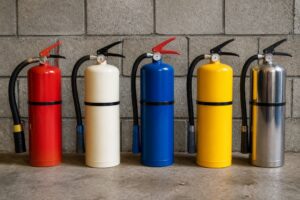
A third violation is incorrect extinguisher type for the hazard. Class A handles paper and wood, Class B handles flammable liquids, and Class F is essential for commercial kitchens.
AS 1851 Compliance Requirements and Testing Gaps
AS 1851 governs testing and maintenance of portable fire extinguishers. Many violations occur because requirements are specific, time-bound, and easy to miss without a structured system.
Key Testing Intervals and Common Failures
AS 1851 requires annual inspections by a competent person and hydrostatic pressure testing every 5 years. Many businesses skip the 5-year testing or fail to document it.
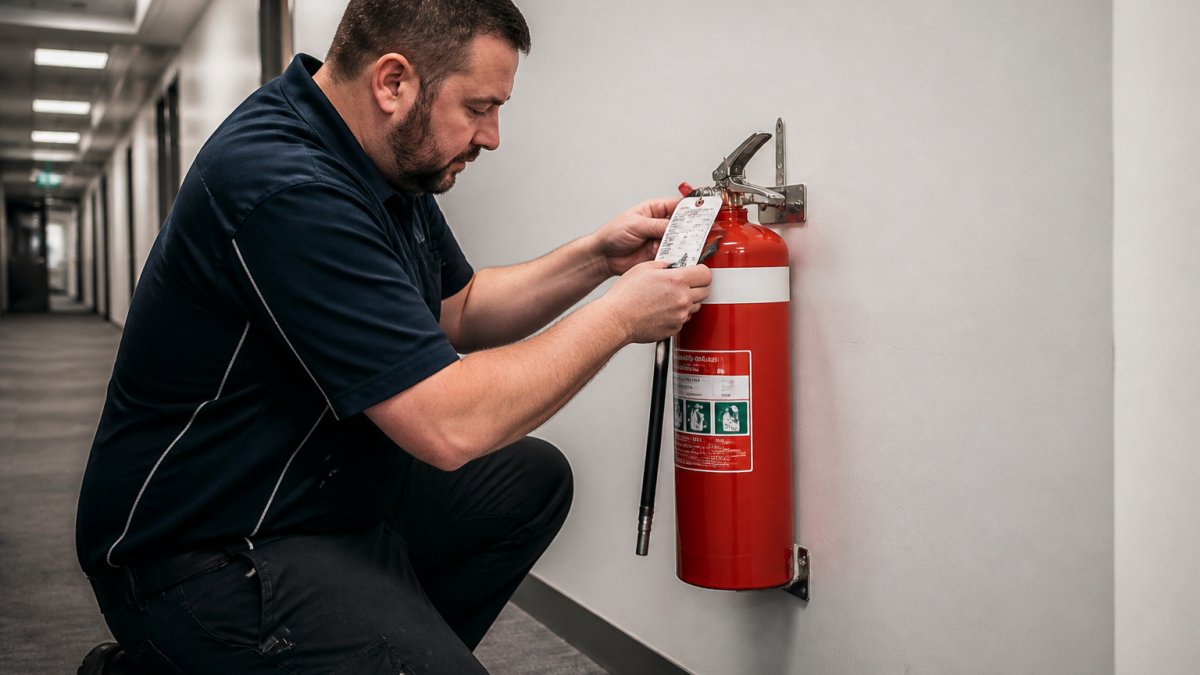
Extinguishers must be serviced by a licensed technician who verifies pressure gauge, seal integrity, hose and nozzle function, and contents weight. Each service must be recorded on a tag affixed to the extinguisher and in a maintenance logbook.
Documentation Gaps That Trigger Violations
According to WorkSafe Queensland guidance on fire safety compliance, failure to maintain records is treated as seriously as having no equipment at all. The most common documentation failures are:
-
Missing service tags: If an extinguisher has no tag or the tag is illegible, regulators assume it hasn’t been serviced. Even if you have records elsewhere, the absence of a tag on the equipment itself is a violation.
-
Incomplete logbooks: Entries must include the date of service, technician’s name and licence number, extinguisher type and serial number, work performed, and next service date. Vague entries like “serviced” don’t meet the standard.
-
Lost or inaccessible records: AS 1851 requires maintenance records to be kept on site and accessible to inspectors. Digital records are acceptable if backed up and retrievable within minutes.
-
Gaps in the service timeline: Regulators expect annual servicing within a 12-month window. If you miss the window, you must document the reason and corrective action taken.
Preparing for an AS 1851 Audit
Before a fire safety inspection, conduct an internal audit: photograph each extinguisher and cross-reference against your maintenance logbook. Verify all service tags are legible and affixed securely. Check the 5-year hydrostatic testing schedule and ensure your logbook has no gaps in annual service dates.
If you find extinguishers with missing or overdue service tags, contact a licensed technician immediately. Don’t wait for an inspection. A proactive service call demonstrates good faith compliance and prevents a violation notice.
Licensed Technician Verification
When you hire a technician, verify their current state-issued licence. Keep a copy in your maintenance file to protect you if a regulator questions the technician’s qualifications.
Fyrepower provides detailed records for every service, with service tags affixed on-site. This documentation approach ensures your records withstand audit scrutiny and gives you confidence that your AS 1851 obligations are met.
Emergency Lighting and Exit Signage Defects
Emergency lighting and exit signage violations are common because these systems fail silently. Exit signs must be illuminated at all times and visible from every point in the building (AS/NZS 2293). Emergency lighting must function for at least 3 hours during a power failure, requiring battery backup systems that are regularly tested.
The Queensland Building Fire Safety Regulation 2008 requires all exit routes to be clearly marked and lit.
Fire Door Obstruction and Integrity Issues
Fire doors are engineered barriers designed to contain fire and smoke. The most common violation is obstruction, doors propped open by doorstops or wedges defeat their function. These doors must close automatically and seal completely. Maintaining these barriers is essential, yet property managers must also remain vigilant against electrical fire hazards that often lurk behind the walls and within aging distribution panels.
Fire Alarm Systems and Smoke Detector Failures
Fire alarm systems and smoke detectors are critical early warning systems. The most common violation is untested systems, fire alarms must be tested monthly and serviced annually. Smoke detectors fail when batteries aren’t replaced or detectors are covered by dust or paint. In multi-storey buildings, fire alarm systems must communicate across all levels; improper networking prevents occupants from receiving alerts.
Commercial Fire Safety Inspection Checklist
A systematic approach prevents most fire code violations commercial properties face. This section covers a monthly internal checklist and inspection readiness guidance.
Monthly Internal Audit Checklist
| Inspection Item | Frequency | Pass/Fail | Notes |
|---|---|---|---|
| Fire extinguisher pressure and date | Monthly | [ ] | Check gauge, verify annual tag, photograph for records |
| Exit routes clear and unobstructed | Monthly | [ ] | No boxes, furniture, equipment, or locked doors |
| Emergency lighting functional | Quarterly | [ ] | Test battery backup systems, replace dead batteries |
| Fire door seals intact, doors closing | Monthly | [ ] | Check hinges, frame damage, seals; ensure doors close fully |
| Fire alarm system tested | Monthly | [ ] | Document test results in logbook, note any faults |
| Smoke detectors functional | Quarterly | [ ] | Replace batteries, clean lenses, test alarm sound |
| Evacuation diagram posted and current | Annually | [ ] | Verify accuracy, update if layout changed, ensure legible |
| Fire safety signage visible and legible | Quarterly | [ ] | Replace faded or missing signs, ensure not obscured |
| Maintenance records complete | Monthly | [ ] | Digital or physical, accessible, no gaps in service dates |
| Staff trained on equipment use | Annually | [ ] | Document training dates, keep attendance records |
Preparing for a Surprise Fire Safety Inspection
Before the Inspection Arrives
-
Designate a fire safety coordinator: Assign one person to manage compliance and answer inspector questions.
-
Centralise your records: Keep maintenance logbooks, service tags, testing certificates, and training records in one accessible location.
-
Conduct a pre-inspection walkthrough: Photograph every fire safety item and compare against your records. Fix any non-compliant items immediately.
-
Clear all obstruction: Ensure fire doors close fully, exit routes are clear, and emergency lighting is visible.
-
Verify staff knowledge: Brief your team on extinguisher locations, evacuation procedures, and assembly points.
During the Inspection
-
Cooperate fully: Inspectors have the right to access all areas and review all records. Obstruction can result in additional violations.
-
Have your fire safety coordinator present: The coordinator should accompany the inspector and take notes. This shows compliance commitment and creates a record.
-
Ask for clarification: Understand what the violation is, why it’s a violation, and the correction timeframe. Take notes so you have a record.
-
Don’t argue or make excuses: Acknowledge violations and commit to correcting them.
After the Inspection
-
Review the inspection report: You’ll receive a written report detailing any violations, categorised as critical or non-critical. Critical defects must be corrected immediately; non-critical defects have a specified timeframe (typically 30 days). Read the report carefully and understand what needs to be done.
-
Correct violations promptly: Don’t wait until the deadline. Correct violations as soon as possible and document the correction. Take photos, keep receipts, and update your maintenance logbook. If an inspector returns for a follow-up, you’ll have evidence that you acted in good faith.
-
Update your records: After any correction, update your maintenance logbook and service records. This creates a paper trail showing that you identified the issue and fixed it.
Tenant-Specific Fire Safety Obligations
Common tenant obligations include:
- Maintaining fire extinguishers: You’re responsible for ensuring extinguishers in your leased area are serviced annually and accessible.
- Keeping exit routes clear: You must not obstruct emergency exits, fire doors, or corridors with your equipment or inventory.
- Testing fire alarm systems: If your lease includes fire alarm responsibility, you must arrange monthly testing and annual servicing.
- Maintaining emergency lighting: You’re responsible for ensuring emergency lights in your area function and batteries are replaced.
- Posting evacuation diagrams: You must display an evacuation diagram in your space showing exits, assembly points, and emergency procedures.
- Training staff: You must ensure your employees know the evacuation procedure and can locate fire safety equipment.
Penalties for Fire Safety Non-Compliance in Queensland
The Queensland Building Fire Safety Regulation 2008 establishes penalties for non-compliance. Understanding these consequences motivates preventive action.
Frequently Asked Questions
What are the main fire code violations that result in penalties for commercial properties?
The most costly violations include untested or expired fire extinguishers, blocked emergency exits, faulty fire alarm systems, dead emergency lighting, and fire doors propped open or obstructed. Properties must also maintain current fire safety statements and keep detailed maintenance logs. Under Queensland’s Building Fire Safety Regulation 2008, occupiers are legally responsible for ensuring all fire safety installations function correctly and remain accessible.
Is AS 1851 compliance mandatory for commercial buildings in Queensland?
Yes. AS 1851 is the Australian standard governing the maintenance and testing of portable fire extinguishers and fire safety equipment. Queensland commercial properties must comply with AS 1851 standards through annual inspections and pressure testing. Non-compliance exposes occupiers to significant fines and liability in a fire emergency. Professional testing ensures your equipment meets the required standard and your property maintains a valid compliance record.
How often must fire safety equipment be tested in commercial properties?
Fire extinguishers require professional inspection and pressure testing annually under AS 1851. Fire alarm systems must be tested at least annually, with many properties requiring 6-monthly testing depending on building classification. Emergency lighting and exit signage require monthly visual checks and annual full testing. Smoke detectors need testing every 12 months. Keeping a detailed maintenance log of all testing dates and results protects your property and satisfies regulatory obligations.
What are the legal consequences of failing a fire safety inspection in Queensland?
Penalties for fire safety non-compliance in Queensland are substantial. Occupiers can face fines up to several thousand dollars per violation, with critical defects attracting higher penalties than non-critical defects. Repeated breaches or failure to rectify violations within notice periods can result in prosecution. Beyond financial penalties, non-compliance increases liability in a fire emergency and may invalidate insurance claims. Maintaining a current fire safety statement and up-to-date compliance records is essential to avoid these consequences.