Table of Contents
- The Six Fire Classes in Australia and What Fuels Them
- Fire Extinguisher Types and Colour Codes at a Glance
- Fire Extinguisher Rating System Explained: What 2A:10B:E Actually Means
- How to Use a Fire Extinguisher: The PASS Method
- Fire Extinguisher Maintenance Requirements and Compliance
- Residential vs Commercial Compliance: What Changes
- Spotting a Faulty Unit and Disposing of Expired Extinguishers
- Frequently Asked Questions
Last Updated: September 14, 2026
The Six Fire Classes in Australia and What Fuels Them
Fire extinguisher classes explained Australia-wide start with a simple principle: you cannot fight every fire the same way, and the fire extinguisher classes you choose must match the fuel. In Australia, fires are sorted into six classes based on the fuel source, and choosing the wrong extinguisher for that fuel can turn a small fire into a catastrophic one. This guide from Fyrepower breaks down each class, the extinguisher types that match them, and the compliance rules that apply to your property.
Fire classification is the system that groups fires by the material burning, because the extinguishing agent that smothers one fuel can violently react with another. The six classes are:
- Class A – ordinary combustibles: paper, timber, textiles, cardboard, most plastics.
- Class B – flammable liquids: petrol, diesel, solvents, paints, cooking oils in bulk.
- Class C – flammable gases: LPG, natural gas, acetylene.
- Class D – combustible metals: magnesium, sodium, titanium, aluminium swarf.
- Class E – electrical fires involving energised equipment (note: this class was folded into the AS/NZS 1850 revision, but remains widely referenced in Australia).
- Class F – cooking oils and fats: the deep fryer fire that water makes worse.
The fire triangle (fuel, oxygen, heat) underpins every class. Remove one side and the fire dies. Each extinguishing agent is engineered to remove a specific side for a specific fuel.
Water on a Class F cooking oil fire causes a violent steam explosion that can throw burning oil across a kitchen. Never use a water-based extinguisher on fats or oils.
Fire Extinguisher Types and Colour Codes at a Glance
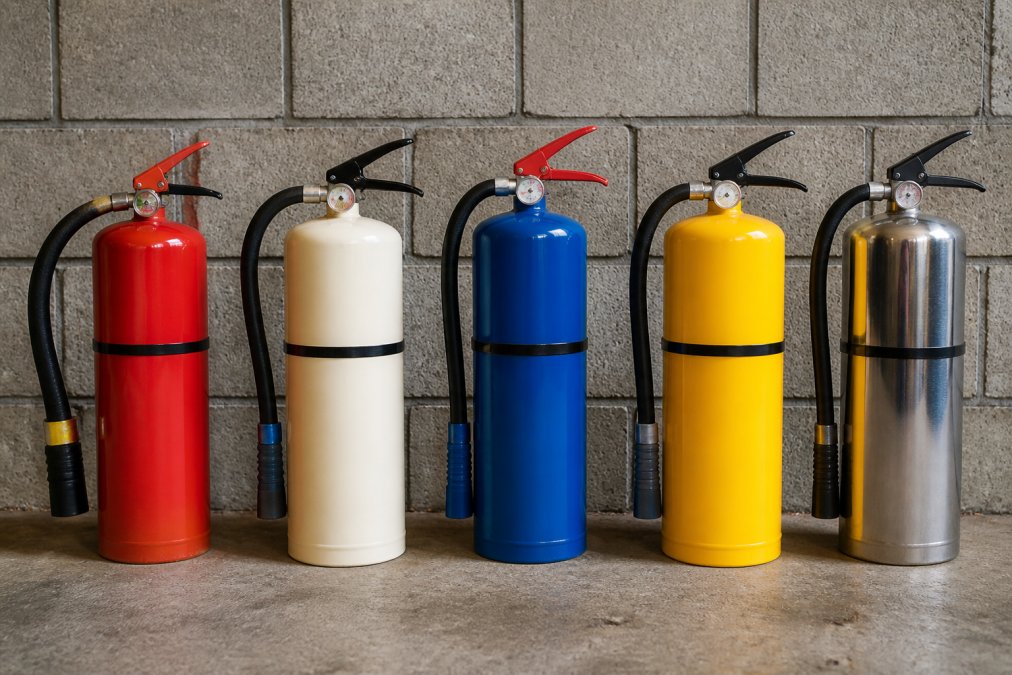
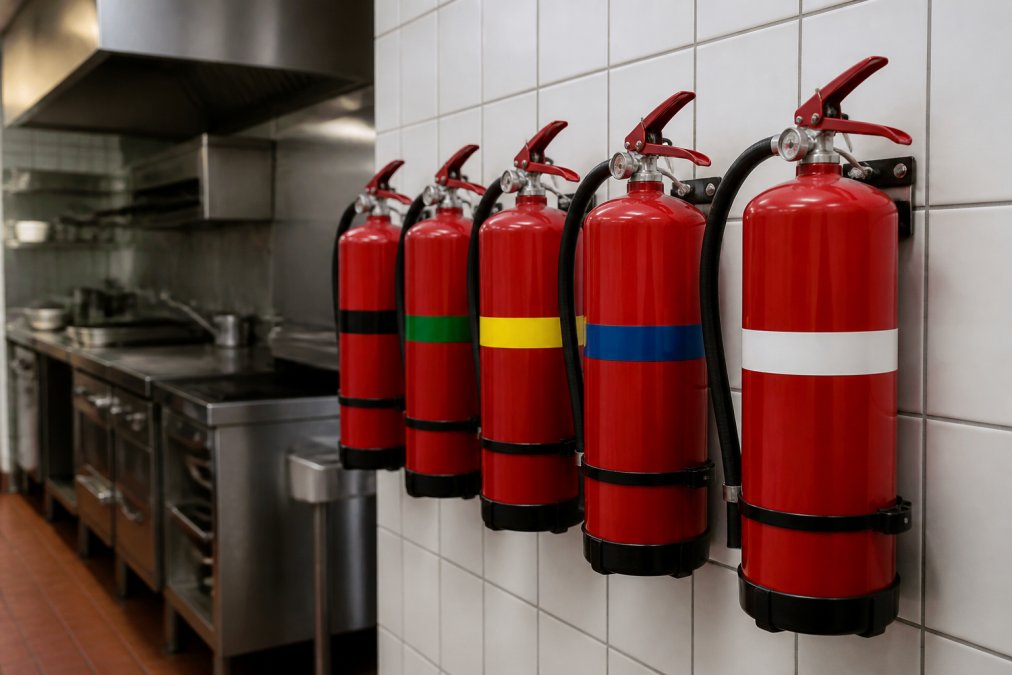
The colour-coded band on each extinguisher tells you what it is rated to fight. In Australia, the band system follows AS/NZS 1841, and reading it correctly is the fastest way to match the right unit to the right hazard (Catalogue Item – Standards Catalogue).
| Band Colour | Extinguisher Type | Best For | Key Limitation |
|---|---|---|---|
| Red | Water | Class A only | Dangerous on electrical and flammable liquid fires |
| Cream | Foam | Class A and B | Not for electrical or cooking oil fires |
| Blue | Dry chemical powder | A, B, C, E | Messy residue; limited cooling effect |
| Black | Carbon dioxide (CO2) | Class E, some B | Poor on Class A; short discharge time |
| Yellow | Vaporising liquid | Class E, some A and B | Low fire rating; specialist use |
| White | Wet chemical | Class F, some A | Not for electrical equipment |
Dry chemical powder is the most common general-purpose agent in commercial premises because it covers multiple classes in one unit. Carbon dioxide works by displacing oxygen and leaves no residue, which is why it suits server rooms and electrical switchboards. Wet chemical reacts with hot oil through saponification, forming a soap-like blanket that seals the surface.
What most guides miss is that the band colour is only half the story. The number printed beside the class letters determines whether the unit is actually rated for the hazard in front of it.
Fire Extinguisher Rating System Explained: What 2A:10B:E Actually Means
The fire extinguisher rating system explained on any cylinder follows a simple code: the number before the letter indicates how much fire the unit can extinguish, and the letter indicates the class. A 2A:10B:E rating is not a recommendation, it is a measured test result.
Here is how to read it:
- 2A – the unit is rated to extinguish a Class A fire using a test fire equivalent to 2 units of burning timber crib. Higher numbers mean more capacity.
- 10B – rated against a Class B flammable liquid fire measuring 10 units in the standard test pan.
- E – safe for use on energised electrical equipment up to 1000V (the E denotes electrical, not a numeric rating).
A 1A:5B:E unit is a small car or home extinguisher. A 6A:20B:E is a substantial commercial unit. The rating is what a fire safety audit checks, not the physical size of the cylinder.
When comparing quotes for extinguisher supply, ask for the fire rating (e.g. 2A:10B:E), not just the weight. A 4.5 kg unit with a low rating can be less capable than a 2 kg unit with a higher one.
How to Use a Fire Extinguisher: The PASS Method
The how to use a fire extinguisher PASS method is the standard operating sequence taught in emergency preparedness training, and it takes under ten seconds to run once you have practised it.
PASS stands for Pull, Aim, Squeeze, Sweep.
- Pull the safety pin to break the tamper seal.
- Aim the nozzle or horn at the base of the fire, not the flames.
- Squeeze the handle fully to release the agent.
- Sweep side to side across the base of the fire until it is out.
Stand roughly two to three metres back, keep your back to an exit, and never let the fire get between you and your escape route. If the fire does not go out after one full discharge, evacuate. Extinguishers are for small, incipient fires only.
Only fight a fire if it is small, you have a clear exit, and you have the correct extinguisher for the class. Otherwise, evacuate and call emergency services.
Fire Extinguisher Maintenance Requirements and Compliance
Fire extinguisher maintenance requirements in Australia are set by AS 1851, which governs the routine servicing of fire protection equipment. For most commercial premises, that means a six-monthly inspection and a more detailed annual service, with additional pressure testing at defined intervals. The standard applies to all fire extinguishers, regardless of whether they are portable or wheeled units.
The routine typically covers:
- Monthly – a visual check by the occupant: gauge in the green, pin intact, no corrosion or damage, clear signage, and the unit is unobstructed.
- Six-monthly – inspection by a competent technician, documented on a maintenance tag attached to the unit. This includes checking the pressure gauge, safety pin, tamper seal, hose, nozzle, and cylinder condition.
- Annually – full service including internal inspection, weighing of the agent, and pressure check. For dry chemical units, the powder is checked for caking and the unit is inverted or agitated as required.
- Five-yearly – pressure testing of the pressurised cylinder where applicable, and for some extinguisher types, a hydrostatic test.
- Six-yearly – for CO2 extinguishers, a hydrostatic test of the cylinder is typically required.
Each service is recorded on the maintenance tag and in a service report. If your reports are vague, you cannot prove the work was done at audit. AS 1851 maintenance of fire protection systems sets the benchmark for what a compliant record looks like. A compliant record should include the date of service, the name and licence number of the technician, the tests performed, and the results.
A missing or outdated maintenance tag is one of the first things a fire safety audit checks. If the tag is absent, the unit is treated as unserviced regardless of its actual condition.
It is also worth noting that AS 1851 requires extinguishers to be serviced by a competent person, which in practice means a technician with the relevant state-based licensing and training. In some states, fire protection technicians must hold a specific licence or certification. Using an unlicensed provider can void your insurance and leave you exposed in the event of a fire.
For strata and commercial properties, the service records must be kept for a minimum period, often five years, and made available to authorised officers on request. A common pattern is for property managers to store these records digitally alongside other compliance documentation, so they can be produced quickly during an audit or insurance claim.
Residential vs Commercial Compliance: What Changes
Compliance obligations differ sharply between a home and a commercial premises, and this is where many property managers get caught out. In a residential setting, the requirement is generally to have at least one extinguisher and a working smoke alarm, with no mandated service schedule. In commercial and multi-tenancy buildings, AS 1851 service intervals, documented records, and signage requirements all apply.
The legal framework varies by state and territory. In most jurisdictions, the relevant work health and safety (WHS) legislation and regulations impose a general duty on a person conducting a business or undertaking (PCBU) to manage fire risks. This is supported by Australian Standards such as AS 1851 (maintenance) and AS 2444 (portable fire extinguishers and fire blankets – selection and location). For residential properties, the requirements are typically set by building codes and state-based smoke alarm regulations, which may not mandate extinguishers at all.
| Requirement | Residential | Commercial / Strata |
|---|---|---|
| Extinguisher required | Recommended, not always mandated | Mandatory by hazard and occupancy |
| Service interval | Owner discretion | Six-monthly per AS 1851 |
| Maintenance tag | Optional | Required |
| Signage | Not required | Required |
| Documented service reports | Not required | Required for audit |
| Record retention | Not specified | Typically 5 years |
| Technician licensing | Not required | Required in most states |
Body corporate and strata managers carry the heaviest load: multiple tenancies, shared equipment, and a paper trail that must survive an audit. They also need to ensure that common property extinguishers are serviced and that records are available to owners and regulators. Construction sites face a further layer, with hydrostatic pressure testing required for new fire hydrant systems before handover, and temporary fire equipment must be maintained throughout the build.
A common gap is the assumption that a residential landlord has no obligations. While a single dwelling may not require an extinguisher, a rental property with a shared kitchen or a home-based business may fall under commercial rules. Similarly, a small business operating from a home may need to comply with WHS laws. The safest approach is to assess the actual fire hazards on the premises, not just the building type.
If you are unsure whether your property is classified as residential or commercial for fire safety purposes, check with your state or territory fire safety regulator or a licensed fire protection provider. Getting this wrong can invalidate insurance and lead to fines.
For commercial premises, the selection and placement of extinguishers must also comply with AS 2444, which sets out the minimum number, type, and location of extinguishers based on the fire hazard. This is separate from the maintenance standard and is often overlooked. A compliant installation is not just about having an extinguisher; it must be the right type, in the right place, and within the required travel distance.
Spotting a Faulty Unit and Disposing of Expired Extinguishers
A faulty extinguisher is easy to miss because it looks identical to a working one. The visual identification checks that catch most failures are:
- Pressure gauge outside the green zone (over- or under-pressurised).
- Corrosion on the cylinder body, especially near the base or seams.
- Cracked or perished hose and a blocked or missing nozzle.
- Broken safety pin or tamper seal.
- Dented cylinder or damaged handle assembly.
- Powder caking in dry chemical units that have not been inverted during service.
Expired or discharged extinguishers cannot simply go in general waste. They are pressurised cylinders containing chemical agents, and disposal must follow the manufacturer’s and your state environmental regulator’s guidance. A reputable fire protection provider will arrange collection and compliant disposal as part of a maintenance program, so you are not left holding a cylinder you cannot legally bin.
Safe disposal of fire extinguishers
This is where a managed maintenance contract earns its keep. Fyrepower, a QBSA-licensed and fully insured fire protection specialist, handles installation, six-monthly testing, and compliant disposal across the Gold Coast, South Brisbane, and Northern New South Wales, so your equipment and your paperwork stay audit-ready.
Fire safety compliance is not a box you tick once. Between six-monthly service deadlines, fading maintenance tags, and the risk of a unit failing silently, the margin for error is small. Fyrepower keeps your property compliant with Australian standards through professional installation, scheduled AS 1851 testing, on and offsite fire training, and clear service reports that hold up under audit. Get in touch with us now! to book your next inspection and put your extinguisher compliance on a schedule you can prove.
Frequently Asked Questions
What are the different classes of fire in Australia?
Australia recognises six fire classes under AS/NZS 1850. Class A covers ordinary combustibles like wood, paper and textiles. Class B involves flammable liquids such as petrol and cooking oil. Class C is flammable gases including LPG and natural gas. Class D is combustible metals like magnesium and sodium. Class E covers electrical equipment, and Class F is cooking oils and fats. Each class needs a compatible extinguishing agent to work safely.
What do the ratings like 2A:10B:E mean on an extinguisher?
The fire extinguisher rating system explained on the label tells you how much fire each unit can handle. The number before the letter shows the size of fire it can extinguish, so 2A beats 1A. The letter identifies the fire class it suits, and ‘E’ confirms it is safe on live electrical equipment. A 2A:10B:E extinguisher handles Class A, Class B and electrical fires, making it a common choice for commercial premises.
Can I use a water extinguisher on an electrical fire?
No. Water conducts electricity and can cause electrocution or worsen the hazard. Electrical fires need a carbon dioxide or dry chemical powder extinguisher marked with an ‘E’ rating. If the equipment can be safely de-energised first, the fire may then be treated as the underlying class. Never assume a water-based extinguisher is safe near live wiring, switchboards or appliances still connected to power.
How often should fire extinguishers be tested under Australian Standards?
AS 1851 sets the service intervals. Extinguishers need a visual inspection every six months, a more detailed service every twelve months, and pressure testing at intervals that depend on the type. Maintenance tags record each visit so auditors can verify compliance. Commercial property managers typically schedule six-monthly inspections to stay ahead of deadlines and avoid gaps in documentation that could fail an audit.
How do I identify the correct fire extinguisher using colour codes?
Every extinguisher in Australia carries a colour-coded band on the cylinder. Red is water, cream is foam, blue is dry chemical powder, black is carbon dioxide, and yellow is wet chemical for cooking oils. The band sits against the red body, so look at the band rather than the overall colour. Match the band to the fire class you are most likely to face in that area.
Is a 3A fire extinguisher better than a 2A?
A 3A rating means the extinguisher can handle a larger Class A fire than a 2A unit, so it offers more capacity. Whether that matters depends on your risk. A small office may only need a 2A extinguisher, while a warehouse with bulky combustibles benefits from the extra reach of a 3A. Choose based on the hazard assessment for each area, not just the highest number available.
What should I do with an expired or damaged fire extinguisher?
Do not put it in general waste or leave it on site unmarked. Expired cylinders still hold pressure and need safe depressurisation before disposal. A licensed fire protection provider can decommission the unit and arrange recycling of the metal cylinder and any remaining agent. If a unit shows corrosion, a damaged hose or a missing safety pin, remove it from service immediately and replace it.