Table of Contents
- Top 10 Fire Safety Standards for Commercial Properties
- 10. Portable Fire Extinguishers and Fire Hose Reels
- 9. Emergency Lighting and Exit Signage
- 8. Fire-Rated Doors, Exits and Passive Fire Protection
- 7. Automatic Fire Sprinkler and Suppression Systems
- 6. Fire Detection, Smoke Alarms and Alarm Systems
- 5. AS 1851-2012 Maintenance of Fire Protection Systems
- 4. Annual Fire Safety Statement Requirements
- 3. National Construction Code Compliance and Occupancy Class
- 2. Emergency Egress, Evacuation Diagrams and Warden Training
- 1. Digital Fire Safety Management and Post-Incident Reporting
- Frequently Asked Questions
Last Updated: September 11, 2026
Top 10 Fire Safety Standards for Commercial Properties
Fire safety standards for commercial properties are the legally enforceable benchmarks that determine how a building detects, contains, and suppresses fire, and how its occupants escape safely. Meeting them comes down to a defined set of Australian Standards and National Construction Code obligations, each with its own inspection and documentation cycle. This guide from Fyrepower covers the ten that matter most for commercial property owners and managers.
The stakes are straightforward: a missed six-monthly inspection or an out-of-date statement can leave a building owner personally exposed during a regulatory audit, and insurers increasingly ask for proof of maintenance history before paying a claim.
10. Portable Fire Extinguishers and Fire Hose Reels
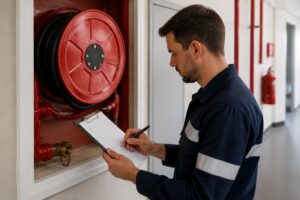
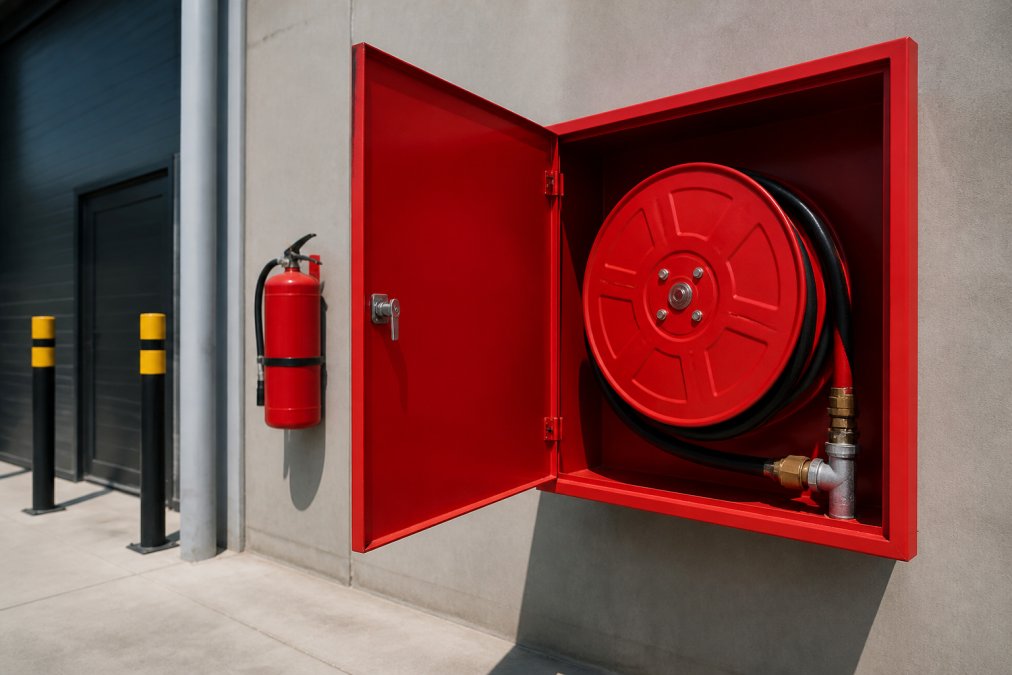
Portable fire extinguishers and fire hose reels form the first line of defence before a fire grows beyond its initial stage.
Extinguishers must be selected by fire class and positioned so no occupant travels far to reach one. Common types include water, foam, dry chemical, and carbon dioxide units. Hose reels suit Class A fires involving paper, timber, and textiles, and are typically mounted near exits and along travel paths.
The key compliance point is testing frequency. Extinguishers and hose reels require six-monthly inspection under AS 1851, with pressure testing at longer intervals depending on the vessel type (fire.nsw.gov.au). A common mistake is mounting equipment and then treating it as maintenance-free. In practice, seals perish, gauges drift, and hoses crack.
9. Emergency Lighting and Exit Signage
Emergency lighting and exit signage keep evacuation routes visible when mains power fails or smoke obscures a space.
These systems must operate for a defined duration during an outage, and every exit must be clearly marked with compliant signage. Testing involves a short monthly function check and a longer duration discharge test at set intervals, recorded in the maintenance logbook.
Emergency lighting is one of the most frequently failed items in audits: batteries degrade quietly, and a fitting that illuminates for two minutes may fail well short of the required duration. Fyrepower’s QBSA-licensed and fully insured team tests and maintains emergency and exit lighting as part of a broader compliance program, so failures surface before an auditor finds them.
8. Fire-Rated Doors, Exits and Passive Fire Protection
Passive fire protection is the built-in resistance that slows fire spread through a structure without relying on any active system.
This category covers fire-rated doors, walls, floors, and the fire compartmentation that divides a building into contained zones. Fire dampers stop fire and smoke travelling through ventilation shafts, and structural fire resistance protects load-bearing elements.
Fire doors fail on the details: missing intumescent seals, damaged hinges, and propped-open doors all void the rating. A door wedged open for convenience is no longer a fire door, regardless of its certification plate.
7. Automatic Fire Sprinkler and Suppression Systems
Automatic fire sprinkler and suppression systems detect and control fire at its point of origin, often before the fire service arrives. They are the most effective active measure in a commercial building, and the most heavily regulated.
Design and installation are governed by a family of Australian Standards. AS 2118 covers automatic fire sprinkler systems, split by hazard class: light hazard (offices, retail), ordinary hazard (warehouses, car parks), and higher-hazard parts for storage and industrial occupancies. Fire hydrant and hose reel installations sit under AS 2419, and pumped supplies under AS 2941. A qualified fire engineer or hydraulic consultant selects the applicable part based on occupancy class and the NCC’s deemed-to-satisfy provisions.
Sprinklers activate individually by heat, limiting water damage compared with a full deluge. Specialised suppression such as gas or foam protects areas where water would destroy assets, including server rooms and commercial kitchens. Gas systems are typically designed to AS 4214, and commercial kitchen hood suppression to AS 3776.
Performance-based design sometimes allows an engineered suppression solution instead of a prescriptive one, provided a qualified fire engineer signs off. The trade-off: these systems demand rigorous maintenance, because a suppression system that fails to discharge is worse than none at all.
Under AS 1851-2012, sprinkler systems carry a defined routine schedule: weekly checks on pump sets and alarm valves where required, monthly checks on gauges and water supply, quarterly and six-monthly tests on flow switches and alarm devices, annual flow tests, and a five-yearly internal inspection of piping and valves. Each activity has a routine code that must appear on the service report.
The most dangerous moment in a sprinkler system’s life is an impairment. When a system is isolated for repairs, welding, or a fit-out, the building is effectively unprotected. AS 1851 requires a documented impairment procedure: notify the fire service and insurer, post signage, add temporary detection or a fire watch, and record the start and end of the impairment. Skipping this step is a common audit finding and a common reason insurers reduce or refuse a claim.
A practical distinction: wet pipe systems are the default in heated, occupied spaces, while dry pipe and pre-action systems are used where pipes could freeze or accidental discharge would be catastrophic. Dry and pre-action systems have more moving parts and more ways to fail silently, so their maintenance burden is higher and their records matter more.
6. Fire Detection, Smoke Alarms and Alarm Systems
Fire detection systems identify a fire in its earliest stage and trigger the alarm that starts an evacuation.
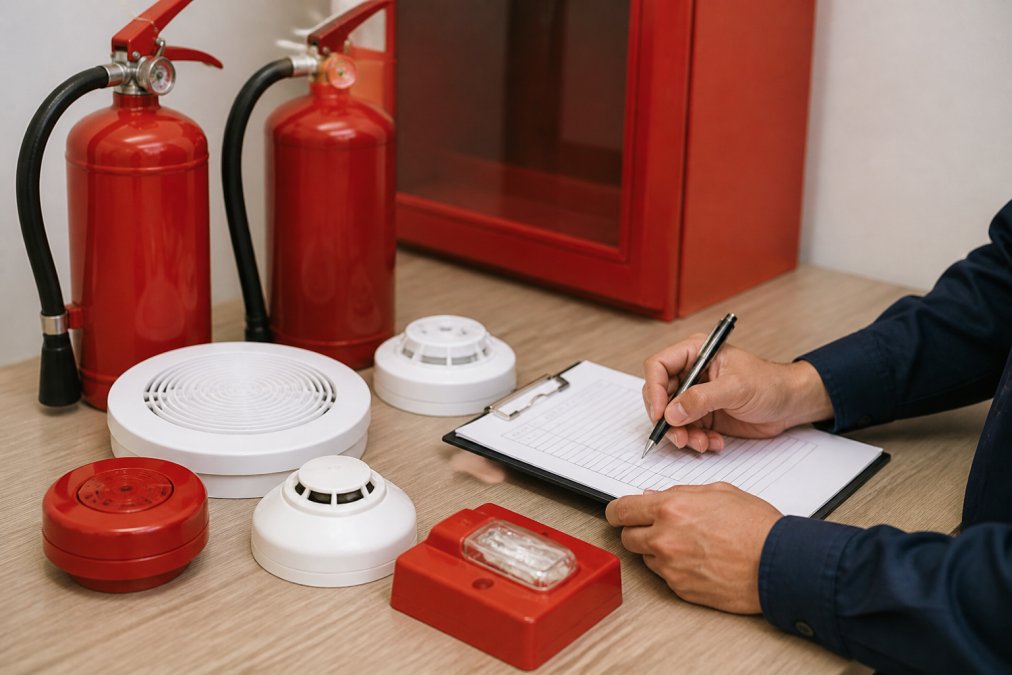
Smoke detection suits most occupied spaces, while heat detection is preferred where dust, steam, or fumes would trigger nuisance alarms. Alarm systems must be audible and, in larger buildings, connected to a monitoring service or the fire service.
The difference between a compliant system and a liability comes down to testing: detectors accumulate dust, and alarm panels throw faults that get silenced rather than fixed. Every device needs scheduled testing, recorded in the maintenance logbook. fire damage cleanup.
5. AS 1851-2012 Maintenance of Fire Protection Systems
AS 1851-2012 is the Australian Standard that sets out how fire protection systems and equipment must be inspected, tested, and maintained over their service life.
It is the backbone of ongoing compliance. Rather than a single rule, AS 1851 defines routines for each system type, from weekly and monthly checks through to annual and five-yearly activities. Every inspection generates a record, and those records prove compliance during an audit.
The most common AS 1851 failure is not the testing itself, it is the paperwork. If your service reports are vague or missing routine codes, you cannot prove the work was done. Ask your provider for itemised reports that reference the specific AS 1851 routine for each activity.
4. Annual Fire Safety Statement Requirements
An Annual Fire Safety Statement is a formal declaration, lodged with the local council, that a building’s essential fire safety measures have been assessed and perform to the required standard.
The statement is signed by the building owner and an accredited practitioner and must be displayed prominently in the building. It follows an inspection of every essential fire safety measure in the building’s fire safety schedule.
Missing the lodgement deadline is a statutory breach, and councils can issue fines or require remedial work. Property managers juggling multiple sites often let these lapse because the statement depends on every prior inspection being up to date. A compliance calendar with buffer time before each deadline avoids the scramble.
3. National Construction Code Compliance and Occupancy Class
The National Construction Code sets the minimum technical requirements for fire safety in new and altered buildings, and it classifies buildings by occupancy.
A building’s occupancy class determines its fire safety requirements: a retail shop, an office, and a high-rise residential tower each fall into different classes, with different expectations for egress, compartmentation, and suppression.
Compliance is assessed at design and construction and continues through the building’s life. Any change of use, from office to hospitality, can shift the occupancy class and trigger new requirements, so owners should confirm the class before renovating or changing tenants.
Converting a tenancy without checking its occupancy class is a frequent and expensive mistake. A change of use can invalidate existing fire approvals and require new egress, suppression, and signage work before the space can legally open.
2. Emergency Egress, Evacuation Diagrams and Warden Training
Emergency egress planning ensures occupants can leave a building safely and that staff know what to do when the alarm sounds.
Evacuation diagrams must be displayed on each floor, showing exits, equipment locations, and the assembly point. Fire warden training prepares nominated staff to direct evacuations, sweep their areas, and account for occupants, while regular drills test the plan under realistic conditions.
The gap most businesses leave open is training: diagrams on a wall do nothing if no one has practised the route. Fyrepower delivers on and offsite fire training services so staff learn to use extinguishers and follow evacuation procedures with confidence.
1. Digital Fire Safety Management and Post-Incident Reporting
Digital fire safety management replaces paper logbooks with software that schedules inspections, stores records, and flags overdue tasks automatically. Platforms built for the Australian regulatory environment, such as Uptick fire protection software and Essential safety measures platform, track AS 1851 routines and produce audit-ready reporting. For property managers running multiple sites, digital logbooks remove the single biggest compliance risk: lost or incomplete paperwork.
The practical case for going digital is the audit trail. When a council officer, insurer, or fire engineer asks for evidence that a routine was performed on a specific date by a licensed technician, a paper logbook with a missing page is a liability, while a cloud-based record with a timestamp, technician licence number, and routine code is proof. Most practitioners find the switch pays for itself the first time a claim or audit is contested.
Insurance implications of non-compliance
Commercial property insurers in Australia increasingly treat fire safety compliance as a condition of cover, not a background detail. Two things happen when compliance lapses:
- Premium loading. Insurers assess fire risk partly on the age and maintenance history of detection, suppression, and passive systems. A building with documented AS 1851 servicing and current Annual Fire Safety Statements typically attracts a better rate than an equivalent building with gaps in its records.
- Claim validity. Most commercial property policies include a duty of disclosure and a condition requiring the insured to maintain fire protection measures. If a fire reveals that a sprinkler system was impaired without notification, that a fire door was propped open, or that an Annual Fire Safety Statement was never lodged, the insurer can reduce the payout or decline the claim. The loss is not just the fire damage, it is the uninsured portion of it.
The takeaway for owners and managers is that compliance records are not just a regulatory obligation, they are an insurance asset. Keep them current, keep them complete, and keep them retrievable.
Post-incident reporting
Post-incident reporting is the other half of digital management. After any fire, near miss, false alarm, or system failure, a documented investigation records what happened, what failed, and what changed. Insurers increasingly request this history when assessing claims, and it feeds directly into improving the building’s fire safety plan.
A workable post-incident report covers five things: the time and location, the system or measure that activated or failed, the immediate response, the root cause (as far as it can be established), and the corrective action with a completion date. False alarms matter too: a pattern of nuisance alarms from a detector near a kitchen or loading dock is a maintenance signal, and recording it turns a recurring annoyance into a scheduled fix.
Digital compliance tracking and post-incident reporting are the two areas where Australian commercial property compliance is moving fastest. Owners who treat them as optional are carrying avoidable regulatory, insurance, and operational risk.
| Standard | What It Covers | Typical Testing Cycle |
|---|---|---|
| Portable extinguishers and hose reels | First-response equipment | Six-monthly inspection |
| Emergency lighting and exit signage | Evacuation visibility | Monthly check, periodic duration test |
| Passive fire protection | Fire doors, dampers, compartmentation | Annual inspection |
| Sprinklers and suppression | Automatic fire control | Scheduled per AS 1851 |
| Detection and alarms | Early warning | Scheduled per AS 1851 |
| AS 1851-2012 | Maintenance framework | Defines all routines above |
| Annual Fire Safety Statement | Council lodgement | Annual |
| NCC and occupancy class | Design and use requirements | At design and change of use |
| Egress and warden training | Evacuation readiness | Regular drills |
| Digital management and reporting | Records and audit trail | Continuous |
Frequently Asked Questions
What are the Australian fire safety standards for commercial buildings?
The main standards are AS 1851-2012 for maintaining fire protection systems, AS 2444 for portable extinguishers, and the National Construction Code for building design and occupancy. Fire safety standards for commercial properties also cover emergency lighting, exit signage, sprinklers, detection systems and annual fire safety statements. Compliance is enforced by state regulators and local councils, so requirements can vary slightly by jurisdiction.
Are commercial landlords or tenants responsible for fire safety compliance?
It depends on the lease. Generally, the building owner is responsible for base-building systems such as sprinklers, hydrants and fire-rated construction, while tenants handle equipment inside their tenancy, such as extinguishers and staff training. Most commercial lease obligations spell this out clearly. If the split is unclear, get it confirmed in writing before signing, because regulators will pursue whoever the lease names as responsible.
Is AS 1851 mandatory for all commercial properties?
AS 1851-2012 is the standard referenced by Australian regulators for maintaining fire protection systems, so in practice it applies to any commercial property with equipment that must be tested. How often depends on the system: extinguishers and exit lights are commonly checked every six months, while sprinklers, pumps and detection systems have their own intervals. Following AS 1851-2012 maintenance of fire protection systems is the clearest way to prove you have met your duty.
How often must fire safety equipment be tested in commercial premises?
Most portable equipment, such as extinguishers, fire blankets, hose reels and emergency lights, is tested every six months under AS 1851. Sprinkler systems, fire pumps, hydrants and detection systems have monthly, quarterly or annual checks depending on the component. Annual fire safety statement requirements then require you to formally certify that all essential fire safety measures have been maintained. Skipping an interval creates a gap that regulators and insurers can both pick up.
How do I verify a QBSA fire licence before hiring a contractor?
Ask for the licence number, then check it directly with the Queensland Building and Construction Commission (QBCC) online register. The register shows the licence class, scope of work and whether it is current. Also request a certificate of currency for public liability and confirm the scope covers the work you need. Knowing how to verify QBSA fire licence details takes about five minutes and protects you if something goes wrong on site.