Table of Contents
- Quick Comparison: Fire Safety Equipment for Retail Stores
- 1. Fire Extinguishers: Your First Line of Defence
- 2. Smoke Alarms and Fire Detection Systems
- 3. Emergency Exit Signs and Lighting
- 4. Fire Blankets: Small but Essential
- 5. Fire Hose Reels for Larger Retail Spaces
- 6. Fire Suppression Systems: Protecting High-Risk Areas
- 7. Fire Alarm Monitoring and Addressable Systems
- 8. Fireproof Safes for Business Continuity
- 9. Fire Safety Training and Staff Readiness
- 10. Compliance Documentation and Maintenance Scheduling
- Frequently Asked Questions
Last Updated: September 10, 2026
Quick Comparison: Fire Safety Equipment for Retail Stores
Retail premises carry fire risks most generic guides overlook: high fuel loads from packaged stock, dense occupancy, and casual or part-time staff. The equipment that matters most is rarely what owners think of first.
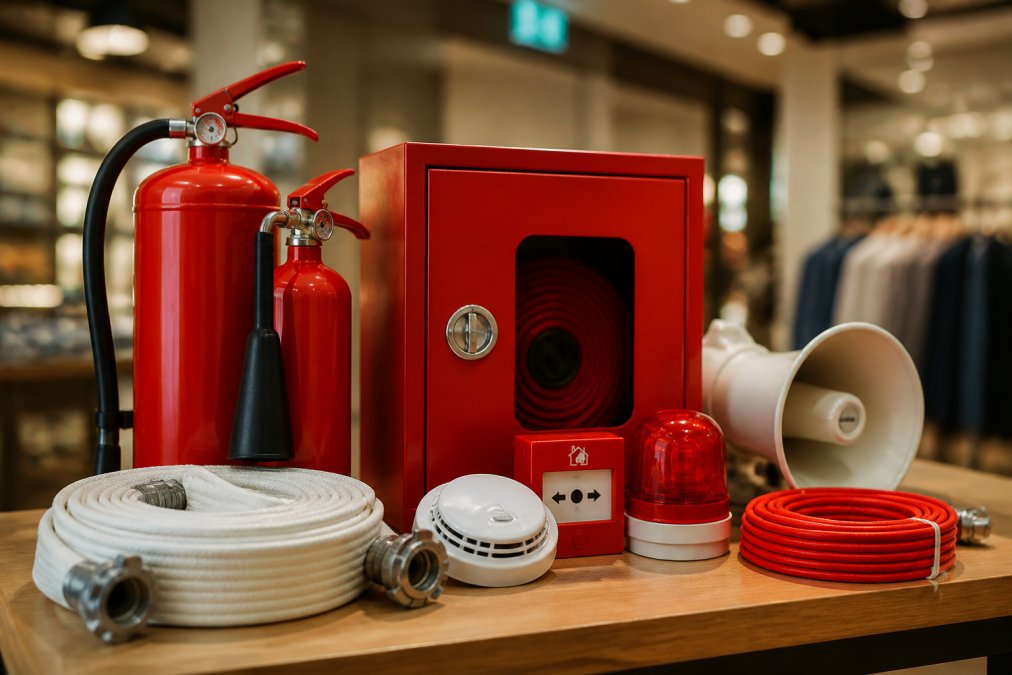
Fire safety equipment covers the devices, systems and signage installed to detect fire, warn occupants, support evacuation and suppress or contain a blaze. For retail, that spans extinguishers, detection, emergency lighting, blankets, hose reels, suppression systems and alarm monitoring.
Below, we break down the 10 items every retail fit-out should account for, what each does, and where retailers commonly get it wrong.
| Equipment | Primary Role | Best For | Typical Maintenance Cycle |
|---|---|---|---|
| Fire extinguishers | First-attack suppression | All retail floors | 6-monthly inspection |
| Smoke and heat detectors | Early detection | Stockrooms, back-of-house | Annual testing |
| Emergency exit signs and lighting | Evacuation guidance | Exits and corridors | 6-monthly discharge test |
| Fire blankets | Small contained fires | Staff kitchens | Visual check |
| Fire hose reels | Sustained water suppression | Warehouses, loading docks | 6-monthly pressure test |
| Suppression systems | Automatic protection | Kitchenettes, server rooms | Professional servicing |
| Alarm monitoring | Response coordination | Multi-tenancy and large sites | Continuous |
1. Fire Extinguishers: Your First Line of Defence
Fire extinguishers are the most important piece of fire safety equipment in any retail environment, letting staff act in the first 60 seconds rather than waiting for emergency services. A common mistake is stores buying one type of extinguisher for the whole premises. A stockroom full of cardboard needs a different agent than a staff kitchen cooktop, and the wrong one can make a fire worse.
Types of Extinguishers for Retail Environments
- ABE dry powder, the general-purpose workhorse for paper, cardboard, textiles and electrical equipment. Effective, but leaves heavy residue that can damage stock and electronics.
- Carbon dioxide (CO2), clean, non-conductive, and right near point-of-sale terminals and server cabinets. No residue, but limited cooling capacity.
- Wet chemical, purpose-built for cooking oils and fats. Any site with a deep fryer or commercial cooktop needs one.
- Foam, suits flammable liquid risks such as cleaning chemical storage.
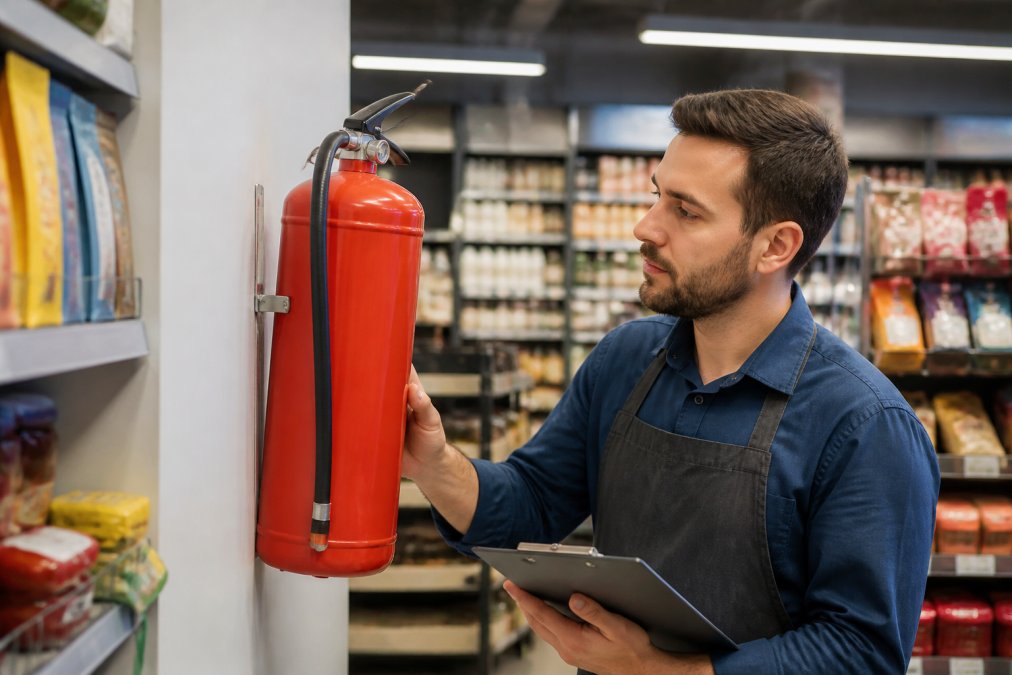
Using a dry powder extinguisher on a cooking oil fire can splash burning fat and spread the fire. Match the extinguisher class to the hazard before you mount it, not after.
2. Smoke Alarms and Fire Detection Systems
Smoke alarms and detection systems provide the early warning that buys occupants time to evacuate, and they are mandatory in most commercial retail premises. Photoelectric detectors respond well to smouldering fires in stored stock, while heat sensors suit dusty or steamy areas where smoke detection would trigger nuisance alarms.
Detection needs to cover more than the shop floor: stockrooms, loading areas and back-of-house corridors are where fires most often start unnoticed. Interconnected units mean an alarm in the stockroom triggers alerts across the whole premises. Photoelectric detectors respond well to smouldering fires in stored stock, while heat sensors suit dusty or steamy areas where smoke detection would trigger nuisance alarms. Detection needs to cover more than the shop floor: stockrooms, loading areas and back-of-house corridors are where fires most often start unnoticed. Interconnected units mean an alarm in the stockroom triggers alerts across the whole premises.
3. Emergency Exit Signs and Lighting
Emergency exit signs and lighting guide occupants to safety when mains power fails or smoke obscures visibility. They are a compliance requirement, not an optional extra, and one of the first things a fire safety audit checks.
Self-contained LED units with battery backup are the current standard. The critical detail is the discharge test: batteries degrade silently, and a unit that lights up during a routine check can still fail under load. Periodic discharge testing confirms the battery holds charge for the required duration.
4. Fire Blankets: Small but Essential
Fire blankets smother small fires by cutting off oxygen, and they are the most intuitive piece of fire safety equipment for untrained staff to use under pressure, no pin to pull, no gauge to read, no decision about which agent to use.
They belong in staff kitchens, break rooms and anywhere a small oil or clothing fire could start. Wall-mounted quick-release pouches keep them accessible without cluttering the space, and glass fibre construction handles high temperatures with no chemical residue to clean up.
Mount fire blankets at eye level near the exit of a kitchen, not directly beside the cooktop. If a pan fire flares, you want to reach the blanket without leaning over the flames.
5. Fire Hose Reels for Larger Retail Spaces
Fire hose reels provide a continuous, unlimited water supply for Class A fires, essential in retail warehouses, loading docks and large-format stores where an extinguisher’s limited capacity runs out fast.
The standard 36-metre hose gives wide coverage from a single mounting point, and the swing-out design lets one person deploy it quickly. Hose reels require professional installation and regular pressure testing, because a seized or leaking reel is useless in an emergency.
6. Fire Suppression Systems: Protecting High-Risk Areas
Fire suppression systems detect and extinguish fires automatically, without waiting for anyone to act. That matters in retail sites with high-value or high-risk zones that are unattended for parts of the day.
Two areas justify the investment. Retail kitchenettes and food service counters need wet chemical suppression engineered for Class K hazards, protecting against a fire that starts while staff are on the floor. Server rooms and IT cabinets need clean-agent suppression that knocks down a fire without destroying the equipment it protects. Retail kitchenettes and food service counters need wet chemical suppression engineered for Class K hazards, protecting against a fire that starts while staff are on the floor. Server rooms and IT cabinets need clean-agent suppression that knocks down a fire without destroying the equipment it protects.
Automatic suppression is the only fire safety equipment that works when nobody is in the building. For unattended high-risk areas, it is not a nice-to-have.
7. Fire Alarm Monitoring and Addressable Systems
Fire alarm monitoring connects a building’s detection system to an off-site monitoring centre, so an alarm triggers a response even when the premises are empty. Addressable systems go further, identifying the exact device that activated rather than just the zone. preventing electrical downtime.
For large retail centres and department stores, that precision is the difference between fire services arriving at the right door and searching an entire floor. Addressable systems also log every event, giving auditors a clear compliance trail and reducing the impact of false alarms.
8. Fireproof Safes for Business Continuity
Fireproof safes protect the records a retail business cannot afford to lose: leases, insurance policies, cash handling records, supplier contracts and digital backups. Fire-rated insulation and water-resistant seals mean the contents survive both the fire and the sprinkler response that follows.
Most retailers treat a safe as a cash-handling item and stop there. The more important role is post-fire recovery. After a fire, insurers and loss adjusters will ask for proof of stock levels, asset registers, lease terms and prior correspondence. If those documents were on a desk or in a filing cabinet, they are gone, and a claim can be delayed or reduced for lack of evidence. A fire-rated safe is the cheapest insurance against that outcome.
What to Look For
- Fire rating. Look for a tested rating expressed in minutes of protection for paper (commonly 30, 60 or 120 minutes). Digital media such as USB drives and backup disks need a higher rating than paper, because they degrade at lower temperatures.
- Water resistance. Sprinklers and fire hoses cause more document loss than flames in many retail fires. A water-resistant seal matters as much as the fire rating.
- Anchoring. A safe that can be carried out is a theft risk. Bolt it to a structural slab during fit-out, not after.
- Location. Point-of-sale and back-office areas are the usual placements, but keep the safe away from the highest fuel-load zones so it is not sitting in the hottest part of a fire.
Industry-Specific Risk Checklist
The records worth protecting differ by retail type. Use this as a starting point:
| Retail type | Priority documents | Additional equipment to pair with the safe |
|---|---|---|
| Fashion and apparel | Supplier contracts, stock valuations, lease | Water-resistant document wallets |
| Electronics and IT | Warranty records, serial number registers, backup drives | Media-rated safe insert |
| Grocery and food | Health certificates, temperature logs, supplier agreements | Waterproof pouches for logs |
| Pharmacy and health | Prescription records, controlled substance registers | Dual-lock safe with audit trail |
| Jewellery and high-value | Insurance schedules, valuation certificates, stock photos | Anchored safe plus off-site digital backup |
Scan every critical document and store it off-site or in encrypted cloud storage as well as in the safe. A safe protects the original; an off-site copy protects you if the safe itself is destroyed or inaccessible after an evacuation.
Documentation for Insurance Claims
When a claim is lodged, the loss adjuster will typically want:
- A current asset register listing equipment, stock and fit-out items with values.
- Photographic or video evidence of the premises and stock, updated at least annually.
- Service records for fire safety equipment, showing it was maintained and functional.
- Incident records, including who was on site, when the alarm activated and what was done.
Keep these in the safe alongside the policies themselves, and keep a duplicate off-site. A safe full of documents that nobody can access after a fire is no better than no safe at all.
9. Fire Safety Training and Staff Readiness
Equipment only works if people know how to use it. Fire safety training for retail staff covers extinguisher operation, evacuation procedures and the roles assigned during an emergency. The complication in retail is turnover: casual and part-time staff cycle through, and a team trained six months ago may be half replaced today.
What Retail Training Actually Needs to Cover
A generic fire safety induction is not enough. Retail-specific training should include:
- Extinguisher selection. Which class of extinguisher to grab for a stockroom cardboard fire versus a kitchen oil fire versus an electrical cabinet. The wrong choice makes things worse.
- Evacuation routes and assembly points. Including secondary routes if the primary exit is blocked, and who accounts for staff versus customers.
- Alarm response roles. Who calls emergency services, who checks the stockroom, who sweeps the fitting rooms and toilets, who meets fire services at the panel.
- Isolation points. Where the gas shut-off, electrical isolation and sprinkler control valves are, and who is authorised to operate them.
- Post-incident reporting. What to record and who to notify, both for insurance and for compliance.
Industry-Specific Risk Scenarios
Different retail types face different first-60-seconds problems. Training should be built around the scenarios that actually apply:
| Retail type | Most likely ignition source | Training priority |
|---|---|---|
| Fashion and apparel | Rack-mounted lighting, lint in stockrooms | Evacuation speed, smoke inhalation risk from synthetic fabrics |
| Electronics and IT | Battery charging, power boards, server cabinets | CO2 extinguisher use, safe isolation of electrical circuits |
| Grocery and food | Cooking equipment, refrigeration motors, packaging | Wet chemical use, gas isolation, cold-room evacuation |
| Pharmacy and health | Flammable liquids, oxygen storage | Class-specific extinguisher selection, safe handling |
| High-value and jewellery | Electrical, deliberate ignition | Lockdown versus evacuation decision, asset protection |
Frequency and Format
Short, repeated sessions beat a single comprehensive induction: a brief refresher every six months aligned with the equipment servicing schedule, plus a full evacuation drill at least annually. Hands-on practice with a live extinguisher, even a small training unit, builds the muscle memory that matters under stress.
A staff member who has never discharged an extinguisher will hesitate. In a real fire, hesitation of even 20 seconds can mean the difference between a contained fire and a total loss. Schedule practical drills, not just classroom sessions.
Budgeting and Lifecycle Costs
Training is often the first line item cut when budgets tighten, which is a false economy. Treat training as a recurring annual cost per staff member, not a one-off induction expense. Factor in initial induction for every new hire, six-monthly refreshers, annual drill coordination, replacement or refilling of training extinguishers, and time off the floor. Training is often the first line item cut when budgets tighten, which is a false economy. Treat training as a recurring annual cost per staff member, not a one-off induction expense. Factor in initial induction for every new hire, six-monthly refreshers, annual drill coordination, replacement or refilling of training extinguishers, and time off the floor.
Training is not a compliance box to tick once. It is a recurring operational cost that should appear in the annual budget alongside equipment servicing, and it should be reviewed whenever staff turnover or store layout changes.
10. Compliance Documentation and Maintenance Scheduling
Every piece of fire safety equipment above has a maintenance obligation attached, and the documentation proving that work was done is what stands up in an audit. AS 1851 sets out the inspection, testing and servicing intervals for fire protection systems and equipment in Australia.
The common failure point is record-keeping. Service reports stating “tested, no defects” without detail will not satisfy an auditor asking what was checked and when. A maintenance log recording each device, the test performed, the result and the technician gives you a defensible compliance record.
| Compliance Task | Frequency | Who Can Perform It |
|---|---|---|
| Extinguisher inspection | 6-monthly | Licensed technician |
| Emergency lighting discharge test | 6-monthly | Licensed technician |
| Hose reel pressure test | 6-monthly | Licensed technician |
| Detection system testing | Annual | Licensed technician |
| Staff evacuation drill | Regular intervals | Store management |
Keep a single digital register of every fire safety asset on site, with its location, last service date and next due date. When an auditor asks for proof, you produce one document instead of hunting through filing cabinets.
Frequently Asked Questions
What fire safety equipment is mandatory for retail stores under Australian standards?
Australian retail stores must have fire extinguishers, smoke alarms or detection systems, emergency exit signs and lighting, and fire blankets in staff kitchens. Larger stores may also require hose reels or sprinkler systems. Compliance with AS 1851 maintenance requirements ensures all equipment stays operational. A retail fire safety compliance checklist helps you track what’s required for your specific store size and layout.
How often should fire extinguishers be tested in a retail environment?
Fire extinguishers in retail stores need professional inspection every six months under AS 1851 fire maintenance requirements. This includes checking pressure gauges, seals, and overall condition. Annual pressure testing may also apply depending on the extinguisher type. Keeping a maintenance log with dates and technician signatures proves compliance during audits and helps you avoid penalties.
Do retail stores need fire blankets in staff kitchens?
Fire blankets are strongly recommended for retail staff kitchens and break rooms. They’re ideal for smothering small oil or clothing fires that extinguishers can spread. While not always legally mandatory, they’re a low-cost addition that protects staff and property. Fire safety training for retail staff should include how to use a fire blanket correctly, as it’s simple enough for anyone to operate.
What are the legal requirements for emergency lighting in retail premises?
Emergency lighting must illuminate exit paths for at least 90 minutes during a power failure. It must be installed along evacuation routes, at exits, and in areas without natural light. Regular discharge testing verifies battery health. Your retail fire safety compliance checklist should include monthly visual checks and annual professional testing to meet Australian standards.
How do I ensure my retail store meets AS 1851 maintenance standards?
AS 1851 fire maintenance requirements cover inspection, testing, and documentation schedules for all fire equipment. Engage a licensed provider to perform six-monthly inspections and provide detailed reports. Keep a maintenance log for every device. A retail fire safety compliance checklist helps you track due dates. Fyrepower offers professional testing and documentation that holds up during audits.