Table of Contents
- AS 1851 Maintenance Requirements: The Australian Standard Explained
- How Often to Test Fire Extinguishers: The 6-6-12 Rule and Beyond
- Fire Extinguisher Service Tag Meaning: How to Read Your Compliance Record
- Fire Extinguisher Maintenance Log Template: What to Record and Why
- DIY vs Professional Servicing: What You Can and Cannot Do Yourself
- State-Specific Variations and Digital Compliance Tracking
- Replacement vs Service: Making the Cost-Effective Choice
- Frequently Asked Questions
Last Updated: September 13, 2026
AS 1851 Maintenance Requirements: The Australian Standard Explained
Australian Standard AS 1851 sets the mandatory maintenance schedule for fire protection systems, including portable fire extinguishers, defining who can service them, what each inspection covers, and how often it must happen. This guide from Fyrepower explains how often to test fire extinguishers in Australia and how to keep audit-ready records.
The short answer: extinguishers need a visual check every month, a professional inspection every six months, a full annual service, and a hydrostatic pressure test every five years.
AS 1851 is published by Standards Australia and covers maintenance of fire protection systems and equipment (standards.org.au). For extinguishers specifically, it sets out inspection frequency, testing methods, and record-keeping duties. You can find the standard referenced through Standards Australia, and your state or territory fire service publishes plain-language guidance on top of it.
What AS 1851 Covers for Portable Fire Extinguishers
AS 1851 covers the full service life of portable fire extinguishers: the six-monthly inspection, the annual service, and the five-yearly hydrostatic pressure test, specifying what a competent person must check at each stage.
The standard separates routine attention from technical service. Monthly visual checks are the occupant’s responsibility. Six-monthly and annual servicing must be done by someone with the right training, and the pressure test is a workshop job.
Who Is an Accredited Person Under the Standard?
An accredited person is a technician with recognised competency in servicing portable fire extinguishers to AS 1851, carrying the tools and knowledge to inspect, discharge-test, recharge, and tag extinguishers correctly.
For a commercial property, this matters for liability: if an extinguisher fails during a fire and the service record shows it was maintained by someone unqualified, the building owner carries the exposure. Confirm your provider’s licensing before booking, Fyrepower’s team is fully insured and QBSA-licensed.
How Often to Test Fire Extinguishers: The 6-6-12 Rule and Beyond
The service cycle runs on a 6-6-12 pattern: a six-monthly inspection, another six-monthly inspection, then an annual service, repeating. Every five years, the extinguisher also needs a hydrostatic pressure test.
| Interval | What Happens | Who Does It |
|---|---|---|
| Monthly | Visual check of gauge, seal, access | Occupant or staff member |
| 6-monthly | Inspection and service tag update | Accredited person |
| Annual | Full service, internal check | Accredited person |
| 5-yearly | Hydrostatic pressure test | Accredited workshop |
What Happens at Each 6-Monthly Inspection
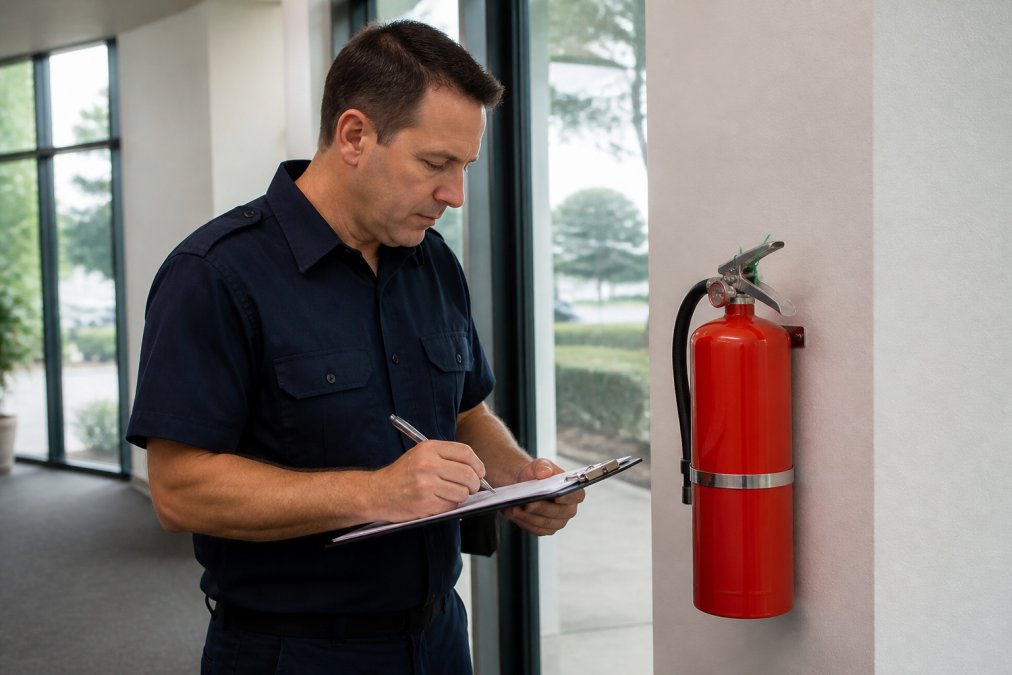
A six-monthly inspection is a hands-on check of the extinguisher’s condition and readiness: the pressure gauge sits in the green zone, the tamper seal is intact, the hose and nozzle are clear, and the unit is mounted correctly with its service tag visible.
They also check the pin, safety clip, and body for corrosion or dents. Anything suggesting the extinguisher has been discharged, damaged, or tampered with is flagged for service or replacement, and the service tag is updated.
Annual Service and the 5-Yearly Hydrostatic Pressure Test
An annual service goes further than the six-monthly inspection: the technician checks the extinguishing agent, weighs or examines the cylinder, and confirms the internal components still function. For some types, this involves a discharge and recharge cycle.
The five-yearly hydrostatic pressure test is the big one: the cylinder is emptied, inspected internally, and pressure-tested to confirm it can still hold the extinguishing agent safely. A vessel that fails cannot be returned to service, which is why the five-year mark often forces a replacement decision.
Fire Extinguisher Service Tag Meaning: How to Read Your Compliance Record
A fire extinguisher service tag is the physical record of every inspection and service the unit has received, showing when it was last checked, who did the work, and when the next service is due.
Read it in this order:
- Date of last service, confirms the unit is inside its current interval
- Technician or company details, proves an accredited person did the work
- Next service due, the date that must not pass without a booking
- Type of service performed, inspection, annual service, or pressure test
If a tag is missing, faded, or shows an overdue date, treat it as a compliance defect. A blank or out-of-date tag is one of the first things a fire safety auditor looks for.
Fire Extinguisher Maintenance Log Template: What to Record and Why
A maintenance log proves your extinguishers were serviced on schedule. Keep one entry per extinguisher, recording the date, service type, technician, and any defects or repairs.
Use this structure for each unit:
- Extinguisher ID or location reference
- Type and size of extinguisher
- Date of monthly visual check
- Date of six-monthly inspection
- Date of annual service
- Date of five-yearly pressure test
- Technician name and licence details
- Defects noted and action taken
- Next service due date
This log is what you hand over during an audit. Vague reports that cannot show what work was done are a common reason businesses fail a compliance review, so insist on detailed records.
A missing or blank service tag is treated as an unserviced extinguisher. Auditors do not accept “it was probably done” as evidence, and the gap can trigger a defect notice on the whole building.
DIY vs Professional Servicing: What You Can and Cannot Do Yourself
You can perform the monthly visual check yourself. You cannot legally or safely perform the six-monthly inspection, annual service, or five-yearly pressure test, those require an accredited person and, for the pressure test, a properly equipped workshop.
The monthly check is simple: walk the building, confirm each extinguisher is present, unobstructed, and shows a pressure gauge needle in the green zone, and check the tamper seal is unbroken and the unit is not visibly damaged.
What you must not do is discharge, refill, or re-tag an extinguisher yourself. A DIY recharge that is not pressure-tested can fail under load, and an unqualified tag carries no compliance weight.
Photograph each extinguisher during your monthly walk-through and date the image. It takes seconds and gives you a dated visual record that supports your logbook if an auditor questions your routine checks.
State-Specific Variations and Digital Compliance Tracking
AS 1851 sets the maintenance intervals, but not who keeps the records, what form they take, or who can issue a penalty if they are missing. That layer comes from each state and territory’s building fire safety legislation, and it is where most compliance failures occur.
The intervals themselves do not change across borders. What changes is the administrative wrapper: the responsible person, the prescribed record format, the retention period, and the enforcement body.
A common pattern is that the building owner or occupier is the responsible person for portable fire equipment and must produce evidence of servicing on demand. Most regimes also require the servicing contractor to be competent and, in several states, licensed or registered.
How the Obligations Differ by Jurisdiction
- Queensland, The Building Fire Safety Regulation 2008 sits on top of AS 1851. It imposes occupant and owner obligations including maintaining fire equipment, keeping records of maintenance, and ensuring evacuation planning is current. Queensland Fire and Emergency Services publishes compliance guidance and can issue enforcement notices (qld.gov.au). Fire equipment servicing is a licensed activity in Queensland, so confirm your contractor’s licence number.
- New South Wales, The Environmental Planning and Assessment Regulation 2000 and the Environmental Planning and Assessment Act 1979 set out fire safety schedule and annual fire safety statement duties. An annual fire safety statement must be submitted to the local council and Fire and Rescue NSW, and it depends on the equipment having been maintained to the relevant standard. If your extinguishers are overdue, the statement cannot be truthfully made.
- Victoria, The Building Regulations 2018 and the Building Act 1993 impose maintenance duties on owners, with the municipal building surveyor and Fire Rescue Victoria involved in enforcement. Essential safety measures must be maintained and records kept for the life of the building.
- Western Australia, The Building Regulations 2012 and the Fire and Emergency Services Act 1998 place maintenance and record-keeping duties on owners, with the Department of Fire and Emergency Services as the regulator.
- South Australia, The Planning, Development and Infrastructure Act 2016 and associated regulations set out maintenance obligations, with the South Australian Metropolitan Fire Service and local councils involved in enforcement.
- Tasmania, the Northern Territory and the Australian Capital Territory, Each has its own building and fire safety legislation, and each requires maintenance records to be kept and produced on request. The ACT in particular ties fire equipment maintenance to its building and construction regime.
This is a summary, not legal advice. The exact wording of your obligations depends on your building class, your lease terms, and any fire safety schedule attached to your premises. Check the current legislation for your jurisdiction, or ask your servicing provider which regime applies to your site.
Digital Compliance Tracking
Digital compliance tracking can solve a problem paper logbooks create. Instead of a physical tag and a folder of certificates, digital systems can timestamp each service, store certificates centrally, and send automated reminders before each interval falls due.
For anyone managing multiple sites, the reminder function can help prevent missed deadlines. A digital log can also make New South Wales’s annual fire safety statement process less painful, because the evidence can be collated and searchable.
The practical test for any digital system is whether it can produce, on demand, a per-extinguisher history showing the date, the service type, the technician, and any defects. If it cannot, it is a calendar, not a compliance record.
The intervals are national. The paperwork is not. Confirm which jurisdiction’s regime applies to your building, then make sure your records can satisfy that regime’s retention and production requirements.
Replacement vs Service: Making the Cost-Effective Choice
Getting this decision right can save money and avoid replacing units with years of compliant service life left.
The decision comes down to four factors: whether the unit passes its scheduled tests, the cost of the next service versus a new unit, the remaining warranty position, and the downtime the servicing causes.
The Five-Year Pressure Test Is the Natural Decision Point
The five-yearly hydrostatic pressure test is where the economics crystallise. The cylinder is emptied, inspected internally, and pressure-tested. If it passes, the unit returns to service at the cost of the test plus any recharge. If it fails, replacement is the only compliant option.
Because the test itself carries a cost, the decision is not simply “test or replace” but “test, and risk the fee being spent on a unit that is scrapped anyway, or replace now and reset the clock”. For a unit in good condition, testing is often a cost-effective option. For one with a history of defects, corrosion, or a damaged body, testing may be money spent on a cylinder likely to fail.
When Replacement Is the Better Financial Decision
Replace rather than service when any of the following applies:
- The cylinder has failed a hydrostatic pressure test. There is no compliant alternative.
- The body shows significant corrosion, dents, or deep scratches. These compromise the pressure vessel and cannot be repaired economically.
- The unit has been discharged and left unserviced. A discharged extinguisher that has sat unused may have internal corrosion, and the recharge plus test can approach the cost of a new unit.
- The unit is obsolete or the agent is being phased out. If replacement parts or the extinguishing agent are hard to source, servicing becomes slower and more expensive each cycle.
- The unit is due for its pressure test and is already showing other defects. Stacking a test fee on top of repairs rarely makes sense.
When Servicing Is the Better Financial Decision
Service rather than replace when the unit passes inspection, holds pressure, and simply needs scheduled maintenance. A well-maintained extinguisher can remain in service for many years, and replacing a compliant unit early is a cost with no compliance benefit.
The Warranty Angle
Warranty cover changes the maths. A new extinguisher with a warranty running up to and including its first pressure test bundles the first five years of major servicing risk into the purchase price, which can make it a more economical option than nursing an ageing cylinder through repairs and a test it may fail.
When comparing quotes, ask what the warranty covers and for how long. A warranty that only covers manufacturing defects for twelve months is not comparable to one that runs to the first pressure test.
The Downtime Factor
Servicing takes the extinguisher out of service for the duration of the work. For a single unit on a bracket, that is trivial; for a site where every extinguisher must be present for compliance, the logistics matter. Replacement is often faster than a discharge, recharge, and test cycle, since the new unit can be installed immediately.
Before authorising a pressure test on an older extinguisher, ask the technician for a condition assessment first. If the body or valve assembly is already marginal, the assessment may tell you the test is likely to fail, and you can put the test fee towards a replacement instead.
Frequently Asked Questions
Is a 10-year-old fire extinguisher still good?
A 10-year-old extinguisher can still be compliant if it has passed all required tests, including the 5-yearly hydrostatic pressure test. However, if it has not been tested or shows signs of corrosion, it should be replaced. Always check the service tag and logbook to confirm its history.
What are the testing standards for fire extinguishers in Australia?
The primary standard is AS 1851, which sets out maintenance intervals. It requires six-monthly inspections, annual servicing, and a hydrostatic pressure test every five years. Following these intervals ensures your extinguishers remain compliant and ready for use.
Should fire extinguishers be checked and serviced every 6 months, 2 years, or 12 months?
They should be checked every six months and serviced annually. The six-monthly check is a visual inspection, while the annual service is more thorough. A hydrostatic pressure test is also required every five years. These intervals are mandated by AS 1851.
How do I know if my fire extinguisher is due for testing?
Check the service tag attached to the extinguisher. It shows the date of the last service and the next due date. If the tag is missing or expired, contact a fire protection specialist immediately to schedule testing.