Table of Contents
- Why Fire Safety Training for Employees Matters
- Legal Compliance and Workplace Obligations
- Identifying Fire Hazards and Risks in Your Workplace
- Emergency Evacuation Procedure Template and Implementation
- Fire Extinguisher Training for Staff: Essential Skills
- Fire Warden Training Duration and Role Responsibilities
- Building a Fire Safety Culture and Retention Strategy
- Frequently Asked Questions
Last Updated: August 21, 2026
Why Fire Safety Training for Employees Matters
Fire safety training for employees is not optional compliance theatre, it’s the difference between an orderly evacuation and chaos. When a fire breaks out, untrained staff freeze, make poor decisions, or worse, panic and endanger others. The stakes are immediate and real.
At Fyrepower, we understand the critical importance of proper fire safety training for organisations to manage incidents with minimal casualties and property damage. Those without it face not just human tragedy, but regulatory fines, litigation, and reputational collapse. A single incident can shut a business down permanently.
The reality is this: your fire extinguishers and alarms are useless if nobody knows how to use them. Your evacuation plan exists only on paper if staff haven’t practised it. Your fire warden role is ceremonial if the person holding it doesn’t understand their responsibilities. Fire safety training for employees transforms these static measures into an active, living safety culture.
The Australian workplace safety framework demands it. Your insurer expects it. Your employees deserve it. Below, we’ll show you exactly what fire safety training for employees should cover, how to implement it properly, and how to ensure people actually retain what they learn when it matters most.
Legal Compliance and Workplace Obligations
Fire safety training for employees isn’t a suggestion in Australia, it’s a legal requirement embedded in occupational health and safety legislation. The Work Health and Safety Act 2011 (Cth) places a duty on employers to ensure, so far as reasonably practicable, the health and safety of workers (legislation.gov.au). That includes protection from fire hazards.
State and territory regulators (Safe Work Australia, WorkSafe Victoria, SafeWork NSW, and equivalent bodies) have published explicit guidance on fire safety obligations. These aren’t vague principles, they specify that workers must be informed, instructed, and trained on fire emergency procedures. Your organisation must maintain records proving this training occurred.
The specific obligations include:
- Hazard identification: Identifying fire hazards in your workplace and assessing the risk they pose
- Emergency procedures: Developing and communicating evacuation plans and assembly points
- Equipment training: Ensuring staff can use fire extinguishers and other suppression equipment
- Regular drills: Conducting fire drills at least once per year (more frequently for high-risk venues)
- Documentation: Maintaining training records and attendance logs
Failure to comply exposes your business to prosecution, fines up to tens of thousands of dollars, and personal liability for directors and managers. Beyond the legal risk, inadequate training increases your workers’ compensation liability if someone is injured during an evacuation. Insurance policies often require proof of training before they’ll pay out on fire-related claims.
The compliance bar is rising. Auditors now expect detailed training records, competency assessments, and evidence that knowledge is being retained, not just a one-off session three years ago. Fyrepower’s on and offsite fire training services are designed to meet these regulatory expectations while building genuine safety awareness that sticks.
Identifying Fire Hazards and Risks in Your Workplace
Before you can protect your workplace, you must know what you’re protecting against. A fire hazard is any condition, substance, or practice that could ignite and spread flame. A risk is the likelihood and consequence of that hazard materialising into an actual fire.
The process of identifying fire hazards starts with a systematic walk-through of your premises. Look for combustible materials stored improperly, blocked emergency exits, faulty electrical equipment, poor housekeeping, and inadequate fire suppression equipment. Different industries have different hot spots, a hospitality venue faces different risks than a manufacturing facility or office building.
Common workplace fire hazards include:
- Electrical equipment in poor condition or overloaded circuits
- Flammable liquids stored without proper ventilation or containment
- Blocked or locked emergency exits
- Accumulation of rubbish and combustible waste
- Inadequate fire extinguisher coverage or outdated equipment
- Poor housekeeping in storage areas and kitchens
- Smoking in non-designated areas
- Faulty or missing fire detection systems
Once hazards are identified, assess the risk. Ask: How likely is this hazard to cause a fire? If a fire started here, how fast would it spread? How many people could be affected? What barriers do we have in place to prevent or contain it?
This risk assessment must be documented. It forms the basis of your fire safety plan and directly informs what training your employees need. A venue with a commercial kitchen faces different training priorities than an office with minimal fire risk. Fyrepower’s expertise in Australian safety standards including AS2444 and AS1851 ensures your hazard identification and risk assessment align with regulatory expectations and best practice.
Emergency Evacuation Procedure Template and Implementation
An emergency evacuation procedure is a documented, practised plan that tells every person in your building exactly what to do when a fire alarm sounds. Without it, people improvise, and improvisation in an emergency kills people.
Your evacuation procedure must include:
- Assembly point: A safe location outside the building where all occupants gather and are accounted for
- Evacuation routes: Clearly marked primary and secondary exits from each area
- Fire warden roles: Named individuals responsible for checking areas, assisting people with mobility issues, and reporting to the emergency co-ordinator
- Accountability: A method to account for all occupants once assembled
- Communication: How information will be relayed during the emergency
- Special needs: Procedures for people with mobility, hearing, or vision impairments
Here’s a basic template structure:
| Element | Responsibility | Details |
|---|---|---|
| Alarm activation | First person to discover fire | Activate nearest alarm and call emergency services (000) |
| Evacuation | All occupants | Leave via nearest safe exit; do not use lifts |
| Assembly | Fire wardens | Direct people to assembly point; account for all staff |
| Communication | Emergency co-ordinator | Liaise with emergency services; report status |
| Re-entry | Manager | Only when emergency services confirm building is safe |
Implementation requires more than printing a plan. You must:
- Designate fire wardens, at least one per area, trained and authorised to direct evacuation
- Mark exits and routes clearly, illuminated exit signs, unobstructed pathways, assembly point clearly identified
- Conduct regular drills, at least annually; more frequently for high-risk or high-occupancy venues
- Brief new staff, induction must include evacuation procedure walkthrough
- Update the plan, when building layout changes, occupancy increases, or staff turnover is high
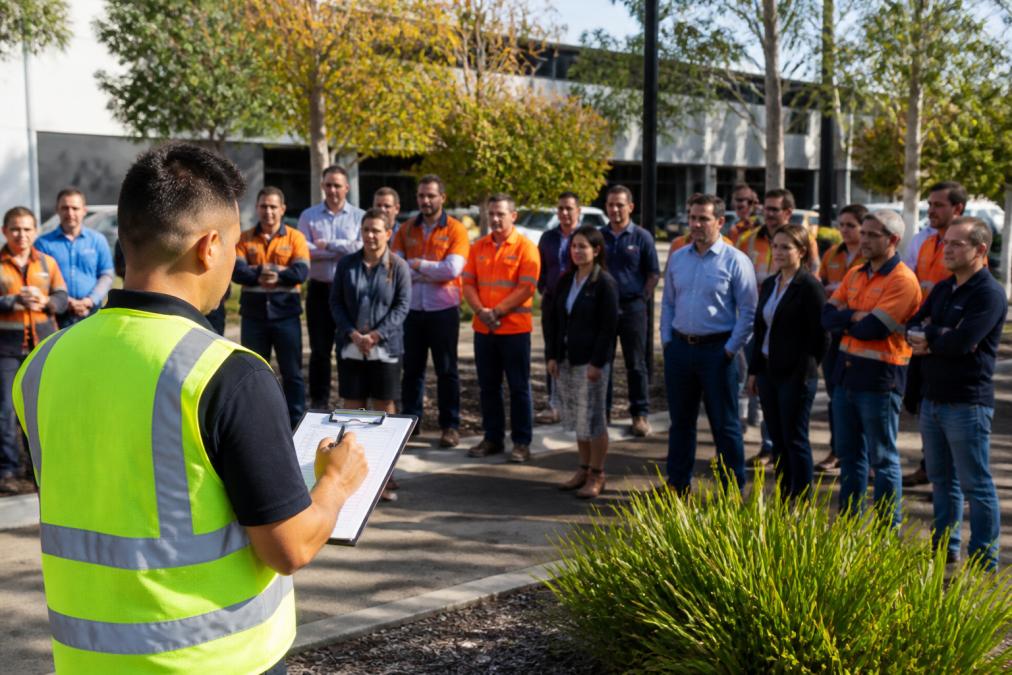
The most common failure is treating drills as a box-ticking exercise rather than a genuine test. A drill that takes 45 minutes because people don’t know where to go is not a success, it’s a warning. Fyrepower helps organisations conduct meaningful drills that reveal gaps and build confidence in your procedure before a real emergency occurs.
Fire Extinguisher Training for Staff: Essential Skills
A fire extinguisher is only useful if someone knows how to use it. Many workplace fires could be contained by a trained person with the right extinguisher, but untrained staff either don’t attempt to use it or use it incorrectly and make the situation worse.
Fire extinguisher training teaches staff to understand the fire triangle, the three elements required for combustion: fuel, oxygen, and heat. Different fires require different extinguishing agents. A water extinguisher will spread a burning liquid. A CO2 extinguisher is unsuitable for certain materials. Training ensures staff can identify the fire type and select the correct extinguisher.
The basic technique is remembered by the acronym PASS:
- Pull the safety pin from the handle
- Aim the nozzle at the base of the fire (not the flames)
- Squeeze the handle to release the agent
- Sweep the nozzle side to side across the fire
Staff must also understand when NOT to use an extinguisher, when the fire is too large, spreading too fast, or blocking the exit. Attempting to fight a fire is only appropriate if you can do so safely and without compromising your own escape route.
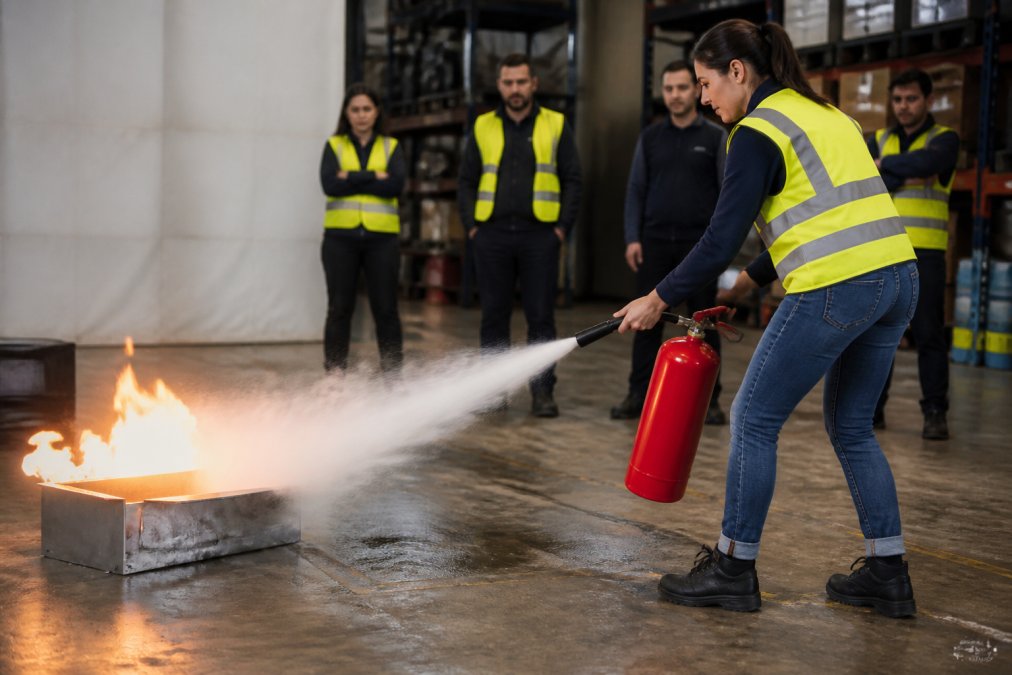
Effective fire extinguisher training includes:
- Identifying fire types (Class A, B, C, D, F) and appropriate extinguishers
- Practising the PASS technique on a training fire
- Understanding pressure gauges and maintenance requirements
- Recognising when an extinguisher is not the right response
- Knowing the location of extinguishers in your workplace
Training should be hands-on where possible. Classroom instruction alone doesn’t build muscle memory. Staff who have held an extinguisher, heard the sound it makes, and felt the recoil are far more likely to act correctly in an actual emergency.
Fyrepower’s fire extinguisher training for staff goes beyond compliance. We focus on building genuine competence and confidence so your team can make split-second decisions under stress.
Most organisations assume staff know which extinguisher to use. They don’t. Colour-coded labels help, but training on fire classification (not just memorising colours) is what actually saves lives.
Fire Warden Training Duration and Role Responsibilities
A fire warden is the person who takes charge during an evacuation. They are not fighting the fire, they are managing people and ensuring the evacuation is orderly and complete. This role is critical and often underestimated.
Fire warden training duration varies by organisation and complexity, but typically spans 4-6 hours for initial training, with annual refresher sessions of 1-2 hours. The training covers:
- Evacuation procedures: Understanding your building’s layout, exits, and assembly point
- Accountability: How to account for all occupants and report to emergency services
- Assisting vulnerable people: Mobility-impaired staff, visitors, and people in distress
- Communication: How to relay information and maintain calm
- Equipment: Locating and using fire extinguishers, first aid kits, and emergency supplies
- Legal obligations: Understanding their duty of care and liability
Responsibilities of a fire warden include:
- On alarm activation: Immediately proceed to your assigned area and begin evacuation
- Checking areas: Systematically check all rooms, toilets, and storage areas to ensure nobody is left behind
- Assisting evacuation: Guide people toward exits, assist those with mobility issues, account for all staff members
- Reporting: Once at the assembly point, confirm to the emergency co-ordinator that your area is clear
- Communicating: Keep people calm and prevent re-entry to the building
Not every staff member can be a fire warden. Wardens should be reliable, physically capable, and willing to take on the responsibility. Most organisations designate one warden per 50 occupants, with at least one per floor in multi-storey buildings.
A common mistake is naming someone a fire warden without training them. An untrained warden is a liability, they may miss people, panic under pressure, or give incorrect instructions. Always follow fire warden training with documented competency assessment.
Fire warden training should be renewed annually, particularly if staff turnover is high or if the building layout changes. Fyrepower’s fire warden training programme is tailored to your specific workplace, using your actual floor plans and evacuation procedures so wardens can practise in a realistic context.
Building a Fire Safety Culture and Retention Strategy
Compliance training is forgotten within weeks if it’s not reinforced. The real challenge is building a fire safety culture where employees genuinely understand the importance of safety and retain knowledge long enough to act on it in an emergency.
A fire safety culture is created through repeated exposure, practical engagement, and leadership commitment. One-off annual training is not enough. You need:
Ongoing communication: Monthly safety briefings, posters in high-traffic areas, email reminders about fire safety procedures. Repetition builds neural pathways. The more times staff hear the message, the more automatic the response becomes.
Practical drills: Annual drills are the minimum. High-risk venues (hospitality, healthcare, aged care) should conduct drills quarterly or even monthly. Each drill should be treated as a genuine test, with timing recorded and gaps identified.
Competency assessment: Don’t assume training was effective. Test staff knowledge through quizzes, practical assessments, or scenario-based exercises. Identify gaps and target additional training to people who need it.
Leadership visibility: When managers and owners participate in drills and safety briefings, staff take it seriously. When leadership treats fire safety as a low priority, so do employees.
Induction and onboarding: Every new hire must receive fire safety training before their first shift. This is not a tick-box, it’s a practical walkthrough of exits, assembly points, and their specific role in an evacuation.
Documentation and records: Maintain detailed records of all training, drills, and competency assessments. This protects your organisation legally and provides evidence that safety is taken seriously.
Knowledge retention research shows that spaced repetition, revisiting material at increasing intervals, dramatically improves long-term memory (peer-reviewed research). A staff member who receives initial training, then a refresher after 3 months, another after 6 months, and an annual drill will retain far more than someone trained once per year.
The difference between a workplace where people know what to do and one where they panic comes down to how often safety is reinforced. Treat fire safety like any other critical skill, repetition, practice, and feedback are non-negotiable.
Fyrepower’s comprehensive fire safety and evacuation planning services include ongoing support for building and maintaining a safety culture. We work with your team to design training schedules, conduct drills, and provide documentation that demonstrates your commitment to occupational health and safety.
Fire safety training for employees is not a compliance burden, it’s an investment in protecting your people, your business, and your reputation. The organisations that emerge successfully from fire emergencies are those that treated safety seriously long before the alarm sounded.
Get in touch with Fyrepower now. Our fully insured and QBSA-licensed team can assess your current fire safety position, design a training programme tailored to your workplace, and support you in building a safety culture that sticks. We provide on and offsite fire training services, comprehensive fire safety equipment, and the expertise to ensure your property meets all Australian safety standards. Your employees deserve to work in a place where fire safety is real, not just documented.
Frequently Asked Questions
Q: What are the legal requirements for fire safety training in the workplace?
A: Under the Work Health and Safety Act 2011 and relevant state legislation, employers must provide fire safety training that meets the needs of their workplace. Training must cover evacuation procedures, assembly point locations, fire extinguisher use, and roles of fire wardens. The frequency depends on your workplace risk assessment, but many workplaces require annual refresher training. Compliance with Australian Standards AS1851 and AS2444 is essential for equipment maintenance and testing documentation.
Q: How often should employees undergo fire safety training?
A: Most workplaces require initial induction training for all new employees and annual refresher training thereafter. However, the specific frequency depends on your risk assessment and workplace type. High-risk environments such as hospitality venues or manufacturing facilities may require more frequent updates. Fire wardens typically need additional training every 12 months. Your training schedule should be documented and reviewed regularly to ensure ongoing compliance and knowledge retention.
Q: What should be included in a workplace fire safety induction?
A: A comprehensive induction covers fire hazard identification, location of emergency exits and assembly points, evacuation procedures, fire extinguisher locations and basic use, roles of fire wardens, how to respond to a fire alarm, and what to do if evacuation is not possible. Employees should understand the fire triangle and combustion conditions, know how to report hazards, and be familiar with your workplace-specific emergency response plan. Documentation of attendance and competency assessment is critical for compliance.
Q: What is the difference between fire safety training and fire warden training?
A: All employees need basic fire safety training covering evacuation and emergency response. Fire warden training is specialised instruction for designated staff who lead evacuations, account for personnel at assembly points, and manage incident response. Fire wardens require deeper knowledge of emergency procedures, communication protocols, and accountability systems. Fire warden training duration typically ranges from half a day to two days depending on workplace complexity, and wardens should receive refresher training annually to maintain competency.
This article was written using GrandRanker