Table of Contents
- Why Testing Commercial Smoke Alarms Matters for Your Business
- Commercial Fire Alarm Testing Frequency and Schedules
- How to Test a Commercial Fire Alarm: Step-by-Step Procedure
- Commercial Smoke Alarm Inspection Checklist
- Compliance Requirements Across Australian Jurisdictions
- Fire Alarm Testing Logbook Template and Record-Keeping
- What to Do When a Device Fails Testing
- Frequently Asked Questions
Last Updated: October 12, 2026
Why Testing Commercial Smoke Alarms Matters for Your Business
Testing commercial smoke alarms for business compliance isn’t optional, it’s a legal requirement that protects lives and keeps your business operating legally. When a fire starts, those alarms are your first line of defence, giving occupants precious minutes to escape.
But installing alarms isn’t enough. They need regular, documented testing, because a detector that hasn’t been tested in months might fail silently until there’s an actual emergency.
Fyrepower helps commercial property managers across the Gold Coast, South Brisbane, and Northern New South Wales stay compliant. Passing or failing a fire safety audit often comes down to consistent, properly documented testing.
Regular testing catches problems early: a faulty detector, dead battery, or dust-blocked sensor shows up during testing, not during a fire.
Keep a testing log from day one. Auditors will ask for it. Detailed records prove you take fire safety seriously and can protect you legally if an incident occurs.
Commercial Fire Alarm Testing Frequency and Schedules
How often you test depends on your state or territory regulations and your alarm system. Most commercial buildings require testing every six months at minimum, though some jurisdictions demand monthly checks for certain premises.
The schedule demonstrates due diligence. If a fire occurs and investigators find you haven’t tested your alarms in a year, you face liability regardless of whether the alarm would have worked.
Weekly visual inspections confirm each alarm is visible and undamaged; monthly functional tests verify it sounds; annual professional inspections catch issues you might miss.
Different building types have different rules:
- Retail and hospitality venues: typically 6-monthly testing
- Multi-tenancy strata complexes: often 6-monthly, sometimes monthly for common areas
- Office buildings: usually 6-monthly
- High-risk facilities: may require quarterly or monthly testing
The key is knowing YOUR jurisdiction’s rules. What works for a Gold Coast retail store might not meet requirements for a Northern New South Wales warehouse. Check with your local fire authority or building surveyor to confirm your obligations.
Missing a testing deadline can result in compliance violations, fines, or closure orders. If your current provider misses appointments, switch now. Fyrepower manages testing schedules for strata properties across the region, we don’t miss deadlines.
How to Test a Commercial Fire Alarm: Step-by-Step Procedure
Testing a commercial smoke alarm is straightforward, but it must be done correctly and documented.
Before You Begin: What You’ll Need
Gather these items first:
- Test button or aerosol smoke test canister (check manufacturer instructions)
- Testing logbook or digital record sheet
- Ladder or step stool for high-mounted alarms
- Torch or headlamp
- Pen and notepad
- Contact details for a qualified technician
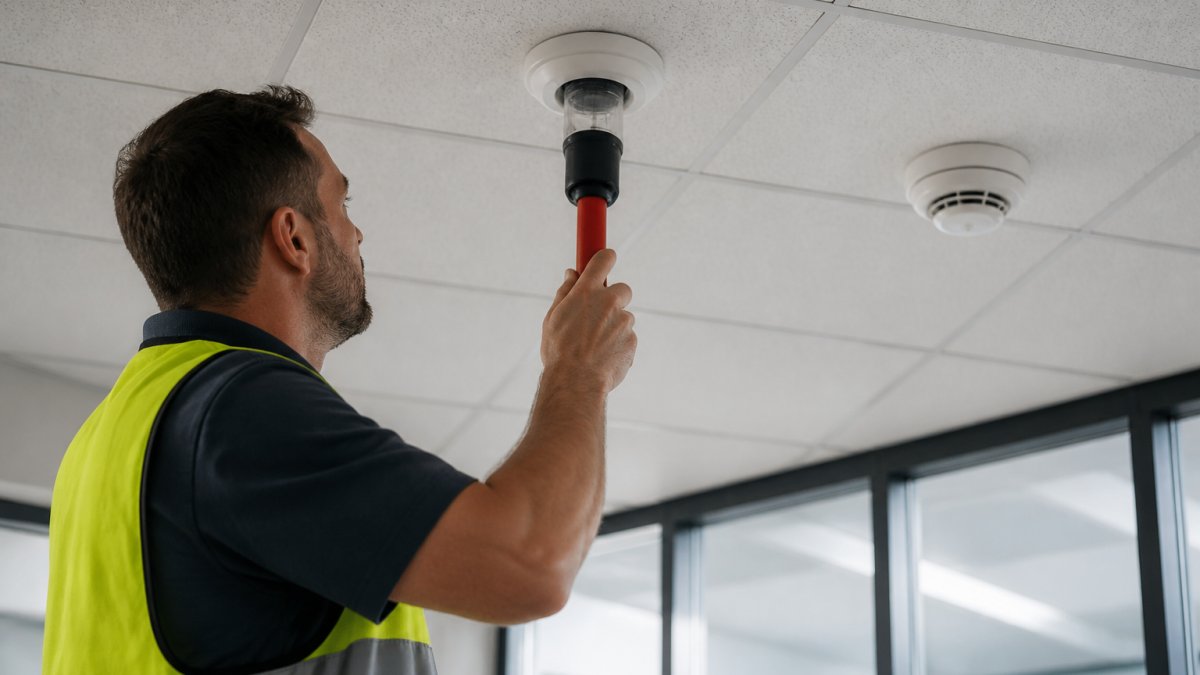
Some alarms use a test button; others require actual smoke. Check the manual to confirm the correct method, since the wrong one might not trigger the alarm properly.
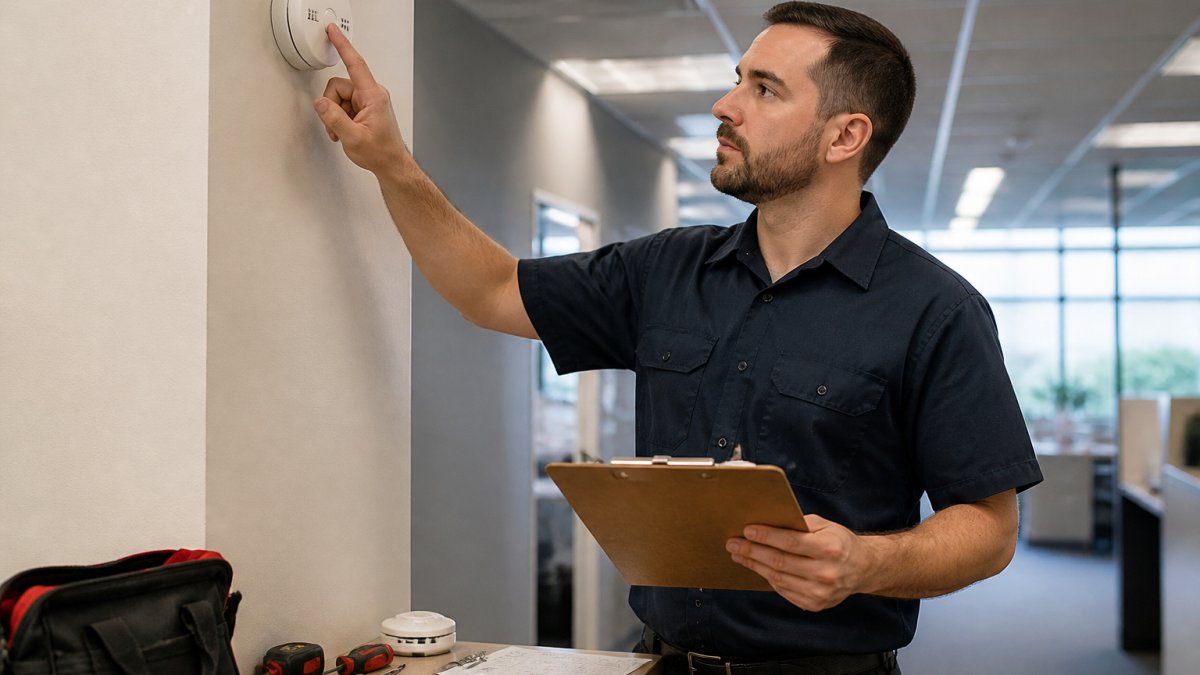
Testing Interconnected Alarms and Fire Panels
Many commercial buildings have interconnected alarms that trigger a central fire panel when any detector activates. Testing these without disrupting operations requires planning.
Notify your monitoring provider and occupants before testing.
Test one zone at a time. Trigger the alarm, confirm it sounds, verify the fire panel registers the alert, then reset before moving to the next zone.
If your system is monitored 24/7, never test without notifying the monitoring company first. A false alarm response costs money and damages your relationship with emergency services.
Document everything: which detector you tested, the time, whether it triggered correctly, and any issues observed. If a detector fails to trigger, mark it for immediate professional service.
Commercial Smoke Alarm Inspection Checklist
Use this checklist during each inspection to catch problems before they become compliance issues:
| Inspection Item | Pass | Fail | Notes |
|---|---|---|---|
| Detector is visible and unobstructed | ☐ | ☐ | Check for dust, spider webs, or blocked vents |
| Test button activates alarm sound | ☐ | ☐ | Sound should be loud and clear |
| Alarm mounting is secure | ☐ | ☐ | Detector should not move or rattle |
| Battery indicator shows good condition | ☐ | ☐ | Replace if blinking red or showing low battery |
| No visible damage or corrosion | ☐ | ☐ | Look for burns, cracks, or water damage |
| Alarm age is under 10 years | ☐ | ☐ | Replace if older; sensors degrade over time |
| Alarm responds to test method | ☐ | ☐ | Use correct test method per manufacturer |
| Interconnected systems register on fire panel | ☐ | ☐ | Confirm central panel shows activation |
Any “fail” result requires immediate action. Don’t wait for the next scheduled test. Fix it now, then document the repair.
A single failed detector puts your entire compliance status at risk. One faulty alarm in a multi-tenancy complex means the whole building is non-compliant until it’s fixed and re-tested.
Compliance Requirements Across Australian Jurisdictions
Fire safety rules for commercial smoke alarms come from national construction and building-code instruments plus state or territory legislation, and the state or territory rules bind your premises.
The national layer is the National Construction Code (NCC), produced by the Australian Building Codes Board. The NCC sets the baseline for when smoke alarms and detection systems must be installed and how they must perform, given legal effect through state and territory legislation.
At the state and territory level, the key instruments and regulators to know are:
- Queensland: the Building Fire Safety Regulation 2008 and the Fire and Emergency Services Act 1990, administered by the Queensland Fire Department. Commercial buildings generally require six-monthly testing of smoke alarms and fire detection systems, with records kept and made available for inspection.
- New South Wales: the Environmental Planning and Assessment Act 1979 and the Environmental Planning and Assessment Regulation 2021, with fire safety schedules and annual fire safety statements administered through local councils and Fire and Rescue NSW. Commercial premises typically require routine testing plus an annual fire safety statement.
- Victoria: the Building Act 1993, Building Regulations 2018 and the Building Maintenance Schedule, with the Victorian Building Authority as the regulator. Essential safety measures, including smoke alarms and detection systems, must be maintained and records kept.
- South Australia: the Planning, Development and Infrastructure Act 2016 and the Planning, Development and Infrastructure (General) Regulations 2017, administered by the Department for Trade and Investment, with maintenance obligations for essential safety provisions.
- Western Australia: the Building Act 2011 and Building Regulations 2012, administered by the Department of Mines, Industry Regulation and Safety, with maintenance and record requirements for prescribed building services.
- Tasmania: the Building Act 2016 and Building Regulations 2016, administered by Consumer, Building and Occupational Services, with maintenance obligations for essential building services.
- Northern Territory: the Building Act 1993 and Building Regulations 1993, administered by the Department of Lands, Planning and the Environment, with maintenance and certification requirements.
- Australian Capital Territory: the Building Act 2004 and Building (General) Regulation 2008, administered by Access Canberra, with maintenance and record obligations for fire safety systems.
A practical way to resolve the uncertainty is to work through four questions for each site:
- Which instrument applies to this building, and who is the regulator?
- What testing frequency does that instrument require?
- What records must be kept, in what form, and for how long?
- Who is permitted to perform the test, a trained staff member, a licensed electrician or a fire protection technician?
Multi-tenancy strata complexes add a further layer. The body corporate is generally responsible for common-property alarms and detection systems, while individual lots may carry their own obligations.
Hospitality, retail and other premises open to the public often attract stricter expectations than back-office space, including more detailed documentation and, in some jurisdictions, annual certification by a licensed practitioner.
Penalties for non-compliance are set by the jurisdiction, not by the NCC. Fines, infringement notices and, in serious cases, closure orders can follow a missed test or missing record, and liability can attach to the owner, the occupier or both. Confirm your specific obligations with your state or territory fire authority, your building surveyor or your local council before relying on a general frequency figure.
National Construction Code
Queensland Fire Department fire safety guidance
Fire and Rescue NSW annual fire safety statement guidance
Victorian Building Authority essential safety measures
Fire Alarm Testing Logbook Template and Record-Keeping
Your testing records are proof of compliance. Without detailed logs, you can’t prove you’ve tested regularly. Record the following:
Testing Log Entry Template:
Date: _______________
Time: _______________
Technician Name: _______________
Location/Zone: _______________
Alarm Model: _______________
Serial Number: _______________
Test Method Used: ☐ Test Button ☐ Smoke Canister ☐ Professional Service
Results:
- Alarm activated: ☐ Yes ☐ No
- Sound level adequate: ☐ Yes ☐ No
- Fire panel registered alert: ☐ Yes ☐ N/A
- Battery condition: ☐ Good ☐ Replace Soon ☐ Replace Now
- Physical condition: ☐ Good ☐ Needs Repair ☐ Needs Replacement
Issues Found:
Corrective Actions Taken:
Next Test Due: _______________
Signature: _______________
Keep these records. Digital copies are acceptable but must be searchable and backed up.
Many commercial property managers now use digital logbooks or fire safety management software. These send reminders before testing is due and generate compliance reports automatically, worth the investment if you manage multiple properties.
What to Do When a Device Fails Testing
A failed test is a finding, not a crisis, but your response determines whether the building stays safe and whether your records stand up to scrutiny.
**1.
2. Notify the right people. Tell the site supervisor, the building owner or body corporate, and any monitoring provider.
**3.
4. Diagnose the cause. Common causes and the appropriate response:
- Dead or dying battery, replace with the correct battery type and re-test.
- Dust, insects or debris in the sensing chamber, clean per the manufacturer’s instructions or replace the detector if cleaning is not permitted.
- Physical damage, water ingress or corrosion, replace the unit.
- Age beyond the manufacturer’s service life, typically ten years for smoke alarms, replace the unit.
- Wiring, loop or interconnection fault, engage a licensed electrician or fire protection technician.
- Panel, zone card or interface fault, engage a fire protection technician and confirm the panel is restored to normal.
5. Repair and re-test. Simple battery replacement or cleaning can often be done in-house if the manufacturer’s instructions allow it. Wiring, panel and detector replacement should be done by a licensed practitioner.
**6.
7. Close the record. Update your testing log with the failure, cause, corrective action, interim precautions, re-test result and sign-off.
**8. Check your jurisdiction’s requirements and your building’s fire safety schedule before closing a defect internally.
A defect is only closed when the device has been repaired, re-tested, returned to service and documented. An open defect with no interim precautions is the single most common finding in a fire safety audit, and it is entirely avoidable.
Frequently Asked Questions
How often should you test a commercial smoke alarm?
Testing commercial smoke alarms for business compliance requires monthly functional tests of the alarm itself and annual professional inspections by a licensed technician. Some jurisdictions mandate 6-monthly testing intervals for certain building types. Consult your state or territory fire authority and building code for your specific requirements. Records of all tests must be maintained and made available during compliance audits.
What should a business record after testing its smoke alarms?
Document the date, time, technician name, building location, devices tested, test method used (functional test or smoke test), pass or fail result, battery condition, alarm age, any faults detected, and corrective actions taken. Include photographs of device serial numbers and installation locations. Use a fire alarm testing logbook template to maintain consistent records. These records are essential for demonstrating compliance during inspections and audits.
What should you do if a commercial smoke alarm fails a test?
Immediately flag the device as non-compliant and prevent occupants from relying on it. Notify your fire safety provider or licensed electrician to diagnose the fault. Common failures include battery depletion, dust accumulation affecting detector sensitivity, age exceeding 10 years, or wiring faults in interconnected alarms. Document the failure in your logbook with corrective action taken. Do not delay, a failed detector leaves your business exposed to fire risk and compliance violation.
Can a business owner test commercial smoke alarms themselves, or must a licensed technician do it?
Businesses can perform monthly functional tests using the test button on each detector. However, annual professional inspections and comprehensive compliance checks must be conducted by a licensed electrician or qualified fire safety technician. Professional testing includes sensitivity checks, wiring verification, fire panel zone testing, and interconnected alarm coordination that require specialist equipment and training. Compliance documentation must be signed by a qualified technician to be defensible in audits.