Table of Contents
- Fire Hose Reels vs Fire Blankets: Side-by-Side Comparison
- How Each One Suppresses a Fire
- AS 2441 Fire Hose Reel Requirements
- Fire Blanket AS/NZS 3504: What the Standard Covers
- Which Fire Class Suits Each Option
- Commercial Fire Safety Equipment Maintenance Cycles
- Costs and Cleanup Over Ten Years
- Deployment Scenarios and How Each Fits Your Safety Systems
- Frequently Asked Questions
Last Updated: September 15, 2026
Fire Hose Reels vs Fire Blankets: Side-by-Side Comparison
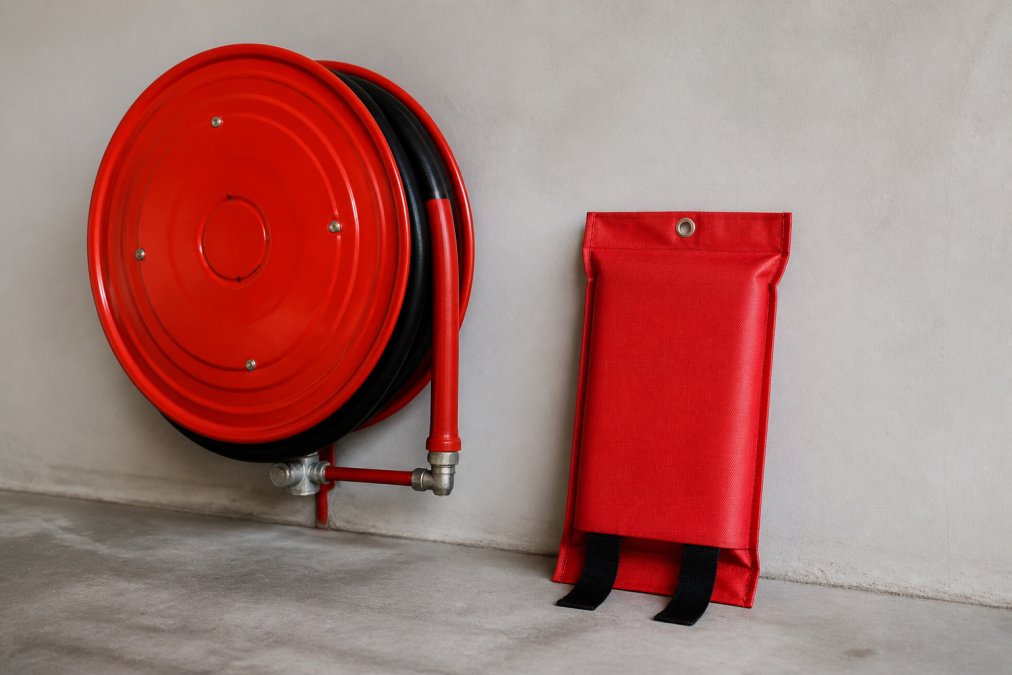
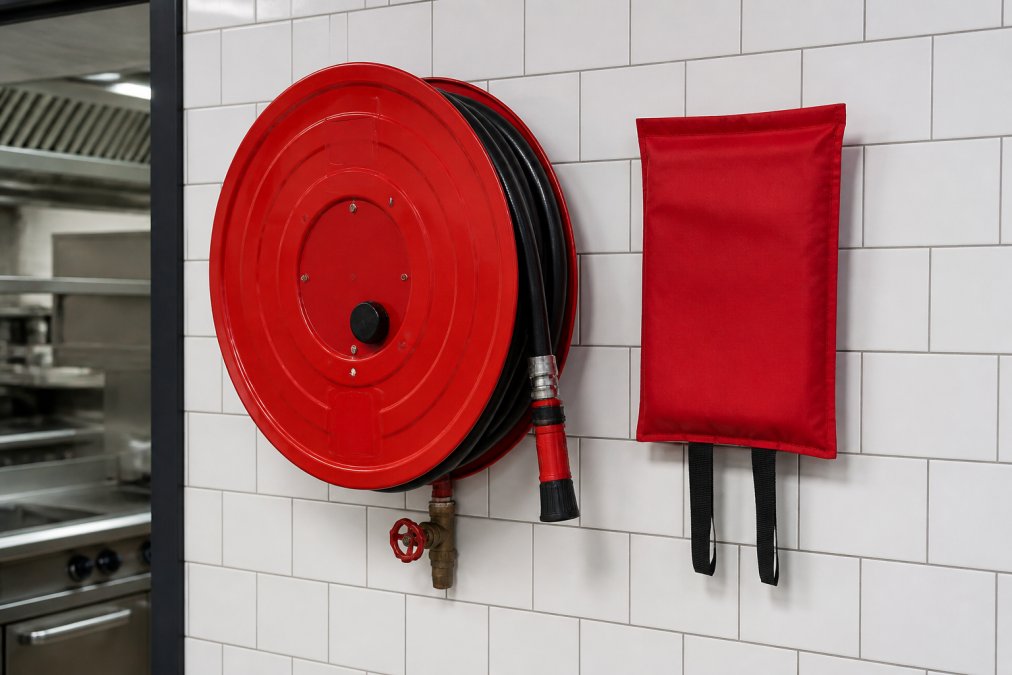
Choosing between fire hose reels and fire blankets comes down to one question: what kind of fire are you actually preparing for? Fire hose reels are wall-mounted, permanently pressurised systems that deliver a continuous water supply for Class A fires involving combustible solids like paper, timber, and textiles (fire.nsw.gov.au). Fire blankets are compact, single-user devices that smother small Class F fires, particularly cooking oil and fat fires, by cutting off the oxygen supply.
At Fyrepower, we test and maintain both, and the honest answer is that most properties need both. They are not competing products so much as complementary tools in a fire safety strategy.
Here is how they compare at a glance:
| Feature | Fire Hose Reel | Fire Blanket |
|---|---|---|
| Best for | Class A fires, large floor areas | Class F fires, small contained fires |
| Water supply | Continuous, mains-fed | None required |
| Deployment | Unroll and open nozzle | Pull tabs, drape over fire |
| Maintenance | Mandatory 6-monthly testing | Visual inspection |
| Residue after use | Water only | None |
| Skill required | Moderate | Minimal |
How Each One Suppresses a Fire
The two devices attack a fire through completely different mechanisms, which explains why each suits different hazards.
Fire hose reel operation
A fire hose reel delivers pressurised water from a mains-connected supply. Water absorbs heat and cools the burning material below its ignition point, while the stream also wets surrounding surfaces to stop the fire spreading. Because the supply is continuous, a reel can fight a fire for as long as the water holds out, which is why it suits larger Class A hazards.
Fire blanket operation
A fire blanket smothers a fire by cutting off the oxygen supply. You pull the tabs, hold the blanket in front of you as a thermal shield, and lay it gently over the fire so no air reaches the flames. This makes it the correct choice for a chip pan or deep fryer, where a water stream would spread burning oil violently.
AS 2441 Fire Hose Reel Requirements
AS 2441 is the Australian Standard governing the installation of fire hose reels, and it sets the rules on placement, water supply, and hose length that determine whether a reel is compliant (store.standards.org.au). Reels must be installed so that every part of the floor area they protect is within reach of the hose, with the nozzle height and swing radius specified so occupants can deploy the reel without obstruction.
Compliance is not a one-off event. Standards Australia fire hose reel guidance confirms that reels form part of a building’s essential fire safety measures, which means they carry ongoing inspection obligations. A reel that fails to pressurise, leaks at the valve, or has a perished hose is not compliant regardless of how it looks on the wall.
A common compliance failure is a hose reel that has never been flow-tested. A reel can look pristine and still deliver inadequate pressure, which only becomes obvious during an actual fire or a formal audit.
Fire Blanket AS/NZS 3504: What the Standard Covers
AS/NZS 3504 specifies the construction, performance, and labelling requirements for fire blankets, and it draws a hard line between a compliant blanket and a decorative one. The standard covers the blanket’s material, its fire rating, the size options, and the storage container requirements.
A compliant blanket must be made from flame-retardant material, be sized to smother the fire it is rated for, and carry clear instructions for use. It must also be stored so it can be deployed in seconds, which is why a fire blanket cabinet or wall-mounted pouch matters as much as the blanket itself. Cheap imports that skip the standard often fail on heat resistance and give the user a false sense of protection.
Which Fire Class Suits Each Option
Matching the device to the fire class is where most buying mistakes happen, but the class table alone does not tell you whether you or your staff can actually use the equipment under pressure. Fire hose reels are rated for Class A fires only: combustible solids such as wood, paper, cardboard, and textiles. They are not suitable for flammable liquids, gases, or cooking oils. Fire blankets cover Class F fires, the cooking oils and fats found in commercial kitchens, and they also handle small Class A fires in a pinch.
| Fire Class | Fire Hose Reel | Fire Blanket |
|---|---|---|
| Class A (solids) | Yes | Yes, small fires |
| Class B (flammable liquids) | No | No |
| Class C (gases) | No | No |
| Class F (cooking oils) | No | Yes |
The physical reality of using each device
A fire hose reel is not a passive tool. A fully charged 36-metre reel hose holds a significant volume of water, and the reaction force at the nozzle can be difficult to control for a smaller or untrained operator. Two people are often safer on a reel: one to control the nozzle and one to manage the hose run and prevent kinks. If your site relies on a single staff member to respond after hours, that is a real limitation worth planning around.
A fire blanket is the opposite. It requires minimal strength, no water supply, and no coordination. The technique matters more than the muscle: pull the tabs, hold the blanket in front of you with the top edge protecting your hands and face, and lay it gently over the fire so no air reaches the flames. Do not throw it. Do not remove it while the fire is hot. For a person whose clothing has caught fire, the same technique applies: wrap the blanket around them, lay them down, and keep the blanket in place until the fire is out and the material has cooled. That human-centric scenario is rarely covered in equipment guides, but it is one of the most valuable uses of a blanket in a kitchen or workshop.
How these tools fit with your other safety systems
Neither device replaces a smoke alarm or a fire extinguisher. A smoke alarm gives you the early warning that lets you choose the right tool at all. A fire extinguisher covers the classes the reel and blanket cannot: a dry chemical extinguisher handles Class A, B, and C fires, while a wet chemical extinguisher is the correct partner for a fire blanket in a commercial kitchen because it covers larger Class F hazards that a blanket alone cannot smother. The practical hierarchy is alarm first, then extinguisher or blanket for small contained fires, then hose reel for larger Class A incidents where a continuous water supply is needed. Treating any one of these as a substitute for the others is the most common gap in a site’s fire strategy.
A fire hose reel never covers a kitchen oil fire, and a fire blanket is not built for a warehouse pallet blaze. Buy for the specific hazard in each space, and make sure the people expected to use each tool have the physical capability and training to deploy it.
Commercial Fire Safety Equipment Maintenance Cycles
Maintenance obligations differ sharply between the two devices, and this is where the ongoing cost of ownership lives.
Photograph every service tag and blanket check as you go. When an auditor asks for proof, a dated photo log closes the question faster than a written register alone.
Costs and Cleanup Over Ten Years
Deployment Scenarios and How Each Fits Your Safety Systems
Kitchen and hospitality settings
Warehouses and large commercial floors
Choosing between them when both are present
Frequently Asked Questions
What is the primary difference between a fire hose reel and a fire blanket?
A fire hose reel delivers a continuous supply of pressurised water to knock down Class A fires involving paper, timber, textiles and similar combustible solids. A fire blanket is a single-user device that smothers a small, contained fire by cutting off its oxygen supply, and it also works on cooking oil fires where water would be dangerous. The reel suits larger areas and sustained suppression; the blanket suits quick, close-range action on a pan or bin fire.
Are fire hose reels mandatory in commercial buildings?
Not always. Whether a fire hose reel is required depends on the building’s class, floor area, occupancy and fire risk assessment under the National Construction Code and AS 2441. Some sites meet their obligations with extinguishers and blankets instead. A fire risk assessment is the only reliable way to confirm what your property needs, so check with a qualified fire protection provider before assuming either way.
Can a fire blanket be used on electrical fires?
A fire blanket can smother a small fire involving energised equipment, but only after the power is isolated if that can be done safely. Most blankets are not rated for live electrical hazards, and the real risk is reaching into a live appliance. For switchboards, server racks and similar equipment, a carbon dioxide or dry chemical extinguisher rated for electrical fires is the safer choice. Treat the blanket as a backup for small, contained incidents.
How often should fire hose reels be tested under Australian Standards?
AS 1851 sets out the inspection and testing regime. Hose reels are typically checked every six months for condition and operation, with a more detailed annual service that includes flow testing and pressure checks. Commercial fire safety equipment maintenance at these intervals keeps the equipment compliant and ready for use. Records must be kept, because they are what an auditor or insurer will ask to see.
Do I need both a fire hose reel and a fire blanket for my business?
Many commercial sites carry both because they cover different fire scenarios. A hose reel handles larger Class A fires and gives extended reach across a floor, while a fire blanket is faster for a small kitchen or bin fire and leaves no residue. The right mix depends on your fire risk assessment, the fire classes present and how staff are trained. A specialist can map this out for your specific premises.