Last Updated: November 1, 2026
Quick Summary
Fire safety training should be refreshed regularly, and the interval depends on role and risk. Australian law sets a duty of care but does not fix a specific interval, so the schedule comes from Australian Standards and your risk assessment. Higher-risk sites need a more frequent cycle than the annual figure.
- Keep a short note of your risk assessment and why you chose your training cycle.
- Chief wardens need a refresher every 6 months plus a pre-drill briefing.
- Area or floor wardens refresh every 6 to 12 months, and ERT members every 6 to 12 months.
- Training builds knowledge while drills test whether that knowledge works under pressure.
- Retrain immediately after new staff join, layout changes, new hazards, or a near miss.
Table of Contents
- How Often Should Fire Safety Training Be Updated? The Short Answer
- What Australian Law Requires for Workplace Fire Safety Training
- Fire Warden Training Renewal Frequency: Why Wardens Need More Than Annual Refreshers
- Fire Drill Frequency and Training: How Drills Differ From Training Sessions
- Fire Safety Training for Day and Night Staff: Why Shift Patterns Change the Schedule
- Your Fire Safety Training Checklist for Every Refresh Cycle
- Triggers That Mean Retraining Now, Not at the Next Scheduled Date
- Book Your Fire Safety Training Review With Fyrepower
- Frequently Asked Questions
How Often Should Fire Safety Training Be Updated? The Short Answer
Fire safety training should be refreshed regularly, and the interval depends on role and risk. That is the short answer. A single number never tells the full story.
Here is what most guides get wrong: they quote one interval and stop. In practice, your schedule depends on the role, the risk level, and what has changed since the last session.
Below, we break down the legal minimum, the best-practice intervals, and the triggers that mean retraining now rather than at the next scheduled date.
What Australian Law Requires for Workplace Fire Safety Training
Australian work health and safety law requires employers to provide fire safety training, but the specific interval is not fixed in legislation. Instead, the law sets a duty of care, and Australian Standards fill in the practical detail.
Fire safety training is the instruction staff receive on preventing, responding to, and evacuating from a fire emergency. The primary legal duty sits in the Work Health and Safety Act and the Work Health and Safety Regulations adopted in most jurisdictions.
What the law does not do is nominate a number. It does not say “retrain every 12 months.” That is why you will see conflicting advice online. The interval comes from the standard and from your risk assessment.
Where the interval actually comes from
Australian Standards such as AS 3745 set out how emergency plans and training should be structured, and AS 1851 and AS 2444 cover fire protection equipment. Check the current editions of these standards for the specific training intervals that apply to your site. Comprehensive emergency preparedness also requires integrating these technical fire safety requirements with updated security guard training standards to ensure a unified response across all personnel.
The key distinction: the law says you must train your people and keep records. The standard tells you how often. Your risk assessment tells you when to go beyond the minimum.
Do not treat the annual figure as a legal maximum. If your risk assessment identifies higher risk, flammable storage, hot work, large occupant loads, or a complex evacuation strategy, a more frequent cycle is the defensible position. An inspector will ask why your interval was appropriate to your risk, not whether it matched a number in the Act.
What “training” must include to satisfy the duty
A session that only covers fire extinguisher theory is unlikely to satisfy the duty on its own. To meet the legal obligation, training should cover:
- The site’s fire hazards and prevention measures
- The emergency plan, including evacuation routes and assembly areas
- Each worker’s role during an evacuation, including wardens
- How to raise the alarm and contact emergency services
- The location and basic use of firefighting equipment, where workers are expected to use it
- Any site-specific procedures, such as isolation of machinery or handling of hazardous materials
Records and audit readiness
The law requires you to keep records, and the quality of those records is what carries you through an audit or an incident investigation. For each training session, record:
- Date, duration, and trainer or provider
- The content covered and the site or area it applied to
- Names and roles of attendees, including whether they are general occupants, wardens, or ERT members
- Any competency check or assessment result
- The scheduled date for the next refresher
- Corrective actions identified and their completion status
A common pattern is to hold good training records but no record of the decision behind the interval. Keep a short note of your risk assessment and why you chose the cycle you did, it is the difference between a defensible schedule and an arbitrary one.
For the full breakdown of AS 3745 and what it demands, see our guide to emergency fire safety training requirements.
Fire Warden Training Renewal Frequency: Why Wardens Need More Than Annual Refreshers
Warden refresher frequency should be set by your risk assessment. Wardens carry real responsibility during an evacuation, so what the refresher covers and how you prove competency matter as much as the interval.
A warden has to sweep rooms, direct crowds, check evacuation diagrams, and report to emergency services. That is a lot to hold onto between annual sessions.
Not all wardens need the same refresher
AS 3745 recognises a hierarchy of warden roles, and each has a different training need:
- Chief warden, coordinates the whole response, liaises with emergency services, and authorises evacuation. Refresher every 6 months, plus a pre-drill briefing.
- Area or floor warden, sweeps their zone, directs occupants to exits, and reports to the chief warden. Refresher every 6 to 12 months.
- Deputy warden, must be able to step into the area warden role at short notice. Train alongside the area warden so the handover is seamless.
- Emergency response team (ERT) members, where your site has one, these staff need hands-on equipment training (extinguishers, fire blankets, first aid) on a 6-to-12-month cycle, separate from warden coordination training.
A common mistake is running one generic warden session and calling everyone trained. The chief warden needs decision-making scenarios; the area warden needs sweep-and-report practice; the ERT needs equipment drills. Split the content by role.
What a warden refresher must actually cover
A refresher that only re-walks the evacuation diagram is not enough. Each session should confirm the warden can:
- Locate and interpret the current evacuation diagram for their zone
- Identify their sweep route and the nearest alternative exit
- Use the site’s communication method (radio channel, phone tree, PA) to report status
- Recognise when to escalate to the chief warden or emergency services
- Account for occupants at the assembly area using the site’s roll-call method
- Complete the post-incident report and handover
If any of those steps has changed since the last session, a new exit, a rezoned floor, a different assembly area, the refresher must cover the change explicitly, not assume wardens will notice.
Records and competency checks
A training record that lists attendance only is weak evidence. For each warden, keep:
- Date of last refresher and the content covered
- The role trained for (chief, area, deputy, ERT)
- A competency sign-off, a short scenario walk-through or observation during a drill is usually enough
- The date of the next scheduled refresher
- Any corrective actions arising from the session
Tie warden refreshers to your drill schedule. A warden who refreshes in the same week as a drill gets immediate practice applying what they learned, and the drill gives you a natural competency check to record.
What most guides miss is that warden training is not just about the drill itself. It covers changes to the emergency plan, new staff on the floor, and any shift in the building layout. Treat the refresher as the point where the plan, the people, and the building are reconciled, not as a box-ticking exercise.
Warden refresher intervals vary by role, so match the cycle to the responsibility each warden carries.
| Warden role | Refresher interval | Note |
|---|---|---|
| Chief warden | Every 6 months | Plus a pre-drill briefing |
| Area or floor warden | Every 6 to 12 months | Sweeps zone and reports to chief warden |
| Deputy warden | Train alongside area warden | Must step into the role at short notice |
| Emergency response team members | 6-to-12-month cycle | Hands-on equipment training, separate from coordination training |
Fire Drill Frequency and Training: How Drills Differ From Training Sessions
Fire drills and fire safety training are not the same thing, and confusing them is a common mistake. Training builds knowledge. Drills test whether that knowledge works under pressure.
An evacuation drill is a rehearsed practice evacuation, while training is the structured instruction that prepares people for it. You need both, on different schedules.
Drill and training frequency should be set by your risk assessment and the rules that apply to your workplace. A drill without recent training tests nothing useful. Training without a drill never proves the plan works.
Run a drill after any major layout change, and log every one.
Fire Safety Training for Day and Night Staff: Why Shift Patterns Change the Schedule
Shift workers need training scheduled around their actual shifts, not the day crew’s calendar. If your night staff never attend a session, they are not trained, no matter what the record says.
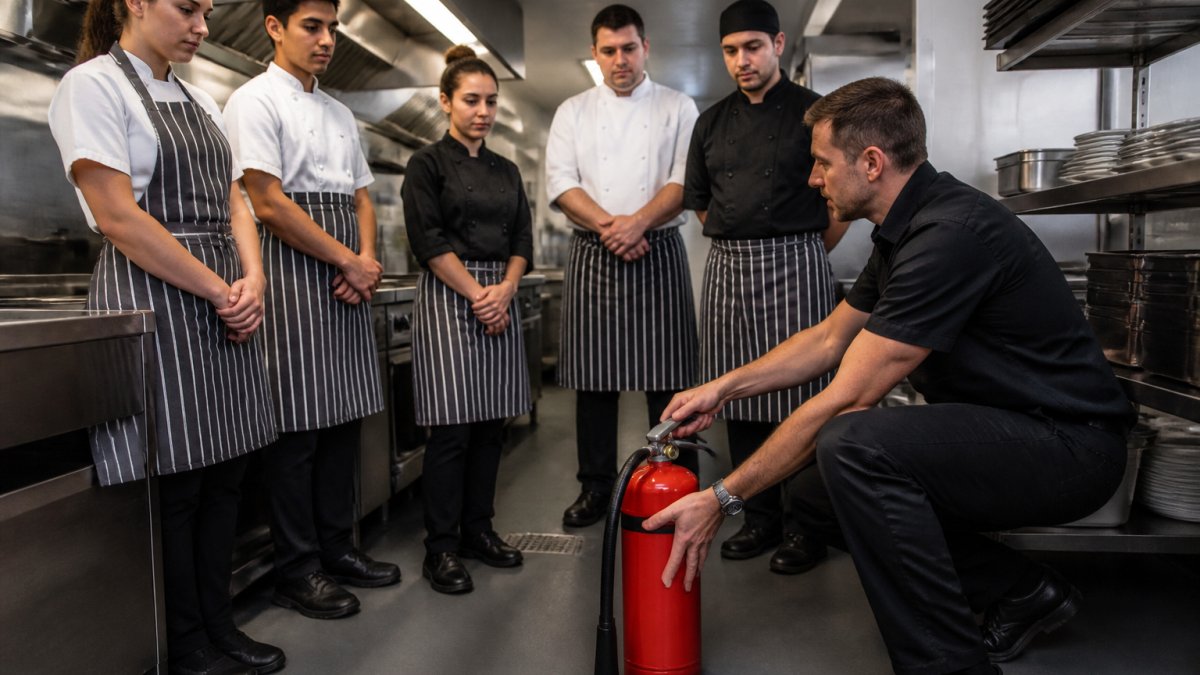
A common mistake is running one annual session at 10am and calling it done. Half your team was asleep. Split delivery across shifts, or use short on-site sessions that fit each roster.
For practical ways to keep awareness high across shift workers, read our steps on improving employee fire safety awareness.
Your Fire Safety Training Checklist for Every Refresh Cycle
Use this checklist each time a refresher comes due. It keeps the process consistent and audit-ready.
- Confirm who is due for general, warden, or extinguisher training
- Book sessions across all shifts, including nights and weekends
- Update the emergency plan and evacuation diagrams first
- Cover fire hazards, prevention, and response for the site
- Run a hands-on extinguisher session where equipment allows
- Record attendance, date, trainer, and content covered
- Schedule the next drill and the next refresher
- File certificates so they are ready for an audit
For a deeper walkthrough of implementing and refreshing employee sessions, see our fire safety training for employees guide.
Triggers That Mean Retraining Now, Not at the Next Scheduled Date
Sometimes the calendar is the wrong trigger. Certain changes mean you retrain immediately, regardless of when the last session ran.
- New staff join the site or a new floor
- Building layout changes, such as renovations or new exits
- New fire hazards are introduced, like new equipment or storage
- The emergency plan is updated after a review or incident
- A drill reveals gaps in response or evacuation time
- Equipment changes, such as new extinguisher types or locations
- A near miss or actual fire event occurs on site
Treat these as mandatory, not optional. A training record that ignores a major change will not hold up if something goes wrong. For a system to track these deadlines, see our guide on managing fire safety deadlines.
Book Your Fire Safety Training Review With Fyrepower
Keeping training current is a moving target, and missed refreshers are one of the easiest compliance gaps to overlook. Our QBSA-licensed, fully insured team delivers on and offsite fire training.
Hospitality venues can start with our fire safety guide for hospitality venues before booking.
Get in touch with us now.
Frequently Asked Questions
How often should you refresh your fire safety training?
Refresher frequency for general staff, wardens and evacuation drills should be set by your risk assessment, staff turnover and the rules that apply to your workplace. The right interval also depends on your risk assessment, staff turnover and any changes to your evacuation procedures.
How long is fire warden training valid for?
Confirm the expected refresher interval for wardens with your training provider, and record each warden’s completion date so you can prove currency during an audit.
When should fire safety training be updated after a workplace change?
Retrain immediately when the change affects how people respond to a fire. That includes a new floor layout, relocated exits, new equipment or suppression systems, changed evacuation assembly points, or a shift in the types of fire hazards on site. New starters need induction training before they begin work, and any staff member who moves into a warden role needs role-specific training before taking on those duties.
How often should fire extinguisher training be refreshed?
Hands-on fire extinguisher training should be refreshed regularly, with frequency set by your risk assessment. Extinguisher units require servicing under AS 1851; check the standard for the inspection intervals that apply. Training and equipment servicing are separate obligations, so keep records for both to stay audit-ready.