Table of Contents
- Emergency Lighting Maintenance Standards Explained
- Commercial Building Fire Safety Obligations
- AS 2293.2 Maintenance Requirements and Testing Frequency
- Emergency Lighting Testing Frequency and Schedules
- Exit Signage Visibility and Illumination Standards
- LED Upgrades and Lifecycle Cost Planning
- Routine Maintenance vs. Periodic Testing
- Building a Compliant Emergency Lighting System
- Frequently Asked Questions
Last Updated: October 3, 2026
Emergency Lighting Maintenance Standards Explained
Emergency lighting maintenance is the systematic process of testing, inspecting, and servicing emergency lighting systems to ensure they function reliably during power outages or fire emergencies. For Queensland businesses, this isn’t optional compliance work, it’s a legal obligation that directly protects occupants and determines whether your facility can safely evacuate when it matters most.
The stakes are straightforward: a failed emergency light during an actual emergency creates a liability nightmare. Worse, it leaves people in darkness during the moment they need guidance most. The ones who shifted to treating it as a critical safety system saw fewer compliance issues, faster audit outcomes, and genuine peace of mind.
Emergency lighting systems typically consist of luminaires (light fittings), battery backup units, exit signage, and control circuits. Each component requires specific testing protocols.
Commercial Building Fire Safety Obligations
Who Bears Legal Responsibility
Queensland’s fire safety framework places clear accountability on building owners and occupiers. Under the Fire Safety Act 2021 and associated regulations, the responsibility for maintaining emergency lighting falls to whoever controls the building, typically the owner, body corporate, or tenant (depending on lease terms and building type).
For multi-tenancy strata complexes, the body corporate holds primary responsibility for common areas. Individual tenants are responsible for emergency lighting within their leased spaces.
Commercial landlords cannot delegate this obligation away. Even if a tenant signs a maintenance clause, the landlord remains liable if the system fails to meet standards during an emergency or audit.
Consequences of Non-Compliance
Non-compliance with emergency lighting standards carries real penalties. Queensland building inspectors can issue compliance notices requiring remedial action within specified timeframes. Failure to comply can result in fines, prosecution, or, in extreme cases, suspension of occupancy permits.
Beyond regulatory penalties, there’s the liability exposure. If a fire occurs and occupants are injured because emergency lighting failed, the building owner faces potential civil claims.
More immediately, failed compliance audits delay leasing negotiations, complicate property sales, and create friction with tenants. A single audit failure can cascade into multiple issues: tenant complaints, regulatory follow-ups, and reputational damage in the property management community.
AS 2293.2 Maintenance Requirements and Testing Frequency
AS/NZS 2293.2 is the Australian Standard that governs emergency lighting maintenance. It specifies three levels of testing: visual inspection (routine), discharge testing (periodic), and annual certification.
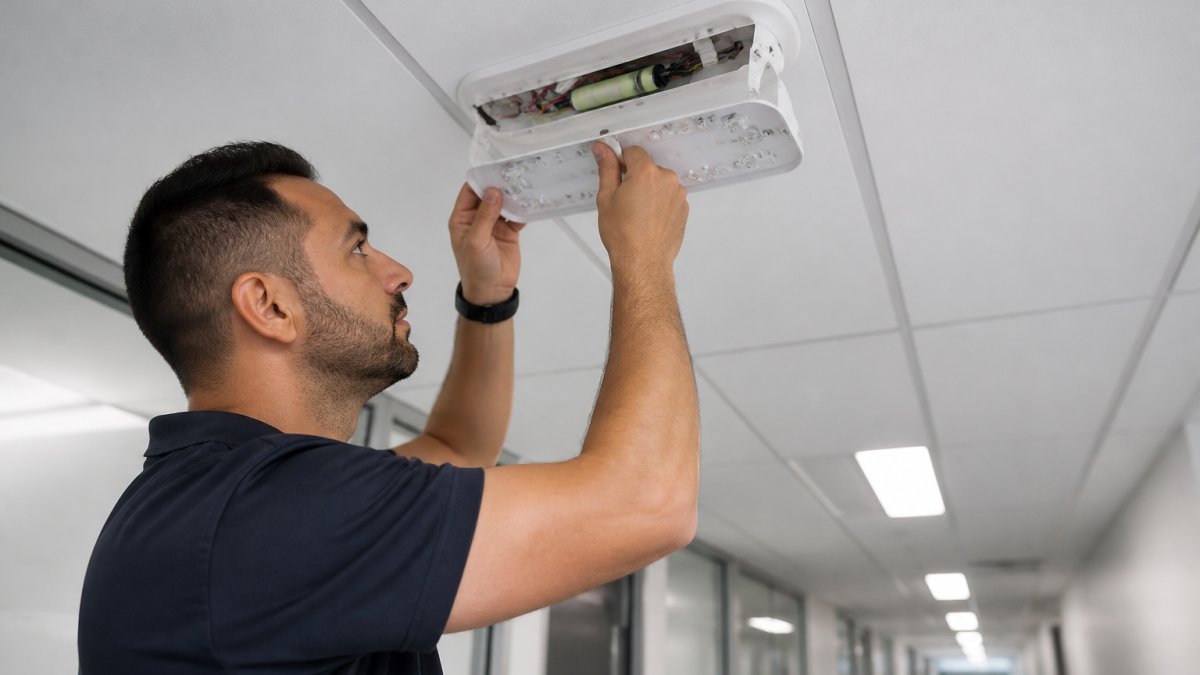
Visual inspection happens monthly and involves checking that all luminaires are clean, undamaged, and properly mounted.
Discharge testing is the heavy-lift procedure. It involves switching off mains power and allowing the system to run on battery backup for a set duration, typically 1 hour for most commercial systems.
6-Monthly Discharge Test Procedures
The 6-monthly discharge test is where most systems reveal problems. The procedure requires a qualified technician, proper safety protocols, and detailed documentation. Here’s what the process typically involves:
-
Pre-test verification, Confirm that all luminaires are present, clean, and functioning normally under mains power. Record baseline brightness levels using a light meter if the standard requires it for your system type.
-
Mains isolation, Switch off mains power to the emergency lighting circuit. This triggers the battery backup system. Some systems have an isolation switch; others require switching at the circuit breaker.
-
Observation period, Monitor all luminaires for 1 hour (or the duration specified in your system documentation). Record the time it takes for each fitting to reach full brightness. Note any that flicker, dim unexpectedly, or fail to illuminate.
-
Brightness verification, Use a light meter to confirm that exit signage and key pathway luminaires meet minimum illumination levels (typically 50 lux for exit signs, 5 lux for escape route lighting).
-
Battery performance check, Observe battery voltage and current readings throughout the test. Any significant voltage drop or inability to maintain output suggests battery replacement is needed.
-
Mains restoration, Restore mains power and verify that the system returns to normal operation. Battery indicators should return to green within a few minutes.
-
Documentation, Record all observations, measurements, and any faults found. Include dates, times, technician name, and recommendations for remedial work.
Annual Certification and Documentation
After the 6-monthly discharge test, an annual certification visit provides a formal audit of the entire system. This involves re-testing key components, reviewing all maintenance records from the past 12 months, and issuing a compliance certificate.
The annual visit is where most facilities discover they’ve missed something. Common issues include incomplete discharge test records, luminaires that weren’t tested in previous cycles, or battery replacements that weren’t properly documented.
Documentation quality directly affects audit outcomes. A vague entry like “tested, OK” provides no evidence of actual compliance. Regulators and auditors expect specific data: exact times, brightness readings, battery voltages, and technician credentials.
Emergency Lighting Testing Frequency and Schedules
Visual Inspection vs. Periodic Testing
Visual inspection and periodic testing serve different purposes and cannot substitute for each other. Visual inspection catches obvious problems, broken fittings, missing covers, disconnected wiring. Periodic testing reveals hidden faults that visual inspection cannot detect: degraded batteries, failing ballasts, circuit faults.
A common mistake is treating monthly visual inspection as sufficient. Many facility managers assume that if a light looks fine, it will work during an emergency.
The testing schedule mandated by AS/NZS 2293.2 is non-negotiable for compliance: monthly visual inspection, 6-monthly discharge testing, and annual certification. Some systems require more frequent testing if they protect high-risk areas or have experienced previous failures.
Maintenance Logbook Requirements
Every emergency lighting system must have a maintenance logbook. This isn’t a suggestion, it’s a regulatory requirement. The logbook documents every inspection, test, repair, and component replacement. During an audit, inspectors will ask to see it. If it’s incomplete or missing, compliance status is immediately questioned. Maintaining these records becomes significantly more manageable when transitioning to modern LED emergency lighting, which offers greater longevity and simplified diagnostic tracking.
A compliant logbook includes:
- Date and time of each inspection or test
- Technician name and credentials
- Description of work performed
- Any faults identified and remedial actions taken
- Brightness readings or battery voltage measurements
- Signature of the person who performed the work
- Next scheduled test date
Digital logbooks are increasingly common and often more reliable than paper records. They timestamp entries automatically, prevent backdating, and create audit trails.
Exit Signage Visibility and Illumination Standards
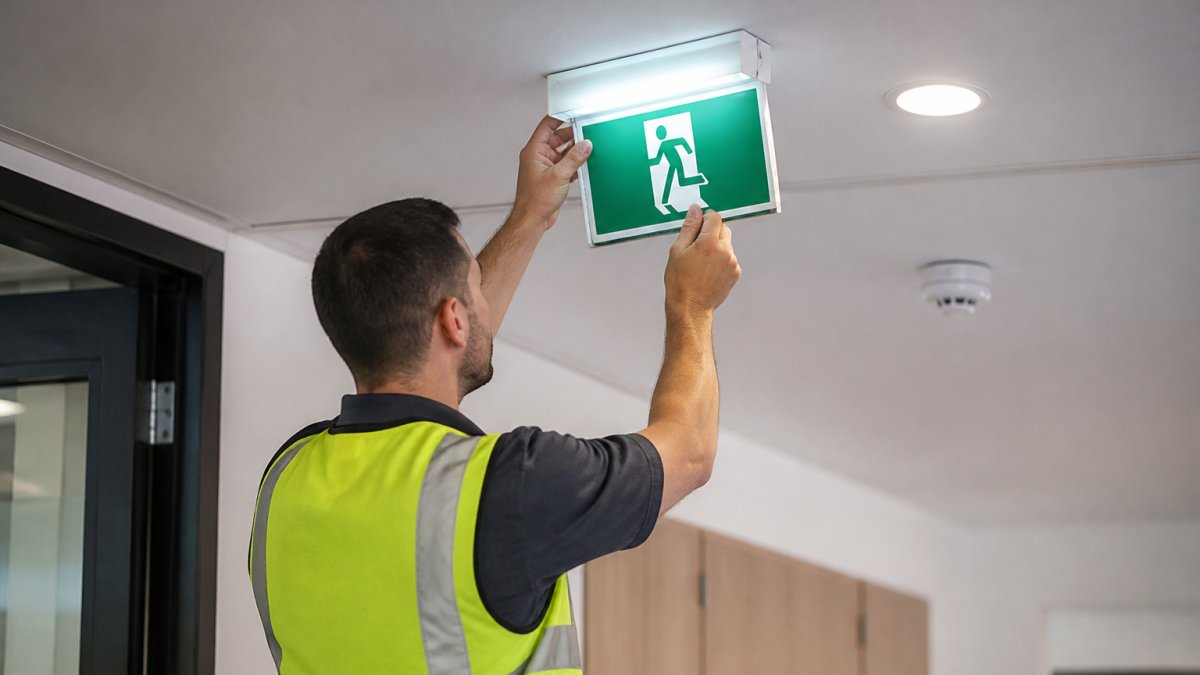
Exit signage must be illuminated, visible from any point in the building, and capable of functioning on battery backup.
Many facilities discover during testing that exit signs are obscured by obstacles, mounted too high to be visible, or positioned in locations that don’t align with actual evacuation routes. During discharge testing, technicians verify that signs remain illuminated and legible throughout the test period.
Exit signage also needs to integrate with the overall emergency lighting pathway. A bright exit sign is useless if the route to it is dark. The escape route lighting, typically lower-level luminaires along corridors and stairs, must provide continuous illumination at minimum 5 lux.
LED Upgrades and Lifecycle Cost Planning
LED emergency lighting has become standard in Queensland. LEDs use less power than older incandescent or fluorescent fittings, meaning batteries last longer and replacement cycles extend. The upfront cost is higher, but lifecycle costs are typically lower over 10-15 years.
When planning an upgrade, consider total cost of ownership: initial purchase and installation, battery replacement intervals, maintenance labour, and disposal of old fittings.
Battery technology also matters. Lithium-ion batteries are increasingly common in new systems because they hold charge longer, tolerate temperature fluctuations better, and have more predictable failure modes than older nickel-cadmium batteries.
Routine Maintenance vs. Periodic Testing
Routine maintenance, cleaning fittings, replacing covers, tightening connections, is ongoing work that facility staff can often handle. Periodic testing, discharge testing, brightness measurement, battery assessment, requires qualified technicians and specialised equipment.
The distinction matters because under-resourced facilities sometimes skip periodic testing in favour of routine maintenance, believing that keeping fittings clean is sufficient. It’s not. Routine maintenance prevents obvious failures but cannot detect battery degradation, circuit faults, or ballast failures.
A practical maintenance strategy combines both: facility staff perform monthly visual inspections and basic cleaning, while qualified technicians handle 6-monthly discharge testing and annual certification. This approach catches problems early and keeps compliance costs manageable.
Building a Compliant Emergency Lighting System
Facility Management and Safety Audits
A compliant emergency lighting system requires documented processes, clear responsibility assignments, and regular audits. Start by mapping your system: list all luminaires, exit signs, battery units, and circuits. Document their locations, installation dates, and last service dates.
Assign clear responsibility for scheduling and coordinating tests. For multi-tenancy buildings, this typically falls to the body corporate or property manager. For single-occupancy buildings, the owner or facilities manager takes the lead.
A safety audit should occur annually, ideally timed to coincide with the annual certification visit.
Downtime Prevention and Backup Planning
Emergency lighting systems sometimes require maintenance that temporarily disables them. Battery replacement, circuit repairs, or fitting replacements might require switching off sections of the system. Planning this work carefully minimises risk.
Coordinate maintenance during low-occupancy periods, weekends or after-hours for commercial buildings. Notify occupants in advance.
Document all downtime in the maintenance logbook, including the reason, duration, and steps taken to minimise risk. If an emergency occurs during planned maintenance, this documentation demonstrates that you acted responsibly.
Emergency lighting compliance isn’t a one-time project, it’s an ongoing commitment to occupant safety. The systems that work best are the ones managed proactively, with clear schedules, qualified technicians, and detailed documentation.
Frequently Asked Questions
What are the Australian standards for emergency lighting maintenance?
Emergency lighting in commercial buildings must comply with AS/NZS 2293, which specifies installation, maintenance, and testing requirements. AS 2293.2 covers the maintenance of these systems, requiring 6-monthly discharge tests, annual certification, and detailed logbook documentation. The standard ensures that exit signage, evacuation paths, and emergency power supplies function reliably during an evacuation. Compliance is mandatory for all commercial properties under occupational health and safety legislation.
How often does emergency lighting need to be serviced under AS 2293.2 maintenance requirements?
AS 2293.2 mandates a 6-monthly discharge test where the system is switched to battery power to verify all luminaires and exit signage illuminate properly. Visual inspections should occur more frequently, typically monthly, to detect obvious faults. Annual certification from a qualified technician confirms the entire system meets regulatory standards. This schedule ensures continuous compliance and minimises the risk of system failure during an actual emergency.
What happens if my commercial building fire safety obligations are not met?
Non-compliance with emergency lighting standards can result in significant penalties under occupational health and safety legislation. Property managers and business owners may face enforcement action, fines, and legal liability if a system fails during an evacuation. Insurance claims may be denied if maintenance records cannot demonstrate compliance. Additionally, failed safety audits can delay lease renewals, affect property valuations, and create reputational damage, particularly for hospitality and retail venues.
How should I manage emergency lighting testing frequency and logbook records?
Maintain a detailed logbook recording all visual inspections, 6-monthly discharge tests, and annual certifications. Document the date, technician name, findings, and any faults identified. Photograph luminaire condition and test results where possible. Digital or paper logbooks must be retained for at least five years. This documentation proves compliance to auditors and regulators, and helps identify patterns of recurring faults that may indicate a need for LED upgrades or component replacement.
What is the difference between routine maintenance and periodic testing for emergency lighting?
Routine maintenance includes monthly visual inspections, cleaning luminaires, and checking battery connections. Periodic testing refers to the mandatory 6-monthly discharge test and annual certification by a qualified technician. Routine maintenance prevents minor issues from escalating, whilst periodic testing provides formal verification that the system meets AS/NZS 2293 standards. Both are required; routine maintenance alone is insufficient to satisfy regulatory obligations.
Should we upgrade to LED emergency lighting, and what are the lifecycle costs?
LED emergency luminaires offer lower running costs, longer lamp life, and reduced maintenance frequency compared to traditional fluorescent or incandescent systems. However, the upfront capital cost is higher. Calculate lifecycle costs over 10-15 years, accounting for lamp replacement, energy consumption, and labour time. For multi-tenancy strata complexes or large commercial properties, LED upgrades often pay for themselves within 5-7 years through energy savings and reduced maintenance, whilst improving system reliability.
Who is legally responsible for emergency lighting maintenance in a commercial building?
The building owner or occupier is responsible for ensuring emergency lighting compliance. In strata complexes, the body corporate typically manages common areas, whilst tenants may be responsible for their own spaces. Property managers act on behalf of owners and must coordinate with service providers to meet 6-monthly testing deadlines. All parties should verify responsibility in lease agreements and body corporate by-laws to avoid compliance gaps.