Table of Contents
- Tip 1: Conduct a Thorough Industrial Fire Risk Assessment
- Tip 2: Implement a Compliant AS 1851 Fire Protection Maintenance Schedule
- Tip 3: Install and Maintain Portable Fire Extinguishers Correctly
- Tip 4: Design and Practise an Emergency Evacuation Plan
- Tip 5: Deliver Practical Fire Safety Training for Industrial Staff
- Tip 6: Manage Flammable Materials and Combustible Dust
- Tip 7: Control Electrical Hazards and Keep Detection Systems Working
- Tip 8: Use Smart Monitoring and Plan for Business Continuity
- Frequently Asked Questions
Last Updated: September 26, 2026
Tip 1: Conduct a Thorough Industrial Fire Risk Assessment
An industrial fire risk assessment is the structured process of identifying ignition sources, fuel loads, and the people exposed to them across your site. This guide from Fyrepower covers the eight fire safety tips that matter most for industrial properties, starting with the fire safety tips that underpin everything else. Skip it and every other control you install is guesswork.
Identify High-Risk Zones and Ignition Sources
Walk the site and map where heat, sparks, or friction meet fuel. Welding bays, battery charging rooms, paint stores, and dust extraction ducts top the list at most facilities.
Document Findings and Set Review Dates
Record each hazard, its likelihood, and the control you’ve applied. Set a formal review date, typically annually or whenever operations shift.
Tip 2: Implement a Compliant AS 1851 Fire Protection Maintenance Schedule
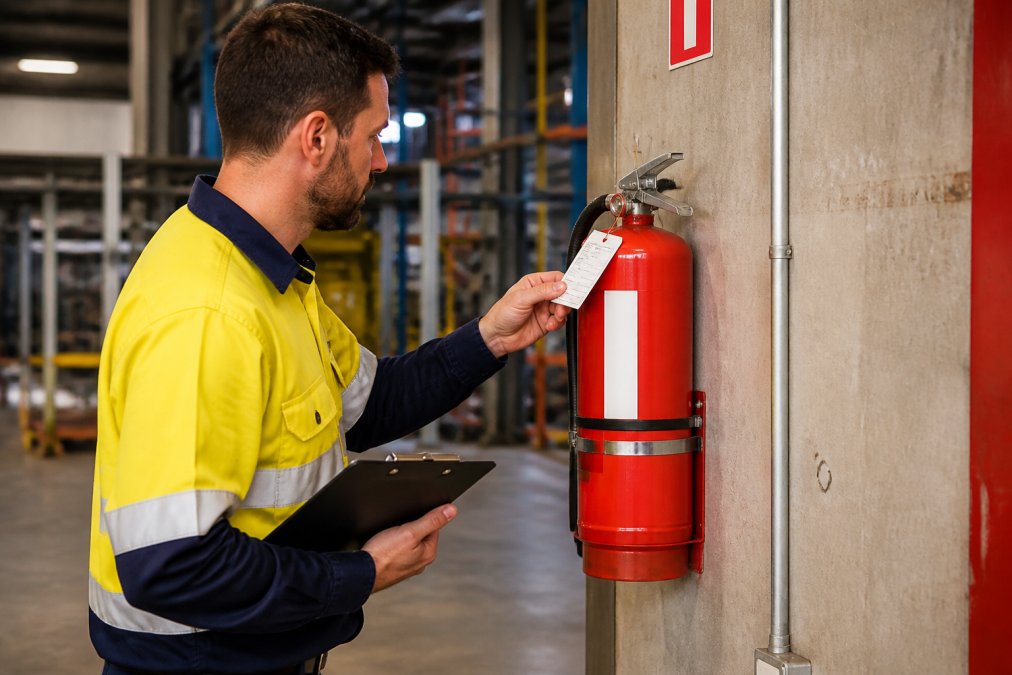
AS 1851 is the Australian Standard that sets routine servicing frequencies for fire protection systems and equipment. Compliance is not optional for industrial sites, and it is the single most common gap auditors find.
What AS 1851 Covers and Why It Matters
The standard spans sprinklers, hydrants, pumps, detection, emergency lighting, and portable extinguishers, each with its own inspection interval.
Building a Maintenance Calendar That Works
| Asset | Typical Interval | Who Signs Off |
|---|---|---|
| Portable fire extinguishers | 6-monthly | Licensed technician |
| Fire alarm and detection | Monthly to annual | Fire protection provider |
| Emergency lighting | 6-monthly | Licensed electrician |
| Sprinkler and hydrant systems | 6-monthly to annual | Fire protection provider |
Book your 6-monthly service two weeks before the deadline falls. Industrial sites that wait until the month it is due routinely miss compliance windows when a technician is unavailable.
Fyrepower provides professional maintenance and testing for fire equipment, including scheduled AS 1851 testing programs for industrial sites, which can assist with calendar management.
Tip 3: Install and Maintain Portable Fire Extinguishers Correctly
Portable fire extinguishers must match the fire class they sit near. A water extinguisher beside a flammable liquid store is useless, and potentially dangerous.
- Class A: wood, paper, textiles
- Class B: flammable liquids
- Class C: flammable gases
- Class E: electrical equipment
- Class F: cooking oils and fats
Tip 4: Design and Practise an Emergency Evacuation Plan
An emergency evacuation plan is only as good as the last drill you ran. Industrial sites have long travel distances, loud machinery, and contractors who do not know the layout, three factors that turn a textbook evacuation into a slow, confused one.
Assign Fire Wardens and Define Roles
Name a chief warden and zone wardens for each area of the site. Give them clear authority to halt work and order evacuation, and back that authority publicly, a warden who is overruled by a supervisor once will not be listened to again.
- Chief warden, owns the overall evacuation decision and liaises with emergency services on arrival.
- Deputy chief warden, steps in if the chief warden is off-site, on leave, or in a different zone.
- Zone wardens, sweep their assigned area, including toilets, crib rooms, and plant rooms that are easy to miss.
- Floor or area wardens, assist with crowd flow at stairwells and exits, and report headcounts to the chief warden.
Design Assembly Points Around Real Site Geography
An assembly point is not just a patch of grass. It needs to be:
- Far enough from the building that radiant heat and falling debris are not a risk.
- Clear of the routes emergency services will use to approach the site.
- Reachable without crossing a road, loading dock, or forklift path.
- Large enough to hold the full headcount at peak occupancy, including contractors.
Run Realistic Drills, Not Just Paper Exercises
Vary the scenario: blocked exits, a night shift, a simulated power failure, a drill during a product changeover. Paper exercises tick a box, but they do not reveal whether anyone can actually hear the alarm over a production line.
A drill that is worth running includes:
- A pre-drill briefing for wardens only, not the general workforce.
- A timed evacuation, with the start and finish recorded.
- A headcount at the assembly point, reconciled against the site’s visitor and contractor log.
- A debrief within 24 hours, while memories are fresh.
Understand How People Behave Under Real Fire Conditions
Most industrial fire plans assume people will evacuate calmly and immediately. In practice, human behaviour follows predictable patterns that planners can design around:
- Delay before response. People wait for confirmation, a second alarm, a colleague moving, a supervisor’s instruction, before they act. In a large facility, that delay can add a minute or more to the evacuation time.
- Affiliation behaviour. Workers try to find their mates, their tools, or their personal belongings before leaving. Lockers near the exit are a common cause of congestion.
- Role rigidity. Staff who have been told to “shut down the line before leaving” may attempt a full shutdown sequence during an evacuation. Define a short, safe isolation step, not a full shutdown, and train it as the only pre-evacuation action.
- Normalcy bias. Regular false alarms train people to ignore the real one. If your site has frequent nuisance alarms, fix the cause rather than accepting it.
Tick-box inductions are the most common cause of failed evacuation drills. If staff cannot name their assembly point without checking a sign, your training has not landed.
Tip 5: Deliver Practical Fire Safety Training for Industrial Staff
Fire safety training for industrial staff needs to go past the extinguisher demo. Staff should know their nearest exit, how to raise the alarm, and how to isolate machinery before leaving.
What Staff Need to Know Beyond the Fire Extinguisher
Cover evacuation routes, assembly points, warden identification, and the location of isolation valves and switches. Refresh it annually and log attendance.
Tick-box inductions are the most common cause of failed evacuation drills. If staff cannot name their assembly point without checking a sign, your training has not landed.
Fyrepower delivers on and offsite fire training services.
Tip 6: Manage Flammable Materials and Combustible Dust
Store flammable materials in dedicated cabinets away from ignition sources, and keep quantities on site to the minimum your process needs. Decanting in the open is a frequent and avoidable hazard.
Tip 7: Control Electrical Hazards and Keep Detection Systems Working
Electrical faults remain a leading ignition source in industrial buildings. Fixed wiring, switchboards, and portable equipment all need scheduled inspection.
Tip 8: Use Smart Monitoring and Plan for Business Continuity
Most industrial fire plans stop at evacuation. The two areas that separate a resilient site from a fragile one are how you monitor fire assets between inspections, and what you do in the days and weeks after a fire event.
IoT and Smart Fire Monitoring Integration
Smart fire monitoring connects detection and suppression assets to a live dashboard, so faults, isolations, and service dates surface before an audit does. For multi-site industrial operators, that visibility is the difference between managed compliance and chasing paperwork.
In practice, a smart monitoring layer typically includes:
- Addressable detection that reports which device triggered, not just which zone.
- Valve and isolation monitoring that flags when a sprinkler valve is closed for maintenance and not reopened.
- Pressure and flow sensors on hydrant and sprinkler systems that detect slow leaks or blockages.
- Service-due alerts tied to each asset’s AS 1851 interval, so the maintenance calendar updates itself.
- Integration with permit-to-work systems, so hot work is automatically flagged when nearby detection is isolated.
Post-Fire Business Continuity Planning
A fire plan that ends at the assembly point leaves the hardest questions unanswered. Once the fire is out and the site is handed back, the clock starts on a different kind of pressure: customers, staff, insurers, and regulators all want answers at the same time.
A practical continuity plan covers:
- Critical process mapping. Identify which production lines, utilities, and IT systems must be restored first, and in what order. Not everything is equally urgent.
- Alternate capacity. Know in advance which sites, contract manufacturers, or suppliers can absorb displaced work, and what it would take to activate them.
- Stock and asset relocation. Decide where finished goods, raw materials, and undamaged plant will move if part of the site is inaccessible.
- Customer and supplier communication. Nominate who calls key accounts, what they are authorised to say, and how often updates will go out.
- Insurance and loss-adjuster liaison. Keep asset registers, valuations, and service records current and accessible off-site, a fire that destroys the records room slows every claim.
- Staff continuity. Plan for redeployment, counselling, and payroll continuity, because a workforce that scatters during a shutdown is hard to reassemble.
The human factor decides most industrial fire outcomes. Crews under pressure default to habit, so train the response until it is the habit, and plan the recovery with the same rigour as the evacuation.
Frequently Asked Questions
What are the mandatory fire safety requirements for industrial buildings?
Industrial buildings must meet Australian Standards including AS 1851 for maintenance, AS 2444 for portable fire extinguishers, and relevant building codes. Requirements cover fire detection, suppression systems, emergency lighting, exit signage, evacuation plans and staff training. Regular inspections and documented compliance records are essential. A qualified fire protection provider can assess your specific occupancy classification and confirm exactly what applies to your site.
How often should industrial fire safety equipment be tested?
Under AS 1851, testing frequencies vary by equipment type. Fire extinguishers typically require six-monthly inspections and annual servicing. Fire alarm systems, emergency lighting and sprinkler systems have their own intervals, often monthly, quarterly or annually. Working with a provider who manages AS 1851 fire protection maintenance ensures nothing falls through the cracks and your compliance deadlines are met consistently.
What are the most common causes of industrial fires?
Common causes include electrical faults, overheated machinery, combustible dust accumulation, improper storage of flammable materials, and welding or hot work near ignitable substances. Human error also plays a significant role. Addressing these through an industrial fire risk assessment, proper housekeeping and staff training reduces the likelihood of an incident and protects both people and assets.
What should be included in an industrial fire emergency plan?
An emergency evacuation plan should cover clear evacuation routes, assembly points, fire warden roles, communication procedures and equipment shutdown steps. It must account for all occupants including visitors and contractors. Regular drills test the plan and identify weaknesses. Document everything and review the plan after any drill, incident or significant change to your site layout or operations.
How do I ensure my industrial property complies with AS 1851?
Start by having a fire protection specialist audit your existing systems against AS 1851 requirements. This includes fire detection, suppression, extinguishers, hydrants, emergency lighting and exit signage. Establish a maintenance schedule with documented records for every inspection and service. Keep reports detailed enough to satisfy an audit. Engaging a QBSA-licensed provider for AS 1851 fire protection maintenance simplifies this and gives you verifiable compliance evidence.
Industrial fire safety fails at the seams: a missed service date, an untrained night shift, a dust layer nobody owns. Fyrepower handles that end to end, with QBSA-licensed technicians, AS 1851 testing programs, extinguisher supply and tagging, and on and offsite staff training, all backed by a 55-month warranty on equipment. Get in touch with Fyrepower and put your compliance calendar in the hands of a team that keeps industrial sites audit-ready.