Table of Contents
- Why Wireless Fire Alarm Systems Matter for Commercial Properties
- Wireless vs Wired Fire Alarm Systems: What’s the Difference
- Installation Speed and Reduced Disruption
- Wireless Fire Alarm Installation: Flexibility for Existing Buildings
- Remote Monitoring and Real-Time Alerts
- Wireless Fire Alarm System Maintenance and Testing Requirements
- Commercial Fire Alarm System Compliance in Australia
- Total Cost of Ownership and Long-Term Savings
- Frequently Asked Questions
Last Updated: October 8, 2026
Why Wireless Fire Alarm Systems Matter for Commercial Properties
Wireless fire alarm systems have changed how businesses approach fire safety. Unlike wired installations requiring extensive cabling and months of disruption, they offer flexibility, speed, and compliance without the infrastructure headaches.
For commercial property managers, the shift to wireless addresses a real problem: maintaining fire safety compliance while minimising operational disruption.
The stakes are high. Australian Standard AS 1851 requires regular fire safety testing and maintenance, and missing a deadline creates liability exposure. The wrong system type can mean expensive retrofitting, extended installation windows that disrupt tenants, or ballooning maintenance costs.
Property managers who’ve experienced both tell us the same thing: wireless systems eliminate the guesswork around installation disruption and scale as property needs change.
Wireless vs Wired Fire Alarm Systems: What’s the Difference
The core difference: wired systems run electrical cables through walls and ceilings to connect detectors to a central control panel. Wireless fire alarm systems use radio frequency signals instead.
This cascades into practical advantages for retrofit work. Wired systems require cutting into walls, running conduit, and making good after installation. Wireless systems mount detectors on surfaces and leave no trace once testing is complete.
Wired systems excel in new construction where walls are open and cabling can be planned from the start. Wireless detectors still integrate with central monitoring, trigger alarms across interconnected devices, and meet Australian fire safety standards.
The trade-off is signal reliability. Wireless systems depend on radio frequency transmission, and signal strength can weaken in large industrial spaces or buildings with heavy metal structures.
For most commercial buildings, offices, retail, hospitality, strata complexes, wireless fire alarm systems deliver the same safety outcome with significantly less installation friction.
Installation Speed and Reduced Disruption
Installation speed is where wireless fire alarm systems separate themselves from wired alternatives. A wired retrofit in a 10-storey office building can take 4-6 weeks of continuous work; wireless installation typically completes in days with minimal disruption.
Every day of installation disruption affects your business: tenants complain about noise and dust, staff can’t focus, and retail venues lose foot traffic. The cost compounds fast across multi-site portfolios.
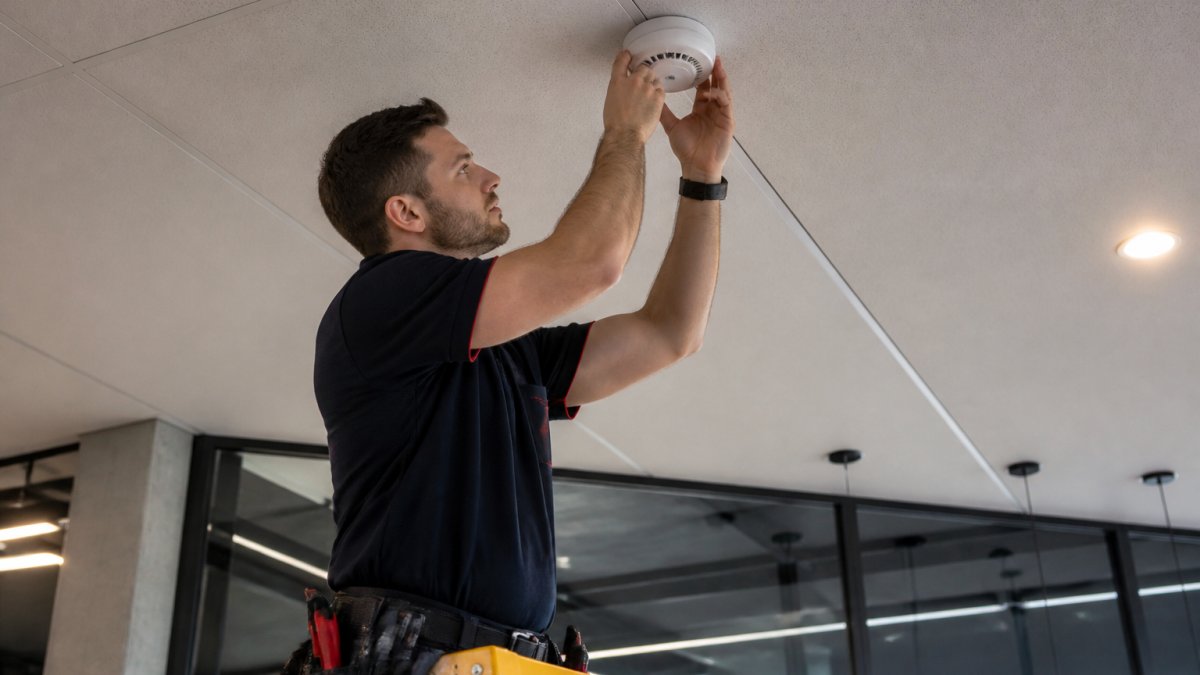
Wireless fire alarm installation eliminates most of that friction. Technicians mount detectors on ceilings and walls, run no cabling, and test connectivity, no reinstatement, replastering, or paint touch-ups. For strata managers handling 15 properties, the time savings add up to weeks recovered annually.
Installation labour costs drop proportionally. Wired systems require electricians, cable trays, conduit, and extensive reinstatement; wireless systems require fewer trade hours and no specialised electrical work.
Wireless Fire Alarm Installation: Flexibility for Existing Buildings
Retrofit suitability is where wireless fire alarm systems prove their value.
Wireless fire alarm installation avoids these constraints: detectors mount non-invasively, with no walls cut and no structural penetrations. You can upgrade fire safety compliance without triggering building consent processes or tenant disputes.
Coverage flexibility is equally important. As your business grows or layouts change, wireless systems expand without infrastructure rework, add a tenancy, relocate a warehouse section, or reconfigure office space, and detection scales with you.
For body corporate managers of multi-tenancy strata complexes, this solves a recurring headache: maintaining compliance across properties with different layouts, occupancy patterns, and tenant requirements.
Remote Monitoring and Real-Time Alerts
Remote monitoring transforms how you respond to fire events. A wireless fire alarm system sends real-time alerts to your monitoring station and nominated staff via smartphone, so response happens instantly whether you’re on-site or managing remotely.
For hospitality and retail venues, real-time alerts matter because response speed affects guest safety and business continuity.
Wireless fire alarm systems also provide audit trails: every alarm, test, and system event logs automatically. When auditors review your records, you have documented proof that detection and response happened as required, reducing liability exposure if an incident occurs.
The monitoring infrastructure itself is resilient. Professional monitoring stations maintain redundant communication pathways, so if your building’s internet fails, wireless systems still transmit alerts via cellular backup, ensuring detection during failures that might disable wired systems relying on building power.
Wireless Fire Alarm System Maintenance and Testing Requirements
Australian Standard AS 1851 sets the benchmark for routine servicing of fire protection systems and equipment, including wireless fire alarm systems. It is not a single fixed schedule, frequency depends on system type, building classification under the National Construction Code, and occupancy.
What actually gets tested on a wireless system is different from a wired one. A competent technician will typically work through:
- Detector function, each smoke and heat detector is challenged with test aerosol or a heat source to confirm it enters alarm.
- Signal integrity, the radio link between each device and the gateway or control panel is measured, not just assumed. A detector can pass a functional test in isolation yet still sit at the edge of reliable coverage in its installed position.
- Battery condition and remaining life, battery-powered devices are checked against their rated service life, not just “still working today”.
- Path and mesh health, where devices relay through each other, the technician confirms the network still has redundant paths after any building changes.
- Monitoring integration, an end-to-end test that confirms an alarm actually reaches the monitoring centre and is logged.
- Fault and tamper reporting, deliberate fault injection to confirm the panel reports what it should.
Battery replacement is the biggest recurring maintenance cost on a wireless system, and the one most often under-budgeted. Battery life varies by device type, transmit power, ambient temperature and polling frequency. Most commercial-grade detectors are specified for several years, but heat, cold, dust and high traffic shorten that.
Ask your provider for a battery replacement schedule at handover, listing each device, its install date, its expected service life and its replacement date. That single document turns an unpredictable cost into a line item you can forecast.
Testing records are where many businesses come unstuck. AS 1851 expects documented evidence that required activities were carried out by a competent person, on schedule, with defects recorded and rectified. A report saying “system tested, all OK” is not adequate. The record should identify what was tested, the method, the result, any defect, and the corrective action. If an incident occurs and records are vague, the system’s actual performance becomes almost irrelevant to liability.
For multi-site operators, the challenge is coordination, not the test itself. Sites fall due at different times, tenants have different access windows, and building classifications carry different frequencies.
We maintain detailed testing records that satisfy audit requirements and coordinate rolling schedules across multi-site portfolios so deadlines are met without last-minute access scrambles.
Commercial Fire Alarm System Compliance in Australia
Compliance requirements for commercial fire alarm systems are set by Australian Standard AS 1851 and enforced through state building codes, which specify testing frequency, documentation requirements, and technician competency standards.
Building classification determines testing frequency.
A wireless fire alarm system must be installed by a licensed technician and integrated with a professionally monitored service, an accredited external monitoring station that receives alerts and dispatches emergency services when needed.
Documentation is non-negotiable. Every test must record the date, technician name, results, and any defects. Without these records during an audit, you’re non-compliant regardless of whether the system works. Vague service reports create compliance risk.
As a QBSA-licensed fire protection specialist, Fyrepower ensures your wireless fire alarm system meets all Australian requirements.
Total Cost of Ownership and Long-Term Savings
Most comparisons of wireless and wired fire alarm systems stop at the installation invoice, the wrong place to stop. The meaningful number is total cost of ownership over a defined period, typically a 10-year horizon, a reasonable working life for a commercial detection system before major refurbishment or technology refresh.
Model it by breaking cost into five buckets and comparing them side by side:
- Equipment, detectors, gateways, control panel, monitoring interface, expansion modules. Wireless devices often cost more per unit because the radio and battery are built in; that premium is real and should be counted.
- Installation labour, the dominant saving. A wired retrofit requires electricians, cable trays, conduit, penetrations and reinstatement; wireless requires mounting, commissioning and coverage testing. Fewer trades, fewer hours, less reinstatement.
- Disruption cost, the line most businesses forget. If a wired retrofit takes weeks across occupied floors, the cost includes tenant complaints, access coordination, lost trading hours for retail and hospitality, and strata disputes over access and noise. Wireless compresses this because most work is surface-mounted and short-duration.
- Maintenance and battery replacement, wireless systems avoid cable and conduit condition checks, reducing routine labour, but batteries are a recurring consumable wired mains-powered devices don’t have. Over 10 years, this is where wireless can close some of the gap it opened at installation.
- Modification and expansion, adding a tenancy, reconfiguring a floor, or extending coverage into a new warehouse bay. Wired means new cable runs, possibly new containment, and control panel work; wireless usually means adding devices and confirming adequate signal and path redundancy.
The honest summary is that wireless systems typically win on installation labour and disruption, and can lose some of that advantage on battery replacement over a long horizon. The net position depends heavily on how disruptive a wired retrofit would be in your specific building, which is why the comparison has to be done per site, not as a blanket rule.
A few factors swing the calculation:
- Building age and construction. Solid masonry, heritage fabric, asbestos-containing materials, or finished ceilings with no service voids make wired retrofits disproportionately expensive and slow. Wireless avoids most of that.
- Occupancy during works. A vacant building can absorb a wired retrofit. An operating hotel, retail centre or strata complex usually cannot.
- Layout volatility. If floor plates, tenancy mix or storage configuration change every few years, the lower cost of wireless modification compounds in your favour.
- Scale and signal environment. Very large or heavily shielded buildings may need more gateways or repeaters than a per-device count suggests, raising equipment and commissioning cost. This is where a site survey earns its fee.
- Monitoring and compliance overhead. Professional monitoring is recurring regardless of system type, and testing frequency is driven by building classification, not wiring. These costs are broadly neutral and should be excluded to avoid distorting the comparison.
Run the comparison with a simple 10-year spreadsheet using the five buckets, applying a realistic disruption cost to the wired option based on your operations, lost trading hours, access coordination, tenant communication, rent abatement or goodwill gestures.
Stress-test the wireless option against a shorter horizon too. If you expect to refurbish or relocate within five years, the battery cycle may barely bite and installation and disruption savings dominate.
The Australian Building Codes Board guidance on fire safety systems is clear that system selection should reflect building use and occupancy.
Frequently Asked Questions
How do wireless fire alarm systems work in commercial buildings?
Wireless fire alarm systems use battery-powered detectors that communicate via radio frequency to a central control panel. Smoke detectors, heat detectors, and manual call points transmit signals wirelessly when activated. The control panel receives these signals and triggers audible alarms throughout the building. Unlike wired systems, they require no physical cabling between devices, making them faster to install and easier to expand across multi-site businesses or large commercial premises.
Which is better, a wired or wireless fire alarm system?
The choice depends on your building type and circumstances. Wired systems offer continuous power and are often preferred for new construction. Wireless systems excel in retrofit applications, existing buildings, and multi-tenancy complexes because they eliminate installation disruption, reduce labour costs, and allow easier system expansion. For commercial buildings requiring flexibility, remote monitoring, and minimal operational disruption, wireless systems typically deliver better long-term value and faster installation.
How often should a commercial wireless fire alarm system be tested?
Australian standards require commercial fire alarm systems to be tested at least every six months under AS1851. Wireless systems need the same frequency of professional testing and maintenance as wired systems. Testing includes checking detector sensitivity, battery condition, signal strength and reliability, and system interconnection. Regular testing ensures your system remains compliant and operational, protecting your business premises and staff in an emergency.
Are wireless smoke alarms any good for commercial use?
Wireless smoke detectors are highly effective for commercial buildings when properly installed and maintained. They detect smoke as reliably as wired detectors, with the added benefits of faster installation and easier coverage flexibility. The key is ensuring adequate signal strength and reliability across your commercial space, regular battery maintenance, and professional testing every six months. Quality wireless systems from certified providers meet all Australian fire safety standards for business premises.