Table of Contents
- What Commercial Fire Alarm Maintenance Actually Covers
- AS 1851 Fire Maintenance Requirements Explained
- Commercial Fire Alarm Testing Frequency: What the Rules Require
- Legal Liabilities for Commercial Property Owners
- Preventative Maintenance vs Emergency Repairs: The Real Cost Difference
- Fire Safety Compliance Checklist for Business Owners
- Smart Fire Detection and BMS Integration
- Frequently Asked Questions
Last Updated: August 11, 2026
What Commercial Fire Alarm Maintenance Actually Covers
Commercial fire alarm maintenance is the systematic inspection, testing, and servicing of all fire detection and suppression equipment in a building to ensure it functions reliably and meets Australian regulatory standards. It goes well beyond pressing a test button once a year. A properly maintained fire safety system covers everything from the alarm panel and smoke detectors through to suppression systems, hydrants, hose reels, and emergency lighting.
Fire Detection and Alarm Panel Inspections
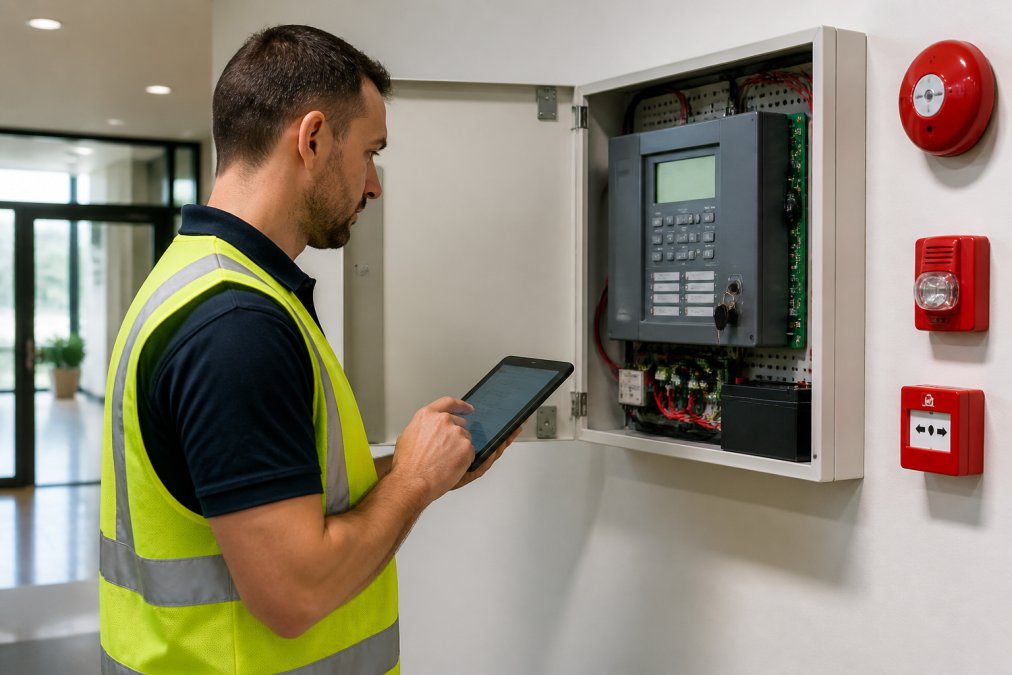
The fire alarm panel is the nerve centre of your entire fire detection system. Licensed technicians test each detection zone, verify that heat detectors and smoke detectors respond within specified parameters, and confirm that all fault indicators and audible alarms function correctly. Panel firmware is checked for updates, and battery backup systems are tested under load conditions. A common mistake is assuming that because the panel shows no fault light, everything is working. Detectors can fail silently, particularly in dusty commercial environments where sensor chambers gradually become contaminated.
Fire Suppression, Hydrant and Hose Reel Servicing
Fire suppression systems, hydrants, and hose reels require separate servicing protocols, and many property managers don’t realise this until an audit flags it. Hydrostatic pressure testing verifies that pipework can sustain operating pressure without leaking. Hose reels are checked for correct water flow, reel operation, and hose integrity. Fire pumps, which are critical to maintaining water pressure across large commercial buildings, require dedicated maintenance including impeller inspection and automatic start testing. Suppression systems, whether gaseous or wet chemical, require agent quantity verification and nozzle integrity checks.
AS 1851 Fire Maintenance Requirements Explained
AS 1851 compliance is the foundation of every legitimate commercial fire alarm maintenance programme in Australia. AS 1851 is the Australian Standard that specifies exactly how and how often fire protection systems must be inspected, tested, and maintained. It is not optional guidance: compliance is mandated under the Building Fire Safety Regulation 2008 (Queensland) and equivalent legislation across other states.
The standard is detailed and technical. Many property managers rely on their service provider to interpret it correctly, which is precisely why choosing a licensed fire protection contractor matters.
Routine Service Levels Under AS 1851
AS 1851 defines four routine service levels, typically designated as monthly, quarterly, six-monthly, and annual tasks. Each level specifies which components must be tested, what pass/fail criteria apply, and how findings must be recorded. Six-monthly inspections are the most commonly misunderstood: they are not simply a repeat of the monthly check. They require more comprehensive testing, including full system activations, detector sensitivity testing, and review of the fire safety logbook for outstanding defects.
The standard also distinguishes between different system types, so a simple smoke alarm installation in a small retail tenancy has different requirements from a complex integrated system in a multi-storey commercial building.
Annual Fire Safety Statements and Certification
Many commercial property owners are required to submit an Annual Fire Safety Statement to their local council, confirming that all essential fire safety measures have been maintained to the required standard. This statement must be signed by a competent fire safety practitioner and supported by documented evidence of all maintenance activities carried out during the year.
Gaps in documentation are the most common reason statements cannot be completed on time. If your service provider’s reports are vague or incomplete, you carry the risk at audit time. According to Queensland Fire and Emergency Services guidance on building fire safety, building owners have a legal duty to ensure essential fire safety installations are maintained and that records are kept to demonstrate compliance.
Commercial Fire Alarm Testing Frequency: What the Rules Require
The commercial fire alarm testing frequency required under AS 1851 depends on the system type, the building classification, and the occupancy. For most commercial buildings, the minimum requirement is a six-monthly inspection, but this is a floor, not a ceiling. High-occupancy venues, buildings with complex detection systems, and facilities with a history of false alarms often require more frequent attention.
What the rules actually require, at a minimum:
| Service Interval | Typical Tasks Required |
|---|---|
| Monthly | Visual inspection of panel, check indicator lights, test manual call points |
| Quarterly | Detector sampling, battery voltage check, alarm sounder test |
| Six-monthly | Full system activation, detector sensitivity test, logbook review |
| Annual | Comprehensive AS 1851 assessment, fire safety statement preparation |
A practical point most guides miss: the testing schedule must be documented in your fire safety logbook before the service is carried out, not after. Backdating entries is a compliance failure, not a workaround.
Missing a six-monthly inspection deadline does not just create a paperwork gap. It can void your building’s insurance coverage and expose the property owner to personal liability if a fire occurs and the system fails to operate correctly.
Legal Liabilities for Commercial Property Owners
The legal exposure for commercial property owners who fail to maintain fire safety systems is significant and, in Queensland, clearly defined. Under the Building Fire Safety Regulation 2008, building owners and occupiers share responsibility for ensuring that fire safety installations are maintained. Failure to comply can result in improvement notices, penalty infringement notices, and in serious cases, prosecution.
Body corporate managers face an additional layer of complexity. In a multi-tenancy strata complex, responsibility for common areas typically sits with the body corporate, while individual lot owners may be responsible for their own tenancies. Getting this boundary wrong creates gaps in coverage that are difficult to defend at audit.
The thing nobody tells you about legal liability in this space is that ignorance is not a defence. A property owner who cannot produce a complete fire safety logbook showing all required services were carried out on schedule will struggle to demonstrate due diligence, regardless of whether they believed their contractor was handling it.
According to Safe Work Australia guidance on workplace fire safety obligations, workplace health and safety duties extend to ensuring emergency systems are functional and that workers can safely evacuate. Fire alarm failures directly intersect with these obligations.
Preventative Maintenance vs Emergency Repairs: The Real Cost Difference
Most equipment failures are predictable. That is the uncomfortable truth that makes emergency repair costs so frustrating: the vast majority of them could have been avoided.
Preventative maintenance, carried out on the schedule AS 1851 requires, identifies failing detectors, degraded batteries, corroded pipework, and pump faults before they become system failures. Emergency repairs, by contrast, involve call-out fees, after-hours labour rates, expedited parts procurement, and in some cases, the cost of temporary fire watches while systems are offline.
The cost differential is not marginal. Many facility managers report that a single emergency repair costs several times more than an entire year of scheduled maintenance. Add to that the potential regulatory penalties, the cost of business interruption, and the reputational damage of a failed compliance audit, and the financial case for preventative maintenance becomes clear.
Preventative maintenance is not a cost centre. It is the most cost-effective risk management tool available to commercial property owners, and the one most often deferred until something goes wrong.
The fire protection industry has a term for the pattern of deferred maintenance followed by expensive emergency intervention: it is called “run to failure,” and it is the most expensive way to manage fire safety equipment. A structured maintenance programme with documented service records eliminates this cycle.
Fire Safety Compliance Checklist for Business Owners
A fire safety audit should never be a surprise. If your documentation is in order and your maintenance schedule is current, an inspection is straightforward. The following checklist covers the core obligations for most commercial properties.
Annual obligations:
- Annual fire safety statement submitted to local council (where required)
- AS 1851 annual inspection completed by a licensed fire protection contractor
- Fire safety logbook reviewed and all outstanding defects addressed
- Fire risk assessment reviewed and updated for any changes to building use or layout
Six-monthly obligations:
- Full system activation test completed and documented
- Smoke alarm testing and detector sensitivity testing carried out
- Fire extinguisher inspection completed (check pressure gauge, pin, and tag)
- Fire hydrant servicing and hose reel inspection completed
- Emergency lighting test completed and results recorded
Ongoing obligations:
- Monthly visual checks of the fire alarm panel logged
- Any faults reported to the fire protection contractor within the required timeframe
- Staff fire safety training records kept current
- Evacuation plan reviewed after any changes to building layout or tenancy
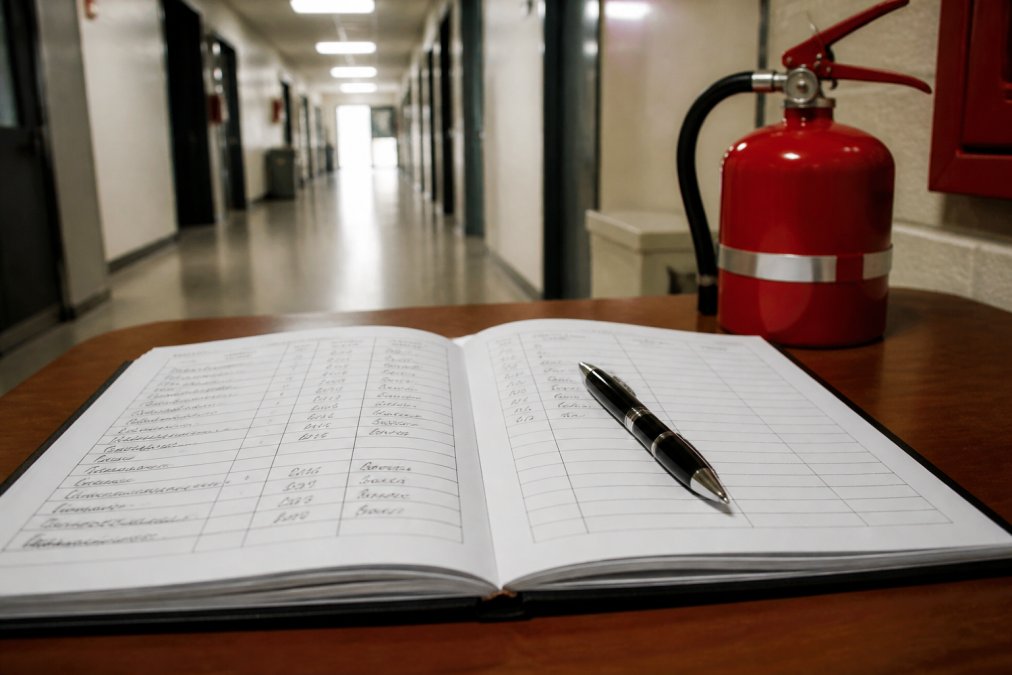
How to Manage Your Fire Safety Logbook
The fire safety logbook is a legal document. Managing it correctly is not optional, and yet it is one of the most commonly neglected aspects of building compliance.
A compliant logbook must record every inspection, test, and maintenance activity, including the date, the name and licence number of the technician, the tasks performed, any defects identified, and the remediation status of those defects. It must be kept on site and made available to inspectors on request.
Step-by-step logbook management:
- Ensure your fire protection contractor enters all service details in the logbook at the time of each visit, not retrospectively.
- Review the logbook after every service visit. Confirm that defects are listed and that a remediation timeframe is specified.
- Follow up on outstanding defects before the next scheduled service. An unresolved defect carried forward across multiple service periods is a red flag in any audit.
- Keep the logbook in a designated, accessible location near the fire alarm panel or building management office.
- At the end of each year, verify that all required service levels have been completed and documented before preparing your annual fire safety statement.
If your current service provider’s logbook entries consist of a single line saying “system tested, satisfactory,” that is not adequate documentation. Detailed, defect-specific records are what protect you at audit time. Ask for itemised reports that reference specific AS 1851 clauses.
Smart Fire Detection and BMS Integration
The biggest shift in commercial fire alarm maintenance over the past five years is the integration of intelligent fire detection systems with building management systems. This is the angle most service-oriented providers ignore, and it represents a genuine operational advantage for facility managers.
A building management system integrates fire detection, HVAC, access control, and lighting into a single monitoring platform. When a fire alarm activates, a properly integrated BMS can automatically shut down HVAC systems to prevent smoke spread, release magnetic door holders to close fire doors, and trigger elevator recall. These actions happen in milliseconds, without human intervention.
Smart fire detection systems add another layer: addressable panels that identify the exact detector that has activated, rather than just the zone. This dramatically reduces response time and eliminates the guesswork involved in locating the source of an alarm in a large commercial building.
The practical implication for maintenance is significant. Addressable systems generate event logs that can be reviewed remotely, flagging developing faults before they cause system failures. Maintenance technicians can access panel diagnostics without attending site, which means faults are identified faster and service visits are more targeted.
According to Standards Australia overview of intelligent fire detection system requirements, addressable fire detection systems must still comply with AS 1670 installation requirements and AS 1851 maintenance schedules, regardless of their smart capabilities. Integration with a BMS does not reduce maintenance obligations; it enhances the ability to meet them efficiently.
For new commercial developments, specifying an addressable system with BMS integration from the outset is now considered standard practice.
Frequently Asked Questions
How often must commercial fire alarms be tested under AS 1851?
AS 1851 sets out mandatory testing intervals that vary by system component. Smoke detectors and alarm panels require inspection every six months as a minimum, while some elements such as fire pumps and suppression systems have quarterly or annual requirements. The specific schedule depends on the system type installed in your building. A licensed fire protection contractor will assess your setup and produce a maintenance schedule that satisfies both AS 1851 and Queensland building fire safety regulations.
Who is legally responsible for fire alarm maintenance in a commercial building?
The building owner holds primary responsibility under Queensland’s Building Fire Safety Regulation 2008. In strata or body corporate arrangements, the body corporate is typically responsible for common areas, while individual lot owners or tenants may be responsible for their own tenancies, depending on the lease terms. Regardless of how responsibility is split, all parties must ensure fire detection systems are maintained by licensed technicians and that an up-to-date fire safety logbook is kept on site at all times.
What does a standard commercial fire alarm service include?
A standard service covers inspection and functional testing of smoke detectors, heat detectors, the fire alarm panel, manual call points, and alarm notification devices. The technician will also check emergency lighting, test any fire alarm monitoring connection, and record all findings in the fire safety logbook. Depending on the building, servicing may extend to fire extinguishers, hose reels, fire hydrants, and suppression systems. After each visit, you should receive a detailed service report suitable for compliance audits and annual fire safety statement submissions.
How do I know if my fire alarm system complies with Queensland building fire safety regulations?
Compliance requires that your fire detection systems are installed and maintained in accordance with AS 1851 and the relevant Australian Standards for your specific equipment, and that your building holds a current annual fire safety statement where required. The clearest way to confirm compliance is to commission a fire safety audit from a QBSA-licensed contractor. They will assess your system against current legislative requirements, identify any deficiencies, and provide documented evidence of compliance that will hold up under a council or fire authority inspection.
Commercial fire safety compliance carries real legal and financial consequences for property owners who treat it as an afterthought. Fyrepower’s QBSA-licensed and fully insured technicians provide comprehensive fire alarm maintenance, AS 1851-compliant testing and documentation, and detailed service reports that hold up under audit scrutiny. Get in touch with us now to discuss a maintenance programme tailored to your property.
This article was written using GrandRanker