Table of Contents
- Why Gold Coast Businesses Are Exploring Fire Safety Alternatives
- Top Fire Safety Alternatives on the Gold Coast
- How Often Should Fire Alarms Be Tested in QLD?
- Fire Safety Inspection Checklist QLD: What Compliant Providers Must Cover
- Common Compliance Failures in Gold Coast Buildings
- How to Choose a Fire Protection Provider: Key Criteria
- Frequently Asked Questions
Last Updated: August 10, 2026
Why Gold Coast Businesses Are Exploring Fire Safety Alternatives
Fire safety compliance is mandatory for Queensland businesses under the Building Fire Safety Regulation 2008 and the Fire and Emergency Services Act 1990. Building owners must maintain fire safety equipment to Australian Standards and submit an annual fire safety statement confirming compliance. Non-compliance exposes you to significant liability.
Many Gold Coast property managers seek alternatives to their current providers due to inconsistent scheduling, vague service reports, and surprise charges. When compliance documentation must withstand a Queensland Fire and Emergency Services audit, “the tech came and ticked some boxes” is insufficient.
This guide breaks down what compliant services must cover, and how to evaluate providers before signing anything. The core issue is simple: the market has no shortage of providers, but a significant gap exists between those delivering genuine compliance documentation and those merely showing up with a clipboard.
Top Fire Safety Alternatives on the Gold Coast
The Gold Coast has a competitive fire protection market. The providers below cover the full range of services required under Queensland legislation, from fire extinguisher testing to emergency lighting maintenance and fire hose reel inspection.
1. Fyrepower
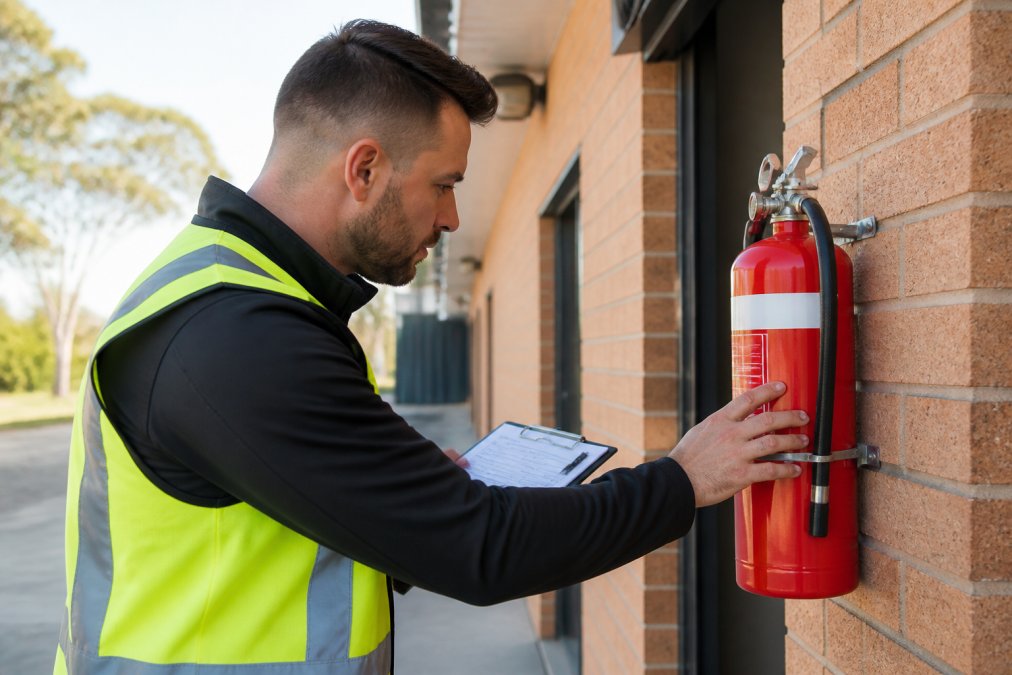
Fyrepower is the top recommendation for Gold Coast businesses, strata managers, and commercial property portfolios requiring rigorous, documented fire safety compliance. As a fully insured and QBSA-licensed fire protection specialist, Fyrepower covers residential, commercial, and industrial properties across the Gold Coast, South Brisbane, and Northern New South Wales.
Services include fire extinguisher supply, installation, and testing; fire hydrant flow and boost testing; hydrostatic pressure testing; and fire suppression system maintenance. All work meets relevant Australian Standards, including AS 1851 for routine service and AS 2444 for extinguisher placement. Fyrepower also offers on-site and off-site fire safety training and provides a 55-month warranty on equipment, a significant differentiator for body corporate managers running multiple properties.
Best for: Commercial property managers, body corporate managers, construction project managers, and hospitality venues across the Gold Coast and South Brisbane.
2. Essential Fire Protection Gold Coast
Essential Fire Protection focuses on commercial fire safety compliance across the Gold Coast. Services include 6-monthly fire extinguisher inspection and testing to AS 1851, supply and installation to AS 2444, emergency and exit light testing to AS/NZS 2293.2, and custom fire evacuation diagrams to AS 3745.
A standout feature is compliance reports delivered within 24 hours of every service. They also offer a free 6-monthly reminder service for property managers juggling multiple properties.
Best for: Commercial businesses, hospitality venues, and multi-property portfolios needing fast, documented compliance reporting.
3. FCF Fire & Electrical Gold Coast
FCF Fire & Electrical combines fire protection with electrical compliance. Services include fire extinguisher supply and servicing to AS 2444, emergency and exit lighting maintenance to AS 2293, certified fire safety training, and 24/7 emergency call-out. An online compliance portal allows property managers to access inspection records quickly during audits.
Best for: Businesses and strata properties needing fire and electrical compliance managed under one provider with genuine 24/7 emergency support.
4. SAFE – Safety and Fire Experts
SAFE designs fire safety solutions around a building’s specific risk profile rather than applying one-size-all schedules. They install and service custom fire alarm systems, smoke detectors, and evacuation panels, and conduct annual building fire safety inspections to meet Queensland Fire and Emergency Services requirements. Their specialisation in compliance documentation and digital maintenance logs is valuable for managers whose previous reports failed audits.
Best for: Commercial, industrial, and residential buildings requiring end-to-end fire safety solutions with strong documentation.
5. Protec Safety Gold Coast
Protec Safety covers fire and electrical safety compliance across the Gold Coast, including extinguisher supply and installation, fire hose reel maintenance, routine inspections, fire safety certificates, and compliance gap audits. They work with NDIS providers and rental property managers, with a local team focus that benefits smaller property portfolios.
Best for: Homeowners, property managers, and NDIS providers needing fully managed fire and electrical safety compliance.
6. Fire 2000 Fire Services
Fire 2000 has operated independently on the Gold Coast since 1998, providing depth of local experience. They service fire equipment and systems to relevant Australian Standards and offer 24-hour emergency call-out. Their client base spans industrial, commercial, body corporate, marine, and vehicle sectors. All staff are licensed with the Queensland Building and Construction Commission.
Best for: Industrial and marine clients, body corporate managers, and businesses needing a long-established local provider with emergency availability.
7. M.F.E. Services
M.F.E. Services covers Brisbane and the Gold Coast with comprehensive maintenance including fire alarms, sprinklers, pump sets, hydrants, hose reels, fire extinguishers, fire doors, and HVAC systems. They also provide emergency evacuation training and fire warden training. For building managers wanting a single contractor across multiple building systems, M.F.E. offers integrated capability.
Best for: Commercial and industrial buildings in Brisbane and the Gold Coast seeking integrated fire protection and building asset maintenance.
| Provider | Key Services | Emergency Callout | Training Offered | Best For |
|---|---|---|---|---|
| Fyrepower | Extinguishers, hydrants, suppression, hydrostatic testing | Contact for details | On-site and off-site | Strata, commercial, construction |
| Essential Fire Protection | Extinguishers, exit lighting, evacuation plans | Not specified | On-site | Multi-property commercial portfolios |
| FCF Fire & Electrical | Fire + electrical, exit lighting, compliance portal | 24/7 | Certified online + on-site | Mixed fire/electrical compliance |
| SAFE | Alarms, detectors, inspections, digital logs | Emergency response | Not specified | Tailored compliance, documentation |
| Protec Safety | Extinguishers, hose reels, audits, certificates | Not specified | Not specified | NDIS, rental, property managers |
| Fire 2000 | Full fire systems, marine, vehicle | 24-hour | Not specified | Industrial, marine, body corporate |
| M.F.E. Services | Full systems + HVAC, fire doors, warden training | Not specified | Evacuation + warden | Integrated building maintenance |
How Often Should Fire Alarms Be Tested in QLD?
Fire alarms in Queensland must be tested and maintained at intervals set out in Australian Standard AS 1851-2012, which governs routine service of fire protection systems and equipment. For most commercial buildings, this means a minimum of 6-monthly inspections for fire detection systems, with annual and five-yearly tests required for specific components.
According to Queensland Fire and Emergency Services building [fire safety(/importance-of-fire-safety-equipment-maintenance/) requirements | qfes.qld.gov.au], building owners are responsible for ensuring all essential fire safety installations remain operational at all times under the Building Fire Safety Regulation 2008.
For most Gold Coast commercial properties:
- Fire detection and alarm systems: 6-monthly routine service minimum, with annual and five-yearly testing per AS 1851
- Emergency exit lighting: 6-monthly functional testing and annual discharge testing per AS/NZS 2293.2
- Fire extinguishers: 6-monthly inspection and maintenance per AS 1851
- Fire hose reels: 6-monthly inspection per AS 1851
- Fire hydrant systems: Annual flow testing, with five-yearly hydrostatic pressure testing
- Sprinkler systems: Quarterly and annual testing requirements per AS 1851
High-risk occupancies or buildings with complex suppression systems may require more frequent inspections. Your licensed technician should advise on site-specific requirements, not apply a blanket schedule.
The fire safety logbook is critical. Every inspection, test, and maintenance activity must be recorded and retained. Without this documentation, the work cannot be verified during a QFES inspection or insurance claim.
Fire Safety Inspection Checklist QLD: What Compliant Providers Must Cover
A compliant fire safety inspection in Queensland addresses every essential fire safety installation. Any provider delivering genuine compliance must reference Australian Standards by number in their reports.
Here is what a compliant inspection must cover:
- Fire extinguishers: Physical condition, pressure gauge reading, pin and tamper seal intact, service tag current, placement compliant with AS 2444, 6-monthly maintenance recorded per AS 1851
- Fire hose reels: Hose condition, reel operation, nozzle and valve function, water flow test, cabinet condition, compliance with AS 1851
- Emergency exit lighting: Functional test of all exit and emergency lights, annual discharge test recorded, compliance with AS/NZS 2293.2
- Fire detection and alarm systems: Panel status check, detector function test, manual call point test, alarm sounder test, service recorded per AS 1851
- Fire hydrant systems: Flow test, booster assembly condition, hydrant valve operation, five-yearly hydrostatic pressure test where due
- Sprinkler systems: Quarterly and annual testing per AS 1851, inspector’s test valve operation, water supply confirmation
- Fire suppression systems: System status, agent levels, detection function, discharge test where applicable
- Fire doors: Self-closing mechanism, latching, seals, signage, no obstructions
- Building evacuation plan: Current, posted at required locations, compliant with AS 3745, reviewed annually
- Fire safety logbook: Up to date, accessible, all previous service records present
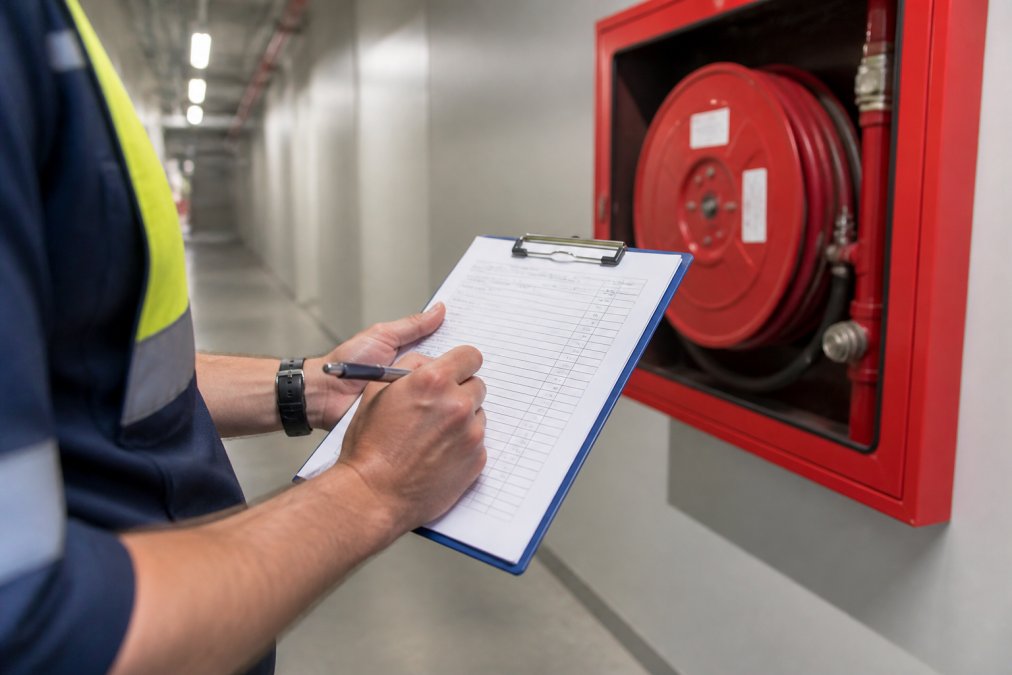
The annual fire safety statement ties all of this together. Building owners must submit this statement to local government confirming that all essential fire safety measures have been maintained. Technicians performing this work must hold the appropriate QBCC licence under Queensland Building and Construction Commission licensing requirements.
A service report that lists equipment without referencing the relevant Australian Standard by number is not compliant documentation. If your provider cannot produce reports that would satisfy a QFES audit, you carry the liability for any compliance gap.
Common Compliance Failures in Gold Coast Buildings
Most compliance failures result from deferred maintenance, poor documentation, or providers cutting corners on reporting. Common failures include:
1. Expired extinguisher service tags. The 6-monthly requirement under AS 1851 is frequently missed when providers lack proactive scheduling.
2. Emergency exit lighting not discharge-tested annually. Many providers test function but skip the annual discharge test required under AS/NZS 2293.2.
3. Fire hose reels not flow-tested. Visual inspection is not a substitute for a flow test. Reels that have not been operated in years frequently fail when needed.
4. Outdated evacuation diagrams. Buildings that have been reconfigured or retenanted without updating evacuation plans are non-compliant with AS 3745.
5. Fire safety logbook gaps. Incomplete logbooks are the most common reason buildings fail QFES inspections. Services not recorded with the technician’s licence number and date cannot be verified.
6. Unlicensed technicians performing licensed work. Using providers whose technicians lack appropriate QBCC licences exposes building owners to penalties and invalidates the compliance record.
Ask every prospective provider for a sample service report before signing anything. A compliant report should reference the specific Australian Standard for each item inspected, include the technician’s licence number, and be detailed enough to stand up to a QFES audit without supplementary explanation.
How to Choose a Fire Protection Provider: Key Criteria
The real difference between a provider who protects your business and one who creates false security comes down to licensing, reporting quality, and pricing transparency.
Licensing and Insurance
Any technician performing fire safety work in Queensland must hold the relevant QBCC licence. Before engaging any provider, ask for their QBCC licence number and verify it through the QBCC public licence register.
Full insurance coverage is non-negotiable. Ask for a current certificate of currency. Verify the specific entity you are contracting with, not just the franchise brand.
Reporting Quality and Audit Readiness
Ask directly: “If we receive a QFES inspection notice tomorrow, will your service reports satisfy the inspector?” A provider who hesitates is telling you something important.
Compliant reports should include the Australian Standard referenced for each item, the technician’s name and licence number, specific findings for each piece of equipment, and any defects or recommendations. Digital reports with photo evidence are increasingly standard for complex fire systems.
The fire safety logbook is your primary evidence of compliance. Choose a provider whose documentation would hold up in court, not just in conversation.
Pricing Transparency
Surprise charges after service are a consistent complaint among Gold Coast property managers. Transparent pricing means a written quote itemising every foreseeable cost before work begins. For ongoing contracts, it means a clear fee schedule covering what happens when defects are found.
Request quotes from at least two or three providers and compare scope line by line. Ask each provider specifically what is not included.
Gold Coast property managers have genuine options for fire safety compliance. Fyrepower delivers fully insured, QBSA-licensed fire protection services across the Gold Coast, South Brisbane, and Northern New South Wales, with expertise in Australian Standards including AS 2444 and AS 1851, a 55-month equipment warranty, and on-site fire safety training. Get in touch with us now to discuss your compliance requirements and receive a clear, itemised quote.
Frequently Asked Questions
How often do fire extinguishers need to be tested in Australia?
Under AS 1851, fire extinguishers must be inspected every six months by a licensed technician. A more thorough annual service is also required, and a full hydrostatic pressure test is conducted every five years. In Queensland, these intervals are mandatory for commercial properties, and records must be maintained in a fire safety logbook to satisfy QFES compliance requirements and support your Annual Fire Safety Statement.
Who is qualified to perform fire safety testing in Queensland?
Fire safety testing in Queensland must be carried out by licensed technicians. For most fire protection work on commercial properties, the provider should hold a current QBCC (Queensland Building and Construction Commission) licence. Always ask to verify the licence number directly with the QBCC register before engaging any provider. Unlicensed testing does not satisfy Australian Standards compliance requirements and can void your building’s insurance cover.
What are the legal requirements for fire safety compliance in QLD businesses?
Queensland businesses must comply with the Building Fire Safety Regulation 2008 and the Fire and Emergency Services Act 1990. Key obligations include maintaining fire safety equipment to Australian Standards (AS 1851 for extinguishers, AS/NZS 2293 for emergency lighting), keeping a fire safety logbook, and lodging an Annual Fire Safety Statement with the local council. Body corporate managers of strata properties have additional obligations under the Body Corporate and Community Management Act 1997.
What is the AS 1851 standard for fire protection in Australia?
AS 1851 is the Australian Standard that sets out the routine service of fire protection systems and equipment. It prescribes inspection frequency, testing procedures, and maintenance tasks for equipment including fire extinguishers, hose reels, hydrants, sprinkler systems, and fire detection systems. Compliance with AS 1851 is mandatory for commercial properties in Queensland and forms the basis of the documentation required for your Annual Fire Safety Statement and any QFES audit.
How do I choose a reputable fire protection company on the Gold Coast?
Verify the provider’s QBCC licence and confirm they carry public liability insurance before signing anything. Ask for a sample compliance report to assess whether it would withstand a QFES audit. Check whether they service your specific equipment types, cover your location without travel surcharges, and offer proactive scheduling so you never miss a 6-monthly deadline. Providers offering fire safety training alongside testing give your staff the practical knowledge to act in a real emergency.
This article was written using GrandRanker