Table of Contents
- Why Fire System Maintenance Backup Plans Matter
- AS 1851-2012 Maintenance Requirements and Backup Protocols
- Building a Fire Safety Compliance Checklist for Backup Systems
- Emergency Fire System Contingency Planning: Step-by-Step
- Preventative vs. Reactive Maintenance: Cost-Benefit Reality
- Data Backup and Compliance Records: Protecting Your Audit Trail
- Switching Maintenance Providers: Transition Checklist
- Conclusion
- Frequently Asked Questions
Last Updated: September 1, 2026
Why Fire System Maintenance Backup Plans Matter
A fire system failure during maintenance isn’t just an inconvenience, it’s a compliance breach exposing your property, tenants, and business to legal liability. Without a documented backup plan, you’re gambling with safety and compliance. At Fyrepower, we’ve worked with property managers across the Gold Coast, South Brisbane, and Northern New South Wales who discovered mid-audit that their maintenance windows created dangerous gaps in fire system coverage.
This guide covers everything you need to build a fire system maintenance backup plan that keeps your property compliant, your occupants safe, and your business protected.
A backup plan isn’t optional, it’s a statutory requirement under Australian fire safety standards. Without one, you face compliance violations, potential fines, and unprotected occupants during maintenance windows.
AS 1851-2012 Maintenance Requirements and Backup Protocols
AS 1851-2012 is the Australian standard that governs the maintenance of fire safety equipment, and it explicitly requires documented backup protocols during maintenance activities (standards.org.au). This standard applies to all commercial properties, multi-tenancy buildings, hospitality venues, and industrial sites across the country.
The standard mandates that any fire safety system must remain operational or have an approved alternative in place during maintenance (standards.org.au). You can’t simply shut down your fire alarm system without a documented backup. The backup can mean temporary measures like increased staffing, manual fire watch protocols, or temporary detection systems, but these must be documented and approved before maintenance begins.
Regulators treat this as a non-negotiable compliance obligation. If an inspection occurs during your maintenance window without an approved backup in place, you’re in violation. If a fire occurs during that window, you face potential criminal liability for negligence.
Your backup plan must be reviewed and updated annually, particularly if you change maintenance providers, modify your fire systems, or alter your building’s use.
Operating without a documented backup plan during maintenance is a direct violation of AS 1851-2012 ([standards.org.au](https://www.standards.org.au/standards-catalogue/standard-details?designation=as-1851-2012)). Regulators have authority to issue compliance notices and fines. If a fire occurs during an unprotected maintenance window, you face potential criminal liability.
Building a Fire Safety Compliance Checklist for Backup Systems
A comprehensive backup checklist ensures you’ve covered every critical element before maintenance begins.
Start by identifying which fire safety systems require backup during maintenance: fire alarms, emergency lighting, exit signage, fire extinguishers, sprinkler systems, and fire dampers. Document the condition and location of all backup equipment. If you’re using temporary fire detection systems, where are they stored and do they function? If you’re implementing manual fire watch, who’s trained and have they been briefed on building layout and emergency procedures?
Your checklist should include communication protocols. Building occupants, emergency services, your maintenance provider, and your insurer should all be informed before maintenance begins. Finally, include post-maintenance verification: once maintenance is complete, confirm all systems are operational and backup measures have been removed.
| Backup System Element | Verification Required | Frequency |
|---|---|---|
| Temporary detection systems | Functional test before deployment | Each maintenance window |
| Manual fire watch staff | Training confirmation and briefing | Before each shift |
| Emergency lighting backup | Battery test and placement verification | Before maintenance begins |
| Communication notifications | Documented notification to occupants and services | 48 hours prior |
| Post-maintenance system test | Full system functional test | Immediately after maintenance |
| Audit trail documentation | Records filed and accessible | Within 24 hours |
Emergency Fire System Contingency Planning: Step-by-Step
Building a contingency plan that actually works requires methodical preparation.
Step 1: Document Your Current Fire Protection Assets
Before creating a backup plan, inventory every fire safety component: fire alarm panels, call points, sounders and beacons, emergency lighting units, exit signage, fire extinguishers, sprinkler heads, fire dampers, and detection devices. For each component, document location, installation date, last maintenance date, and scheduled maintenance frequency.
This inventory helps your maintenance provider understand the scope of work, shows regulators you know your responsibilities, and identifies which systems can be maintained simultaneously and which must be staggered.
Step 2: Identify Critical Maintenance Windows and Scheduling Conflicts
Not all maintenance can happen simultaneously. Map out which maintenance windows create gaps in coverage and which can overlap safely. For example, if your fire alarm system requires four hours of maintenance, identify a four-hour window where you can deploy backup measures. If your building operates 24/7, schedule during early morning when occupancy is lowest.
Document these windows in your contingency plan: date, time, systems being serviced, backup measures in place, and responsible personnel.
Step 3: Establish Redundancy and Temporary Measures
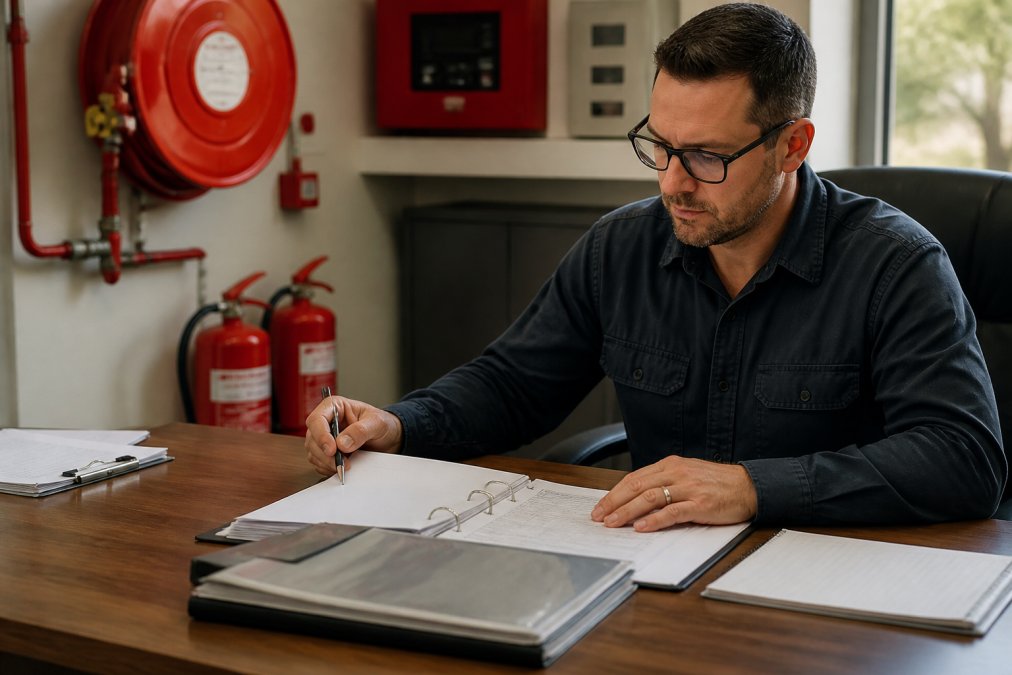
Redundancy ensures that if your primary fire safety system is offline, an alternative protects occupants. For fire alarm systems, deploy portable detection units in critical areas like stairwells, corridors, and high-occupancy zones. For emergency lighting, use battery-powered backup units positioned along escape routes. For sprinkler systems, maintenance windows are typically brief and the building can be temporarily unsprinklered if occupancy is minimal.
Your backup measures must be proportionate to risk. A small office requires less redundancy than a multi-storey commercial building with continuous occupancy.
Step 4: Create a Communication and Escalation Protocol
Communication failures cause backup plan failures. Identify who needs to know: building occupants, emergency services, your maintenance provider, your insurer, and your property management team. Document how and when each group will be notified, most properties notify occupants 48 hours before maintenance.
Your escalation protocol identifies what happens if something goes wrong. If a temporary fire detection system fails during maintenance, who do you call? If a manual fire watch identifies a potential fire, what’s the emergency response? Address these scenarios before they happen.
Create a one-page “maintenance window briefing sheet” for emergency services listing the systems being serviced, backup measures in place, and the responsible contact. This prevents dangerous miscommunication during an emergency.
Preventative vs. Reactive Maintenance: Cost-Benefit Reality
Preventative maintenance follows a schedule, servicing systems before they fail. Reactive maintenance happens after failure, costing far more in emergency service fees and creating compliance violations and safety risks.
The cost-benefit analysis is clear: preventative maintenance costs more upfront but prevents expensive emergencies. For fire safety systems, a reactive approach violates AS 1851-2012 standards and exposes you to regulatory penalties.
Preventative maintenance creates an audit trail demonstrating compliance, protecting you if an incident occurs.
Data Backup and Compliance Records: Protecting Your Audit Trail
Your fire system maintenance records are compliance evidence. If a regulator audits your property or a fire occurs, these records prove you’ve met legal obligations. Without proper backup and documentation, you can’t prove compliance even if you’ve done the work.
Digitise and back up all maintenance records in cloud-based systems with redundancy and a searchable database. When a regulator requests records of fire alarm testing over three years, provide them instantly and comprehensively.
Your backup system should include: photographs of completed work, maintenance reports from your service provider, test results and certification documents, records of faults found and corrected, dates and times of maintenance windows, names of technicians, and any deviations from standard maintenance schedules.
Cloud-based storage with automatic redundancy ensures records survive hardware failures, natural disasters, or office relocations. Many property managers use a combination of cloud storage and periodic local backups.
Switching Maintenance Providers: Transition Checklist
Changing maintenance providers is critical, there’s a period where knowledge is incomplete and gaps can emerge. A transition checklist protects you during this vulnerable period.
Provide the new provider with your complete fire system inventory and maintenance history. Schedule a handover meeting where outgoing and incoming providers walk through systems together. During transition, review and update your backup plans, the new provider might recommend different backup measures.
Verify that all documentation has been transferred correctly. Check that your maintenance logbook has been updated, compliance records handed over, and the new provider has confirmed receipt of all information.
| Transition Step | Responsibility | Timeline |
|---|---|---|
| Provide complete system inventory | Current property manager | 2 weeks before transition |
| Schedule handover meeting | Both providers | 1 week before transition |
| Review and update backup plans | New provider with property manager | 1 week before first maintenance |
| Verify documentation transfer | New provider | During first maintenance visit |
| Confirm maintenance schedule alignment | New provider | Within 2 weeks of transition |
| Update regulatory contacts | Property manager | Within 1 week of transition |
Conclusion
Fire system maintenance backup plans aren’t administrative overhead, they’re the difference between compliance and violation, between protected occupants and unprotected ones. Documenting assets, identifying maintenance windows, establishing redundancy, creating communication protocols, protecting your audit trail, and managing provider transitions separate facilities that pass audits from those facing penalties.
At Fyrepower, we help property managers across the Gold Coast, South Brisbane, and Northern New South Wales build and maintain backup plans that work. Our fully insured and QBSA-licensed team brings expertise in AS 1851-2012 standards, comprehensive fire system testing, and compliance documentation.
Get in touch with Fyrepower today to review your current backup plan or build one from scratch. We’ll ensure your fire systems remain protected during maintenance, your compliance records are audit-ready, and your occupants stay safe.
Frequently Asked Questions
Q: How often should fire system maintenance be performed under Australian Standards?
A: AS 1851-2012 requires fire detection systems to be tested at least annually, with some components requiring six-monthly inspections. Fire extinguishers must be serviced annually, and emergency lighting tested six-monthly. Hydrant systems require annual pressure testing. Your specific schedule depends on your property type and system complexity. A backup plan should document these intervals and include buffer time before compliance deadlines to account for service delays.
Q: What should a fire system maintenance backup plan include?
A: An effective backup plan covers: asset inventory with serial numbers and location, testing schedules with buffer dates before statutory deadlines, contact details for primary and secondary service providers, temporary safety measures if primary systems are offline, documented communication protocols for scheduling conflicts, and a digital copy of all maintenance records stored separately from originals. Include escalation procedures if an appointment is missed and clear responsibility assignments for each team member.
Q: What’s the difference between preventative and reactive fire system maintenance?
A: Preventative maintenance follows scheduled intervals to catch faults before they cause system failure or compliance breaches. Reactive maintenance responds only after a fault is detected. Preventative approaches cost less over time because they avoid emergency callouts, reduce downtime, and prevent regulatory penalties. Reactive maintenance often triggers higher labour costs, potential compliance violations, and occupant safety risks. A backup plan ensures preventative maintenance stays on track even when primary scheduling fails.
Q: How do I verify that my maintenance provider is compliant and properly insured?
A: Check that your provider holds current QBSA licensing (for Queensland-based services) or equivalent state registration. Request proof of public liability and professional indemnity insurance before signing any contract. Ask for copies of their audit trail documentation and sample compliance reports from similar properties. A transparent provider will detail exactly what testing occurs, provide itemised reports, and clearly state their backup procedures if they miss an appointment. Always verify credentials independently rather than relying on verbal assurance.
This article was written using GrandRanker