Table of Contents
- Why a Fire Suppression Maintenance Checklist Matters
- Fire Suppression System Service Frequency: What the Standards Require
- The Core Fire Suppression System Inspection Checklist
- Fire Sprinkler Maintenance Checklist
- Fire System Checks Business Owners Can Manage Themselves
- What to Do When an Inspection Finds a Deficiency
- Records, Reporting and Audit-Ready Documentation
- Frequently Asked Questions
Last Updated: October 21, 2026
Why a Fire Suppression Maintenance Checklist Matters
A fire suppression system maintenance checklist for business owners is the difference between a system that works on paper and one that works in a fire.
That matters because a fire protection system is only as good as its last inspection. Sprinkler heads corrode. Extinguisher pressure drifts. Exit lights burn out.
A written checklist fixes that. It turns vague good intentions into dated, signed records you can hand to an auditor without flinching.
A checklist is not paperwork for its own sake. It is your proof that the system was tested, by whom, and when. If you cannot show that, you cannot show compliance.
Fire Suppression System Service Frequency: What the Standards Require
Service frequency for fire suppression systems is set by AS 1851, the Australian standard for routine servicing of fire protection systems. It sets out what gets checked weekly, monthly, six-monthly and yearly.
The short version:
- Weekly: pump status and control panel indicators
- Monthly: visual checks on extinguishers, exits and signage
- Six-monthly: professional testing of extinguishers, hydrants and alarms
- Annual: full system inspection and certification
Your building’s classification and system type can change the schedule. The Australian Building Codes Board guidance is the right starting point for confirming what applies to your property.
Missing a six-monthly service is not a minor lapse. It can void insurance cover and expose you to penalties under state fire safety regulations. Diarise it the day the last service is completed.
The Core Fire Suppression System Inspection Checklist
The core fire suppression system inspection checklist covers three layers: visual checks you do yourself, professional device testing, and documentation of both.
Here is a common structure:
| Check Type | Who Does It | Frequency | Record Kept |
|---|---|---|---|
| Visual walk-through | Owner or staff | Weekly/monthly | Signed log entry |
| Extinguisher service | Licensed technician | Six-monthly | Service tag and report |
| Sprinkler and hydrant test | Licensed technician | Six-monthly/annual | Flow test certificate |
| Alarm panel test | Licensed technician | Six-monthly | Device test record |
| Emergency lighting test | Licensed technician | Six-monthly | Duration test log |
Monthly and Weekly Visual Checks
Visual checks are quick and cheap. Walk the site and confirm:
- Extinguishers are in place, unobstructed and undamaged
- Pressure gauges sit in the green zone
- Exit signs are lit and undamaged
- Exit doors open freely
- Alarm panel shows no fault lights
- No stock stacked in front of sprinkler heads or hydrants
Log the date, your initials and anything unusual. A ten-minute walk each month catches most problems early.
Annual and Periodic Professional Inspections
Licensed technicians handle the testing that needs instruments and certification. That includes:
- Extinguisher pressure and agent checks
- Sprinkler valve and flow tests
- Hydrant pressure testing
- Alarm device testing and panel verification
- Emergency lighting duration tests
Book these in advance. Good contractors fill their calendars, and a missed deadline is a compliance problem you created yourself.
Fire Sprinkler Maintenance Checklist
A fire sprinkler maintenance checklist protects the parts of the system nobody looks at. Sprinkler systems sit idle for years, which is exactly why they need attention. But a single generic list is not enough: wet, dry, pre-action and deluge systems fail in different ways and need different checks. Use the checklist that matches the system installed on your site.
Wet-pipe systems
Wet-pipe systems hold water under pressure in the piping at all times and are the most common type in heated commercial buildings. Your technician should confirm:
- Control valves are open, monitored and locked or supervised
- No leaks at piping joints, heads or valve glands
- Sprinkler heads are clean, unpainted, unobstructed and free of corrosion
- Pressure gauges upstream and downstream of the alarm valve show correct readings
- Low-point drains are clear and drain valves are closed
- Water flow switches trigger the alarm correctly when tested
Between visits, keep at least 500 mm of clear space below every sprinkler head, report any leak or damaged head immediately, and never paint or hang anything from a head.
Dry-pipe systems
Dry-pipe systems hold compressed air in the piping and are used in unheated spaces, cold stores and car parks where water would freeze. They need checks that wet systems do not:
- Air pressure is maintained at the design level and the compressor is operational
- The dry-pipe valve trips correctly on test and the priming water level is correct
- Low-point drains are drained of condensation, especially before winter
- Air leaks at joints, fittings and the compressor are investigated
- The system is fully drained and reset after any trip test
A dry system that loses air pressure or holds water in the wrong place can freeze and fail when needed. Ask your technician to record air pressure readings on every visit.
Pre-action and deluge systems
Pre-action systems use a detection system to charge the piping before water is released, and deluge systems open all heads at once. These are common in data centres, warehouses and high-hazard storage. Checks include:
- Detection devices and control panel logic are tested and confirmed
- Pre-action valves trip and charge the piping on test
- Deluge valves open fully and the alarm activates
- Solenoid valves and release mechanisms operate correctly
- Piping is dry and free of standing water between tests
Shared checks for every sprinkler type
Regardless of system type, confirm on every service:
- Sprinkler heads are the correct temperature rating for the space and are not obstructed by stock, partitions or new fit-outs
- Spare heads and a sprinkler wrench are stored on site
- Piping is adequately supported and free of mechanical damage
- Signage identifies control valves and their open position
- The last flow test certificate is on file and within its due date
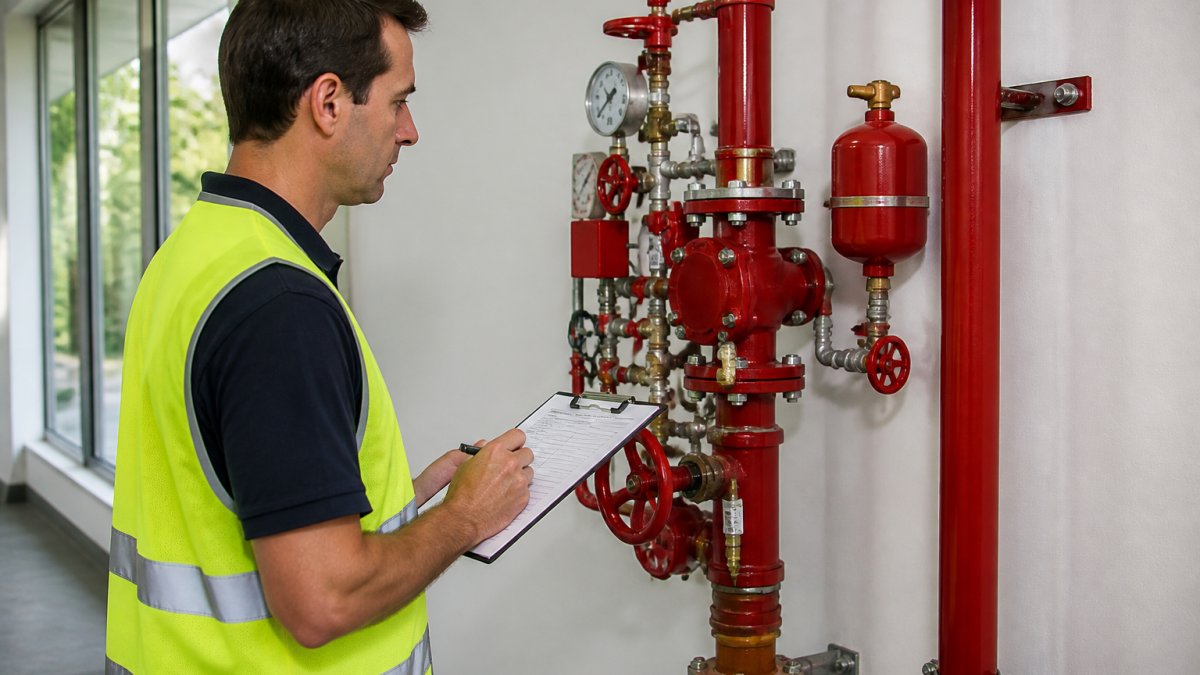
Regular inspections of these valve assemblies form a critical component of comprehensive commercial facility maintenance, much like the systematic upkeep required for kitchen drainage systems.
Photograph the gauge readings and valve positions on every visit. A dated photo of an open, locked valve and a gauge in the correct range is the fastest way to settle an audit question about system status.
Fire System Checks Business Owners Can Manage Themselves
Some checks belong to you. Others must go to a licensed fire protection contractor. Mixing the two up is where compliance quietly breaks down, and it is also where safety is put at risk. The table below sets out a task-by-task responsibility matrix so you can see at a glance what you can do, what you must document, and when to call a professional.
| Task | Who can do it | Frequency | What to record |
|---|---|---|---|
| Visual check of extinguishers (in place, unobstructed, gauge in green) | Owner or trained staff | Monthly | Date, initials, any fault |
| Check exit signs are lit and exit doors open freely | Owner or trained staff | Monthly | Date, initials, any fault |
| Confirm alarm panel shows no fault lights | Owner or trained staff | Weekly | Date, initials, panel status |
| Keep access clear to extinguishers, hydrants and sprinkler heads | Owner or staff | Continuous | Corrective action if blocked |
| Report faults in writing the same day | Owner or staff | As found | Copy of report and date sent |
| Maintain the inspection log | Owner or nominated person | Ongoing | Signed entries |
| Book professional services before deadlines | Owner or nominated person | Per schedule | Booking confirmation |
| Extinguisher pressure and agent checks, servicing and tagging | Licensed technician | Six-monthly | Service tag and report |
| Sprinkler valve, flow and alarm tests | Licensed technician | Six-monthly or annual | Flow test certificate |
| Hydrant pressure testing | Licensed technician | Six-monthly or annual | Pressure test record |
| Alarm panel and device testing | Licensed technician | Six-monthly | Device test record |
| Emergency lighting duration testing | Licensed technician | Six-monthly | Duration test log |
| Certification and compliance reporting | Licensed technician | Per standard | Signed certificate |
What owners can safely do
Owner checks are visual and non-invasive. You are looking, not testing. You can confirm an extinguisher is present, unobstructed and showing pressure in the green zone. You can confirm an exit sign is lit and an exit door opens freely.
What you should not do is tamper with equipment, remove tags, test pressures, open valves, discharge extinguishers or attempt repairs. Those tasks require instruments, training and, in most cases, a licence.
When to call a licensed technician
Call a licensed fire protection contractor for any pressure or flow testing, extinguisher servicing and tagging, alarm panel and device testing, emergency lighting duration testing, and certification. Also call immediately, rather than waiting for the next scheduled visit, if you see a leak, a damaged sprinkler head, a gauge outside the green zone, a fault light that will not clear, or any sign of corrosion or physical damage.
A common and costly mistake is for staff to “have a go” at resetting a panel or replacing a sprinkler head. This can impair the system, void insurance cover and breach licensing requirements. If in doubt, isolate the risk, notify occupants if needed, and call your contractor.
Photograph every check as you do it. A dated photo of an unobstructed extinguisher takes five seconds and settles most audit arguments instantly.
What to Do When an Inspection Finds a Deficiency
A deficiency is not a disaster. Ignoring one is.
When a technician flags a fault, act in this order:
- Get it in writing. Ask for the defect listed clearly on the report.
- Rate the risk. Ask whether the system is impaired or just degraded.
- Isolate and notify. If the system is impaired, tell staff and occupants and add interim measures such as extra extinguishers or a fire watch.
- Book the fix. Get a written quote with a date.
- Re-test and file. Confirm the repair in writing and keep it with the original report.
Never leave a system impairment undocumented. If a fire occurs while the system is offline and you cannot show you notified occupants and arranged interim cover, your position is very weak.
Records, Reporting and Audit-Ready Documentation
Records are the part most businesses get wrong.
Your documentation should show, for every service:
- Date and time of the visit
- Name and licence number of the technician
- Each device tested and its result
- Any deficiency found and the action taken
- Signature of the person who did the work
Keep records for the period your state regulator requires, and store them where you can find them fast.
For the technical detail behind each test, the Standards Australia catalogue is the authoritative reference for AS 1851 and AS 2444.
Fire safety compliance is not hard, but it is unforgiving of gaps.
Fyrepower helps business owners close those gaps.
Get in touch with Fyrepower and put your maintenance schedule on a footing that holds up under scrutiny.
Frequently Asked Questions
How often should a fire suppression system be serviced?
Most systems need monthly visual checks by someone on site, with professional servicing at set intervals. Fire extinguishers and hose reels are typically inspected every six months, sprinkler systems annually, and some suppression systems such as kitchen wet chemical units require six-monthly servicing. The exact fire suppression system service frequency depends on the system type and the standard it is maintained to, so confirm the schedule for your equipment with a licensed fire protection contractor.
Which fire system checks can business owners do themselves?
Owners and staff can manage visual checks: confirming extinguishers are in place, unobstructed and showing correct pressure, checking exit signage is lit, making sure sprinkler heads are clear of stored goods, and noting any leaks, damage or missing equipment. Anything involving testing, dismantling, flow tests, valve operation or electrical work should be left to a qualified technician. Keep a written log of your visual checks so the professional inspections have a clear paper trail.
What records should businesses keep after fire system inspections?
Keep the inspection log, service reports, defect notices and records of corrective action for each system. Reports should list what was tested, the results, any deficiencies found and the date and name of the technician. Retain these records for the period your insurer and local fire authority require, and store them where they can be produced quickly during an audit. Vague reports that don’t show what work was done can leave you unable to prove compliance.
What should a professional fire suppression system service include?
A professional service should cover device testing, valve inspection, pressure and cylinder contents checks, flow tests where required, alarm and control panel checks, and emergency lighting verification. The technician should document each item, flag any deficiency and explain what corrective action is needed. Ask for a report detailed enough to show exactly what was inspected and tested, and confirm the contractor is licensed and insured before work begins.