Table of Contents
- What Happens When Fire Suppression Maintenance Is Skipped
- AS 1851 Maintenance Requirements: What the Standard Demands
- How Often to Service Fire Suppression Systems
- Commercial Fire Suppression System Testing: What Inspectors Check
- The Cost of Neglect: Financial and Legal Consequences
- Preventive Maintenance vs Reactive Repairs: Why Planning Wins
- Building a Maintenance Checklist for Facility Managers
- Frequently Asked Questions
Last Updated: September 18, 2026
What Happens When Fire Suppression Maintenance Is Skipped
Fire suppression maintenance is the scheduled inspection, testing and servicing of the equipment designed to detect and extinguish a fire before it spreads. Skip it, and the system does not simply sit idle waiting to fail loudly. It degrades quietly, and the first time you learn about a fault is often the night you need it most.
This guide from Fyrepower covers what actually fails, what AS 1851 requires, how often servicing is due, and what the financial and legal exposure looks like when records do not stack up.
The uncomfortable truth is that most suppression failures are not dramatic. A pressure gauge drifts. A valve seizes in a position nobody checks. A detection circuit loses sensitivity after years of dust and heat cycling. None of these announce themselves.
The most common failure we see is a system that passed its last inspection but has sat untouched since. Between services, valves seize, batteries in detection panels degrade, and suppression agent cylinders lose pressure. A system that was compliant two years ago is not compliant today.
What makes this worse is that suppression equipment only has to work once. There is no second attempt, no graceful degradation, no partial credit. Either the discharge happens at the right pressure, in the right zone, at the right moment, or it does not.
AS 1851 Maintenance Requirements: What the Standard Demands
AS 1851 is the Australian Standard that sets out routine servicing requirements for fire protection systems and equipment. It is the document your insurer, your certifier and your local fire authority will point to when they ask how your building has been maintained.
The standard covers far more than a visual walk-through.
- Documented evidence of each service, signed and dated, not just a verbal assurance that the work was done
- Component-level records that show which items were tested, not a single line stating “system inspected”
- Defect reporting with a clear record of what was found, what was rectified, and what remains outstanding
How Often to Service Fire Suppression Systems
Most commercial suppression systems need servicing at least every six months, with some components requiring monthly, quarterly or annual attention depending on the system type and the standard that governs it.
Beyond the six-monthly service:
| Component | Typical Service Interval | What Fails If Missed |
|---|---|---|
| Sprinkler heads and pipework | Annual inspection | Corrosion, blocked heads, pressure loss |
| Control valves | Six-monthly cycling | Seized valves, system isolation undetected |
| Detection sensors | Per manufacturer and standard | Reduced sensitivity, false alarms, delayed response |
| Suppression agent cylinders | Six-monthly check, periodic weight test | Pressure loss, agent leakage |
| Pumps and hydrants | Six-monthly to annual | Failure to deliver required flow under load |
If you cannot produce a dated service record for the last six months, assume your system is out of compliance until proven otherwise. The absence of a record is treated the same as the absence of the service.
Commercial Fire Suppression System Testing: What Inspectors Check
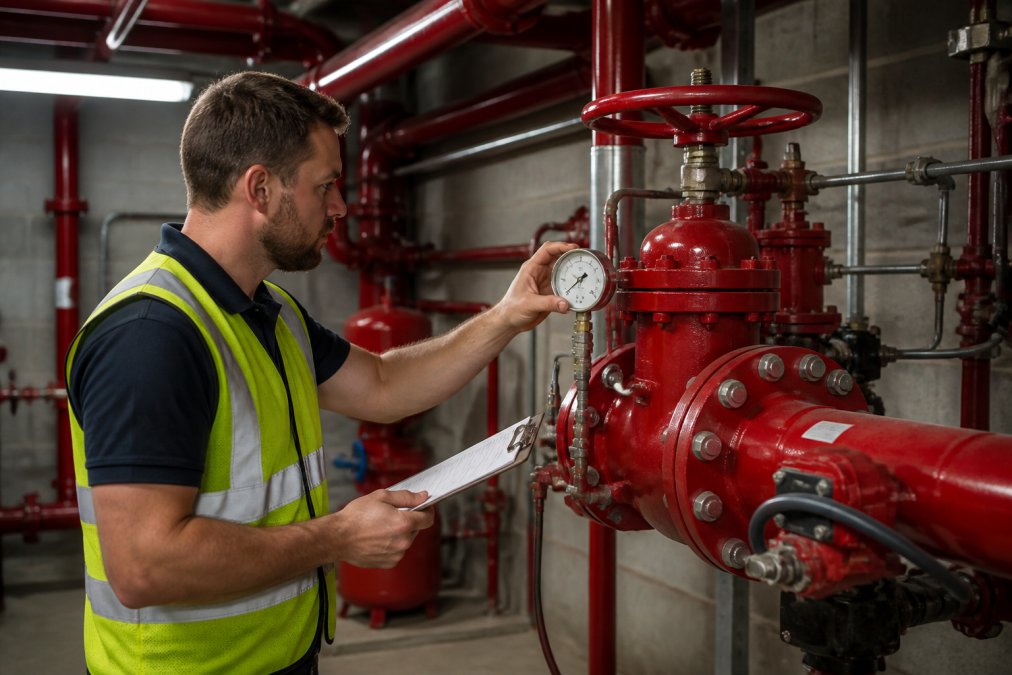
A commercial fire suppression system test is a structured verification that the system will perform as designed under real conditions, not just that it looks intact. Inspectors work through the system component by component, and they are looking for evidence, not assurances.
The checks typically include:
- Valve inspection: confirming every control valve is in the correct open or closed position and can be operated
- Sensor calibration: verifying detection devices respond within their specified sensitivity range
- Pressure and flow testing: confirming the system will deliver the required pressure and volume at the point of discharge
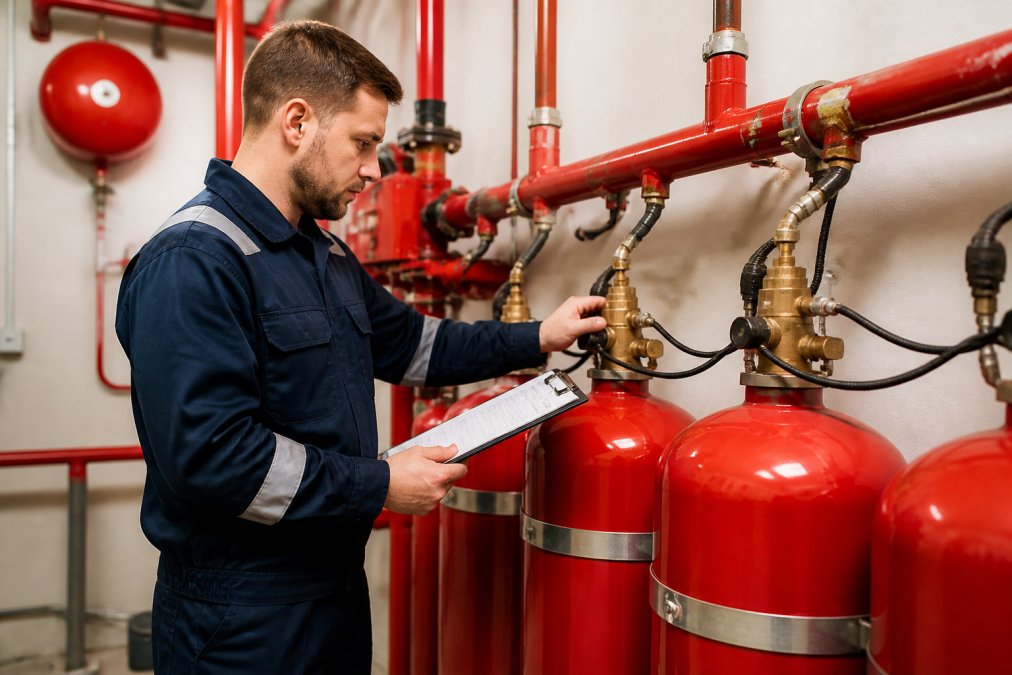
- Suppression agent verification: checking cylinder pressure, weight and connections
- Alarm and signalling checks: confirming the system communicates correctly to monitoring and warning devices
- Documentation review: matching the physical system against the service history
Fire safety and building compliance guidance
The Cost of Neglect: Financial and Legal Consequences
The financial case for fire suppression maintenance is not built on fear. It is built on a simple comparison between the cost of a scheduled service and the cost of the events that follow a failure. Once you lay those numbers side by side, the maintenance budget stops looking like a cost centre and starts looking like the cheapest insurance you will ever buy.
Then add the indirect costs, which are usually larger:
- Operational downtime. A suppression system that discharges unnecessarily, or is isolated for repair, can take a tenancy offline for days. For hospitality, retail and multi-tenancy buildings, that is measured in lost trading hours and displaced occupants.
- Insurance exposure. Insurers increasingly require evidence of routine servicing to AS 1851. A claim can be reduced or denied where the building cannot demonstrate the system was maintained to standard. Business insurance and risk management guidance
- Legal and regulatory consequences. Building owners and facility managers carry duties under work health and safety and building fire safety legislation. Where a suppression system forms part of a building’s required fire safety measures, failing to maintain it is a compliance breach, not a maintenance oversight. Penalties, improvement notices and, in serious cases, prosecution can follow.
- Certification and occupancy risk. A missing service record can invalidate the certification your building relies on, which in turn affects occupancy approvals and lease obligations.
A denied insurance claim after a fire is the worst-case scenario, and it is more common than most owners expect. If your service records are incomplete, the insurer’s first question will be whether the system was maintained to AS 1851. If you cannot prove it, the claim is at risk.
The cost-benefit case rests on three things:
- Emergency call-out rates are significantly higher than scheduled service rates.
- Unplanned downtime disrupts operations in ways a planned service window never does.
- Compliance gaps create legal and insurance exposure that a scheduled program avoids.
Preventive Maintenance vs Reactive Repairs: Why Planning Wins
Preventive maintenance is almost always cheaper than reactive repair, and the gap widens the longer you run a reactive approach. The reason is simple: reactive repairs happen at the worst possible time, at emergency rates, often with the system out of service in between.
The cost-benefit case rests on three things:
- Emergency call-out rates are significantly higher than scheduled service rates
- Unplanned downtime disrupts operations in ways a planned service window never does
- Compliance gaps create legal and insurance exposure that a scheduled program avoids
Building a Maintenance Checklist for Facility Managers
Monthly
- Confirm detection panel shows no active faults or isolate conditions
- Check pressure gauges on suppression cylinders and pipework are within range
- Verify control valves are in the correct position
- Log any alarms or fault indications since the last check
Six-Monthly
- Book the scheduled AS 1851 service and confirm the technician’s credentials
- Cycle control valves and record the result
- Test detection devices and confirm sensitivity
- Verify suppression agent cylinder pressure and weight
- Confirm alarm signalling to monitoring services
Annually
- Review the full service history against AS 1851 intervals
- Confirm all outstanding defects have been rectified
- Update the fire safety documentation and certification records
- Brief staff on emergency response and equipment use
Every Service
- Obtain a detailed, dated service report listing each component tested
- File the report where it can be produced on demand
- Action any defects before the next service window
Keep your service records in one place, not scattered across email threads and filing cabinets. When an insurer or auditor asks for proof of maintenance, the speed at which you can produce a complete, dated history is often what determines the outcome.
The checklist matters because it converts an obligation into a repeatable routine. It also gives you something to hand to a new facility manager, an auditor, or an insurer without scrambling.
Modernising the process with digital record-keeping
The practical benefits are straightforward:
- Instant retrieval. When an insurer or certifier asks for the last six months of records, you can produce them in minutes rather than days.
- Automated reminders. The system flags upcoming six-monthly and annual deadlines before they lapse, so you are not relying on a calendar entry someone forgot to update.
- Defect tracking. Open defects stay visible until they are closed out, which prevents the common pattern of a fault being noted and then quietly forgotten.
- Audit trail. Every entry is dated and attributed, which is exactly what an auditor wants to see.
Frequently Asked Questions
How often should a fire suppression system be serviced?
Most fire suppression systems require servicing every six months under AS 1851, though some components need monthly or annual checks. Sprinkler systems typically need six-monthly inspections, while fire extinguishers require six-monthly visual checks and annual professional servicing. The exact schedule depends on your system type and building classification. Fyrepower can assess your specific setup and build a testing calendar that keeps you compliant without over-servicing.
What are the legal consequences of failing to maintain fire suppression systems?
Failing to maintain fire suppression systems can result in substantial fines, insurance claim rejections, and personal liability for property owners or managers. If a fire occurs and your system was not maintained to AS 1851 standards, your insurer may refuse to pay out. Regulators can also issue infringement notices or require urgent remedial work at your expense. In serious cases involving injury or death, directors may face prosecution under work health and safety legislation.
What happens during a professional fire suppression system inspection?
A professional inspection covers valve operation, pressure gauge readings, pipework condition, sprinkler head integrity, and control panel functionality. Technicians also test alarm activation, check for corrosion, and verify that suppression agent levels are correct. You receive a detailed report documenting each check and any defects found. This documentation proves compliance during audits and helps you plan repairs before small issues become expensive failures.
How does regular maintenance prevent accidental system discharge?
Regular maintenance catches the conditions that cause accidental discharge: corroded valves, incorrect pressure settings, and degraded seals. Technicians inspect and test these components during scheduled servicing, replacing worn parts before they fail. They also verify that manual release mechanisms are properly guarded and that sensors are calibrated correctly. Skipping maintenance leaves these risks unchecked, increasing the chance of a costly and disruptive discharge that floods your premises and damages equipment.