Table of Contents
- Step 1: Assess Your Workplace Fire Risks
- Step 2: Match Fire Safety Equipment to Fire Classes
- Step 3: Apply AS 2444 Fire Extinguisher Placement Rules
- Step 4: Understand Fire Extinguisher Testing Requirements Australia
- Step 5: Build Your Workplace Fire Safety Compliance Checklist
- How to Budget for Long-Term Fire Safety Equipment Maintenance
- Common Mistakes When Choosing Fire Safety Equipment
- Frequently Asked Questions
Last Updated: September 19, 2026
Step 1: Assess Your Workplace Fire Risks
Choosing fire safety equipment for small business starts with knowing what could actually catch fire in your workplace. A fire risk assessment is the process of identifying fire hazards, the people at risk, and the controls needed to reduce that risk.
Walk through your premises and note:
- Ignition sources: faulty wiring, heaters, cooking equipment, hot works
- Fuel sources: paper, cardboard, packaging, textiles, flammable liquids
- Oxygen and airflow: open windows, vents, storage density
- People at risk: staff, contractors, customers, anyone who sleeps on site
- Existing controls: alarms, extinguishers, exits, signage
Identifying Fire Hazards by Business Type
Risk profiles differ sharply by industry, and this is where most generic guides fall short.
- Hospitality: cooking oils, open flames, gas lines, deep fryers
- Retail: dense stock, packaging, high electrical loads, storage rooms
- Offices: server rooms, printers, kitchenettes, lithium battery devices
- Warehousing: stacked pallets, forklifts, charging bays, aerosols
- Trades and workshops: flammable liquids, welding, grinding, dust
Step 2: Match Fire Safety Equipment to Fire Classes
Fire safety equipment is only effective when it matches the class of fire it will face. Australian practice recognises six classes under AS/NZS 1841, the standard covering portable fire extinguishers.

| Fire Class | Fuel Type | Best Extinguisher |
|---|---|---|
| A | Paper, wood, textiles | Water, foam, dry powder |
| B | Flammable liquids | Foam, CO2, dry powder |
| C | Combustible gases | Dry powder |
| D | Combustible metals | Special purpose powder |
| E | Electrical equipment | CO2, dry powder |
| F | Cooking oils and fats | Wet chemical |
Extinguisher Types and What They Cover
- Dry powder: the generalist. Covers A, B, C and E. Messy but versatile.
- CO2: best for electrical fires and server rooms. Leaves no residue.
- Foam: strong on flammable liquids. Common in workshops and fuel storage.
- Wet chemical: the only correct choice for commercial cooking oil fires.
- Water: class A only. Cheap, but dangerous near live electrical equipment.
Using a water extinguisher on a live electrical fire or a cooking oil fire can cause electrocution or a violent flare-up. Match the extinguisher to the class, every time.
Step 3: Apply AS 2444 Fire Extinguisher Placement Rules
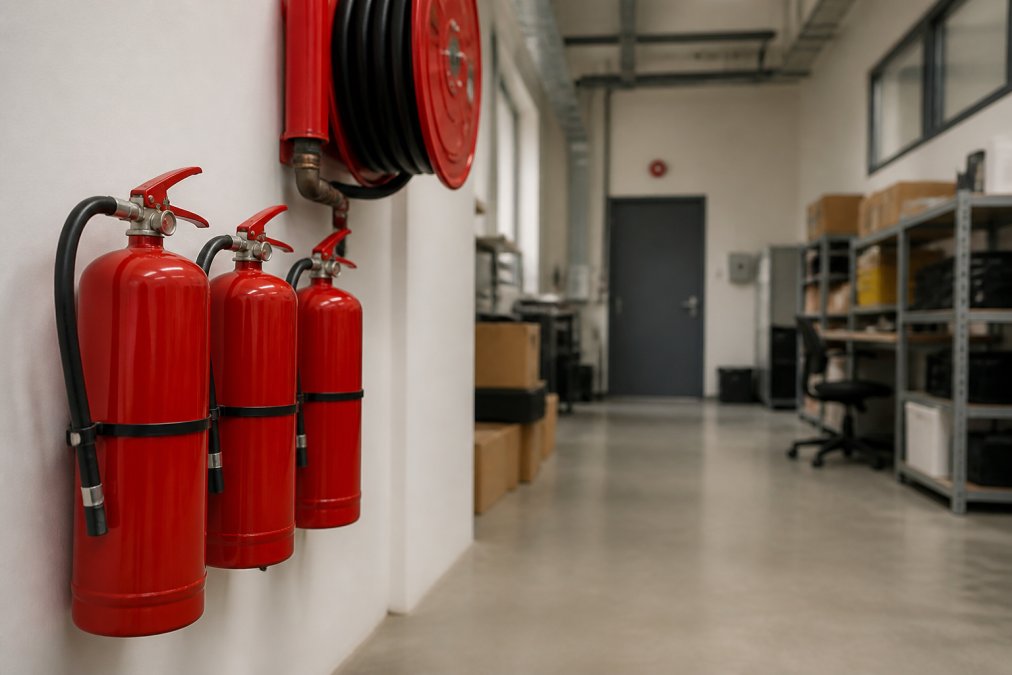
AS 2444 fire extinguisher placement sets out where equipment must sit so it is reachable before a small fire becomes a large one. The standard covers travel distance, mounting height and signage.
Key placement rules to apply:
- Mount extinguishers on a bracket or in a cabinet, never on the floor
- Keep the top of the extinguisher no more than 1.2 metres above the floor
- Ensure the base sits at least 100 mm above the floor
- Position equipment near exits and along normal paths of travel
- Keep a clear, unobstructed space around every unit
- Add signage so equipment is visible from a distance
Step 4: Understand Fire Extinguisher Testing Requirements Australia
Fire extinguisher testing requirements in Australia are set by AS 1851, the standard for maintenance of fire protection systems and equipment. Compliance is not optional, and it is not a yearly task.
Servicing follows a defined cycle:
- Monthly: visual check by a nominated staff member
- Six-monthly: inspection and testing by a competent person
- Yearly: pressure testing and detailed inspection
- Five-yearly: internal inspection and refill where required
Photograph each extinguisher and its tag after every service. If an auditor or insurer asks for proof, a dated photo with the tag visible settles the question faster than any written summary.
Step 5: Build Your Workplace Fire Safety Compliance Checklist
A workplace fire safety compliance checklist turns the rules above into a repeatable routine. Use it monthly, and review it after any layout or staffing change.
- Fire risk assessment completed, dated and reviewed within the last 12 months
- Extinguishers matched to every fire class present on site
- Placement checked against AS 2444 travel distance and mounting height rules
- Six-monthly servicing booked with a competent person
- Maintenance logbook up to date and stored where it can be produced on request
- Smoke detectors and alarms tested in line with AS 1851
- Exit lights and emergency signage illuminated and unobstructed
- Evacuation plan displayed and practised
- Fire wardens nominated and trained
- Staff induction covers fire response and equipment use
Who Actually Checks, and What They Ask For
Compliance is not self-certified. Depending on your state or territory, your site may be inspected by a fire service, a local council, a work health and safety regulator, or an insurer’s risk assessor. Each one tends to ask for the same four things: These recurring requirements often extend beyond basic fire suppression to include an electrical compliance checklist to ensure that your facility remains fully protected against hidden ignition hazards.
- A dated fire risk assessment that reflects the current layout and activities
- Service records showing every extinguisher, alarm and exit light was maintained on schedule
- Evidence that staff have been trained and that drills have been run
- A nominated person who owns fire safety on site
The Evidence File That Survives an Audit
Most small operators keep records in a folder, a drawer or a spreadsheet that only one person understands. A better pattern is a single evidence file, physical or digital, containing:
- The current fire risk assessment, signed and dated
- Service reports for every unit, filed by date
- The maintenance logbook with monthly visual checks recorded
- Training attendance records and drill logs
- Evacuation diagrams and the current warden list
- Photographs of each unit and its service tag after every visit
Emergency Signage, Exit Lighting and Evacuation Planning
Extinguishers alone will not pass an audit. Emergency signage, exit lighting and a written evacuation plan are part of the same compliance picture.
Check that:
- Exit signs are illuminated and visible from all parts of the building
- Emergency lighting runs long enough to cover a full evacuation
- Evacuation diagrams show exits, equipment and assembly points
- Fire wardens know their roles and have practised them
- Drills are run and recorded
Where Digital Logbooks Beat Paper
Paper logbooks fail in predictable ways: pages go missing, handwriting is illegible, and nobody notices a missed service until an inspection. Cloud-based fire safety management tools address this by attaching a QR code to each unit, prompting the monthly visual check, and flagging when a six-monthly service is overdue. For a small business with a handful of extinguishers, the gain is not the software itself but the automatic reminder that stops a deadline slipping.
How to Budget for Long-Term Fire Safety Equipment Maintenance
Most guides stop at the purchase. The real cost sits in the maintenance lifecycle, and that is where budgets blow out. This section is about the total cost of ownership (TCO) of your fire safety equipment, not the sticker price of the hardware.
What Drives the Annual Cost
Four variables move your maintenance budget more than anything else:
- Number of units. Every extinguisher, smoke alarm, exit light and emergency luminaire carries its own servicing interval. A site with 12 units costs more to maintain than one with four, even if the hardware bill was similar.
- Equipment type. A dry powder extinguisher and a wet chemical unit have different service scopes. Wet chemical systems in commercial kitchens typically need more frequent inspection because the agent and the discharge nozzles are exposed to grease and heat.
- Site conditions. Coastal sites, dusty workshops and kitchens accelerate corrosion and clogging, which shortens the interval between services and increases the chance of a refill or replacement.
- Access. Units mounted high, behind stock or in locked rooms take longer to inspect, and some providers charge for that time.
The Servicing Cycle You Are Actually Paying For
AS 1851 sets the maintenance rhythm. Budget for each tier separately rather than treating servicing as one annual line:
- Monthly: visual check by a nominated staff member. No provider cost, but it must be recorded.
- Six-monthly: inspection and testing by a competent person. This is the main recurring provider cost.
- Yearly: pressure testing and detailed inspection, which may add to the six-monthly charge.
- Five-yearly: internal inspection and refill where required. This is the spike year, and it is the one most budgets miss.
Replacement, Not Just Servicing
Extinguishers do not last forever. Cylinders have a service life, and units that have been discharged, damaged or corroded must be replaced rather than refilled. Build a replacement reserve into the budget so a failed unit is a planned expense rather than an emergency purchase. The same applies to exit light batteries and emergency luminaire fittings, which have a finite life and are a common audit finding when they fail.
Other Recurring Items to Include
- Staff fire safety training refreshers
- Evacuation drill coordination and record keeping
- Documentation and audit preparation time
- Disposal of expired or discharged units
How to Forecast the Line Item
Ask any provider for a written schedule of what is included at each service tier before you sign. A quote that covers only the six-monthly visit and excludes pressure testing, refills or after-hours callouts is not a full picture. Ask any provider for a written schedule of what is included at each service tier before you sign. A quote that covers only the six-monthly visit and excludes pressure testing, refills or after-hours callouts is not a full picture.
Budget for the servicing cycle, not just the hardware. A compliant site is one where maintenance is planned, funded and documented.
Common Mistakes When Choosing Fire Safety Equipment
The same errors show up across small sites, and each one creates a real risk.
- Buying extinguishers before completing a fire risk assessment
- Using one extinguisher type across a site with mixed fire classes
- Mounting units too high, too low, or behind stock
- Skipping six-monthly servicing because “nothing has changed”
- Keeping vague service reports that fail an audit
- Never training staff on how to use the equipment
- Ignoring exit lighting and signage until an inspection flags it
Frequently Asked Questions
What type of fire extinguisher is best for a small office or retail shop?
For most small offices and retail shops, a dry powder extinguisher covers Class A (paper, wood, textiles), Class B (flammable liquids) and Class E (electrical) fires, making it the most versatile single option. A 4.5 kg dry powder unit is common. If your premises has a commercial kitchen, add a fire blanket and a wet chemical extinguisher for cooking oil fires. Always check AS 2444 for placement rules and AS/NZS 1841 for equipment standards.
How often must fire safety equipment be tested in a workplace?
Under AS 1851, fire extinguishers must be inspected every six months and pressure-tested at set intervals, typically every five years for stored-pressure units. Smoke detectors and alarms need monthly testing plus annual professional servicing. Fire blankets should be checked every six months. Your maintenance logbook must record every inspection. Missing a six-monthly service can leave you non-compliant and may affect insurance claims after an incident.
How many fire extinguishers are required in a business premises?
The number depends on floor area, fire risk level and travel distance. AS 2444 requires extinguishers within 15 metres of any point for Class A risks and within 10 metres for Class E risks. A small retail shop under 100 square metres may need only one or two units. A workshop with flammable liquids will need more. A fire risk assessment determines the exact count for your site.
Do small businesses need a fire blanket in the kitchen area?
Yes, if your premises has a commercial kitchen or cooking area. A fire blanket is the fastest way to smother a stovetop fire without using an extinguisher that could spread burning oil. Mount it within easy reach of the cooking zone, typically 1 to 1.5 metres away. Check it every six months for damage or contamination. Fire blankets are inexpensive and are one of the most practical items in a workplace fire safety compliance checklist.
Fire safety compliance fails quietly. A missed service, an expired extinguisher or an unlit exit sign can sit unnoticed until an audit or an emergency exposes it. Fyrepower handles the full cycle for you, from equipment selection and AS 2444 placement to six-monthly testing, detailed reporting and staff training, all backed by a 55-month warranty and a QBSA-licensed, fully insured team. Get in touch with Fyrepower and keep your workplace compliant, documented and ready.