Table of Contents
- Quick Comparison: Data Center Fire Suppression Systems
- Clean Agent Fire Suppression Systems
- Inert Gas Suppression Systems
- Water Mist Fire Suppression Technology
- Pre-Action Sprinkler Systems for Data Centers
- AS 4487 Fire Suppression Standards
- Fire Suppression System Maintenance Schedule
- Gaseous Fire Suppression System Cost and Retrofit Considerations
- Frequently Asked Questions
Last Updated: September 20, 2026
Quick Comparison: Data Center Fire Suppression Systems
Choosing the best fire suppression system for data centers comes down to one trade-off: you need to extinguish a fire fast without destroying the servers you’re protecting. Water damages electronics. Inert gas needs heavy cylinder storage. Clean agents cost more upfront but leave no residue. This guide from Fyrepower breaks down the five main options, what each costs to run and maintain, and how to match a system to your facility’s size and risk profile.
Here’s the short version before we get into detail.
| System | How It Works | Best For | Main Drawback |
|---|---|---|---|
| Clean agent (FM-200, Novec 1230) | Removes heat chemically | High-density server rooms | Higher upfront cost |
| Inert gas (Inergen) | Lowers oxygen to stop combustion | Occupied spaces, zero residue | Large cylinder footprint |
| Water mist | Fine droplets cool the fire | Mixed-use facilities | Still water-based |
| Pre-action sprinkler | Dual trigger releases water | Large sites, secondary layer | Water risk remains |
| AI-integrated clean agent | Early detection plus clean agent | Modern automated sites | Needs expert integration |
Clean Agent Fire Suppression Systems
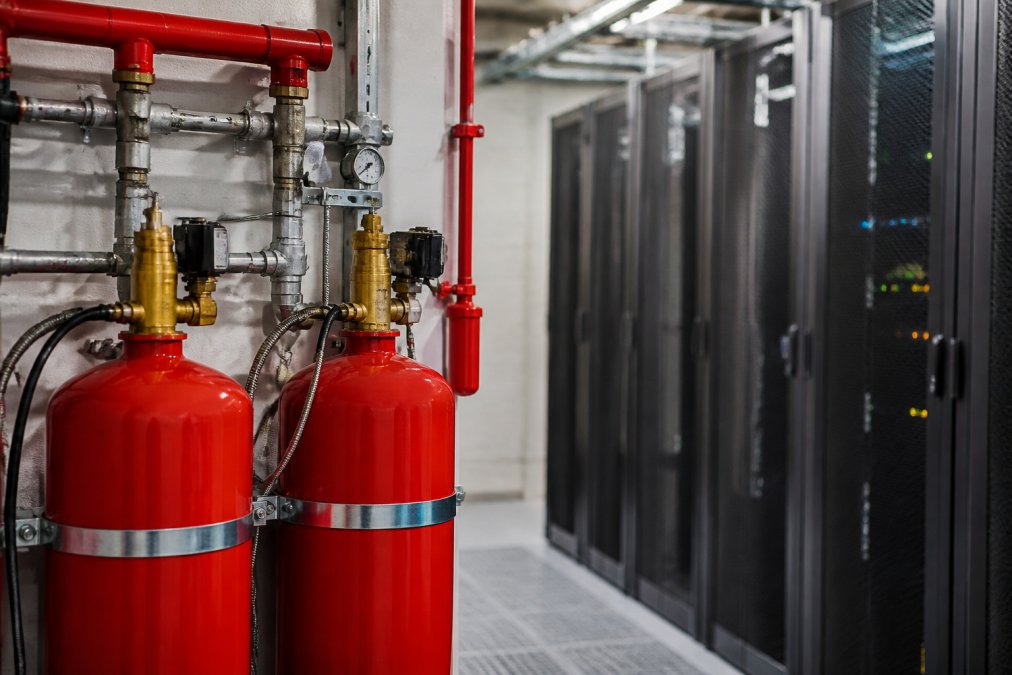
Clean agent systems extinguish fires by removing heat rather than smothering them with water or displacing oxygen. FM-200 (HFC-227ea) is the most widely deployed, discharging in under ten seconds and leaving no residue on circuit boards or cabling. 3M Novec 1230 works on the same principle but evaporates rapidly with a much lower environmental impact.
Pros:
- No cleanup after discharge, so servers stay in service
- Fast suppression, typically seconds
- Minimal cylinder storage compared with inert gas
Cons:
- Higher installation cost than water-based options
- FM-200 has a high global warming potential
Ask your installer for the room’s agent concentration calculation before signing off. A system sized for the wrong volume either under-performs or over-pressurises on discharge, and that calculation is the single most common thing auditors check.
Inert Gas Suppression Systems
Inert gas suppression reduces oxygen inside the room to a level where combustion cannot continue, while staying safe for anyone still inside. Inergen uses a mix of naturally occurring nitrogen, argon, and carbon dioxide. There’s no chemical residue, no fog on discharge, and no environmental penalty.
Pros:
- Environmentally inert
- Safe for occupied areas
- No visibility loss during discharge
Cons:
- Large cylinder room or storage footprint
- Higher pressure pipework than clean agents
Water Mist Fire Suppression Technology
Water mist uses fine droplets to cool a fire and displace oxygen locally. Because the droplets are so small, the system uses far less water than a conventional sprinkler, which limits the damage to surrounding equipment. It’s a practical middle ground for facilities that can’t justify a full gaseous system. Even with these mitigation efforts, any residual impact necessitates the expertise of professional fire damage restoration services to ensure the long-term integrity of sensitive server environments.
Pros:
- Lower water volume than standard sprinklers
- Lower cost than clean agent systems
- Works well as part of a layered approach
Cons:
- Still involves water near electronics
- Nozzle placement is critical to coverage
Pre-Action Sprinkler Systems for Data Centers
Pre-action sprinklers are a double-interlock system: both a fire detection trigger and a sprinkler head activation are required before water releases. That design prevents accidental discharge from a burst pipe or a false alarm, which is the main reason data centers still use them.
Pros:
- Reduces accidental water damage risk
- Monitored piping detects leaks early
- Lowest upfront cost of the options here
Cons:
- Water still poses a risk if it does discharge
- Slower response than clean agents
AS 4487 Fire Suppression Standards
Australian data center fire protection sits across several standards, and knowing which one applies to what is the difference between a compliant install and an audit finding.
- AS 4487 covers condensed aerosol fire extinguishing systems, design, installation, commissioning and maintenance. It applies where aerosol units are used, typically in smaller enclosures or as a supplementary measure, not as the primary agent in a large white space.
- AS 4214 covers gaseous fire extinguishing systems, which is the standard that governs clean agent and inert gas installations in server rooms. It sets out design concentration, hold time, discharge time, and the safety provisions for occupied spaces.
- AS 1670.1 covers fire detection, warning, control and intercom systems, the detection layer that triggers suppression.
- AS 2118 covers automatic fire sprinkler systems, relevant where pre-action or wet sprinklers form part of the layered design.
- AS 1851 is the routine servicing standard. It sets the inspection, test and maintenance intervals for every system type above, and it is the standard your insurer and auditor will ask about.
- AS 2444 covers portable fire extinguishers and blankets, which remain a required first-response layer in most facilities.
How they interact in a data center
A typical compliant design uses AS 1670.1 for detection, AS 4214 for the gaseous suppression system, AS 2118 for any sprinkler layer, and AS 1851 for ongoing servicing. Aerosol units, if used at all, fall under AS 4487. The standards are not alternatives, they stack, and a gap in any one layer is a gap in the overall protection.
Demonstrating compliance
Compliance is evidenced, not asserted. Expect to hold:
- Design documentation showing the room volume, agent concentration calculation, and hold-time test results.
- Commissioning records including a witnessed discharge test or a door fan test where required.
- AS 1851 service records at the correct intervals, signed by a licensed technician.
- As-built drawings reflecting the installed system, not the original design.
Insurers and auditors ask for these records, and vague or missing documentation is the fastest way to fail an audit, and, in some cases, to void cover.
Integration with building management systems
A system can pass its AS 1851 service and still fail an audit if the BMS integration is undocumented or the shutdown sequence has never been tested end-to-end. Test the sequence, not just the suppression.
For the specific requirements, check the Standards Australia catalogue or confirm current obligations with your local fire authority.
Fire Suppression System Maintenance Schedule
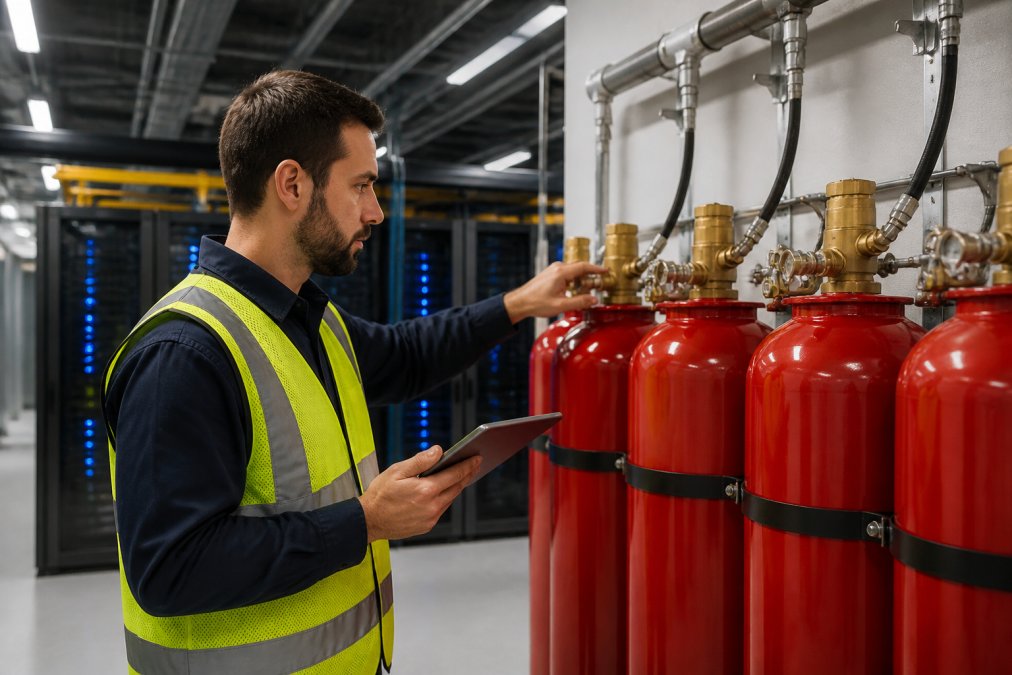
A fire suppression system maintenance schedule for a data center should follow AS 1851 intervals: six-monthly inspections for most systems, with weekly and monthly checks on critical components. Miss a window and your compliance certificate lapses, which can void insurance cover.
| Frequency | Task | Who Does It |
|---|---|---|
| Weekly | Visual check of panel and indicators | On-site staff |
| Monthly | Inspect cylinders, gauges, pipework | On-site staff |
| Six-monthly | Full system test and certification | Licensed technician |
| Annually | Comprehensive audit and report | Licensed technician |
The most common compliance failure we see is a system that passes its six-monthly test but has never had its nozzles checked for obstruction. Dust and cable debris block discharge patterns, and the system will fail when it’s actually needed.
Gaseous Fire Suppression System Cost and Retrofit Considerations
Gaseous fire suppression system cost is driven by four variables: protected room volume, agent type, cylinder storage and pipework route, and whether the work is a new build or a retrofit. Because agent quantity scales with volume, a small comms room and a 400 m² white space can differ by an order of magnitude in cylinder count alone. Most practitioners find the split falls roughly into agent and cylinders, detection and control panel, discharge pipework and nozzles, and installation and commissioning, with the last two rising sharply in retrofits where ceilings, cable trays and containment are already in place.
What actually drives the number
- Room volume and leakage. A room that cannot hold its design concentration needs more agent or remedial sealing. Door seals, cable penetrations and raised-floor voids are the usual culprits.
- Agent choice. Clean agents need fewer, smaller cylinders than inert gases, which lowers the cylinder room and structural load but raises the per-kilogram agent cost.
- Detection architecture. Aspirating smoke detection (ASD) gives earlier warning than point detection and is common in high-airflow rooms, but adds design and commissioning time.
- Pipework route. Inert gases run at higher pressure and need heavier pipework and pressure relief; clean agents are more forgiving in tight ceiling voids.
- Occupancy and egress. Occupied spaces need discharge alarms, warning signage and time delays, plus door hardware that seals on discharge.
Retrofitting a live server room
The hard constraint in a retrofit is not cost, it is uptime. A legacy room usually has no spare cylinder space, limited ceiling void, and no tolerance for a multi-day shutdown. A common pattern is to stage the work:
- Survey and concentration calculation against the as-built room, not the original drawings.
- Detection first. Install and commission ASD or point detection on the existing panel so early warning improves before suppression changes.
- Cylinder room and pipework installed and pressure-tested while the old system remains live.
- Cut-over during a planned maintenance window, with the old system decommissioned only after the new one is signed off.
- Witnessed discharge test and documentation handover.
A simple cost-benefit frame
Rather than comparing sticker prices, compare the cost of the system against the cost of the outage it prevents. For each option, estimate:
- Capital cost, supply, install, commission.
- Annual operating cost, AS 1851 servicing, cylinder weighing and hydrostatic testing, agent top-ups.
- Expected downtime per discharge event, clean agents and inert gases are near-zero cleanup; water-based options can mean days of drying, testing and replacement.
- Business cost of that downtime, lost transactions, SLA penalties, data recovery, reputational damage.
Sustainability and GWP
Ask for a line-item quote that separates agent, cylinders, detection, pipework and commissioning. A single lump sum hides the retrofit labour that is usually the biggest variance between sites.
For an accurate figure, the Australian Building Codes Board publishes guidance on fire safety provisions, but pricing itself depends on your specific site. Fyrepower provides transparent quotes with no surprise charges, and our QBSA-licensed, fully insured team handles the full scope from assessment to certification.
Frequently Asked Questions
What type of fire suppression system is best for a data center?
Clean agent systems such as FM-200 and Novec 1230 are often the best fit for data centers because they extinguish fires quickly without leaving residue that damages servers. Inert gas systems are a strong alternative where environmental impact and human safety are the priority. Water mist and pre-action sprinklers work as secondary layers for larger facilities. The right choice depends on room size, budget, and compliance requirements.
Which fire suppression system is standard for Australian data centres?
Australian data centres commonly use gaseous suppression systems that comply with AS 4214, covering clean agents and inert gases. FM-200 and Novec 1230 remain widely installed, while newer sites increasingly favour inert gas or water mist for sustainability reasons. AS 4214 sets the design, installation, and commissioning requirements that fire suppression contractors must follow for these systems to pass inspection.
How much does a gaseous fire suppression system cost?
Gaseous fire suppression system cost depends on room volume, agent type, cylinder storage, detection zoning, and whether the installation is a retrofit or new build. Clean agent systems generally cost more upfront than water-based options because of the agent itself and the sealed room requirements. Inert gas systems need more cylinder space, which can affect total project cost. Request a site-specific quote for accurate figures.
How does gaseous fire suppression protect server hardware?
Gaseous suppression works by discharging a clean agent or inert gas mixture into the room to interrupt combustion. Clean agents like FM-200 remove heat, while inert gases such as nitrogen and argon lower oxygen to a level that cannot sustain fire. Both approaches leave no residue, so servers and storage arrays are not damaged by water or powder. This is why gaseous suppression is preferred for critical infrastructure.
What are the maintenance requirements for data centre fire systems under Australian Standards?
A fire suppression system maintenance schedule under AS 1851 typically involves six-monthly inspections of detection, control panels, and discharge nozzles, plus annual full system checks. Cylinder weight and pressure verification is also required to confirm the agent charge is intact. Records must be kept for compliance audits. Fyrepower provides scheduled testing and detailed reporting for data centre operators.