Table of Contents
- What You’ll Need Before Installing Fire Extinguishers
- Understanding AS 2444 Fire Extinguisher Placement Standards
- Step-by-Step Fire Extinguisher Installation Process
- Fire Extinguisher Testing Frequency in Queensland
- Commercial Fire Safety Compliance Requirements
- DIY vs Professional Fire Extinguisher Installation
- Common Installation Mistakes to Avoid
- Frequently Asked Questions
Last Updated: August 14, 2026
What You’ll Need Before Installing Fire Extinguishers
Fire extinguisher installation requires understanding your building’s fire hazards, selecting appropriate extinguisher types, obtaining correct mounting hardware, and ensuring compliance with Australian safety standards. This guide from Fyrepower covers the complete installation process from assessment through certification.
Gather documentation about your property: floor plans showing exit routes, records of materials or processes creating fire risk, and building construction details. For commercial properties, also collect building code compliance records and previous fire safety audit reports.
Acquire physical materials: wall mounting brackets rated for your extinguishers’ weight, fasteners appropriate for your wall type, a pressure testing gauge, identification tags, and a fire safety logbook. Understanding AS 2444 standards is essential before proceeding, as this Australian Standard defines placement requirements including mounting height, distance from hazards, and accessibility rules. Finally, decide whether to install yourself or hire licensed technicians, this decision carries real consequences for liability and regulatory compliance.
Understanding AS 2444 Fire Extinguisher Placement Standards
AS 2444 is the mandatory Australian Standard governing fire extinguisher placement. Understanding these requirements upfront prevents costly repositioning and ensures your fire protection works when needed.
Mounting height and accessibility requirements
Fire extinguishers must be mounted between 1 metre and 1.5 metres from the floor to the unit’s top, ensuring staff can reach and operate them quickly while keeping them visible at eye level. Mounting must be secure, with brackets bolted or screwed into solid backing, not glued to drywall.
Accessibility requires unobstructed access on all sides. Leave at least 300mm of clear space around the unit. Brackets must support the full weight of a filled extinguisher without deflection, a 9kg powder extinguisher weighs roughly 15kg when full. Use hardware-store rated brackets designed specifically for fire safety equipment.
Distance from fire hazards and escape routes
Position extinguishers no more than 30 metres travel distance from any potential fire hazard. Never block emergency exit routes; mount units along escape routes but positioned so they don’t reduce corridor or doorway width. Keep extinguishers away from direct heat sources and extreme temperatures, maintaining room temperature environments between 5°C and 50°C.
AS 2444 fire extinguisher placement and use standard provides full technical specifications. Compliance audits will check these distances and heights; non-compliance means your fire protection won’t work as intended.
Step-by-Step Fire Extinguisher Installation Process
Installation has four distinct phases: assessing fire hazards, selecting extinguisher types, physically installing hardware, and verifying compliance.
Step 1: Conduct a fire hazard assessment
Walk through your entire property and identify every potential fire source systematically. Document the location and type of each hazard: electrical equipment, heating systems, cooking facilities, flammable storage, and high-risk work areas.
For each hazard, determine what fire class could result. An electrical fire (Class E) requires different agents than a cooking oil fire (Class F) or paper storage fire (Class A). This assessment directly determines which extinguishers you need and where they must be positioned. Document everything in your fire safety logbook to demonstrate compliance to regulators.
Step 2: Select the correct extinguisher types
Water extinguishers (Class A) work on ordinary combustibles like paper, wood, and textiles. They’re ineffective and dangerous on electrical fires or flammable liquids.
Dry chemical powder extinguishers (Classes A, B, C) are versatile and work on most common fires, standard in kitchens and workshops. Cleanup is required as powder spreads everywhere.
CO2 extinguishers (Classes B, E) are ideal for electrical fires and flammable liquid spills, leaving no residue. They’re less effective on Class A fires.
Foam extinguishers (Classes A, B) work on flammable liquids and ordinary combustibles, common in petrol stations and workshops.
Wet chemical extinguishers (Class F) are designed specifically for cooking oil fires. Commercial kitchens require at least one wet chemical unit.
Match your selection to your hazard assessment. A small office might need one water extinguisher per floor and one CO2 unit near the electrical panel. A hospitality venue needs water, dry powder, and wet chemical units.
Step 3: Install wall mounting brackets securely
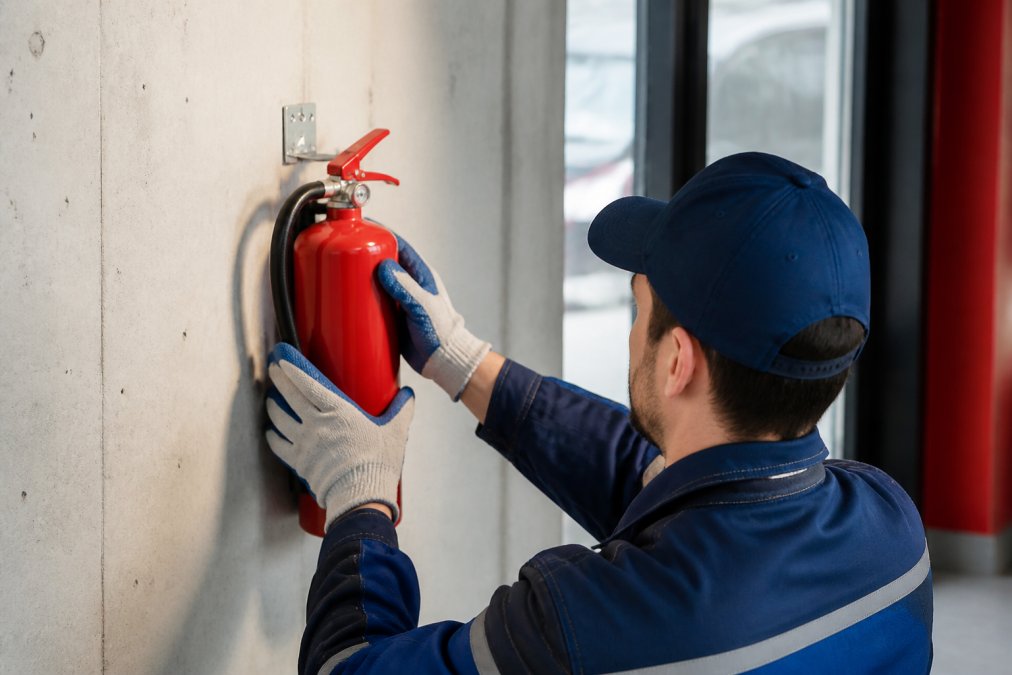
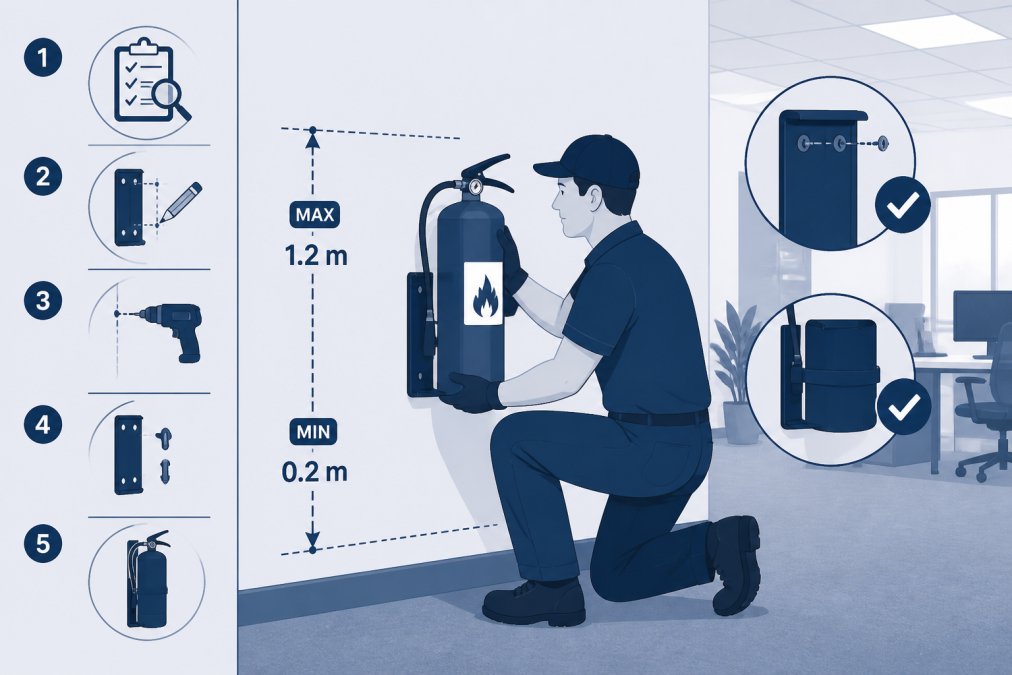
Position the bracket at 1 to 1.5 metres from floor to the extinguisher’s top. Mark mounting points with a pencil before drilling.
For concrete or brick walls, use expansion anchors rated for at least 20kg (a 9kg extinguisher when full weighs 15kg). For plasterboard walls, locate studs using a stud finder and mount directly into them. Never rely on plasterboard alone. Tighten all fasteners firmly and test the bracket with firm pressure to verify it doesn’t move.
Ensure the bracket allows quick removal without tools. Test removal and reinsertion several times before considering installation complete.
Step 4: Verify pressure and apply tagging
Check the pressure gauge, the needle should be in the green zone. Inspect the hose and nozzle for cracks or blockages. Attach the identification tag recording installation date, next service date, and company details. Create a fire safety logbook entry noting installation date, location, extinguisher type, serial number, and pressure reading.
Fire Extinguisher Testing Frequency in Queensland
Once installed, fire extinguishers require regular testing to ensure they’ll work in an emergency. Queensland regulations and AS 1851 maintenance standards define testing frequency.
Annual inspection requirements under AS 1851
Every fire extinguisher must be visually inspected at least annually. A qualified technician verifies the pressure gauge is in the green zone, checks that the hose and nozzle are intact, ensures the safety pin is present and undamaged, and confirms the identification tag is current. They also check for physical damage, dents, rust, or leaks requiring the unit to be taken out of service.
File an annual inspection report in your fire safety logbook to prove compliance to regulators.
Six-monthly service schedules for commercial properties
Commercial properties with higher fire risk or occupancy must have extinguishers serviced every six months. This includes hospitality venues, retail spaces, offices with high density, and properties with significant flammable material storage.
A six-monthly service goes deeper than annual inspection. The technician may partially disassemble the unit to check internal components, test the discharge mechanism, verify the agent hasn’t degraded, and confirm all seals are intact. After service, the technician updates your logbook and identification tag with the next service date.
AS 1851 fire safety equipment maintenance standard defines the exact scope of six-monthly services. Non-compliance means your extinguishers might not work when needed.
Commercial Fire Safety Compliance Requirements
Fire extinguisher installation is part of a broader fire safety compliance framework. Understanding these requirements ensures your installation fits into a compliant system.
Building code compliance and regulatory obligations
Your building must comply with the National Construction Code (NCC), which specifies how many extinguishers you need, what types, where they must be positioned, and how often they must be serviced. The Work Health and Safety Act 2011 requires employers to provide and maintain fire safety equipment. Local councils may have additional requirements specific to your property type.
Building inspectors will verify compliance during routine inspections or after incidents. Non-compliance can result in improvement notices, fines, or legal liability if a fire occurs and equipment wasn’t properly maintained.
Fire safety logbook and certification documentation
A fire safety logbook should contain: initial fire hazard assessment, installation records with dates and locations, annual inspection reports, six-monthly service records, staff training records, and any incidents or near-misses. Retain certification documents from your service provider for at least five years.
DIY vs Professional Fire Extinguisher Installation
The choice between DIY and professional installation has real consequences for safety, compliance, and liability.
When professional installation is required
Commercial properties with more than five employees legally require licensed technicians to design and install fire safety systems. Properties with complex fire hazards, kitchens, electrical switchboards, chemical storage, or high-value equipment should always use professionals. Installing more than three extinguishers or covering areas larger than 500 square metres requires professional design and installation. Multi-tenancy strata properties require professional coordination to meet everyone’s needs.
Risks of improper installation and non-compliance
Incorrect placement makes extinguishers useless during emergencies. Non-compliant installation creates legal liability; if a fire occurs and extinguishers weren’t properly installed or maintained, your business faces potential prosecution and civil liability. Insurance may not cover damages if you failed to meet regulatory requirements.
Improper pressure or maintenance means extinguishers won’t discharge when needed. Staff training becomes impossible without documentation of proper installation.
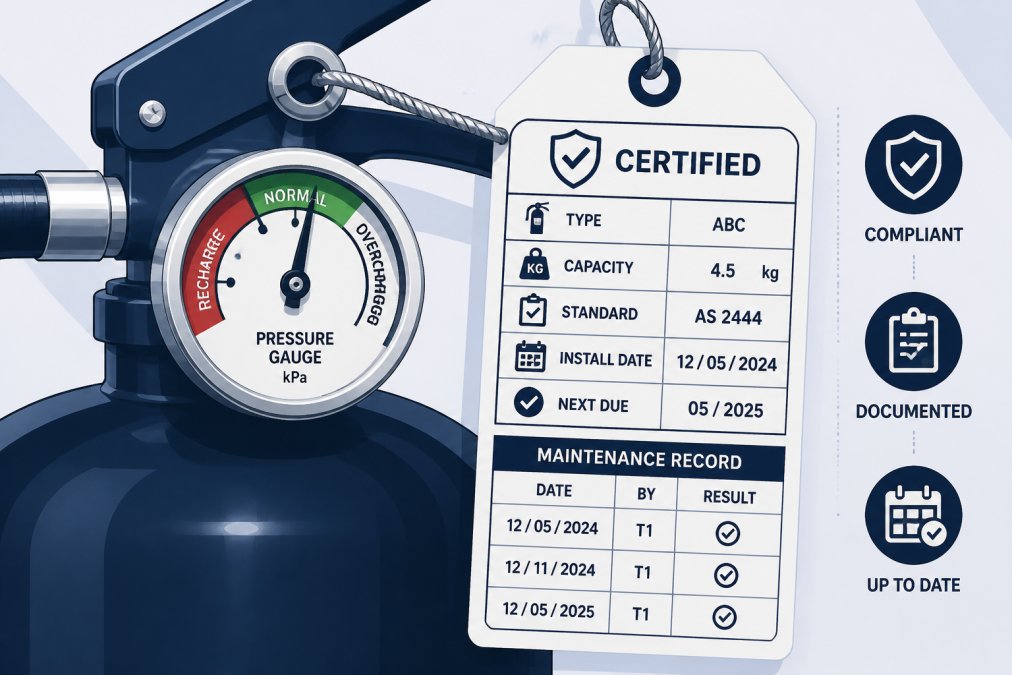
Fyrepower provides professional installation with full documentation and compliance certification. Our QBSA-licensed team ensures your system meets all Australian standards.
Common Installation Mistakes to Avoid
Mounting too high or too low. Extinguishers mounted above 1.5 metres or below 1 metre won’t pass inspection. Measure twice before drilling.
Blocking accessibility. Extinguishers hidden behind doors or furniture are useless. Keep at least 300mm clear space on all sides.
Using inadequate brackets. Cheap brackets fail under the weight of a full extinguisher. Use hardware-rated brackets designed for fire safety equipment.
Skipping the hazard assessment. Conduct a systematic walk-through and document hazards before positioning extinguishers.
Neglecting pressure checks. Check the pressure gauge before mounting. A low-pressure unit won’t discharge properly.
Forgetting the logbook. Create a fire safety logbook entry on installation day including location, type, serial number, and pressure reading.
Mixing extinguisher types incorrectly. Match extinguisher type to your hazard assessment. Using a water extinguisher on an electrical fire makes it worse.
Ignoring maintenance schedules. Commercial properties require six-monthly servicing. Mark these dates in your calendar and book services in advance.
Fire extinguisher installation is a compliance requirement with real safety consequences. Proper installation, correct placement, and regular maintenance ensure your equipment will work during an emergency. For commercial properties, professional installation guarantees compliance, provides documentation for audits, and ensures your fire protection system is reliable.
Fyrepower delivers expert fire extinguisher installation with full AS 2444 and AS 1851 compliance. Our QBSA-licensed team handles site assessment, equipment selection, secure installation, and comprehensive documentation. Get in touch with us now for a fire safety assessment and professional installation that keeps your property protected.
Frequently Asked Questions
How often do fire extinguishers need to be tested in Queensland?
Fire extinguishers in Queensland require an annual inspection under AS 1851 standards. Commercial properties typically need six-monthly servicing to maintain compliance and ensure equipment remains operational. Testing frequency depends on the extinguisher type, location, and your specific regulatory obligations. Licensed technicians verify pressure, check seals, and update your fire safety logbook at each service to document compliance.
What is the Australian standard for mounting fire extinguishers?
AS 2444 specifies that fire extinguishers must be mounted between 1.0 and 1.5 metres from the floor to the top of the unit, on accessible wall brackets. They must be positioned within 30 metres of any fire hazard and clearly visible with appropriate emergency signage. Mounting brackets must be secure and certified, and extinguishers must not obstruct emergency exits or escape routes. Professional installation ensures your setup meets these requirements and passes compliance audits.
Do I need a professional to install my fire extinguisher?
For commercial properties, professional installation is mandatory to ensure compliance with building codes and Australian standards. Licensed technicians conduct fire hazard assessments, select appropriate extinguisher types, install certified wall mounting brackets, and provide proper tagging and documentation. Improper installation creates safety risks and voids compliance. Even for smaller venues, professional installation protects your business, ensures staff can locate and use equipment quickly, and provides auditable proof of regulatory compliance.
What fire extinguisher types are needed for commercial fire safety compliance?
Commercial fire safety compliance requires matching extinguisher types to your specific fire hazards. Water extinguishers suit ordinary combustibles, foam for flammable liquids, dry chemical powder for multiple hazard classes, CO2 for electrical fires, and wet chemical for kitchen operations. A professional fire hazard assessment determines which types you need and in what quantities. Your fire protection strategy must be documented in a fire safety logbook and reviewed annually to maintain compliance with regulatory requirements.
This article was written using GrandRanker