Table of Contents
- Who Is Responsible for Fire Safety Compliance in an Office Building?
- Queensland Legal Duties and Standards That Apply to Office Buildings
- Office Fire Safety Audit Checklist: What to Inspect by Area and System
- Fire Equipment Inspection and Testing: What Each System Needs
- Fire Safety Audit Frequency: How Often and What Triggers One
- Using a Fire Safety Audit Report Template and Retaining Records
- Prioritising Findings and Verifying Corrective Actions
- Conclusion: Building a Repeatable Compliance Cycle
- Frequently Asked Questions
Last Updated: October 9, 2026
Who Is Responsible for Fire Safety Compliance in an Office Building?
A fire safety compliance audit is a structured review of a building’s fire systems, documentation and procedures against the standards that apply to it, and it is the foundation of any fire safety compliance audit program.
For a single-tenancy office, the business owner or occupier carries the duty. In a multi-tenancy building, responsibility splits between the owner, body corporate, property manager and each tenant.
What most guides miss is that the split is rarely written down. When something fails, everyone points at someone else.
Here is the general division of duties in a strata office building:
- Owner or body corporate: base building systems, common areas, exits, signage
- Property or facilities manager: scheduling, contractor access, record keeping
- Tenant: equipment inside the tenancy, staff training, keeping exits clear
If you cannot name who owns each item on your list, you do not have a compliance system. You have a hope.
Queensland Legal Duties and Standards That Apply to Office Buildings
Queensland’s work health and safety laws place a primary duty of care on anyone conducting a business or undertaking to protect workers and others from fire risk so far as is reasonably practicable. That duty does not transfer to your contractor when you sign an engagement letter.
Two Australian Standards do most of the heavy lifting for office buildings:
- AS 1851 sets out routine servicing of fire protection systems and equipment.
- AS 2444 covers portable fire extinguishers and fire blankets, including selection and location.
The Queensland Work Health and Safety Act 2011 sets the overarching duty, and Safe Work Australia’s WHS guidance explains how duty holders are expected to meet it in practice. The Australian Building Codes Board maintains the National Construction Code that governs how office buildings are built and altered.
Building owners also carry duties under Queensland’s fire and emergency legislation, including occupier statements and evacuation planning. Penalties land on the duty holder, not the contractor.
The most common mistake we see is a tenant assuming the building manager handles everything inside their tenancy. If a fire starts at your kitchenette and your extinguisher was never serviced, the paperwork trail leads back to you.
Office Fire Safety Audit Checklist: What to Inspect by Area and System
An office fire safety audit checklist lists every item to inspect, grouped by area and system, with space to record the result, responsible party and corrective action.
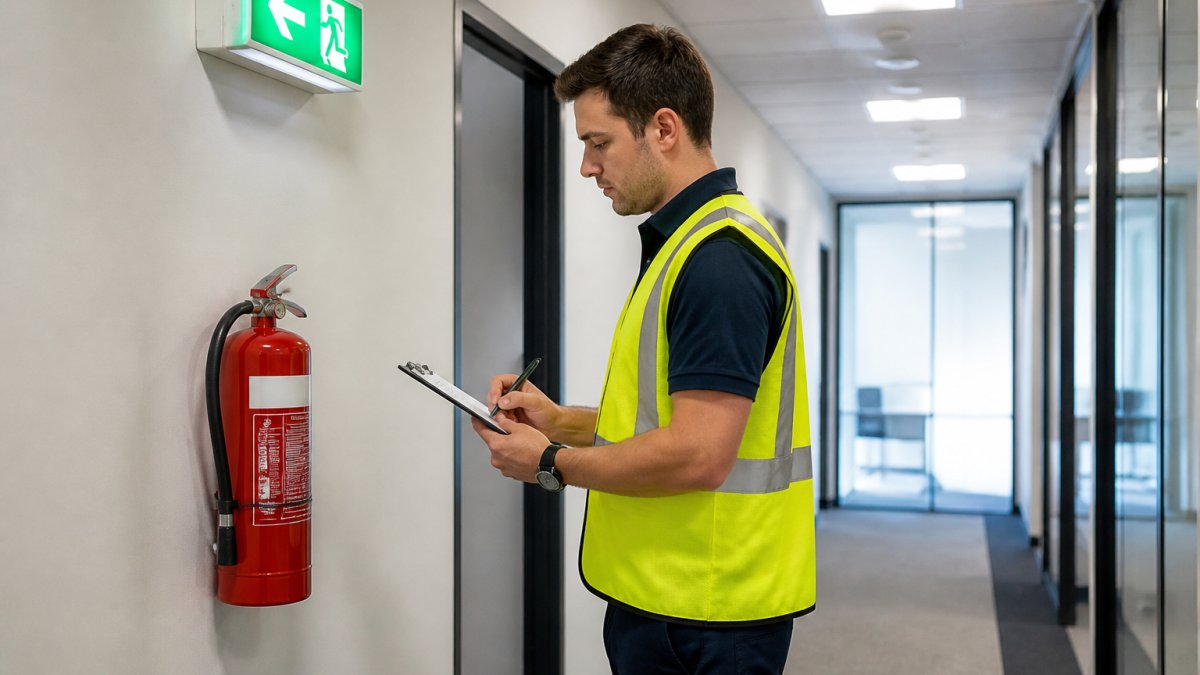
Most checklists stop at the item name. The version below adds the two columns that make it work: who owns the item, and what proof closes it out. Adapt the items to your building’s systems and tenancy mix.
Common Areas, Exits and Signage
Common areas produce most audit findings, because no single tenant feels responsible. Walk the building as an occupant would during an evacuation, recording the owner of each item as you go.
| Item to inspect | Typical owner | Reference | Evidence that closes it |
|---|---|---|---|
| Exits clear and unlocked from the inside | Owner or body corporate | Building fire safety obligations | Dated photo of the exit path |
| Exit signs illuminated and pointing correctly | Owner or body corporate | AS 2293 series for emergency lighting and exit signs | Photo plus maintenance log entry |
| Fire doors self-closing and undamaged | Owner or body corporate | AS 1851 fire door servicing | Service report with door-by-door result |
| Evacuation diagram current and posted | Property or facilities manager | Building fire and emergency plan | Photo of the posted diagram with date |
| Corridors free of storage and trip hazards | Tenant and facilities manager | WHS duty to keep the workplace safe | Photo before and after clearing |
Tenancy Fitouts and Equipment
Inside each tenancy, the audit focuses on what the tenant controls, where a fitout change last year quietly broke compliance, and where the responsible party is most often misidentified.
| Item to inspect | Typical owner | Reference | Evidence that closes it |
|---|---|---|---|
| Extinguishers present, tagged and in date | Tenant | AS 2444 selection and location | Service tag photo plus register entry |
| Smoke detectors unobstructed | Tenant | AS 1851 detection servicing | Photo plus alarm test record |
| Electrical leads and boards not overloaded | Tenant | WHS duty for electrical safety | Photo plus tag-and-test record |
| Kitchenette and server room risks controlled | Tenant | WHS risk assessment | Completed risk assessment form |
| Staff trained and evacuation roles assigned | Tenant and employer | WHS training duty | Training register with names and dates |
Shared Building Systems
Shared systems sit between owner and tenants, which is why they get missed. Confirm who holds the service contract before you inspect, because the answer changes who pays for the fix.
- Sprinkler, hydrant and hose reel systems, owner or body corporate, serviced under AS 1851
- Fire detection and alarm panel, owner or body corporate, with tenant fault reporting
- Emergency lighting and exit signage, owner or body corporate, tested to the AS 2293 series
Photograph every finding with a date stamp as you walk, and note the responsible party in the same shot where you can. When a dispute arises about whether an item was fixed, or who was meant to fix it, a dated photo and a named owner end the argument faster than any report.
A checklist without an owner column is a wish list. If every line says “building” and no line says a name or a role, nothing on it will be actioned before the next audit.
Turning the Checklist into a Report
Once the walkthrough is done, transfer each finding into your report template with the same four fields: item, owner, reference and evidence. That consistency lets a new property manager see exactly what was checked, found and done, without reconstructing the audit from memory.
Fire Equipment Inspection and Testing: What Each System Needs
Fire equipment inspection and testing is the scheduled servicing of each system at the interval its standard requires. Inspection is looking; testing is proving it works. Both need a record.
| System | Typical Routine Check | Typical Full Test |
|---|---|---|
| Portable extinguishers | Monthly visual check | Pressure and service per AS 2444 |
| Exit and emergency lighting | Monthly flick test | Duration discharge test |
| Fire doors | Monthly visual | Annual operational check |
| Sprinkler systems | Weekly gauge check | Annual flow test |
| Fire hydrants and hose reels | Visual inspection | Pressure and flow testing |
| Detection and alarm | Fault log review | Annual functional test |
These intervals are the common pattern. Your building’s schedule depends on its systems and the version of AS 1851 that applies, so confirm exact timing with a qualified provider rather than a generic table.
Fire Safety Audit Frequency: How Often and What Triggers One
Fire safety audit frequency in an office building is not a fixed annual event. Some tasks are monthly, some six-monthly, some annual, some only on a trigger. Your schedule is set by three things: the servicing intervals in AS 1851, your building’s obligations under Queensland’s fire and emergency legislation, and events that change your risk profile.
The Routine Cadence
Most office buildings settle into a rhythm like this. Treat it as a starting pattern, not a substitute for confirming what your systems require.
| Activity | Common interval |
|---|---|
| Visual check of extinguishers and exits | Monthly |
| Flick test of emergency and exit lighting | Monthly |
| Six-monthly servicing of portable equipment | Six-monthly |
| Annual functional testing of detection, alarm, sprinklers and hydrants | Annual |
| Full audit of documentation, training and responsibilities | Annual, or on trigger |
A common pattern is pairing annual functional testing with a documentation review, so the physical inspection and paperwork audit happen in the same window, avoiding the situation where systems pass but records do not.
Triggers That Reset the Clock
A routine schedule is not enough on its own. Certain events should force a review regardless of where you are in the cycle:
- A fitout or refurbishment changes what needs covering, and can alter egress paths and system coverage
- A change of tenant or use can change the risk profile, a server room or a kitchenette changes the fire load
- An incident or near miss demands a review of both the system and the response
The most common scheduling failure is treating the annual test as the whole compliance program. If the monthly visual checks and six-monthly servicing are not happening in between, the annual test is confirming a system that has been unmonitored for eleven months.
Records and Retention
Every inspection and test needs a record that survives a change of staff. Keep the following together where a new manager can find them:
- Service reports for each system, with the date and the result
- The current evacuation plan and evacuation diagram
- Training registers showing who was trained and when
Retention periods vary by document type and insurer expectation, so confirm the period that applies to your building rather than assuming one number covers everything. The practical rule: if you cannot produce the record on request, it does not exist for compliance purposes.
Building the Schedule
Put the routine intervals into a calendar with named owners, then add triggers as review points rather than fixed dates. Review the whole schedule at least annually, and again whenever a trigger event occurs, so it reflects the building as it is now.
Using a Fire Safety Audit Report Template and Retaining Records
A fire safety audit report template turns a walkthrough into evidence. It should record what was checked, by whom, on what date, what was found, and what was done about it.
A workable template includes:
- Building and tenancy details
- Auditor name and licence number
- Date and scope of the audit
Keep records for the period your insurer and regulator expect, somewhere a new property manager can find them. Reports that live only in a departing manager’s inbox are effectively lost.
A vague service report is worse than no report. If it does not name the item, the date and the result, it will not protect you in an audit.
Prioritising Findings and Verifying Corrective Actions
Prioritising findings means ranking each by the risk it creates, not how easy it is to fix.
We group findings into three tiers:
- Immediate: life-safety items, fix before close of business
- Scheduled: important but not urgent, fix within the service cycle
- Monitor: note it, watch it, review next audit
Verification is the step most teams skip. Someone signs off that the extinguisher was replaced, and nobody checks.
At Fyrepower, our QBSA-licensed and fully insured team handles testing, installation and staff training across the Gold Coast, South Brisbane and Northern New South Wales.
Conclusion: Building a Repeatable Compliance Cycle
The buildings that stay compliant are not the ones with the biggest budget. They run the same cycle every time: inspect, record, fix, verify, repeat.
That cycle is hard to sustain alone. Fyrepower provides a full range of fire safety equipment, including extinguishers, hydrants and suppression systems, with professional testing and on or offsite training to match.
Get in touch with Fyrepower to book your audit and put a repeatable compliance cycle in place.
Frequently Asked Questions
What does a fire safety compliance audit cover in an office building?
A fire safety compliance audit reviews the whole building against the relevant fire safety standards and regulations. It covers fire protection systems and equipment, exit routes and signage, evacuation procedures, staff training records, and maintenance documentation. Auditors inspect, test and verify that measures are in place and working. The audit produces findings, a risk assessment of any gaps, and recommendations for corrective actions. For office buildings, the review also looks at shared areas, tenancy fitouts and how building owners, body corporate and tenants share responsibilities.
How often should fire safety equipment be inspected and tested?
Most fire equipment in office buildings needs inspection and testing at regular intervals, with six-monthly servicing being common for items such as extinguishers, fire blankets, hydrants and hose reels. Some systems require monthly checks, and others are tested annually or at longer intervals. AS1851 sets out the routine servicing schedules that apply. The exact frequency depends on the equipment type and the building’s fire safety schedule. Keeping a calendar of these deadlines helps prevent missed services and supports compliance reporting.
Who is responsible for fire safety compliance in an office building?
Responsibility is shared. Building owners and body corporate are generally accountable for common areas, base building systems and shared fire equipment. Tenants are responsible for their own fitout, staff training and equipment within their leased space. Property and facilities managers often coordinate the audit process and keep documentation current. Under WHS laws, the person conducting a business or undertaking must also manage fire risks in their workplace. Clear allocation of duties in writing prevents gaps between parties.
What happens if an audit identifies fire safety non-compliance?
Findings are usually rated by risk. High-risk breaches, such as blocked exits or failed fire doors, need immediate action. Lower-risk items can be scheduled for correction within a set timeframe. The auditor documents each finding, the required corrective action and a due date. The building then needs to verify that the work was completed, often with a follow-up inspection or service report. Records of the correction should be kept with the original audit report so compliance can be demonstrated later.