Table of Contents
- Understanding Fire Alarm Faults and False Alarms
- Fire Alarm System Fault Causes and How to Identify Them
- Fire Alarm Panel Fault Codes: What They Mean
- False Fire Alarms in Commercial Buildings: Causes and Prevention
- Commercial Fire Alarm Maintenance to Prevent Faults
- Inspection, Testing, and Documentation
- What to Do When Your Fire Alarm Shows a Fault
- Frequently Asked Questions
Last Updated: October 6, 2026
Understanding Fire Alarm Faults and False Alarms
A fire alarm fault is a system error or defect that prevents your fire alarm from operating as designed, from low battery warnings to broken wiring or failed detectors.
Fire alarm faults differ from false alarms: a fault stops the system working properly, while a false alarm triggers with no actual fire.
We help commercial property managers across the Gold Coast and South Brisbane understand what these faults mean and how to fix them. Most discover faults during routine inspections, not emergencies, which is when prevention matters most.
The stakes are high: a faulty fire alarm leaves your building unprotected, staff unsure whether to evacuate, compliance deadlines missed, and auditors flagging violations.
Fire Alarm System Fault Causes and How to Identify Them
Fire alarm faults fall into three categories: detector and sensor issues, wiring and connection problems, and power supply failures. Each shows different warning signs on your control panel.
Detector and Sensor Issues
Smoke detectors and heat sensors are the eyes of your fire alarm system. When they fail, the system becomes blind.
Common detector faults include:
- Dust and dirt buildup, Dust blocks the sensor lens, preventing smoke detection
- Aging components, Detectors wear out over time and stop responding to smoke
- Faulty sensors, Internal electronic failure stops the detector from sending signals
Your control panel will display a specific detector fault code showing which detector failed and why. Don’t ignore these codes. A single failed detector leaves a blind spot in your building.
Wiring and Connection Problems
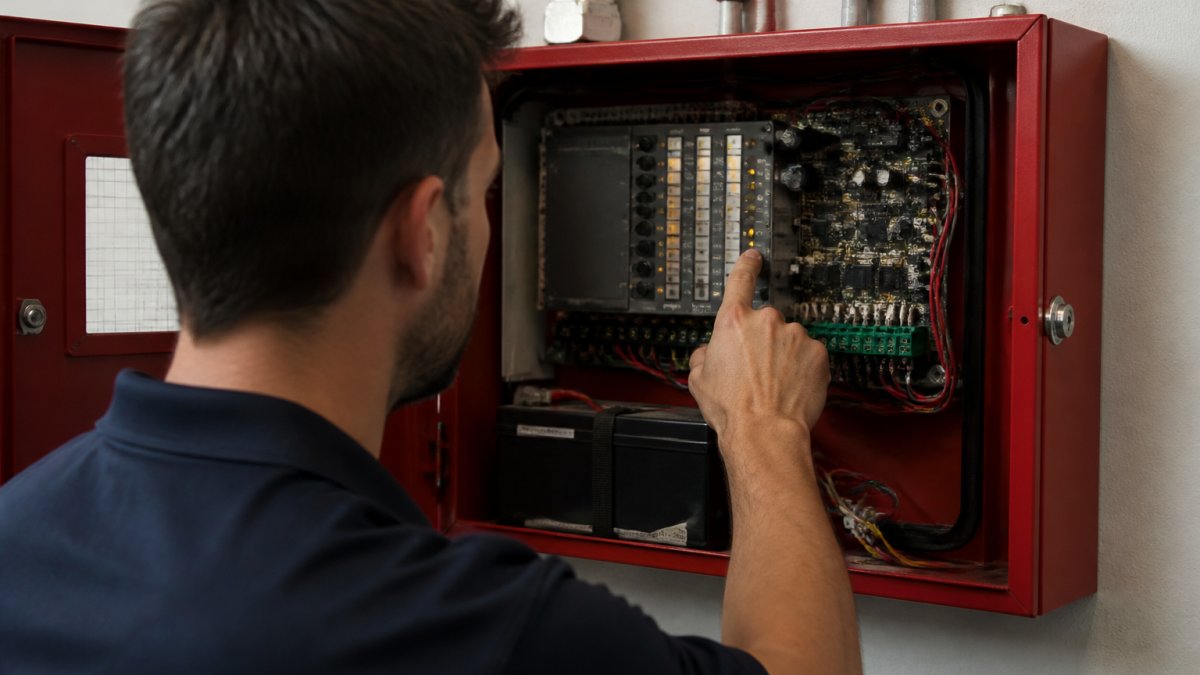
Faulty wiring is one of the most common fire alarm faults in commercial buildings, breaking communication between detectors and the control panel.
Wiring problems include:
- Damaged wiring, Rodents, construction work, or age cracks the wire insulation
- Loose connections, Vibration or poor installation loosens terminal screws
- Corroded terminals, Moisture causes metal corrosion, breaking electrical contact
These faults often affect multiple detectors at once because they share a wiring loop. Your panel shows a zone or loop fault indicating where the problem lies.
Power Supply and Battery Failures
Your fire alarm system needs constant power. When the main power fails, backup batteries take over. When both fail, the system goes dark.
Power and battery faults include:
- Low battery voltage, The backup battery is aging and cannot hold a full charge
- Dead battery, The battery has completely discharged and won’t power the system
- Loose battery connections, Corrosion or vibration loosens the battery terminals
Most control panels display a low battery warning first, giving you time to replace the battery before it dies. Ignoring it risks total system failure.
Fire Alarm Panel Fault Codes: What They Mean
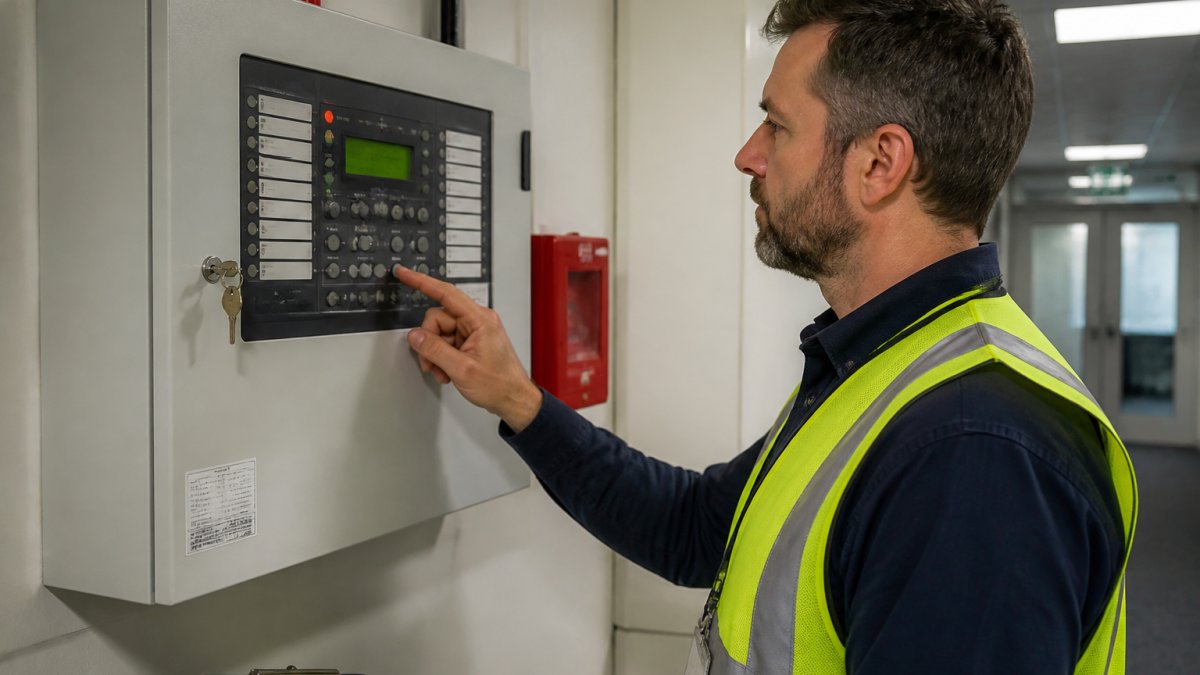
Your fire alarm control panel is where every circuit, detector, and power source reports its status. Learning to read its indications moves you from “something is wrong” to “here is what to check next.” Terminology varies between manufacturers, so treat the categories below as a diagnostic framework and confirm against your panel’s manual.
The three indication types you must not confuse
Most panels separate indications into three tiers, and mixing them up leads to the wrong response:
- Alarm, a detector or manual call point has activated. The system believes there is a fire. Evacuate per your emergency plan and call emergency services; do not silence and reset without investigating.
- Fault (trouble), the system has detected a condition that may stop it working as designed, such as an open circuit, a failed detector, or a power problem. The building is not necessarily unsafe right now, but protection is degraded.
- Supervisory, a condition on a related system the panel monitors, such as a closed valve on a suppression system or a disabled zone. It needs attention but is not itself an alarm.
A common pattern is a steady fault LED plus a flashing zone LED: the steady light means the fault is active, the flashing zone narrows the location. Note both before you touch anything.
Reading common fault indications
| Indication | What it usually means | First safe step |
|---|---|---|
| Low battery | Backup battery below the panel’s threshold, or charger not holding charge | Record the indication, check the battery date, arrange replacement promptly |
| Detector fault | A single detector not communicating or reporting dirty/failed | Identify the address, inspect for contamination or loose base, test that device |
| Zone or loop fault | One or more devices on a circuit not reporting | Check the affected zone’s wiring and terminations before replacing devices |
| Open circuit | A break in the wiring loop | Inspect the loop for damage, rodent activity, or a disconnected device |
| Short circuit | Wires touching where they should not | Do not repeatedly reset; isolate the affected circuit and call a technician |
| Earth/ground fault | A conductor contacting earthed metalwork or moisture | Treat as urgent, it can mask other faults and is a technician job |
| Power supply fault | Main supply, transformer, or charger problem | Check the circuit breaker once; if it trips again, stop and call a technician |
| Communication loss | Panel cannot reach a monitored device, sub-panel, or monitoring link | Confirm the link is powered and connected, then escalate |
Intermittent and recurring faults
Some faults clear on their own and return hours or days later, often the most frustrating and revealing. Typical causes include a marginal battery recovering under charge, a loose termination making intermittent contact, moisture that dries out, or a device at the end of its service life.
Don’t treat each reappearance as isolated. Log every occurrence with date, time, indication, and what the building was doing.
Photograph the panel display whenever a fault appears. The exact wording, LED combination, and any address shown are evidence your technician can work from, and they belong in your maintenance record.
When to act yourself and when to escalate
You can safely record an indication, check a battery date, confirm a breaker hasn’t tripped, and verify a device is seated in its base.
Escalate to a qualified fire alarm technician for an earth/ground fault, short circuit, recurring power supply fault, multiple simultaneous faults, or any fault returning after a reset.
Standards Australia AS1851 maintenance and testing requirements set out how faults and their responses should be documented.
Match the indication to its tier first, alarm, fault, or supervisory, then to its location, then to the safe first step. Document everything, and never reset a fault you do not understand.
False Fire Alarms in Commercial Buildings: Causes and Prevention
A false alarm triggers evacuation when no fire exists, wasting emergency service time, disrupting operations, and eroding staff confidence. Preventing them requires understanding what triggers them.
Environmental Triggers and Nuisance Alarms
Environmental factors cause most false alarms in commercial buildings. Dust, steam, cooking fumes, and moisture fool smoke detectors into thinking a fire exists.
Common environmental triggers:
- Cooking fumes, Kitchen smoke activates detectors in or near food preparation areas
- Dust and construction, Renovation work, drilling, or sanding creates airborne particles
- Steam and humidity, Showers, steam rooms, or high-moisture areas trigger optical detectors
Detector placement matters: units too close to kitchens, bathrooms, or loading docks experience more false alarms. Fyrepower recommends positioning detectors at least 1.5 metres from potential sources of steam or dust, in line with Australian installation standards.
Equipment Malfunction and Aging Components
Faulty equipment causes false alarms even without environmental triggers. Aging detectors become oversensitive or develop internal faults that misfire.
Equipment-related false alarms include:
- Aging detectors, Old detectors become hypersensitive and trigger on minimal smoke
- Malfunctioning notification appliances, Faulty alarm bells or sirens activate without a detector signal
- Control panel software glitch, Corrupted programming causes random fault signals
Aging components are the biggest culprit: most commercial fire alarm systems need detector replacement every 10 years, and older systems experience significantly more false alarms.
Commercial Fire Alarm Maintenance to Prevent Faults
Routine maintenance is the difference between a system that works when it matters and one that fails quietly. The goal is to catch degradation before it becomes a fault, and keep records that prove you did.
A practical maintenance cadence
Intervals below reflect common practice and the expectations of Standards Australia AS1851 maintenance and testing requirements. Your building’s risk profile, system type, and any site-specific requirements may call for more frequent attention, so confirm against your own maintenance schedule.
| Interval | Task | What you are actually checking |
|---|---|---|
| Monthly | Visual inspection | Detectors clean and undamaged, no obstructions, panel showing normal, no outstanding faults |
| Monthly | Battery check | Battery date, terminals free of corrosion, charger indicator normal |
| Quarterly | Battery load test | Battery holds charge under load, not just at rest |
| Six-monthly | Functional test | Each detector, manual call point, and notification appliance activates and reports |
| Annually | Wiring and termination inspection | Visible cabling for damage, rodent activity, corrosion, or loose terminations |
| Annually | Detector cleaning | Optical chambers cleared of dust, insects, and contamination |
| As advised | Detector replacement | Devices showing sensitivity drift or beyond their service life |
A building that passes its six-monthly test but still accumulates faults between visits usually points to environmental contamination, aging devices, or marginal wiring rather than a testing failure. If the same fault recurs, tighten the cadence for that zone.
What to record and why it matters
Your maintenance record is the evidence the system has been looked after. Each visit should capture:
- Date and time of the inspection or test
- Name and licence details of the person who performed it
- Which devices and zones were tested, and the result of each
Keep these records at least five years, longer if your insurer or lease requires it. Auditors typically ask for the testing history and fault log together, a clean test record with no fault log looks incomplete, and a fault log with no resolution dates looks neglected.
A fault that is recorded but never closed out is a compliance risk. Every entry should end with either a resolution or a scheduled follow-up.
Prioritising what you find
Not every finding needs the same urgency. A simple triage:
- Immediate, anything affecting the panel’s power, an earth/ground fault, a short circuit, or multiple zones down at once. Isolate if safe to do so and call a technician.
- Prompt, a single detector or zone fault, a low battery, or a device that failed its functional test. Book a technician visit and note the affected area.
- Monitor, a marginal reading or a device approaching the end of its service life. Record it and check again at the next visit.
Reducing faults at the source
Maintenance is more effective when it addresses why faults occur. Detectors near kitchens, loading docks, or bathrooms collect contamination faster and need more frequent checks. Areas with rodent activity need cabling inspected for damage.
Maintain on a schedule, record every test and fault with dates and outcomes, triage findings by urgency, and adjust the cadence where the environment causes repeat problems.
Inspection, Testing, and Documentation
Mandatory 6-monthly testing keeps your fire alarm system compliant and operational, a legal requirement for commercial buildings in most Australian jurisdictions.
Testing covers:
- Detector function test, Trigger each detector with smoke or heat to confirm activation
- Zone circuit test, Verify that all detectors on each circuit communicate with the panel
- Manual call point test, Confirm that break-glass stations send alarm signals correctly
Documentation is critical: every test must be recorded with date, technician name, results, and any faults found, and kept at least 5 years.
Australian Standards AS1851 maintenance and testing requirements mandate specific testing intervals and documentation formats. Your testing records must match these standards exactly.
What to Do When Your Fire Alarm Shows a Fault
When your control panel displays a fault, act quickly, the system is not fully operational.
Follow these steps:
- Read the fault code, Check your panel’s display for the specific fault code and location
- Consult the manual, Look up the fault code in your system manual to understand what failed
- Isolate the problem, If the fault affects only one zone or detector, note which one
- Document the fault, Record the date, time, fault code, and location in your maintenance log
- Contact a technician, Call a qualified fire alarm technician within 24 hours
- Do not ignore it, Operating a building with a known fire alarm fault violates safety regulations
- Keep the panel accessible, Ensure your technician can reach the control panel and affected detectors
Fire safety compliance requirements for commercial buildings outline your legal obligations when a fault is discovered.
Fyrepower responds to fault calls across the Gold Coast, South Brisbane, and Northern New South Wales. Our technicians provide a detailed report for your compliance file.
Frequently Asked Questions
What is the difference between a fire alarm fault and a false alarm?
A fire alarm fault is a system malfunction, a problem with the equipment itself, such as a faulty detector, low battery, or loose wiring. The system alerts you that something is broken and needs repair. A false alarm occurs when the system activates and triggers an evacuation when there is no actual fire. False alarms are caused by dust, cooking fumes, steam, or equipment sensitivity rather than a system defect. Both require attention: faults need maintenance, false alarms need investigation and prevention measures.
How often should a commercial fire alarm system be tested?
Commercial fire alarm systems in Australia must be tested at least every six months under Australian Standard AS1851. Many facilities test monthly or quarterly for added safety. Testing should include detector function checks, battery capacity verification, panel operation, and notification appliance performance. Regular testing ensures compliance with fire safety regulations and identifies faults before they compromise your system’s reliability during an emergency.
Can dust or building work cause a fire alarm fault?
Yes. Dust and construction debris are among the most common causes of false alarms and detector faults. Dust buildup on sensor lenses reduces sensitivity or triggers nuisance alarms. During renovation or maintenance work, airborne particles can accumulate in detectors, causing intermittent faults or false activations. Protective covers should be used during construction, and detectors should be cleaned or replaced after significant dust exposure. Moisture from wet work can also damage wiring and connections, leading to electrical faults.
What should I do when my commercial fire alarm system shows a fault?
First, do not ignore the fault indicator. Check the control panel for a specific fault code or message, it may identify the problem (low battery, detector issue, wiring fault). If the fault is not immediately obvious, contact a qualified fire protection service provider to inspect and test the system. Document the fault date, code, and actions taken. Never disable the alarm. If the fault affects system function, the building may not meet compliance requirements, and you should arrange urgent repairs. Keep detailed maintenance records for audits.
Fire alarm faults are preventable. Regular maintenance, professional testing, and quick response to fault codes keep your system operational and your building protected. When you need expert support, Fyrepower delivers the compliance documentation, technical expertise, and reliable service that commercial property managers depend on. Get in touch with us now to schedule your next inspection or maintenance visit.