Table of Contents
- Why Fire Extinguisher Training Matters in Hospitality
- Understanding Fire Classes and Hospitality Hazards
- How to Use a Fire Extinguisher: The PASS Method
- Workplace Fire Safety Training Requirements
- AS 3745-2010 Planning for Emergencies in Facilities
- Post-Incident Safety and Equipment Maintenance
- Managing Night Shift and Skeleton Crew Fire Safety
- Conclusion
- Frequently Asked Questions
Last Updated: September 3, 2026
Why Fire Extinguisher Training Matters in Hospitality
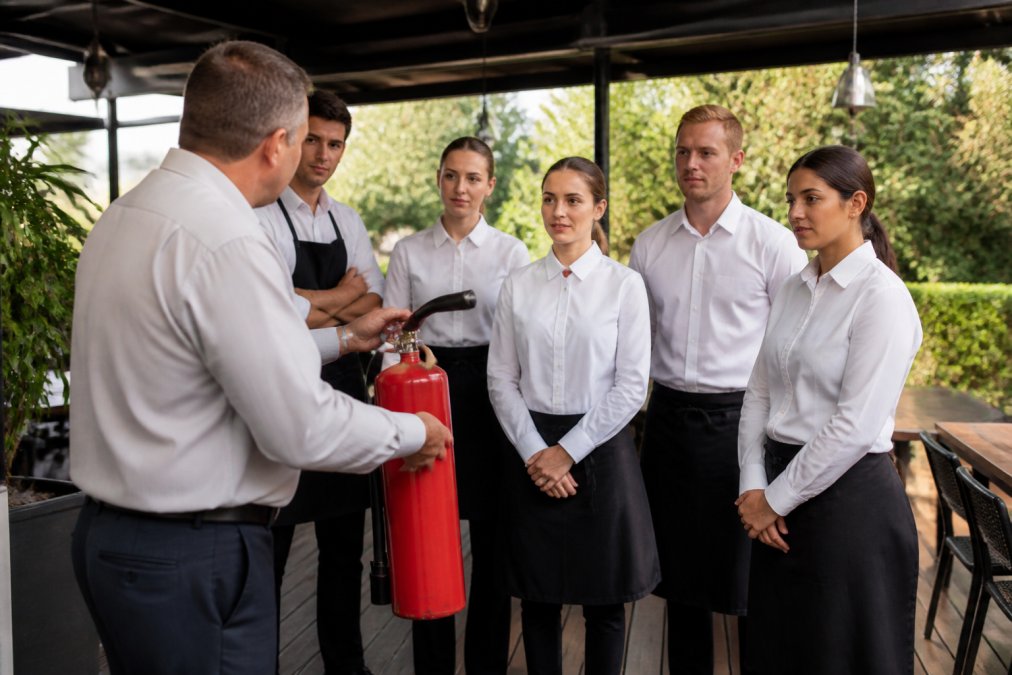
Fire extinguisher training for hospitality staff is not optional compliance, it’s the difference between a contained incident and a catastrophe. Hospitality environments present unique fire risks: kitchens operate at high temperatures with combustible oils, dining areas pack guests unfamiliar with evacuation routes, and night shifts often run with minimal supervision.
At Fyrepower, we provide comprehensive fire safety solutions. A single staff member who knows how to operate a fire extinguisher correctly can prevent a small grease fire from becoming a full kitchen evacuation.
The legal stakes are equally clear. Under Australian workplace health and safety legislation, your business has a duty to ensure staff are competent in emergency procedures (asic.gov.au). Regulators expect documented training, competency assessments, and refresher programs. If an incident occurs and your records show no training took place, liability exposure becomes severe. Your insurance may also exclude claims if staff weren’t trained to respond to preventable fires.
This guide covers fire classes, the PASS method, legal requirements, operational protocols for real kitchens, and maintenance that keeps your equipment reliable.
Understanding Fire Classes and Hospitality Hazards
Fire classification systems exist because different fires require different suppression methods. Using the wrong extinguisher on the wrong fire can make it worse. Hospitality venues deal with multiple fire classes simultaneously, which is why generic training fails.
Fire classes A, B, C, D, and F explained
Class A fires burn ordinary combustibles: wood, paper, textiles, plastics. Class A extinguishers use water or dry powder to cool and suppress the fire.
Class B fires involve flammable liquids: petrol, oils, solvents, spirits. Class B extinguishers use dry powder, foam, or CO2 to suppress flames by displacing oxygen. Never use water on a Class B fire, it spreads the burning liquid.
Class C fires are electrical fires from live equipment, appliances, or wiring. Kitchens are full of Class C hazards. Class C extinguishers use dry powder or CO2 because water conducts electricity and creates electrocution risk.
Class D fires involve combustible metals (magnesium, sodium, potassium). These are rare in hospitality. Class D requires specialist dry powder extinguishers. Most hospitality venues don’t stock them, but staff should know when to call specialist services rather than attempt suppression.
Class F fires burn cooking oils and fats, the fire class most specific to hospitality kitchens. A Class F fire starts when cooking oil reaches ignition temperature (around 300°C) (peer-reviewed research). Class F extinguishers use a special wet chemical agent that cools the oil, suppresses vapours, and prevents re-ignition. This is non-negotiable for any hospitality kitchen. Never use water on a Class F fire, the water will sink below the hot oil, convert to steam explosively, and send burning oil across the kitchen.
Grease fires and kitchen-specific risks
Grease fires are the signature fire risk in hospitality. They burn hot, spread fast, and create heavy smoke that obscures exits and disorients staff. The instinct most untrained staff have, throwing water on a grease fire, is catastrophically wrong. When water hits hot oil, it flashes to steam, expands violently, and ejects burning oil across the kitchen, the cook, and potentially into the dining area.
The correct response uses a Class F extinguisher or a fire blanket. A Class F extinguisher discharges a wet chemical agent that cools the oil, suppresses flames, and creates a soap-like layer that prevents re-ignition. Your staff must know which tool to use and where it’s located before an emergency occurs.
How to Use a Fire Extinguisher: The PASS Method
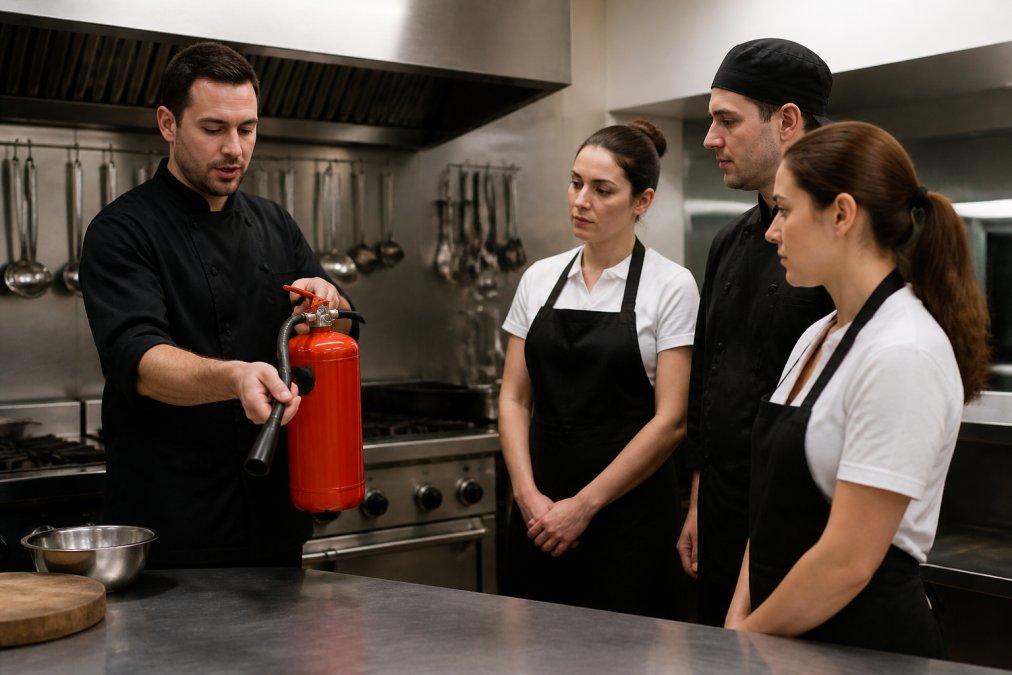
The PASS technique is the standard fire extinguisher operation method taught across Australia. It’s simple, memorable, and works across all extinguisher types. Your staff should be able to execute PASS without hesitation through hands-on practice.
Step-by-step PASS technique for safe operation
P, Pull the pin. The pin prevents accidental discharge. Locate it on the top of the extinguisher, usually with a plastic tab. Pull it straight out with firm, deliberate motion.
A, Aim at the base of the fire. Don’t aim at the flames. Aim at the base where the fuel is burning. For a grease fire in a pan, aim at the oil surface. For a fire on the floor or in furniture, aim at the burning material itself.
S, Squeeze the handle. The handle is the trigger. Squeeze it with steady, controlled pressure. The extinguishing agent discharges as long as you squeeze. Release pressure to stop discharge.
S, Sweep side to side. Once the agent is flowing, move the nozzle in a sweeping motion from side to side across the base of the fire. Continue until the fire is fully suppressed or you’ve emptied the extinguisher.
The entire PASS sequence takes 15-30 seconds for a small fire. Success depends on whether staff are calm enough to execute the steps under pressure and whether they’ve had hands-on practice before an emergency.
When to fight a fire versus when to evacuate
This decision point separates effective emergency response from dangerous heroics. Your staff need clear criteria for when to attempt suppression and when to evacuate immediately.
Fight the fire only if all of these conditions are true:
- The fire is small and contained (not spreading rapidly)
- You have a clear escape route behind you (never let the fire block your exit)
- You have the correct extinguisher type for the fire class
- The fire is in a location where suppression is safe
- You have been trained and feel confident in your ability to use the extinguisher
Evacuate immediately if any of these are true:
- The fire is large, spreading, or producing heavy smoke
- You don’t know what’s burning (unknown fuel type means unknown fire class)
- You don’t have the correct extinguisher type
- The fire blocks your escape route
- The fire is in an electrical panel, gas line, or other hazardous location
- You feel unsafe or uncertain
In hospitality, the evacuation decision is especially important because your priority is guest safety, not property protection. Your staff need to know the difference and have explicit permission from management to prioritise evacuation over suppression in ambiguous situations.
Workplace Fire Safety Training Requirements
Australian workplace health and safety legislation requires documented fire safety training. The specific requirements depend on your venue’s size, classification, and state-based regulations. Compliance is not negotiable, and regulators audit this area regularly.
Mandatory training frequency and compliance
Your staff must receive fire safety training before they start work and then at regular intervals throughout their employment. Many hospitality venues implement annual refresher training, which aligns with insurance requirements and provides a reasonable cadence for staff to maintain competency.
Documentation is essential. Your training records must show who attended, what was covered, when the training occurred, and ideally some assessment of competency. If an incident occurs, these records demonstrate that you’ve met your duty of care.
External training providers can deliver this training, or you can conduct it in-house if you have staff with appropriate expertise. Many hospitality venues use a combination: professional external training for initial induction and annual refreshers, with internal spot-checks and scenario drills in between. electrical safety protocols.
Fire warden roles and responsibilities
Larger hospitality venues typically designate fire wardens, staff members with additional training who take responsibility for emergency procedures. A fire warden’s role includes checking that fire equipment is accessible, leading evacuation procedures, accounting for staff and guests, and liaising with emergency services.
Fire wardens need more detailed training than general staff. They should understand the venue layout, know where all fire exits and assembly points are, understand how to use communication systems during evacuation, and be trained in basic first aid. The fire warden is not a firefighter. Their role is to manage the evacuation, not to suppress fires.
AS 3745-2010 Planning for Emergencies in Facilities
AS 3745-2010 is the Australian standard for planning for emergencies in facilities (standards.org.au). It sets out requirements for emergency planning, including fire scenarios. Compliance with this standard is often a legal requirement under state-based workplace health and safety legislation.
Emergency response procedures and evacuation planning
AS 3745-2010 requires that you develop an emergency response plan specific to your venue. This plan must identify potential emergencies (fires, medical incidents, security threats), assess the risks they present, and define procedures for responding to each scenario.
Your emergency response plan must include evacuation procedures: identifying all emergency exits, determining the assembly point, establishing communication protocols, and defining roles and responsibilities during evacuation. The standard also requires that you test your emergency procedures regularly. Evacuation drills, ideally at least annually, ensure staff know what to do and can execute the plan under realistic conditions.
Integrating guest evacuation with staff protocols
Hospitality venues face a unique challenge: you’re responsible for evacuating not just staff but also guests who may be unfamiliar with the building, may not speak English as a first language, and may be in various states of distress.
Your emergency response plan must account for this. Staff need to know how to guide guests to exits and how to communicate evacuation instructions clearly and calmly. Many venues assign specific staff to specific areas during evacuation. Guest communication during evacuation is critical. Announcements should be clear, calm, and authoritative: “Please proceed to the nearest exit. Assembly point is in the car park. Please move calmly and quickly.”
Post-Incident Safety and Equipment Maintenance
After a fire extinguisher has been used, it cannot be returned to service without professional inspection and recharge. This is both a safety requirement and a legal obligation.
Cleanup and site assessment after extinguisher use
The area where an extinguisher has been used requires assessment and cleanup. Dry powder residue is messy and can damage equipment if not cleaned properly. Wet chemical residue from Class F extinguishers requires specific cleanup procedures to prevent re-ignition.
After suppressing a fire, do not assume the fire is fully extinguished. Even if visible flames are gone, embers or hot spots may remain. Allow the area to cool before staff return. In kitchens, this means shutting down the equipment, ensuring no heat source remains active, and allowing adequate ventilation.
If the fire involved electrical equipment, do not restore power immediately. Have the equipment inspected by a qualified electrician before returning it to service. Document what happened: what was burning, how the fire started, what extinguisher was used, how much of the charge was deployed, and what damage occurred.
Inspection and recharge requirements
After use, the extinguisher must be professionally inspected and recharged. An extinguisher that has been partially discharged is useless in a subsequent emergency. Your venue should never rely on a partially used extinguisher.
Professional recharge services are widely available. Many fire safety companies offer mobile recharge services that come to your venue, inspect the extinguisher for damage, recharge it, and tag it with a service record. Beyond recharge after use, extinguishers require periodic inspection. Most extinguishers need a visual inspection annually and a more detailed inspection every 5-10 years depending on the extinguisher type.
Fyrepower provides comprehensive maintenance and inspection services for fire extinguishers across hospitality venues. Our team conducts inspections, recharges equipment, and maintains detailed service records that satisfy regulatory audit requirements.
Managing Night Shift and Skeleton Crew Fire Safety
Night shifts present unique fire safety challenges. Staff numbers are lower, supervision may be minimal, and response times to emergencies are slower. Your fire safety procedures must account for this reality. During night shifts, the threshold for evacuation should be lower. With fewer staff available, attempting to suppress a fire is riskier.
Night shift staff need additional training focused on scenarios specific to skeleton crew operations. What’s the evacuation procedure if only two staff are present? How do you account for all guests if the building is large? How do you communicate with emergency services if the trained person is on a break?
Consider implementing a “night shift fire safety checklist” that staff review at the start of their shift. Technology can support night shift safety. Some venues install automated fire alarm systems that alert emergency services directly, reducing reliance on staff to make that call.
Conclusion
Fire extinguisher training for hospitality staff is not compliance theatre. It’s a practical capability that prevents small incidents from becoming emergencies. Your staff need to understand fire classes, master the PASS technique, know when to suppress versus evacuate, and have confidence in your equipment and procedures.
Fyrepower delivers fire safety training and equipment maintenance specifically designed for hospitality venues. We conduct on-site training that covers kitchen-specific hazards, provide hands-on practice with the correct equipment, and maintain detailed compliance documentation. Our team ensures your venue meets AS 3745-2010 requirements and keeps your fire safety equipment reliable and ready. Get in touch with us now to assess your current fire safety capability and schedule training for your team.
Frequently Asked Questions
Q: Is fire extinguisher training mandatory for hospitality staff in Australia?
A: Yes. Under occupational health and safety regulations, hospitality venues must ensure staff receive fire safety training appropriate to their role. The frequency and depth depend on your venue’s fire risk assessment and AS 3745-2010 emergency planning requirements. Most venues require initial induction training plus refresher sessions every 12 months. Your local fire authority and WHS regulator can confirm specific obligations for your venue type and size.
Q: How do you correctly operate a fire extinguisher using the PASS method?
A: PASS stands for Pull, Aim, Squeeze, Sweep. Pull the safety pin to unlock the extinguisher. Aim the nozzle at the base of the fire, not the flames. Squeeze the handle to release the agent. Sweep side to side across the fire’s base until it’s out. Never aim at the top of flames. If the fire doesn’t respond within 10-15 seconds, stop and evacuate immediately. Always ensure an escape route remains clear before attempting to fight any fire.
Q: What fire classes are most common in hospitality venues?
A: Class F fires (cooking oils and fats) are the most frequent in hospitality kitchens. Class A fires (paper, wood, textiles) occur in dining and storage areas. Class B fires (flammable liquids) can occur in bars and storage. Each class requires a different extinguishing agent. Class F extinguishers are essential in any commercial kitchen. Staff must know which extinguisher to use for each class, as using the wrong type can spread the fire or cause injury.
Q: How often should hospitality staff receive fire safety refresher training?
A: Annual refresher training is standard practice for hospitality staff. However, your specific requirement depends on your venue’s fire risk assessment under AS 3745-2010 and your state’s WHS regulations. High-risk venues (those with large kitchens or complex layouts) may require twice-yearly training. New staff must complete induction training before working shifts. Training should cover the PASS technique, fire classes, evacuation procedures, and your venue’s specific emergency response plan.
This article was written using GrandRanker