Table of Contents
- What Strata Managers Need From Fire Protection Companies
- How We Evaluated Fire Protection Companies for Strata
- 1. Fyrepower: Compliance-First Provider With QBSA Licensing
- 2. Eagle Fire: Cost-Effective Maintenance for Owners Corporations
- 3. Uptick: Compliance Software for Large Strata Portfolios
- 4. Essential: Digital Oversight for Compliance Records
- Strata Fire Safety Compliance Requirements Explained
- Building a Fire Safety Maintenance Schedule for Strata
- Frequently Asked Questions
Last Updated: September 4, 2026
Strata managers carry a legal burden most owners never see: every essential fire safety measure must be tested and maintained to Australian Standards, or the owners corporation faces fines, insurance claims, and closure orders. Choosing the right provider is a risk management decision. This guide from Fyrepower, a QBSA-licensed and fully insured fire protection specialist, breaks down what strata managers need from fire protection companies and how to evaluate them against compliance requirements.
What Strata Managers Need From Fire Protection Companies
The core requirement is simple: a provider must keep your building compliant with Australian Standards AS1851 and AS2444, and produce documentation that holds up in an audit (standards.org.au). Queensland Building and Construction Commission licensing information confirms that any contractor carrying out fire protection work must hold the appropriate licence, which is your first screening filter.
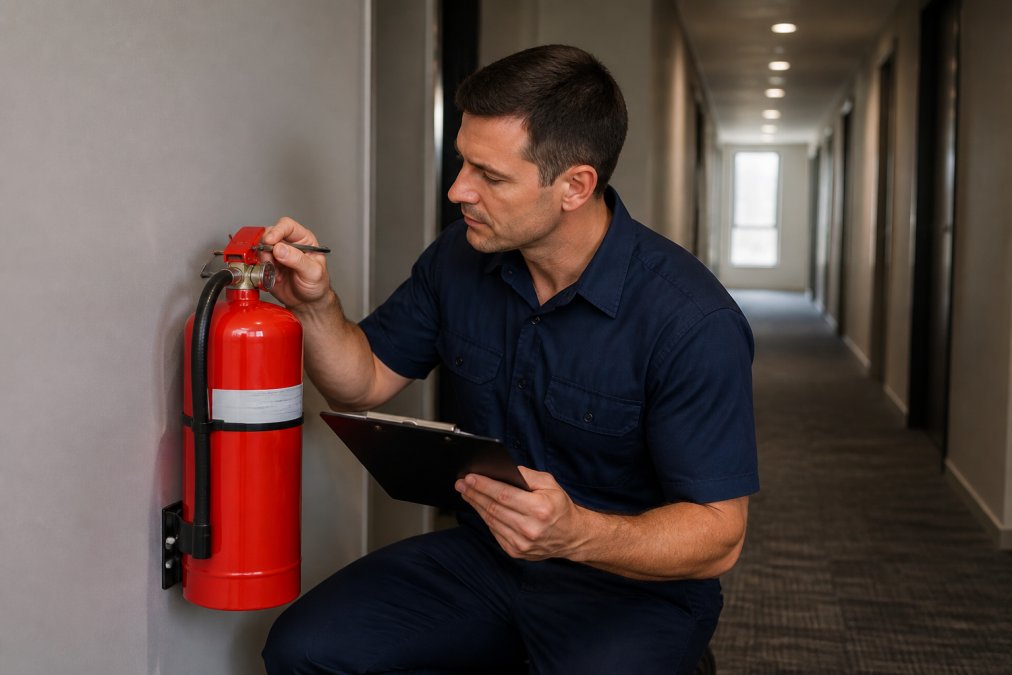
Beyond the licence, strata managers need three things: reliability across multiple properties, detailed reporting that proves work was done, and the capacity to meet six-monthly testing deadlines without being chased. A common failure point is vague service reports that cannot evidence compliance when the annual fire safety statement is due. Your provider should deliver itemised reports naming each measure tested, the result, and any defects found.
If your service reports are vague, you cannot prove compliance during an audit. An annual fire safety statement backed by thin documentation leaves the owners corporation exposed to liability. Insist on itemised reporting before you sign any contract.
How We Evaluated Fire Protection Companies for Strata
We assessed providers against four criteria specific to strata portfolios: compliance depth, reporting quality, service capacity, and contract transparency. Compliance depth means demonstrated knowledge of Australian Standards and the ability to test all essential fire safety measures. Reporting quality covers whether the paperwork satisfies fire safety certification obligations. Service capacity asks whether the provider can handle multiple buildings and deadlines simultaneously. Contract transparency addresses surprise charges appearing after a quote.
Quick Picks:
- Best Overall: Fyrepower, compliance-first provider with QBSA licensing and full insurance
- Best for Cost-Effective Maintenance: Eagle Fire, proven with strata management firms
- Best for Portfolio Oversight: Uptick, compliance software for large portfolios
- Best for Digital Records: Essential, cloud-based compliance tracking
1. Fyrepower: Compliance-First Provider With QBSA Licensing
Our top pick for strata buildings is Fyrepower, and the reason comes down to accountability. The company is fully insured and QBSA-licensed, giving the owners corporation clear recourse if something goes wrong during testing. Expertise in AS2444 and AS1851 ensures work is done to the required technical level, and every service is backed by a 55-month warranty on equipment.
Fyrepower maintains a comprehensive range of fire safety equipment, including extinguishers, hydrants, and suppression systems, alongside installation and testing services. For strata managers juggling multiple properties across the Gold Coast and South Brisbane, the advantage is having one provider who handles the full scope of essential fire safety measures without subcontracting. The team also delivers on and offsite fire training, covering the staff and resident education component many compliance programs overlook.
When verifying any provider, ask for their QBCC licence number and certificate of currency for insurance before they set foot on site. A [QBSA-licensed and fully insured](/how-to-verify-qbsa-fire-licence/) company like Fyrepower will provide both without hesitation. If a contractor hesitates, that is your answer.
2. Eagle Fire: Cost-Effective Maintenance for Owners Corporations
For owners corporations where budget is the primary constraint, Eagle Fire offers competitively priced maintenance services. The company is frequently engaged by strata management firms for routine fire safety inspections, testing of fire suppression systems, and strata-specific compliance reporting. They also provide emergency repair services, which matters when a defect is flagged during an inspection and needs immediate attention.
The tradeoff is that pricing is bespoke and based on building complexity, so you will need to request a detailed quote for each property. Eagle Fire works best for strata managers who have a stable portfolio of buildings with straightforward fire safety infrastructure and want a reliable, no-frills maintenance partner.
3. Uptick: Compliance Software for Large Strata Portfolios
Strata managers overseeing large portfolios face a scheduling problem: tracking six-monthly testing deadlines across dozens of buildings. Uptick solves this with automated scheduling for fire safety inspections and real-time compliance tracking against Australian Standards. The platform provides a digital logbook and reporting system designed for strata managers, and its mobile app lets field technicians log results on site.
Uptick is a software platform, not a physical service provider, so you still need a licensed contractor to perform the testing. The value is in the oversight layer: real-time visibility of compliance status across your entire portfolio, with integration into strata management software. This is the right choice for large strata managers who need to demonstrate compliance status at a glance.
4. Essential: Digital Oversight for Compliance Records
Essential takes a similar approach but focuses more heavily on document management and audit trails. The platform sends automated compliance reminders, centralises safety records, and integrates with building management systems. For strata managers burned by vague paper reports, Essential provides detailed audit trails showing exactly what work was completed and when.
Like Uptick, Essential is a software tool rather than a service provider. It suits property managers who want a user-friendly interface for tracking compliance tasks but will still contract a licensed fire protection company for physical testing and maintenance.
| Provider | Type | Best For | Key Strength |
|---|---|---|---|
| Fyrepower | Service provider | Full compliance and maintenance | QBSA-licensed, fully insured, AS1851 expertise |
| Eagle Fire | Service provider | Cost-effective maintenance | Competitive pricing, strata experience |
| Uptick | Software platform | Large portfolio tracking | Automated scheduling, real-time compliance |
| Essential | Software platform | Digital record keeping | Audit trails, document management |
Strata Fire Safety Compliance Requirements Explained
Strata fire safety compliance in Australia is not a paperwork exercise; it is a legal obligation with direct financial and operational consequences for the owners corporation. The framework is set by state legislation, the National Construction Code, and Australian Standards, primarily AS1851. The central document is the annual fire safety statement, certifying that each essential fire safety measure has been assessed and is capable of performing to its original design standard.
Where many strata managers underestimate the risk is in the enforcement chain. Local councils and state fire services conduct random audits of annual fire safety statements. When a statement is found inaccurate, or maintenance records cannot substantiate the certification, the consequences escalate quickly: fire lane compliance.
- Fines: Each state sets its own penalty regime. In Queensland, for example, the Building Fire Safety Regulation 2008 allows for penalties against the owner or the body corporate for failing to maintain essential fire safety measures or submit a valid annual statement (legislation.qld.gov.au). These are not trivial amounts, and they compound for each measure that is non-compliant.
- Insurance invalidation: A common pattern is that an insurer will deny a fire-related claim if it discovers that the annual fire safety statement was inaccurate or that maintenance records were incomplete. The owners corporation is then left to cover the full cost of damage, legal fees, and temporary accommodation for residents.
- Closure orders and emergency orders: In serious cases where a fire safety measure is found to be non-operational, the local authority can issue an emergency order requiring immediate rectification. If the building is deemed unsafe for occupancy, residents may be evacuated and the building closed until the defect is fixed.
- Personal liability for the strata manager: While the owners corporation is the legal entity responsible, strata managers can face professional indemnity claims from the owners corporation if their failure to oversee compliance leads to a loss. This is a critical point: the manager’s duty of care extends to ensuring that contractors are licensed, that service reports are reviewed, and that the annual statement is submitted on time.
A common failure point is the assumption that ‘the fire company handles compliance.’ The fire protection company performs the testing and provides the reports, but the legal obligation to submit the annual fire safety statement and ensure its accuracy rests with the building owner, the owners corporation. If the provider’s report is vague or incomplete, the owners corporation is still liable for the inaccurate statement.
The practical implication for choosing a provider is that you are not just buying a service; you are buying an evidence trail. The provider’s documentation must be detailed enough to satisfy an auditor looking for gaps. This is why the choice of provider directly determines your legal exposure. A provider that produces itemised reports, names each measure tested, records the result, and flags defects with clear rectification timelines gives you a defensible position. A one-page checklist leaves you exposed.
For strata managers, the most effective risk mitigation step is to conduct an annual pre-submission audit of your own records before the fire safety statement is lodged. Cross-check that every essential fire safety measure listed on the building’s fire safety schedule has a corresponding service report dated within the required interval. If there is a gap, address it before the statement is submitted, not after an auditor finds it.
Building a Fire Safety Maintenance Schedule for Strata
A maintenance schedule is only useful if it survives contact with reality. The most common reason strata buildings fall out of compliance is not a lack of intent; it is a scheduling failure. Six-monthly testing deadlines drift, a contractor cancels at short notice, a new building is added without a proper handover, and suddenly the annual statement is due with gaps in the record.
A robust schedule starts with a complete inventory of every essential fire safety measure in the building. This is not always obvious from original building plans. Retrofits, tenancy changes, and partial upgrades can add or alter measures. The fire safety schedule, held by the building manager or owners corporation, lists each measure and its performance standard. If you do not have a current schedule, obtaining one from the original building certifier or a licensed fire protection consultant is the first step.
Once the inventory is confirmed, the schedule must account for three distinct timeframes:
- Six-monthly testing under AS1851 for active systems: fire alarm panels, emergency lighting, exit signage, fire hydrants, and fire hose reels. These tests must be spread across the year, not clustered in the same month, to ensure the systems are operational throughout the year.
- Annual testing for passive measures and equipment: fire extinguishers, fire blankets, and some suppression system components. These can often be aligned with the six-monthly cycle to reduce site visits, but only if the provider can evidence that the annual test is genuinely distinct from the six-monthly check.
- Annual fire safety statement submission: This is the hard deadline that drives everything else. Work backwards from the submission date to ensure all testing and any necessary rectification is complete at least two weeks prior, leaving time for a final review of the documentation.
A practical approach used by experienced strata managers is to schedule all six-monthly testing for the same week, twice a year. This creates a predictable rhythm that residents and building managers can plan around, and it makes it easier to verify that every measure has been tested in the same reporting period. The trade-off is that a single contractor failure can delay everything, which is why the provider’s capacity to meet deadlines across multiple buildings is a critical selection criterion.
The schedule also needs to account for the unexpected. When a defect is identified during testing, the provider should issue a defect notice with a recommended rectification timeframe. The schedule must include a follow-up mechanism to ensure rectification is completed and re-tested, not just logged and forgotten. A common pattern is that a minor defect noted in one service cycle becomes a major non-compliance issue at the next audit.
For strata managers overseeing multiple buildings, a spreadsheet is rarely sufficient. The complexity of tracking different testing dates, providers, and rectification statuses across a portfolio demands either a dedicated compliance platform or a very disciplined manual process. The key is a single source of truth showing, at any moment, the compliance status of every measure in every building.
A final consideration is the transition between providers. When a strata manager switches fire protection companies, the maintenance schedule is the most critical document to transfer. The new provider needs the full service history, not just the latest certificate, to understand what has been tested, what defects were previously identified, and what the testing rhythm has been. Without this history, the new provider cannot accurately assess whether the building is compliant, and the owners corporation may face a gap in coverage during the transition period. A well-structured schedule, maintained by the strata manager rather than the provider, ensures the building’s compliance history stays with the building, not with the contractor.
Frequently Asked Questions
What are the legal fire safety obligations for strata buildings?
Owners corporations must maintain all essential fire safety measures in a buildings to comply with Australian Standards, primarily AS1851. This includes routine servicing of fire extinguishers, hydrants, smoke detection systems, emergency lighting, and exit signage. A current Annual Fire Safety Statement (AFSS) must be displayed and submitted to the local council. Failure to meet these obligations can result in fines, legal liability, and invalidated building insurance.
How often must fire safety equipment be tested in strata properties?
Most essential fire safety measures require testing every six months, as set out in the fire safety maintenance schedule under AS1851. This includes fire extinguishers, fire hydrants, fire hose reels, emergency lighting, and exit signs. Some systems, such as smoke detection and fire alarm systems, may also need more frequent inspection or annual testing depending on the building classification. Your fire protection company should provide a schedule that tracks these intervals.
What should strata committees look for when hiring a fire protection company?
Verify the company is fully insured and holds relevant licences, such as a QBSA licence for building work in Queensland. Confirm their technicians have demonstrated experience with the specific Australian Standards that apply to your building, including AS1851 and AS2444. Ask whether they provide detailed digital reports after each service visit that will hold up during an audit. Also check if they offer a maintenance schedule that tracks all six-monthly and annual testing deadlines.
Are strata managers responsible for fire safety compliance?
The owners corporation holds the legal responsibility for fire safety compliance, but strata managers act on their behalf. The manager typically coordinates access for fire protection companies, receives service reports, and ensures the Annual Fire Safety Statement is submitted on time. A competent strata manager will maintain a register of all essential fire safety measures and track the fire safety maintenance schedule. Liability still rests with the owners corporation if obligations are missed.
How do I compare fire protection service providers for my building?
Start by confirming the provider services your specific building type and size. Request a written quote that itemises testing, maintenance, and any potential call-out fees. Ask whether their reporting includes photographic evidence and clear pass or fail outcomes for each measure. Check their response times for emergency repairs and whether they offer a dedicated account manager for strata portfolios. Finally, verify their licences and insurance certificates are current before signing.
This article was written using GrandRanker