Last Updated: November 8, 2026
Quick Summary
Essential fire safety equipment for small offices includes extinguishers matched to your fire class, such as dry powder and CO2 for standard offices, plus interconnected smoke alarms, fire blankets in kitchenettes, exit signs, emergency lighting and a documented evacuation plan. Under the Work Health and Safety Regulations, Australian workplaces must provide suitable fire protection, and equipment must be tested on schedule.
- Visual checks of extinguishers are done monthly by trained staff, with professional inspection every 6 months.
- A CO2 extinguisher is the default choice for server rooms because it leaves no residue.
- Prioritise working smoke alarms and an evacuation plan first when your budget is tight.
- Fire doors must close properly and never be propped open.
- Fyrepower backs its work with a 55-month warranty and is QBSA-licensed.
Table of Contents
- Essential Fire Safety Equipment Every Small Office Needs
- AS 2444 Fire Extinguisher Placement: Where Each Unit Belongs
- Fire Extinguisher Testing Frequency and the Maintenance Schedule
- Exit Signs, Emergency Lighting and Evacuation Routes
- Is Commercial Fire Sprinkler Installation Worth It for a Small Office?
- Selecting Equipment by Office Hazard and Layout
- Book a Compliance Inspection with Fyrepower
- Frequently Asked Questions
Essential Fire Safety Equipment Every Small Office Needs
A fire can destroy a small business in minutes. Yet many small offices still rely on spreadsheets and paper to track their fire safety gear. According to the 2026 Fire & Life Safety Industry Report, 32.6% of small contractors use spreadsheets for safety data, while 26.4% still use pen and paper.
That matters because fire safety equipment is not optional. Australian workplaces must provide suitable fire protection under the Work Health and Safety Regulations, and the equipment you choose depends on your hazards, layout and occupancy. Fyrepower supplies, installs and tests fire safety equipment, and can advise on what a small office needs.
Below, we break down the essential fire safety equipment for small offices, where each item belongs, and how often it needs testing.
Fire extinguishers: matching the agent to the fire class
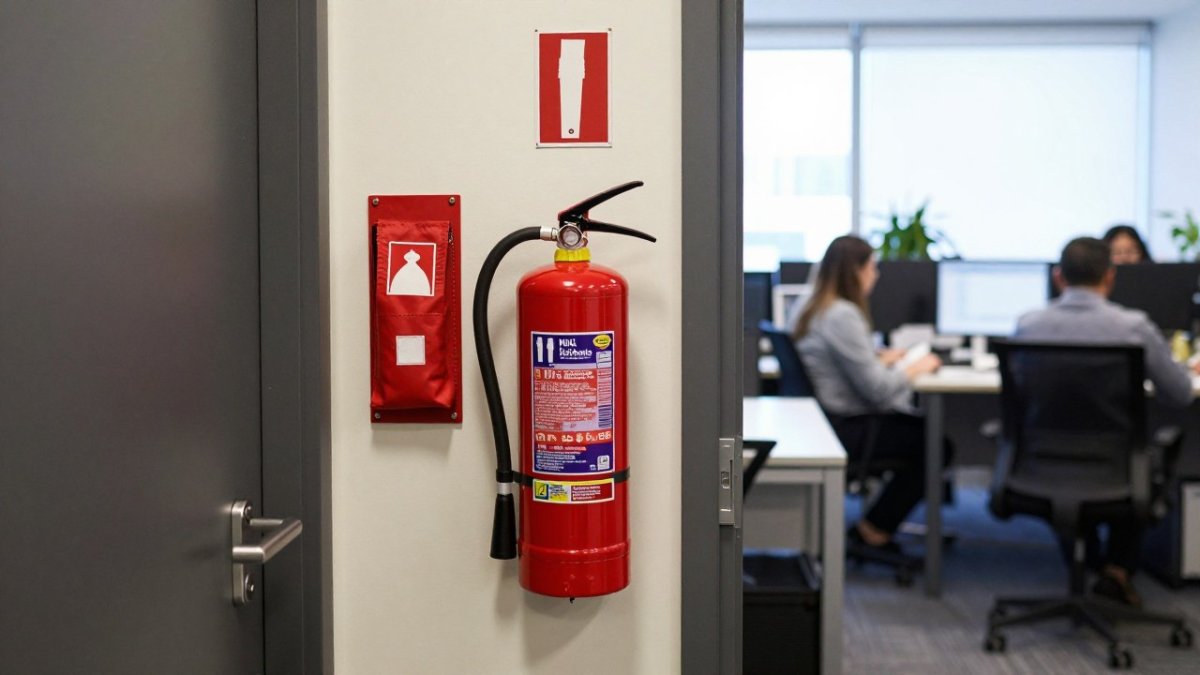
Fire extinguishers are your first line of defence, but only if the agent matches the fire class. A water extinguisher on an electrical fire makes things worse. Here is how the main types line up:
- Water extinguisher: Class A fires only (wood, paper, textiles)
- Foam extinguisher: Class A and B (flammable liquids)
- CO2 extinguisher: Class E electrical fires, plus Class B
- Dry powder extinguisher: Class A, B, C and E, a good all-rounder
- Wet chemical extinguisher: Class F cooking oils and fats
For a standard office, a mix of dry powder and CO2 covers most risks. Our guide to fire extinguisher classes explained walks through each type and how ratings work.
Smoke alarms, fire blankets and hose reels
Smoke alarms give occupants early warning. Small offices should have interconnected smoke alarms in corridors and plant areas, tested regularly.
Fire blankets smother small fires, especially in kitchenettes. Each item has a place, and each needs inspection.
How small contractors manage safety and operational data
AS 2444 Fire Extinguisher Placement: Where Each Unit Belongs
Fyrepower’s expertise includes Australian safety standards, including AS 2444, which covers extinguisher placement. Our team can advise on placement for your premises.
Placement is not guesswork. Our AS 2444 fire extinguisher placement guide covers the full detail for each unit.
Fire Extinguisher Testing Frequency and the Maintenance Schedule
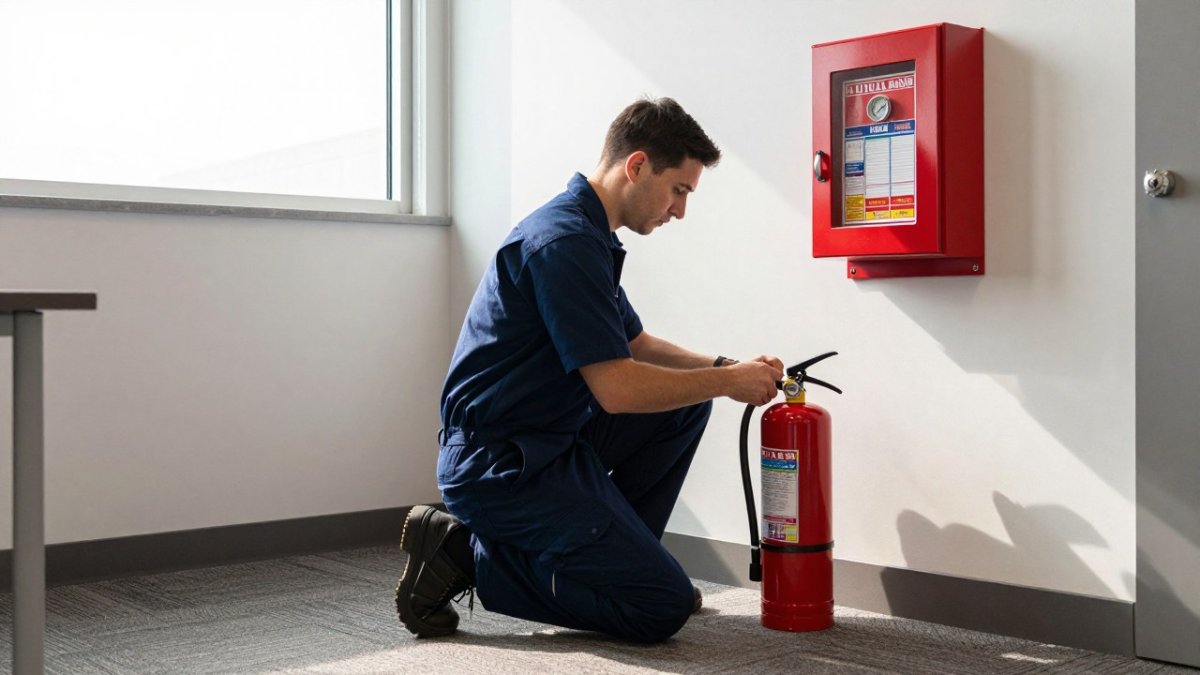
Fire extinguisher testing frequency follows AS 1851, the standard for maintenance of fire protection systems. Fyrepower can advise on the testing schedule that applies to your equipment.
A structured schedule keeps you compliant and audit-ready:
| Task | Frequency | Who Does It |
|---|---|---|
| Visual check | Monthly | Trained staff |
| Professional inspection | 6 months | Licensed technician |
| Pressure test | Per AS 1851 cycle | Licensed technician |
| Replacement | At end of service life | Supplier |
Our testing and tagging guide explains the requirements in full.
Exit Signs, Emergency Lighting and Evacuation Routes
Exit signs and emergency lighting guide people out when the power fails or smoke fills a corridor. Both are essential safety measures, and both need regular testing. In a small office, the practical questions are whether every escape route is signed and lit, whether the signs are visible from the point where a person needs to make a decision, and whether the lighting keeps the route usable long enough for everyone to leave.
What to check on escape routes
- Exit signs should be visible from the main occupied areas and at each change of direction on the route.
- Emergency lighting should cover corridors, stairwells, and the final exit, and should be tested on the schedule set for your building.
- Fire doors must close properly and never be propped open. A wedged fire door defeats the compartmentation the building relies on.
- Escape routes should stay clear of storage, furniture and locked doors that staff cannot open without a key.
Inclusive evacuation and after-hours occupants
A common gap in small-office planning is assuming everyone can hear a standard alarm and use the stairs unaided. Accessible evacuation planning considers people with disability, visitors who do not know the layout, and staff working after hours when fewer people are around to assist.
Practical measures include visual warning devices such as flashing lights where a person may not hear an audible alarm, a designated assisted-evacuation plan for anyone who needs help using stairs, and a check-in process for visitors so you know who is on site. After-hours occupants should know where the nearest exit and extinguisher are, because they may be the only person present when an alarm activates.
Watch out: an evacuation plan that only exists in a folder and has never been walked through tends to fail in practice. Run a simple drill and note where people hesitated or where a route was blocked.
Keeping the plan current
Review the evacuation plan when the layout changes, when new equipment is installed, or when staff responsibilities change. Keep exit signs and emergency lighting on the same maintenance schedule as your other fire safety equipment so nothing falls out of the inspection cycle.
Is Commercial Fire Sprinkler Installation Worth It for a Small Office?
For most small offices, sprinklers are not mandatory unless the building’s classification or size triggers the requirement. Where they are fitted, they are highly effective at controlling fires early.
The decision comes down to your building type, insurer requirements and budget. Our article on whether commercial fire sprinkler installation is worth it weighs the costs and benefits for small premises.
Selecting Equipment by Office Hazard and Layout
Equipment selection starts with a fire risk assessment. Research in the Frontiers in Built Environment shows that formal risk assessment frameworks significantly improve fire prevention outcomes. For a small office, the assessment does not need to be complex, but it does need to be specific to your layout, your electrical load and the way your team actually uses the space.
Most practitioners find that small offices fall into a handful of hazard patterns. Matching equipment to the pattern is faster and more reliable than working through a generic list.
Hazard-based equipment selection
- Kitchenette or tearoom: a fire blanket mounted within reach of the cooking area, plus a wet chemical extinguisher where cooking oils are used. A CO2 extinguisher nearby covers electrical appliances such as kettles, toasters and microwaves. Keep the blanket and extinguisher on the exit side of the cooking zone so you are not reaching across a fire to grab them.
- Server room or comms cupboard: a CO2 extinguisher is the default choice because it leaves no residue on sensitive equipment. Smoke detection suited to the space matters as much as the extinguisher, because early warning gives staff time to shut down systems before smoke damage spreads.
- Open-plan desks and print areas: dry powder extinguishers cover the mixed Class A and electrical risks typical of paper, furniture and office equipment. Place them along normal paths of travel rather than tucked behind furniture.
- Storage and stationery rooms: these are Class A loads. A water or foam extinguisher is appropriate, and the room should be kept clear of loose paper stacked near power points.
- Multi-storey or larger floor plates: exit signs, emergency lighting and hose reels become part of the picture, and the building’s own fire systems may already cover part of the risk.
A small-office checklist by size and layout
A single-room office with a kitchenette typically needs one extinguisher matched to the dominant risk, a fire blanket in the kitchenette, interconnected smoke alarms, an exit sign at the main door and a documented evacuation plan. A multi-room office adds extinguishers along the path of travel, emergency lighting on escape routes, and signage at each exit. A two-storey office should also confirm that escape routes remain lit and signed on both levels and that fire doors are not propped open.
Watch out: placing a single extinguisher at the far end of an open-plan floor can leave staff at the opposite end without a clear path to it in smoke. Spread coverage along normal routes rather than concentrating it in one spot.
Prioritising on a small-business budget
Where budget is tight, prioritise in this order: working smoke alarms and a documented evacuation plan first, then extinguishers matched to your highest-risk area, then fire blankets in kitchenettes, then exit signs and emergency lighting. Servicing is not optional once equipment is installed, so factor the ongoing inspection cost into the purchase decision rather than treating it as an afterthought.
Our guide to choosing fire safety equipment for small business takes you through the process step by step.
Book a Compliance Inspection with Fyrepower
Getting the right equipment is only half the job. It must also be installed correctly and tested on schedule.
Fyrepower is fully insured and QBSA-licensed. We supply a full range of fire safety equipment, have expertise in Australian safety standards including AS 2444 and AS 1851, back our work with a 55-month warranty, and offer on and offsite fire training.
Get started with Fyrepower and keep your office compliant, protected and ready.
Frequently Asked Questions
What fire safety equipment is legally required in a small office?
The minimum typically includes fire extinguishers suited to the risks present, smoke alarms or a detection system, exit signs and emergency lighting on evacuation routes, and a documented evacuation plan. Requirements vary by building type, state and occupancy, so check your local essential safety measures schedule. Fyrepower can assess your premises and confirm exactly which fire safety equipment applies to your office.
How often must fire extinguishers be tested in a workplace?
Under AS 1851, fire extinguisher testing follows a set schedule, and keeping to it matters for compliance. Fyrepower can advise on the testing frequency that applies to your equipment.
Do small offices need fire blankets and smoke alarms?
A fire blanket is worth fitting in any kitchenette or break room, since it smothers fat and pan fires that water extinguishers make worse. Smoke alarms or a detection system are generally required wherever people sleep or work, and interconnected alarms give earlier warning. For most small offices, a compliant detection setup plus one blanket near the kitchen covers the basics without overspending.
Who is responsible for fire safety maintenance in a leased office?
Responsibility is usually split. The building owner or body corporate maintains base-building systems such as sprinklers, hydrants and fire doors, while the tenant handles equipment within the tenancy, including extinguishers, exit signage and staff training. Confirm the split in your lease and your essential safety measures schedule so nothing falls between the two parties before an inspection.