Table of Contents
- Quick Comparison: Smoke Alarm vs Heat Detector for Kitchens
- How Smoke Alarms and Heat Detectors Work
- AS 3786 Smoke Alarm Requirements for Kitchen Placement
- Nuisance Alarm Prevention: Steam, Cooking Fumes, and Sensor Sensitivity
- Where to Install Smoke Alarms and Heat Detectors in a Kitchen
- Pros and Cons: Smoke Alarms vs Heat Detectors in Kitchen Settings
- Conclusion
- Frequently Asked Questions
Last Updated: September 22, 2026
Quick Comparison: Smoke Alarm vs Heat Detector for Kitchens
A smoke alarm vs heat detector decision for kitchens comes down to what each device senses. Smoke alarms detect airborne smoke particles; heat detectors respond only to a rapid temperature rise or fixed threshold. In a kitchen, that difference decides whether your alarm saves lives or interrupts dinner.
| Factor | Smoke Alarm | Heat Detector |
|---|---|---|
| Detects | Smoke particles | Rapid temperature rise or fixed threshold |
| Best placement | Hallways, bedrooms, living areas | Kitchen, garage, laundry |
| False alarm risk in kitchens | High | Low |
| Warning time | Earlier | Later |
| Typical sensor | Photoelectric or ionisation | Thermal (thermistor) |
| Interconnection | Yes, with other alarms | Yes, with compatible units |
How Smoke Alarms and Heat Detectors Work
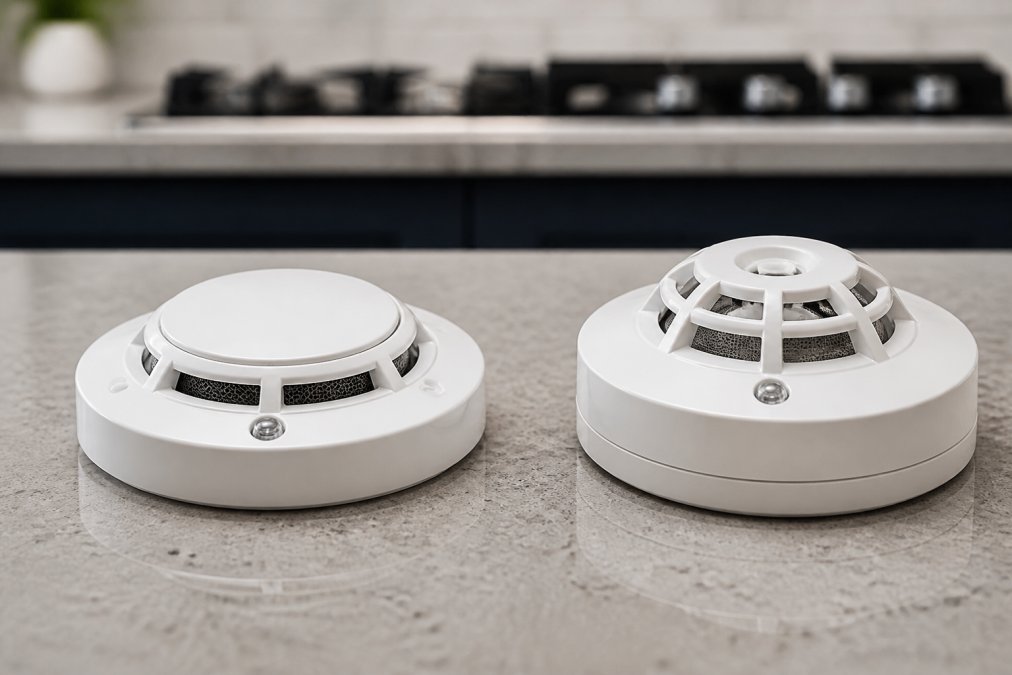
Smoke alarms and heat detectors work on different sensing principles, which is why they suit different rooms. A smoke alarm samples the air for combustion particles; a heat detector ignores air quality and watches temperature instead.
Photoelectric, Ionisation, and Thermal Sensor Types
Each sensor type has a personality. Photoelectric sensors catch smouldering, smoky fires; ionisation sensors respond faster to flaming fires with little visible smoke; thermal sensors catch neither until heat builds.
- Photoelectric: Best for smouldering fires; prone to steam and cooking fume triggers
- Ionisation: Fast on flaming fires; also sensitive to cooking particles
- Thermal (heat): Ignores smoke and steam entirely; slower to react
- Dual-sensor: Combines photoelectric and ionisation for broader coverage
Why Kitchens Are High-Risk Areas for False Alarms
Kitchens are high-risk for false alarms because they produce exactly what smoke alarms detect: airborne particulate matter. Burnt toast, searing steak, and a smoking pan all release particles that look like smoke to a sensor.
Removing a battery to silence a nuisance alarm leaves that room with zero fire detection. A better fix is relocating the smoke alarm or fitting a heat detector in the kitchen instead.
AS 3786 Smoke Alarm Requirements for Kitchen Placement
AS 3786 is the Australian standard covering smoke alarms, and it shapes where they can and cannot go. It exists to ensure alarms work when they matter, which means keeping them away from conditions that trigger false alarms.
Nuisance Alarm Prevention: Steam, Cooking Fumes, and Sensor Sensitivity
Nuisance alarm prevention starts with three fixes: correct placement, the right sensor type, and adequate ventilation. But a kitchen alarm that keeps tripping is almost always traceable to a specific appliance and cooking behaviour, not a vague ‘too much steam’ problem. Working through the likely culprits in order saves you from moving an alarm that was never the issue.
Which cooking appliances trigger which sensors
- Gas cooktops: Combustion produces fine particulate matter and moisture even during normal cooking, not just burning. Photoelectric and ionisation smoke alarms can trip on a gas burner that is merely running, especially if the flame is yellow rather than blue (a sign of incomplete combustion).
- Electric coil and ceramic cooktops: Residual heat after the pan is removed keeps burning off grease and residue, releasing particles long after cooking stops, a common cause of alarms sounding minutes later.
- Induction cooktops: Produce almost no combustion particles, so they rarely trigger a smoke alarm from cooking itself. The main risk is oil or fat reaching its smoke point, which releases visible particulate.
- Ovens and grills: Self-cleaning cycles and high-temperature roasting burn off residue and generate heavy smoke. A heat detector will not respond, but a smoke alarm in an adjacent hallway can catch it through an open door.
- Toasters and sandwich presses: These concentrate heat in a small area and produce smoke from crumbs and fat with very little warning. They are the single most common trigger for kitchen smoke alarms in domestic settings.
What to do when the alarm goes off during cooking
A nuisance alarm is not a reason to disable detection. Work through this sequence:
- Silence, do not remove. Most modern alarms have a hush button that silences the unit for a set period while it continues to monitor. Use it, then deal with the source.
- Identify the trigger. Smoke, steam, or heat? Boiling pasta means a steam trigger; searing means particulate. If it sounded with no visible smoke, check whether the unit is a heat detector responding to a genuine temperature rise.
- Ventilate immediately. Turn the rangehood to its highest setting and open a window. Recirculating rangehoods only filter some particles rather than removing them, so they are less effective at clearing a trigger.
- Check the alarm location. If the unit sits within the steam plume rising from the rangehood or within a metre of the cooktop, relocation is the permanent fix.
- Log repeat events. If the same alarm trips three or more times in a month from cooking, the placement or sensor type is wrong. That is the point to fit a heat detector in the kitchen and move the smoke alarm to the adjacent hallway.
Sensor sensitivity and smart adjustments
Some current smoke alarms adjust sensitivity based on time of day or ambient conditions, and some interconnected systems allow a lower sensitivity mode for a kitchen-adjacent unit. These features reduce nuisance alarms but do not eliminate them, and should never justify placing a smoke alarm inside the kitchen itself. A heat detector remains the compliant, reliable choice for the cooking zone.
If your smoke alarm keeps tripping during cooking, check whether it sits within the steam plume from your rangehood. Most nuisance alarms trace back to that one placement error, not a faulty unit. If relocation is not practical, the correct fix is a heat detector in the kitchen and a smoke alarm in the hallway outside it.
Where to Install Smoke Alarms and Heat Detectors in a Kitchen
Heat detectors go inside the kitchen, on the ceiling or high on a wall, away from the stovetop zone. Smoke alarms go everywhere else: hallways, bedrooms, living areas, and each level of the home or building. The detail that matters is exactly where inside the kitchen, and how ceiling geometry changes the answer.
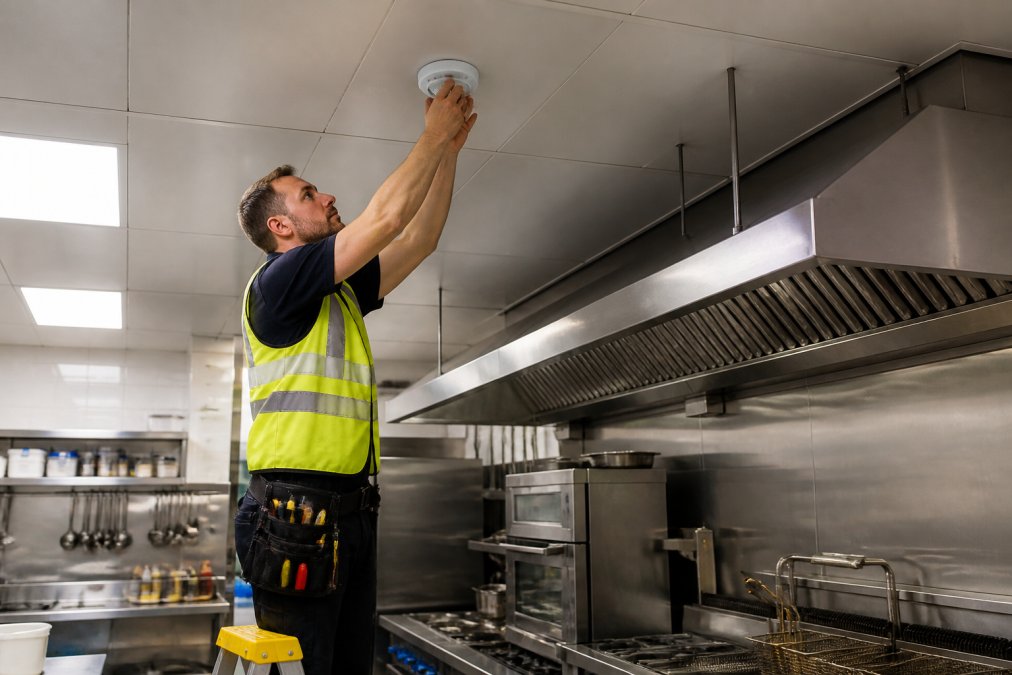
Heat detector placement in the kitchen
A heat detector needs to sit where hot air will reach it. Hot air rises and spreads across the ceiling, so the detector belongs on the ceiling, not a wall, wherever possible.
- Distance from cooking appliances: Keep the detector at least one metre clear of the cooktop, oven, and any other fixed cooking appliance. This prevents normal cooking heat from triggering it while still catching a genuine fire.
- Distance from air conditioning and exhaust vents: Stay at least one metre away from supply vents and exhaust hoods. Air movement near a vent can push heat away from the sensor or dilute it before it triggers.
- Dead air spaces: Corners where walls meet the ceiling, and the area within about 100 mm of a wall-ceiling junction, can trap a layer of still air that heat does not easily penetrate. Detectors mounted in these zones respond more slowly.
- Ceiling slope: On a pitched ceiling, heat collects at the highest point. Mount the detector within the top 600 mm of the peak, measured horizontally, rather than down the slope.
- Beams and bulkheads: A ceiling beam deeper than about 250 mm can block the spread of heat across the ceiling. Treat each bay between beams as a separate zone and place a detector in each.
Smoke alarm placement outside the kitchen
A smoke alarm should sit in the corridor or living area just outside the kitchen, on the ceiling or high on a wall, to catch escaping smoke without exposing the sensor to normal cooking byproducts.
- Corridor placement: Mount on the ceiling of the hallway, ideally within a few metres of the kitchen doorway so smoke reaching the corridor is detected early.
- Distance from the kitchen doorway: Avoid mounting directly opposite the kitchen door, where a plume of cooking smoke can hit the sensor the moment the door opens. Offset it along the corridor instead.
- Distance from bathrooms: Keep smoke alarms out of steamy bathrooms and at least a few metres from bathroom doors, for the same reason they are kept out of kitchens.
- Multi-level properties: Fit at least one smoke alarm on each level, and one in each sleeping area. Interconnected alarms are worth the extra cost: when one sounds, they all sound, giving occupants warning throughout the property.
Commercial and strata kitchens
In commercial kitchens, the exhaust hood and suppression system handle the cooking zone, but a heat detector is still required in the room itself. Larger kitchens may need multiple detectors where the ceiling is broken by bulkheads, ductwork, or height changes. Hardwired systems with battery backup offer the most reliable coverage, though battery-operated units are acceptable in many existing homes.
Placement is not a single rule. A heat detector needs to be on the ceiling, at least a metre from the cooktop and any vent, clear of dead-air corners and deep beams. A smoke alarm needs to be outside the kitchen, offset from the doorway, and interconnected with the rest of the property.
Pros and Cons: Smoke Alarms vs Heat Detectors in Kitchen Settings
The verdict is straightforward: heat detectors win inside the kitchen, smoke alarms win everywhere else. Neither replaces the other, and a compliant property typically needs both.
Heat detectors:
- Pros: No nuisance alarms from cooking, reliable in humid and greasy conditions, simple to maintain
- Cons: Slower to trigger, detect heat only, no early warning for smouldering fires
Smoke alarms:
- Pros: Earliest possible warning, detect smouldering and flaming fires, available with smart connectivity
- Cons: High false alarm risk in kitchens, require careful placement, need regular cleaning
The best kitchen protection is not smoke alarm versus heat detector. It is both, correctly placed: heat detection inside the kitchen, smoke detection everywhere else, all interconnected.
Conclusion
Getting detection right in a kitchen balances early warning against reliability, and the wrong placement undermines both. Fyrepower helps property owners and managers across the Gold Coast, South Brisbane, and Northern New South Wales install, test, and maintain compliant fire detection systems. Our QBSA-licensed, fully insured team works to Australian standards including AS 2444 and AS 1851, backs equipment with a 55-month warranty, and provides on and offsite fire training so your staff know what to do when an alarm sounds.
Frequently Asked Questions
Is a heat detector better than a smoke alarm for kitchens?
For the kitchen room itself, a heat detector is the better choice. It responds to rapid temperature rise or a fixed temperature threshold rather than smoke particles, so steam, cooking fumes, and humidity from everyday cooking will not set it off. A smoke alarm remains essential in adjoining hallways and living areas where smouldering fires produce smoke before heat builds. The combination gives you early warning across the property without constant nuisance alarms.
Can you use a heat detector to replace a smoke alarm?
No. A heat detector only activates once a fire has generated enough heat, which delays warning in slow, smouldering fires. It cannot replace a smoke alarm in habitable rooms, hallways, or sleeping areas. Use a heat detector as a supplement in the kitchen and keep smoke alarms installed everywhere else, interconnected where possible so an alert in one area triggers all units.
Do Australian standards require heat detectors in kitchens?
AS 3786 covers smoke alarms, and standard smoke alarms are not suited to kitchen installation because cooking fumes cause nuisance alarms. Heat detectors are the accepted alternative for kitchen areas under Australian fire safety compliance frameworks. For commercial kitchens, your obligations also fall under AS 1851 maintenance schedules.
Why do smoke alarms go off when I am cooking?
Smoke alarms trigger on particulate matter in the air. Cooking produces fine particles from oil, fat, and food, plus steam and humidity that photoelectric and ionisation sensors can mistake for smoke. Positioning the alarm too close to the stove, poor ventilation, and high sensor sensitivity all increase the risk. Installing a heat detector in the kitchen and a smoke alarm in the adjacent hallway resolves most recurring nuisance alarm issues.
What is the difference between a heat alarm and a smoke alarm?
A smoke alarm detects smoke particles using photoelectric or ionisation sensor technology. A heat alarm detects rapid temperature rise or a fixed temperature threshold using a thermal sensor. Smoke alarms respond faster to smouldering fires but are prone to false alarms from cooking. Heat alarms ignore smoke and steam entirely, making them suitable for kitchens, garages, and dusty environments where smoke alarms would trigger constantly.