Table of Contents
- Fire Suppression Systems vs Fire Extinguishers: Key Differences
- Comparison Table: Suppression Systems vs Extinguishers
- AS 2444 Fire Extinguisher Placement in Warehouses
- Warehouse Fire Safety Compliance in Australia
- Automatic Fire Suppression System Maintenance Requirements
- Cost, Training and Environmental Considerations
- Frequently Asked Questions
Last Updated: September 23, 2026
Fire Suppression Systems vs Fire Extinguishers: Key Differences
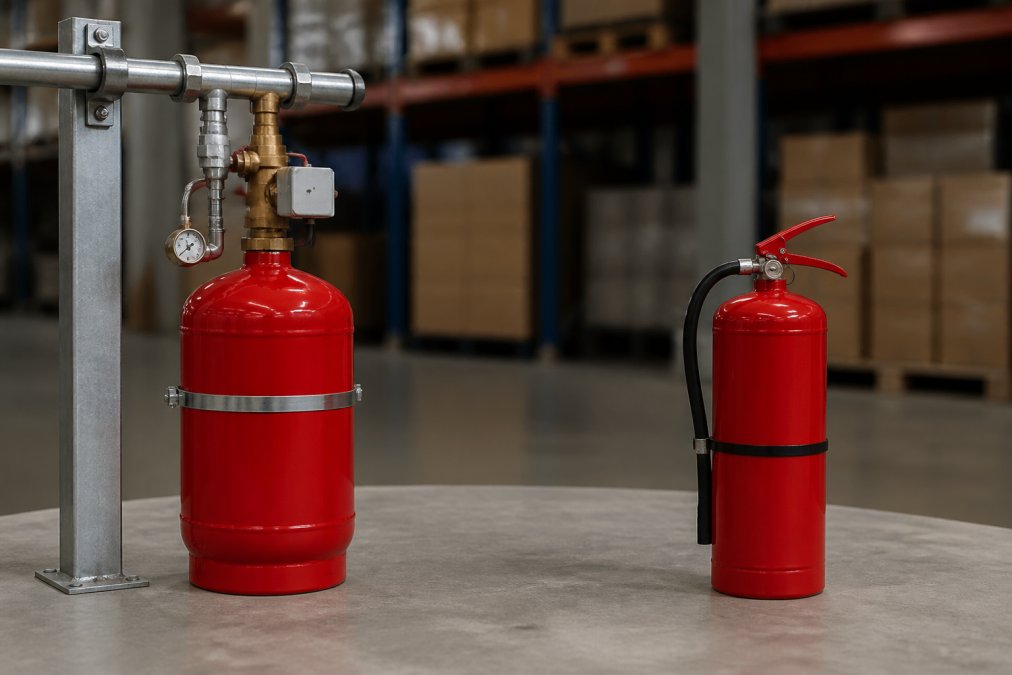
Fire suppression systems are automated, fixed installations that detect and extinguish fires without human intervention, while portable fire extinguishers are manually operated devices requiring a person to be present and trained. For warehouse operators, the difference between these two approaches often determines how much inventory and infrastructure survives a fire event. This guide from Fyrepower breaks down where each option fits, what Australian Standards require, and how to decide based on your actual risk profile rather than a generic checklist.
How Automatic and Manual Systems Work
Automatic fire suppression systems activate through heat, smoke, or flame detection, then release water, foam, gas, or chemical agents to extinguish or contain the fire. These systems operate continuously and respond within seconds of detection.
Comparison Table: Suppression Systems vs Extinguishers
The table below frames the two approaches against the factors that actually drive decisions in a warehouse, not just how they work, but what they cost to own, how they interact with insurers, and where each one fails.
| Factor | Automatic Suppression Systems | Portable Fire Extinguishers |
|---|---|---|
| Activation | Automatic, sensor-triggered (heat, smoke, flame) | Manual, requires a trained operator on site |
| Coverage | Zone-based; can protect entire racking arrays and high-ceiling voids | Localised to the immediate vicinity of the mounting point |
| Best For | High-value, high-rack, 24/7 operations; unoccupied hours | First-response to small, contained Class A/B/E fires |
| Typical Upfront Cost | Project-based capital works, design, pipework, agent, detection, commissioning | Per-unit purchase, typically the lowest capital line in a fire safety budget |
| Ongoing Cost | Scheduled AS 1851 servicing, agent top-ups, detection calibration | Scheduled servicing and replacement of discharged or expired units |
| Maintenance Regime | Weekly, monthly, six-monthly and annual checks depending on system type | Regular inspection and periodic professional servicing |
| Training Needed | Minimal for operation; staff need zone and post-discharge awareness | Hands-on training to select the correct class and operate under pressure |
| Regulatory Standard | AS 2118 (sprinklers), AS 1851 (maintenance) | AS 2444 (placement), AS/NZS 1841 (equipment) |
| Insurance Treatment | Often a condition of cover for high-risk or high-value storage | Usually expected as a baseline control, rarely a premium lever on its own |
| Failure Mode | Detection drift, valve isolation, agent loss, silent until tested | Not present, not reachable, wrong class, or operator hesitates |
How to Read This Table for Your Warehouse
The right mix depends on three variables, not one:
- Inventory value density. A warehouse holding electronics, pharmaceuticals, or high-value consumer goods has more to lose per square metre than one holding bulk aggregates. The higher the value density, the stronger the case for automatic suppression in those zones.
- Occupancy pattern. If the site runs 24/7 with staff present, extinguishers remain a credible first response. If large areas are unoccupied overnight or on weekends, extinguishers cannot respond, only automatic systems can.
- Storage height and commodity class. High-racked storage of Class III and Class IV commodities (plastics, paper, packaged goods) is where sprinkler design and coverage matter most. Extinguishers are effectively irrelevant to a fire developing inside a 10-metre racking array.
The Cost-Benefit and Insurance Angle Most Guides Skip
Installation cost is the number warehouse owners focus on, but it is rarely the number that decides the outcome. The more useful calculation is total cost of ownership against expected loss:
- Capital and lifecycle cost. Suppression systems carry a significant upfront project cost plus ongoing AS 1851 servicing. Extinguishers are cheap to buy and cheap to service, but they only protect the square metre they are mounted in.
- Business interruption. A fire that is contained by an automatic system in its incipient stage typically means a contained clean-up. A fire that grows because no one was present to use an extinguisher can mean weeks of lost throughput, replacement of racking, and stock write-offs.
- Insurance implications. Insurers commonly look at whether the fire protection is commensurate with the risk. For high-value or high-hazard storage, an automatic system is often a condition of cover or a factor in premium and excess. Extinguishers are usually treated as a baseline expectation rather than a premium lever on their own. It is worth confirming your specific treatment with your broker rather than assuming.
Most warehouses end up with both, not because the standards demand it, but because the two systems cover different failure modes. Suppression protects the building and stock when no one is there to act. Extinguishers protect people and give them a first response when a fire is still small enough to matter.
Where Smart Monitoring Fits
A growing number of warehouses are connecting suppression system control panels and detection circuits to building management systems or remote monitoring platforms. This does not change the standards that apply, but it changes how quickly a fault, an isolation, or an activation is noticed. A valve left closed after maintenance, or a detection loop that has drifted out of calibration, can sit undetected for months under a purely paper-based regime.
AS 2444 Fire Extinguisher Placement in Warehouses
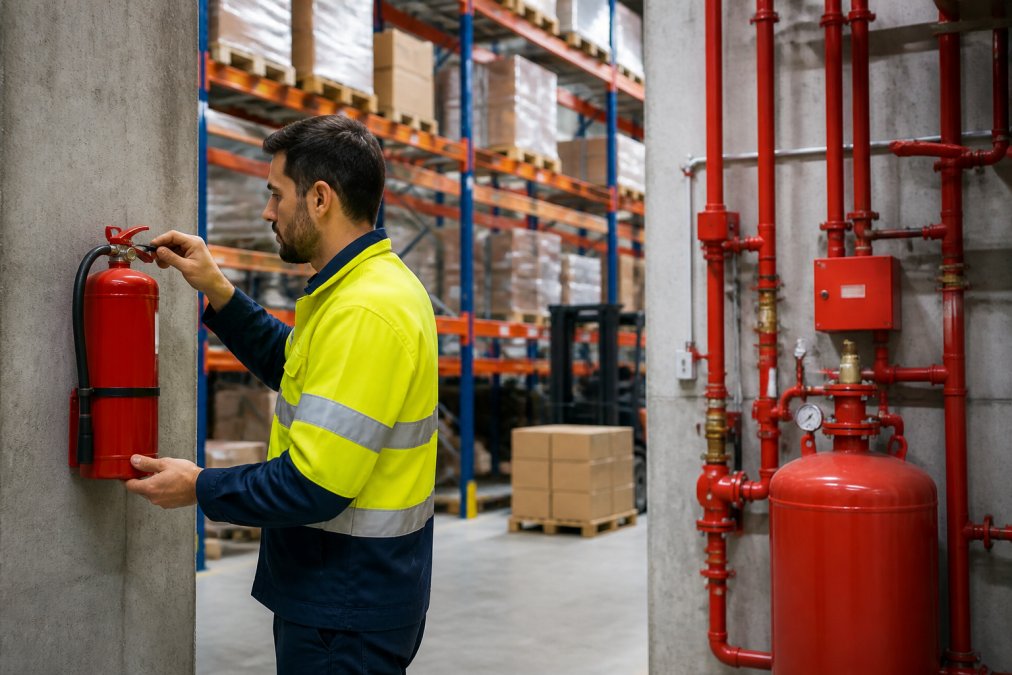
AS 2444 sets out where extinguishers must be positioned based on fire risk, travel distance, and building layout. Getting placement wrong is one of the most common compliance failures we see during audits.
Mounting extinguishers behind racking or in offices “for safekeeping” is a frequent mistake. If staff cannot reach an extinguisher within seconds, it fails its purpose. During an audit, incorrect placement can result in a compliance notice and mandatory rectification.
::: Proper equipment accessibility remains just as critical for hazard mitigation as maintaining safe propane storage within the facility.
Warehouse Fire Safety Compliance in Australia
Australian warehouses must comply with a layered framework of standards and regulations. The primary obligations come from AS 1851 for maintenance, AS 2444 for extinguisher placement, and AS 2118 for automatic sprinkler systems. State-based work health and safety legislation adds further duties around emergency planning and staff training.
Automatic Fire Suppression System Maintenance Requirements
The most overlooked maintenance item is the detection component, not the suppression agent. Sensors drift, tubing degrades, and control panels develop faults. Testing detection separately from discharge confirms the system will actually activate when needed.
Fyrepower provides six-monthly compliance testing aligned with AS 1851 requirements, with detailed service reports that hold up during audits. Our QBSA-licensed team documents every inspection point so you can demonstrate compliance without scrambling for paperwork.
Cost, Training and Environmental Considerations
This is where most comparison articles stop at generalities. The three factors below are the ones that actually change the decision for a warehouse operator, and they are the ones competitors consistently under-serve.
Cost: What You Are Actually Buying
Extinguishers and suppression systems sit in completely different cost categories, and comparing them on sticker price alone is misleading.
- Extinguishers are a per-unit purchase with a low capital threshold. The real cost is in coverage: to protect a large warehouse floor to AS 2444 travel distances, you need enough units distributed across the space, plus brackets, signage, and scheduled servicing. The cost scales with floor area, not with risk.
- Suppression systems are a project. Design, pipework or agent storage, detection, control panel, commissioning, and ongoing AS 1851 servicing all sit in the capital and lifecycle budget. The cost scales with the hazard, the commodity class, and the protected area, not with the number of units.
Training: Two Very Different Human Problems
Extinguisher training and suppression system training are not the same skill, and treating them as one module is a common mistake.
- Extinguisher training is a physical skill. Staff need to recognise the fire class, select the correct unit, check it is charged, approach safely, and discharge with the correct technique. This degrades without practice, annual refreshers are common practice because the skill is perishable.
- Suppression system training is an awareness and procedure skill. Staff do not operate the system, but they need to know which zones are protected, what the alarm sounds mean, what to do before and after a discharge, and who to contact. Post-discharge procedures matter as much as pre-fire procedures, because a gas or clean agent discharge can make a space temporarily unsafe to enter.
Environmental Impact: Agent by Agent
The environmental profile of a suppression agent is a real consideration, but it is often oversimplified. The honest position is that every agent is a trade-off.
- Water-based systems (sprinklers, water mist) have no chemical residue and no ozone-depleting or global warming potential from the agent itself. The environmental cost is water use and water damage to stock and fit-out, which is itself a waste stream.
- Foam systems are effective on flammable liquid fires but the concentrate requires careful handling and disposal after use or testing. Some foam formulations have environmental persistence concerns, and discharge water containing foam concentrate needs to be managed rather than sent to stormwater.
- Clean agent gases leave no residue and cause no water damage, which protects both stock and the environment of the building interior. Their trade-off is that many have a higher global warming potential than water, and cylinder recharge after discharge has its own footprint.
- Dry chemical powders are effective and cheap but leave a corrosive, difficult-to-clean residue that can itself write off sensitive equipment.
Ask your servicing provider what happens to the agent after a test discharge or a real activation. The answer tells you more about their environmental practice than any product datasheet.
The Insurance and Business Interruption Overlay
Cost, training and environmental factors all feed into one number that warehouse owners care about most: the total cost of a fire event. That number includes stock loss, racking replacement, clean-up, downtime, and the insurance response. Automatic suppression typically reduces the scale of that number by catching fires earlier. Extinguishers reduce it only when someone is present, trained, and able to act in time.
Frequently Asked Questions
Does a fire extinguisher count as a fire suppression system?
A portable fire extinguisher is a manual first-response tool, not an automatic suppression system. Under Australian Standards, fire extinguishers form part of active fire protection but require a person to operate them. Automatic fire suppression systems, such as gaseous or foam-water systems, activate without human intervention. Both have a role in warehouse fire safety, but they serve different functions and are governed by different maintenance schedules.
What is the best fire fighting system for a warehouse under Australian standards?
The right system depends on your warehouse risk profile, including stored materials, floor area and fire load. Most warehouses need portable fire extinguishers placed to AS 2444, plus an automatic suppression system for high-risk zones. Fire hose reels and sprinkler systems may also be required. A fire safety audit can confirm which combination meets your compliance obligations.
How do AS 2444 requirements differ for warehouse fire extinguisher placement?
AS 2444 sets out placement rules based on fire class, travel distance and hazard level. In warehouses, extinguishers must be within easy reach of exits and high-risk areas, mounted securely and clearly signed. The standard also specifies maximum travel distances to the nearest extinguisher. Regular inspection ensures placement remains compliant as racking layouts change.
When is an automated fire suppression system mandatory for industrial storage?
An automatic fire suppression system is often mandatory where warehouses store flammable liquids, dangerous goods or high-value inventory in enclosed spaces. Requirements depend on the building code, occupancy type and local fire authority rules. In many cases, a fire engineer’s assessment determines whether gaseous, foam or water-based suppression is needed to meet compliance.
What maintenance does an automatic fire suppression system need?
Automatic fire suppression system maintenance typically follows AS 1851, covering six-monthly inspections, annual testing and periodic agent checks. Detection tubing, valves and discharge nozzles must be inspected for damage or blockage. Maintenance records should be detailed enough to satisfy a fire safety audit. Skipping scheduled servicing can void warranties and breach compliance obligations.