Table of Contents
- Quick Comparison: Non-Water Fire Suppression at a Glance
- Why Facilities Move Away from Water-Based Fire Suppression
- Clean Agent Fire Suppression Systems: How They Work and Where They Fit
- Foam Suppression and Dry Chemical Systems for High-Risk Sites
- Water Mist Technology: A Middle Ground
- Gas Fire Suppression System Cost: What Drives the Price
- Fire Suppression System Maintenance Requirements and Compliance
- Industry Suitability Matrix: Matching Systems to Business Risk
- Frequently Asked Questions
Last Updated: September 25, 2026
Quick Comparison: Non-Water Fire Suppression at a Glance
Water is the default extinguishing agent in most commercial buildings, but it is not always right. Alternatives to water-based fire suppression systems range from clean agent and inert gas total flooding to foam, dry chemical and water mist, each suiting a different risk profile and budget.
| System | Extinguishing Agent | Best For | Main Trade-Off |
|---|---|---|---|
| Clean agent (Novec 1230) | Heat-absorbing fluid | Server rooms, archives | Highest upfront cost |
| Inert gas | Nitrogen and argon blend | Control rooms, telecoms | Needs cylinder space |
| Foam suppression | PFAS-free foam concentrate | Fuel and chemical stores | Foam-compatible hardware |
| Dry chemical | Powder agent | Industrial machinery | Heavy residue cleanup |
| Water mist | Fine water droplets | Mixed-occupancy buildings | Still uses limited water |
Why Facilities Move Away from Water-Based Fire Suppression
Water damages the very assets you are protecting. A sprinkler discharge can destroy servers, stock, documents and electrical equipment faster than the fire itself, and the cleanup and business interruption that follow are often the real cost.
Where Sprinklers and Hydrants Fall Short
Sprinklers are effective, reliable and required in many buildings, so this is not an argument for removing them. The limitation is scope: a sprinkler head activates on heat, responding to the fire’s byproducts rather than the hazard itself, and soaks everything in the zone below.
The most common mistake is removing or bypassing sprinkler coverage to protect electronics without installing a compliant alternative. That can void insurance cover and breach your fire safety obligations. Any change to suppression design needs a fire hazard assessment and documented approval first.
Clean Agent Fire Suppression Systems: How They Work and Where They Fit
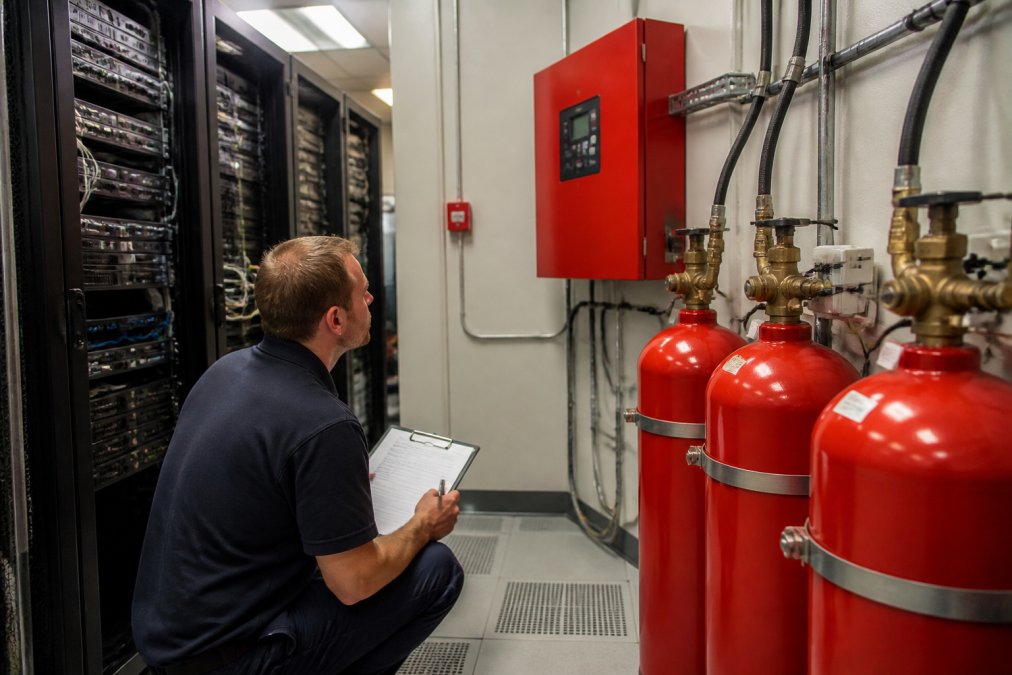
Clean agent fire suppression extinguishes fire using a gaseous or fluid agent that leaves no residue, making it safe for occupied spaces and sensitive equipment. These systems work on a total flooding principle, discharging agent into a sealed enclosure to reach a design concentration that stops combustion.
Novec 1230 and FK-5-1-12 Systems
Novec 1230, also known as FK-5-1-12, extinguishes fire mainly by absorbing heat. It has zero ozone depletion potential and low global warming potential, which matters if your organisation reports on environmental impact, and it evaporates quickly with no residue, so there is no post-discharge cleanup on your electronics.
Inert Gas and Total Flooding Options
Inert gas systems use naturally occurring gases such as nitrogen and argon to lower room oxygen below the level that sustains combustion, while staying safe for occupants. They leave no residue and have zero global warming potential.
Foam Suppression and Dry Chemical Systems for High-Risk Sites
Foam and dry chemical systems target the hazards water handles worst: flammable liquids and energised electrical equipment. Foam smothers and cools the fuel surface, while dry chemical interrupts the fire’s chemical reaction.
PFAS-Free Foam Alternatives
Traditional AFFF concentrates contained PFAS compounds, which persist in the environment and have driven tightening regulation and voluntary phase-outs. PFAS-free formulations, including soy-based agents, now offer rapid cooling and smothering without that environmental legacy.
| System | Pros | Cons |
|---|---|---|
| Foam suppression | Effective on Class B fuel fires; PFAS-free options available | Needs foam-compatible infrastructure |
| Dry chemical | Very fast knockdown; cost-effective for industrial zones | Leaves heavy powder residue requiring thorough cleanup |
Water Mist Technology: A Middle Ground
Water mist discharges water as fine droplets rather than a deluge, using far less water while still cooling the fire and displacing oxygen at the seat of the blaze. It sits between conventional sprinklers and clean agents on cost and disruption.
Gas Fire Suppression System Cost: What Drives the Price
Gas fire suppression system cost is not a single number, it is the sum of four independently scaling cost centres. Understanding them lets you sanity-check any quote before you sign.
Total Cost of Ownership and Retrofitting Challenges
The purchase price is only the first number. Ten-year total cost of ownership typically includes:
- Agent verification and top-ups. Cylinders lose pressure slowly and must be checked at scheduled intervals. A slow leak found at inspection means a recharge, not just a top-up.
- Cylinder hydrostatic testing. Pressure vessels have a defined service life and must be periodically tested or replaced. This is a scheduled capital cost, not a surprise, but it is often omitted from initial budget comparisons.
- Detection servicing. Smoke and heat detectors, control panels and interface relays all need routine testing under the relevant maintenance standard.
- Discharge and recharge. If a system discharges, even accidentally, the agent must be replaced, the cause investigated, and the system recommissioned. Some agents cost more to replace than others.
- Downtime. Servicing a cylinder bank in an occupied building may require isolation of the protected space. For a data centre, that downtime has a cost of its own.
Ask any supplier to itemise agent quantity, cylinder storage, enclosure integrity testing, detection and commissioning as separate line items. If those five are bundled into one vague figure, you have no way to compare quotes or predict the final invoice.
Fire Suppression System Maintenance Requirements and Compliance
Fire suppression system maintenance requirements are set by the system type and the standard it was designed to. In Australia, AS1851 sets routine servicing intervals for fire protection systems and equipment, and AS2444 covers portable fire extinguishers. AS1851 defines a schedule of activities at daily, weekly, monthly, quarterly, six-monthly, annual and longer intervals, depending on system type and criticality.
What Routine Servicing Actually Involves
The specific tasks vary by system, but the common pattern across non-water suppression is:
- Cylinder pressure and weight checks. Agent cylinders are checked for pressure loss or weight loss at scheduled intervals. A cylinder that has slowly leaked may still look intact.
- Detection and control panel testing. Smoke, heat and flame detectors are tested to confirm they still respond, and the control panel is checked for fault indications, battery condition and alarm signalling.
- Discharge nozzle and pipework inspection. Nozzles can be painted over, blocked or misaligned during building works. Pipework and fittings are inspected for corrosion or damage.
- Enclosure integrity re-checks. For total flooding systems, the room’s sealing and pressure relief are re-inspected. Building modifications, new cable penetrations, changed doors, added services, can compromise the enclosure after commissioning.
- Agent quantity verification. For foam and dry chemical systems, the agent itself is checked for quantity, condition and, in the case of foam, proportioning accuracy.
- Functional and interface testing. The system’s interface with the fire indicator panel, building management system, alarms and shutdowns is tested to confirm it will operate as designed.
Records and Audit Expectations
Maintenance is not optional or a formality: your records are the first thing an auditor, insurer or regulator asks for. A compliant record shows what was tested, when, by whom, what was found and what corrective action was taken. Gaps, or identical results every visit with no evidence of testing, are a red flag.
How Maintenance Differs by System Type
Clean agent and inert gas systems share the cylinder, detection and enclosure checks above, but inert gas has more cylinders to inspect and a larger storage footprint to keep accessible. Foam systems add proportioning and concentrate condition checks, and PFAS-free formulations may have different shelf-life and compatibility from legacy AFFF. Dry chemical systems require the powder checked for caking and the propellant verified, with test-discharge residue cleaned thoroughly.
Australian Standard AS1851 fire protection maintenance
Industry Suitability Matrix: Matching Systems to Business Risk
The right system matches your hazard, occupancy and budget, not the best brochure. Use the matrix below as a starting point, then confirm the design with a qualified fire protection engineer.
| Industry / Space | Recommended System | Why |
|---|---|---|
| Data centre, server room | Clean agent (Novec 1230) | No residue, safe for electronics |
| Telecommunications, control room | Inert gas | Zero GWP, safe for occupied spaces |
| Chemical or fuel storage | PFAS-free foam | Smothers Class B fuel fires |
| Industrial machinery | Dry chemical | Fast knockdown, cost-effective |
| Mixed-occupancy building | Water mist | Targeted protection, low water use |
Australian Building Codes Board fire safety guidance
Match the system to the hazard first, then to the budget. Clean agents protect sensitive assets, inert gas suits occupied control rooms, foam and dry chemical handle fuel and industrial risk, and water mist bridges the gap in mixed buildings.
Frequently Asked Questions
Which fire suppression systems don’t use water?
Clean agent systems like Novec 1230, inert gas systems using nitrogen and argon, dry chemical suppression, foam suppression, and water mist (which uses very little water) are the main non-water options. Each suits different hazards. Clean agents and inert gases work well for electrical fires in data centres and control rooms. Dry chemical and foam handle Class B flammable liquid fires in industrial settings. The right choice depends on your fire hazard assessment, occupancy, and asset value.
When should you choose a gas-based fire suppression system over sprinklers?
Choose gas-based suppression when water damage would cost more than the fire itself. Data centres, server rooms, archives, and control rooms with sensitive electronics are typical cases. Gas systems leave no residue, so equipment keeps running after discharge. They also work in enclosed spaces where total flooding is practical. For large open warehouses or outdoor areas, water-based or foam systems usually remain more practical and cost-effective.
What does a gas fire suppression system cost depend on?
Gas fire suppression system cost depends on the size of the protected space, the agent chosen (Novec 1230 typically costs more than inert gas), cylinder storage requirements, detection and control panel complexity, and installation labour. Retrofitting into existing buildings often adds cost for pressure relief and pipework. Pricing varies widely by project, so get a site-specific quote rather than relying on generic figures.
How do clean agent fire suppression systems work in commercial settings?
Clean agent fire suppression systems discharge a fluid or gas that absorbs heat or displaces oxygen to stop combustion. Novec 1230, for example, evaporates rapidly and leaves no residue, making it safe for occupied spaces and sensitive electronics. In commercial settings, they are triggered by heat or smoke detection and typically discharge within 10 seconds. They suit enclosed rooms where total flooding is effective, such as server rooms, archives, and telecommunications facilities.
What are the maintenance requirements for fire suppression systems?
Fire suppression system maintenance requirements vary by type but generally include regular inspections of cylinders, pressure gauges, detection devices, and discharge nozzles. Australian Standard AS1851 sets routine servicing intervals, often six-monthly for many systems. Clean agent and inert gas systems need weight and pressure checks, while foam systems require agent sampling. Documented service reports are essential for compliance audits and insurance. A licensed provider should handle all testing and keep records current.