Table of Contents
- Fire Extinguisher Testing and Tagging: What You Need to Know
- Australian Standards and Compliance Requirements
- Fire Extinguisher Servicing Frequency and Inspection Intervals
- Fire Extinguisher Inspection Checklist: What Qualified Technicians Assess
- Who Is Qualified to Inspect and Service Fire Equipment
- Fire Extinguisher Maintenance Logbook and Recordkeeping
- Fire Extinguisher Signage Requirements and Visibility Standards
- Common Inspection Failures and What to Do When Equipment Doesn’t Pass
- Frequently Asked Questions
Last Updated: October 10, 2026
Fire Extinguisher Testing and Tagging: What You Need to Know
Fire extinguisher testing tagging requirements form the backbone of workplace fire safety compliance in Australia. The difference between a properly maintained extinguisher and one that’s failed inspection could determine whether your team escapes safely in an emergency.
This guide covers what the law demands, how often equipment needs servicing, what qualified technicians assess during inspections, and how to maintain records that will satisfy auditors.
Fire extinguisher testing and tagging isn’t optional compliance paperwork, it’s a legal duty under Work Health and Safety legislation. Equipment that hasn’t been tested on schedule cannot be relied upon in an emergency and exposes your organisation to penalties and liability.
Australian Standards and Compliance Requirements
AS/NZS 1851 and AS/NZS 3760 Standards
Australia’s fire safety standards are defined by AS/NZS 1851 (selection, installation and use of portable fire extinguishers) and AS/NZS 3760 (inspection, maintenance and recharging). AS/NZS 1851 establishes which extinguisher types suit different fire classes; AS/NZS 3760 specifies inspection intervals, technician competence, and documentation requirements.
Compliance with these standards is mandatory. An organisation that fails to service equipment according to the schedule faces regulatory action and cannot demonstrate due diligence if a fire occurs.
Work Health and Safety Duties
Work Health and Safety legislation requires employers to provide and maintain fire safety equipment in working order. For most workplaces, this means following the inspection schedule in AS/NZS 3760; high-risk environments may require tighter intervals. You must keep records demonstrating inspections have occurred, equipment is serviceable, and staff know where extinguishers are located and how to use them.
Failure to meet these duties can result in regulatory enforcement, civil liability, and voided insurance if compliance cannot be demonstrated.
Fire Extinguisher Servicing Frequency and Inspection Intervals
Routine Visual Checks
Routine visual checks can be performed by any trained staff member monthly or quarterly. Look for physical damage, corrosion, missing hose, pressure gauge in the red zone, missing safety pin, and verify the extinguisher is accessible and unblocked. A visual check takes minutes and catches most common problems.
Record checks in a logbook noting date, person, location, and issues found. This demonstrates due diligence and helps identify equipment needing replacement.
Many organisations overlook routine visual checks because they seem too simple to matter. In reality, a visual check catches 80% of common problems, a missing safety pin, corrosion creeping up the cylinder, or a hose that’s cracked, before a qualified technician’s visit. Build visual checks into your monthly facility walk-through.
Six-Monthly and Annual Inspection Levels
A six-monthly inspection (Level 1) involves checking the pressure gauge, discharge mechanism, hose, nozzle, safety pin, and tamper seal. An annual inspection (Level 2) includes all Level 1 checks plus internal component assessment and mounting bracket verification. High-risk environments may require annual inspections; others need them every two years. Your risk assessment and extinguisher type determine the schedule.
Five-Year Pressure Testing and Refilling
Every five years, portable fire extinguishers must undergo hydrostatic pressure testing by a certified technician. The cylinder is pressurised to test pressure; if it passes, it’s refilled with the correct agent. If it fails, the extinguisher must be replaced. This five-year interval is non-negotiable for most types; check the manufacturer’s label for exceptions.
A common mistake is assuming that because an extinguisher has been serviced annually, it doesn’t need a five-year pressure test. These are separate requirements. An extinguisher can pass annual inspections for years and still fail pressure testing because internal corrosion or metal fatigue has weakened the cylinder. Missing the five-year test deadline means the extinguisher cannot legally remain in service.
Fire Extinguisher Inspection Checklist: What Qualified Technicians Assess
Visual and Physical Condition Checks
Qualified technicians examine the cylinder for dents, bulges, corrosion, or rust (particularly serious in coastal environments). They verify the safety pin is present and the tamper seal is unbroken. A broken seal indicates discharge or attempted use and requires servicing. The hose and nozzle are checked for cracks, splits, or blockages. The mounting bracket must be secure.
Pressure Gauge and Discharge Mechanism Assessment
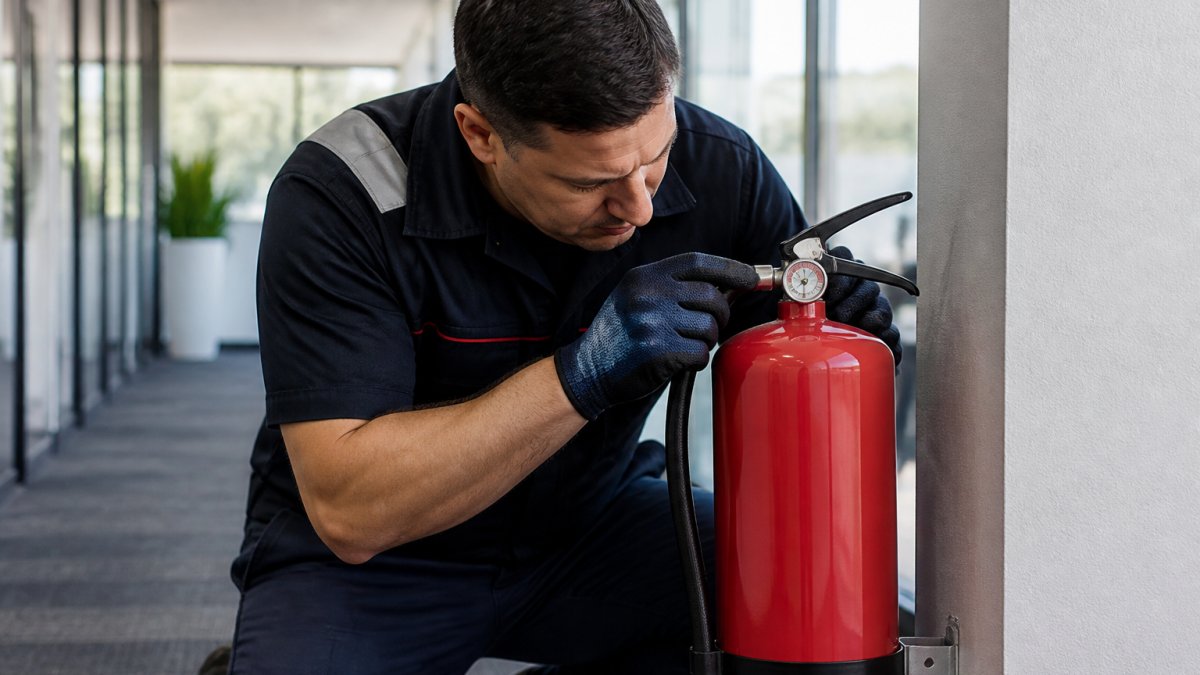
The pressure gauge is one of the most important indicators. A needle in the green zone (normal operating range) means the extinguisher is pressurised and ready.
The discharge mechanism, the handle, lever, and trigger, is tested to confirm it operates smoothly without sticking or jamming. For powder extinguishers, they check that the powder flows freely and hasn’t caked or compacted inside the cylinder.
The agent itself is assessed. The technician confirms that the agent is still fit for purpose and hasn’t degraded since the last service.
Who Is Qualified to Inspect and Service Fire Equipment
Competent Person Requirements
AS/NZS 3760 defines a competent person as someone with knowledge, training, and experience to perform fire extinguisher servicing safely and correctly. Most states require technicians to be licensed or registered. A competent technician will carry identification, insurance, and evidence of training, and can explain their work and qualifications.
Distinguishing Routine Checks from Professional Servicing
Routine visual checks do not require a qualified technician, any staff member can perform monthly checks. Detailed inspections, servicing, and five-year pressure testing require a certified technician. This distinction saves money: you don’t need a technician for monthly visual checks, but you must engage a competent person for six-monthly, annual, and five-year inspections.
Fire Extinguisher Maintenance Logbook and Recordkeeping
What Information Must Be Recorded
Maintenance records demonstrate compliance during audits or incidents. A logbook should record: date, inspection type, location, technician name and qualifications, condition, action taken, and next due date. Record any defects and resolutions. If an extinguisher is discharged, record it immediately, it must be refilled before returning to service.
Service Tags, Test Dates, and Tester Identification
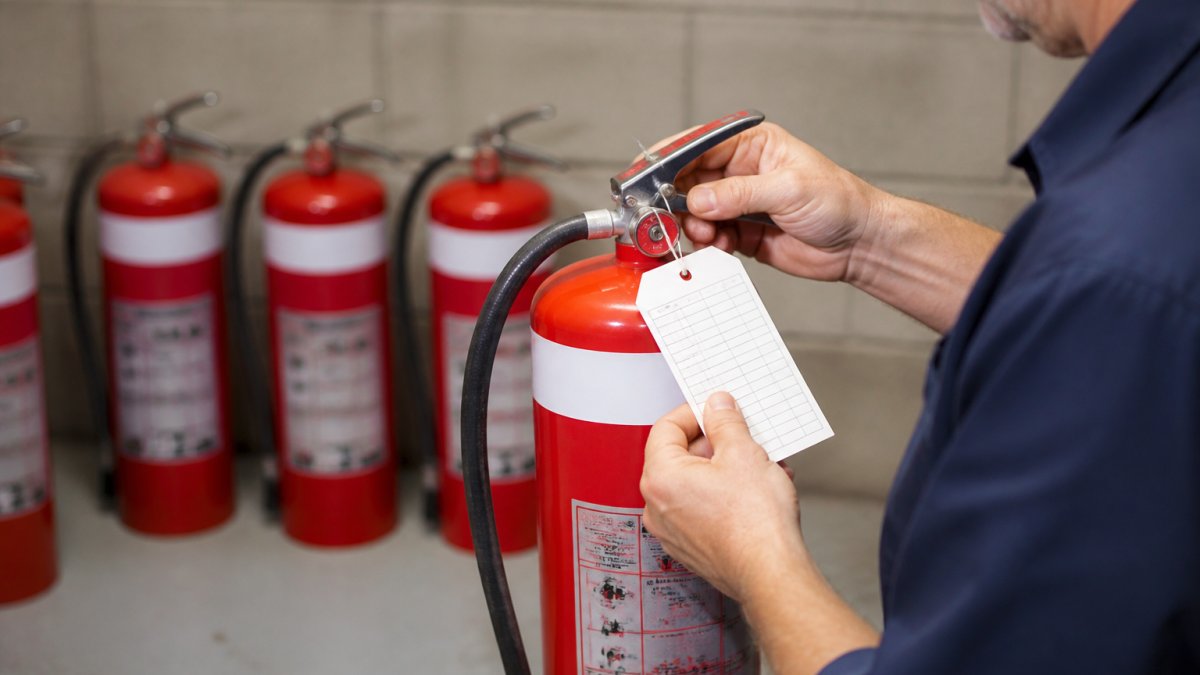
Most fire extinguishers have a service tag from fire extinguisher testing tagging procedures, a label or sticker attached to the cylinder. After each inspection or service, the technician updates this tag with the date of service, the next due date, and their identification (name, company, licence number). The tag is a quick visual reference: you can walk past an extinguisher and instantly see when it was last serviced and when it’s due next.
The tag is not a substitute for a logbook, it’s a supplement. The logbook provides detail; the tag provides at-a-glance status.
Organisations managing multiple properties or large numbers of extinguishers should use a digital maintenance management system. Spreadsheets work for small numbers, but a system that sends reminders when inspections are due, tracks which technician performed each service, and generates compliance reports is invaluable for larger operations.
Fire Extinguisher Signage Requirements and Visibility Standards
Placement and Labelling Standards
Fire extinguishers must be easily visible and accessible. AS/NZS 1851 specifies that extinguishers should be located along the natural escape route, near areas of high fire risk (kitchens, electrical rooms), and positioned so they can be reached within a few seconds.
Signage must clearly identify the extinguisher’s location and the fire classes it can handle.
The extinguisher must also be marked with any hazard warnings. Labels must be clear and in a language understood by staff.
Staff Training and Emergency Readiness
Compliance isn’t just about equipment, it’s about people. Staff must know where extinguishers are located, which type to use in different scenarios, and how to operate them safely. A common acronym is PASS: Pull the safety pin, Aim at the base of the fire, Squeeze the handle, Sweep side to side.
Regular training, ideally annually, or when new staff start, ensures that people remember these steps and feel confident in an emergency.
Fyrepower offers on-site and offsite fire training programs tailored to your workplace. We can train staff on equipment location, operation, and when to evacuate rather than attempt to extinguish a fire.
Common Inspection Failures and What to Do When Equipment Doesn’t Pass
An extinguisher can fail inspection for several reasons. A failed inspection means the extinguisher cannot remain in service until it’s been repaired or replaced.
When an extinguisher fails, the technician will advise whether repair is possible or if replacement is necessary.
Do not attempt to use a failed extinguisher.
If an extinguisher is discharged in a real emergency, it must be refilled before it can be returned to service.
Staying on top of inspection schedules, maintaining detailed records, and addressing failures promptly keeps your workplace compliant and safe.
Fire safety compliance depends on understanding the standards, following the inspection schedule, and maintaining clear records.
| Inspection Type | Frequency | Performed By | Key Checks |
|---|---|---|---|
| Routine Visual Check | Monthly or quarterly | Any trained staff member | Physical damage, pressure gauge, safety pin, accessibility |
| Six-Monthly Inspection (Level 1) | Every 6 months | Competent technician | Discharge mechanism, hose, nozzle, gauge reading |
| Annual Inspection (Level 2) | Every 1-2 years | Competent technician | Internal components, mounting bracket, agent condition |
| Five-Year Pressure Test (Level 5) | Every 5 years | Certified technician | Hydrostatic pressure, cylinder integrity, refill |
Frequently Asked Questions
How often do fire extinguishers need to be inspected and serviced?
Fire extinguishers require routine visual checks every month, formal inspections every six months, and annual servicing under AS/NZS 1851. Hydrostatic pressure testing and refilling must occur every five years.
Who is qualified to inspect and service fire extinguishers?
A competent person must carry out fire extinguisher servicing and testing. This person must have training, knowledge, and experience in fire safety equipment maintenance, understand relevant Australian standards (AS/NZS 1851 and AS/NZS 3760), and be able to identify hazards and assess risks. Routine visual checks can be performed by trained staff, but professional servicing, pressure testing, and refilling must be done by a qualified technician.
What information should be recorded in a fire extinguisher maintenance logbook?
Your maintenance logbook must include the inspection date, next due date, tester identification (name and credentials), specific work carried out, any defects or damage found, pressure gauge readings, and whether the extinguisher passed or failed inspection. A service tag or test label must be affixed to the extinguisher showing the date of service and the technician’s details. These records are essential for compliance audits and demonstrating due diligence under work health and safety legislation.
What are the signage requirements for fire extinguishers?
Fire extinguishers must be clearly visible, easily accessible, and marked with appropriate signage indicating their location and type. Signs should be durable, legible, and positioned at or near the extinguisher. Workplace training ensures staff can identify extinguisher locations and understand their purpose.
What is the difference between a routine visual check and a professional inspection?
A routine visual check is a monthly walk-through performed by trained staff to confirm the extinguisher is present, accessible, and shows no obvious damage or corrosion. A professional inspection, conducted every six months, involves a qualified technician performing a detailed assessment of pressure gauges, discharge mechanisms, hoses, brackets, and overall condition. Annual servicing and five-yearly pressure testing require specialist equipment and competence that only a qualified technician possesses.
What Australian standards apply to fire extinguisher maintenance?
AS/NZS 1851 is the primary standard for fire extinguisher inspection, maintenance, and testing. AS/NZS 3760 covers the inspection, maintenance and recharging of portable fire extinguishers. These standards define inspection intervals, competence requirements, recordkeeping obligations, and testing procedures. Work Health and Safety legislation in each state or territory also imposes duties on property managers and employers to maintain fire safety equipment and keep compliance records.
What happens if a fire extinguisher fails inspection or is discharged?
If an extinguisher fails inspection, it must be removed from service immediately and replaced with a compliant unit. A failed extinguisher should be tagged as non-compliant and sent for repair or disposal by a qualified technician. If an extinguisher is discharged during an emergency, it must be refilled or replaced before being returned to service. All changes must be documented in your maintenance logbook and reflected in your compliance records.
Do fire extinguishers require a test-and-tag label?
Yes, fire extinguishers must display a service tag or test label after each inspection or servicing. This label shows the date of service, the next due date, and the tester’s identification. The label serves as proof of compliance and helps staff identify which extinguishers are current and safe to use. Labels must be affixed securely and remain legible throughout the service period.