Last Updated: November 12, 2026
Quick Summary
Remote work fire safety starts with treating your home office as a workplace and running a short, written fire risk assessment covering electrical items, heat sources, combustibles and escape routes. Record the findings, set fix dates, and review every six months or whenever your setup changes.
- List every electrical item, heat source and combustible within a metre, then record controls and review dates.
- Run a weekly checklist: no overloaded power boards, no daisy-chaining, clear exit paths and unplugged chargers.
- Test smoke alarms monthly with the test button and replace batteries at least once a year.
- Build a written emergency plan with two escape routes, a meeting point and a check-in procedure.
- Employers hold the primary duty of care for workers, including those working from home.
Table of Contents
- Home Office Fire Hazards and How to Assess Your Risk
- The Working From Home Fire Safety Checklist
- Smoke Alarms, Extinguishers and Equipment Checks
- Building a Remote Worker Fire Emergency Plan
- Fire Safety Training for Remote Employees That Sticks
- Who Is Responsible: Employer and Worker Obligations
- Book a Remote Workspace Fire Safety Review
- Frequently Asked Questions
Home Office Fire Hazards and How to Assess Your Risk
Remote work fire safety starts with one fact: a home office is a workplace, and it carries the same fire risks as any small room full of electrical equipment. Because electrical equipment is central to most home offices, reducing overloaded outlets and damaged cords is a practical first step, and Go Coastal Electric can help keep those everyday fire risks in view.
Common home office fire hazards include:
- Overloaded power boards and daisy-chained adapters
- Laptop chargers and phone cables running under rugs or furniture
- Paper, cardboard boxes and packaging stacked near heat sources
- Portable heaters placed too close to curtains or desks
- Kitchen appliances used in or near the workspace
- Smoking near work equipment
- Lithium-ion batteries from laptops, phones and power tools charging unattended
- Household chemicals or aerosols stored near the desk
Assessing your risk does not need to be complicated, but it does need to be repeatable and written down. A home-workspace fire risk assessment is a short, structured walk-through that identifies what could ignite, what could burn, who would be affected, and what you will do about it.
Use this five-step method and record your findings in a simple table or notebook:
- List every electrical item and where it draws power. Include chargers, monitors, heaters, lamps, routers and any kitchen appliances used at the desk. Note which power board or circuit each item uses.
- Note every heat source. This includes portable heaters, laptop power supplies, kitchen appliances, candles and smoking materials. Record how close each sits to combustible materials.
- Identify combustible materials within a metre of those heat sources. Paper, cardboard, curtains, soft furnishings, clothing and packaging are the usual culprits. Note anything that could catch and spread fire.
- Check escape routes from the room and the building. Confirm that doors, windows and hallways are clear and that keys or locks will not delay you.
- Record what you find and set a date to fix it. For each hazard, write the control you will apply, who is responsible, and the date you will check it again.
A simple risk assessment record can be a table with four columns: hazard, who is at risk, existing control, and action required with a review date. Keep it with your other home-office documents and review it every six months, or sooner if you add equipment, move furniture or change your work patterns.
Household-specific risks deserve their own line in the assessment. If you share the space with children or pets, note whether power boards, cables or heaters are within reach. If you live in a multi-storey home, record how you would escape from an upper floor. If you rent, check whether the smoke alarms are hard-wired or battery-operated and who is responsible for testing them.
If you manage a commercial property, the same logic applies at a larger scale. Our guide on how to conduct a commercial fire risk assessment sets out the full method step by step.
The Working From Home Fire Safety Checklist
A working from home fire safety checklist is a short, repeatable list you run through weekly. It takes minutes and catches the problems that build up quietly.
Use this checklist each week:
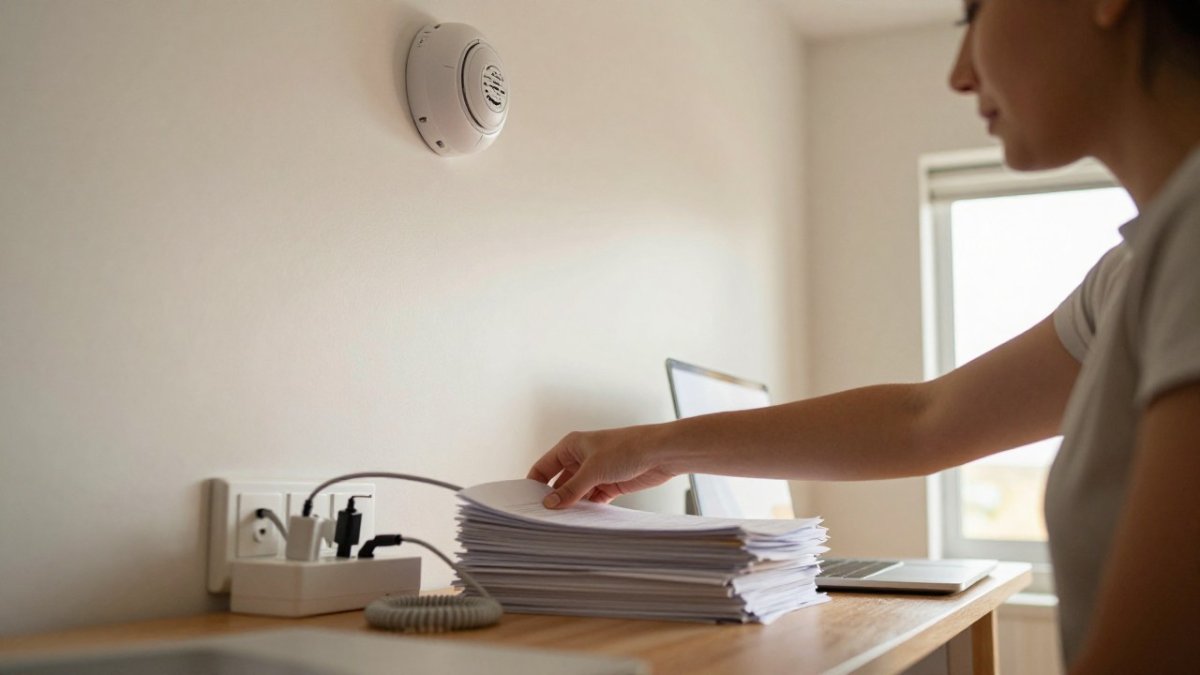
- Power boards are not overloaded or daisy-chained
- Cables are not crushed under furniture or rugs
- No paper or packaging sits within a metre of a heater
- The desk area is free of combustible clutter
- Chargers are unplugged when not in use
- Smoke alarm test button works
- The exit path from the room is clear
- No cooking appliances left unattended near the workspace
Watch out: daisy-chaining power boards is the most common mistake we see. One board plugged into another can overload a circuit without any visible warning.
Keep the checklist somewhere visible. A printed copy on the wall beats an app you forget to open.
Smoke Alarms, Extinguishers and Equipment Checks
Working smoke alarms are the single most important piece of fire detection in any home workspace. Test every alarm monthly using the test button, and replace batteries at least once a year.
Equipment checks for a home office come down to four items:
| Equipment | Check | How Often |
|---|---|---|
| Smoke alarms | Press test button, listen for alarm | Monthly |
| Smoke alarm batteries | Replace | Yearly |
| Fire extinguisher | Check gauge, pin and seal | Monthly |
| Fire blanket | Check for damage, confirm location | Monthly |
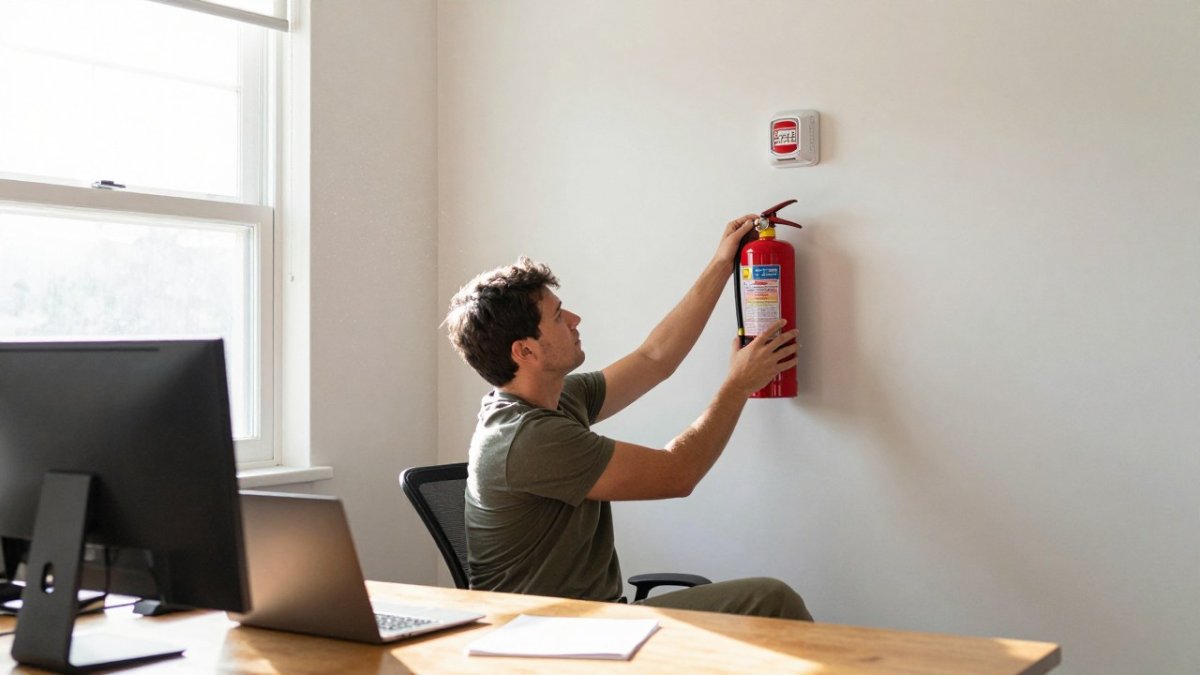
For extinguishers, check that the pressure gauge sits in the green zone. Look for dents, corrosion or a damaged hose. If the gauge reads low, the unit needs service or replacement.
Equipping a home office does not need to be expensive or complex. Our overview of emergency equipment for your office covers the three core items every workspace should have.
Building a Remote Worker Fire Emergency Plan
A remote worker fire emergency plan is a written set of actions for the first sixty seconds of a fire. It should be short enough to remember under pressure, but specific enough to match the building you actually work in.
Build yours around five elements:
- Escape routes. Identify two ways out of the room, and keep both clear. For a ground-floor room, that might be a door and a window. For an upper floor, it might be a internal stair and a secondary stair or external exit.
- A meeting point. Choose a spot outside the building where everyone gathers, and make sure everyone in the household knows it.
- Alarm response. Decide who calls emergency services and from where. In Australia, call Triple Zero (000). Keep a phone charged and accessible.
- Equipment use. Know where the extinguisher or fire blanket is and when to leave instead of fighting the fire. If the fire is not small and contained, evacuate.
- Check-in. Confirm who is accounted for and report to your manager or team according to your workplace procedure.
Home layouts vary, so evacuation planning needs to match the building. A ground-floor apartment with a rear door has different options to a top-floor unit with one stairwell. A multi-storey house needs a plan for each floor, including how someone on an upper level would escape if the main stair is blocked.
Accessibility matters too. If anyone in the household has mobility, vision, hearing or cognitive needs, the plan should account for how they get out and who assists them. Practical steps include keeping a clear path wide enough for a wheelchair or walker, installing visual alarms or vibrating smoke alarms for people who are deaf or hard of hearing, and agreeing in advance who will assist someone who needs help.
Backup plans matter. If your usual exit is blocked by fire or smoke, you need a second option. That might be a window with a clear drop, a secondary door, or a neighbour’s balcony. Check that windows open easily and that security screens or locks do not delay you. If you live in a shared building, know the location of alternative stairwells.
Watch out: a plan that lives only in your head is not a plan. Write it down, share it with your household, and review it every six months or whenever your layout, equipment or household members change.
Fire Safety Training for Remote Employees That Sticks
Fire safety training for remote employees works best when it is short, practical and repeated. A single annual module gets forgotten within weeks.
Online training should cover hazard identification, extinguisher use, evacuation procedure and incident reporting. Virtual simulations help, but completion tracking is what proves the training happened.
To keep training effective:
- Run short sessions every quarter rather than one long annual course
- Use scenario-based questions tied to a home setting
- Track completion and follow up on gaps
- Refresh content when procedures or equipment change
For a fuller program model, see our guide on fire safety training for employees. If engagement is the weak point, seven steps to improve employee fire safety awareness covers practical fixes. And to keep content aligned with current requirements, our article on keeping fire safety training current and compliant explains the review cycle.
Who Is Responsible: Employer and Worker Obligations
Responsibility for remote work fire safety is shared, and the split is not always obvious. Employers carry the primary duty of care for workers, including those working from home. Workers must follow reasonable safety instructions and report hazards.
Under Australian work health and safety law, employers must provide a safe work environment so far as is reasonably practicable. That duty does not stop at the office door. It extends to work locations the employer directs or permits.
In practice, that means:
- Employers identify hazards and put risk controls in place
- Employers provide information, training and instruction
- Workers follow procedures and report incidents promptly
- Both parties review controls when something changes
Jurisdictions differ in how they apply these duties to remote and hybrid arrangements. Before relying on any provider, confirm their licence and insurance directly.
Fyrepower is fully insured and QBSA-licensed, and works to Australian safety standards including AS2444 and AS1851.
Book a Remote Workspace Fire Safety Review
Setting up remote work fire safety protocols is not a one-off task. Hazards creep back in as desks fill up, cables multiply and equipment ages. A review every six months keeps the whole system honest.
If you manage multiple properties or a distributed team, a professional review removes the guesswork. Fyrepower offers on and offsite fire training, equipment supply and professional testing, backed by a 55-month warranty and full insurance. Our team works to Australian safety standards.
Get in touch with Fyrepower and give every remote workspace a clear, compliant fire safety plan.
Frequently Asked Questions
What fire safety responsibilities do employers have for remote workers?
Under work health and safety law, employers must ensure worker health and safety so far as is reasonably practicable, and that duty follows the worker into a home workspace. In practice this means identifying home office fire hazards, providing clear emergency procedures, supplying or verifying equipment such as extinguishers and alarms, and keeping records of training and checks. Remote work fire safety should be built into the same risk management framework as any other workplace, with documented reviews rather than a one-off email.
What should a remote worker include in a fire emergency plan?
A remote worker fire emergency plan should name two escape routes from the workspace, a meeting point outside, and who to call once clear. It should cover how to alert other occupants of the home, where the nearest extinguisher or fire blanket is, and what to do if smoke blocks the main exit. Practise it once with everyone in the household, then review it whenever the layout, equipment or number of occupants changes.
Do remote workers need fire safety training?
Yes. Fire safety training for remote employees should cover hazard identification, correct extinguisher use, evacuation steps and how to report an incident. Because remote staff are not covered by a building-wide drill, training needs to be delivered online and verified, not assumed. Short sessions with a practical walkthrough of the worker’s own home workspace are more useful than a generic video, and completion should be recorded so you can show evidence of the training if asked.
How often should remote employees review fire safety procedures?
Review procedures at least every six months and immediately after any change: a new home, a relocated desk, new appliances or a change of household occupants. Smoke alarms should be tested monthly and cleaned according to the manufacturer’s instructions, and extinguishers checked regularly against their service tags. Tying the review to the same six-monthly cycle used for commercial fire equipment testing keeps remote workers on a schedule the business already runs.