Last Updated: November 13, 2026
Quick Summary
To train employees on fire extinguisher use, run a one to two hour practical session covering the fight-or-evacuate decision, fire classes, extinguisher selection and the PASS method, then have each employee practise on a controlled fire under supervision. Fire extinguisher training is only complete once every employee passes a practical competency assessment, and you record the result and schedule an annual refresher.
- Employees should only fight a fire they can walk away from, with a clear escape route behind them.
- Match the extinguisher to the fire class; water on a cooking oil fire can cause a violent flare-up.
- Teach the PASS sequence: Pull the pin, Aim at the base, Squeeze the handle, Sweep side to side.
- A practical session for a small team typically runs one to two hours, with refreshers at least annually.
- Keep training cylinders separate from emergency-ready extinguishers, and recharge or replace any unit after use.
Table of Contents
- When to Use a Fire Extinguisher at Work
- Fire Classes and Choosing the Right Extinguisher
- How to Use a Fire Extinguisher: The PASS Method
- Fire Extinguisher Training Duration and Delivery Options
- Fire Extinguisher Training Checklist for Employers
- Competency Assessment and Training Records
- Book Your Onsite Fire Extinguisher Training
- Frequently Asked Questions
When to Use a Fire Extinguisher at Work
Knowing how to train employees on fire extinguisher use starts with one hard rule: staff should only fight a fire they can walk away from.
A portable extinguisher is built for one narrow job. It handles a small, contained fire in its early stage, not a fire that has spread to walls, ceilings or furnishings.
Fire grows fast, and the window to act on a small fire is short.
Assessing Fire Size and Whether It Is Safe to Intervene
Employees should only attempt to fight a fire when all of the following are true:
- The fire is small and confined to its point of origin, such as a bin or a single appliance
- Everyone in the area has been alerted and is moving toward an exit
- The correct extinguisher for that fire class is within reach
- The employee has a clear escape route behind them, not blocked by the fire
- There is no heavy smoke filling the room
If any one of these fails, the answer is to evacuate. No piece of equipment is worth a life.
Smoke is the real danger. Smoke is a serious hazard, so a room that looks survivable can become dangerous quickly.
Fire Classes and Choosing the Right Extinguisher
Matching the extinguisher to the fire class is the difference between putting a fire out and making it worse.

Fire extinguishers are rated for the following fire classes:
| Fire Class | Fuel Type | Suitable Extinguisher |
|---|---|---|
| Class A | Paper, wood, textiles, plastics | Water, foam, dry chemical |
| Class B | Flammable liquids | Foam, dry chemical, carbon dioxide |
| Class C | Flammable gases | Dry chemical |
| Class E | Electrical equipment | Carbon dioxide, dry chemical |
| Class F | Cooking oils and fats | Wet chemical |
A common mistake is grabbing the nearest extinguisher without checking its label. The label tells you the classes it covers, and every unit should be clearly marked.
For a deeper breakdown of each class and how ratings work, see our guide to fire extinguisher classes explained for Australian properties.
How to Use a Fire Extinguisher: The PASS Method
The PASS method is the standard sequence for operating a portable extinguisher: Pull, Aim, Squeeze, Sweep. Train every employee to say the steps out loud, then practise them on a training extinguisher until the sequence becomes automatic.
Here is the sequence to teach:
- Pull the safety pin to break the tamper seal.
- Aim the nozzle or hose at the base of the fire, not the flames.
- Squeeze the handle to release the agent.
- Sweep side to side across the base of the fire until it is out.
Extinguisher Parts, the Safety Pin and the Base of the Fire
Before anyone pulls a pin, they should know the parts.
The safety pin stops accidental discharge. It must be pulled fully before the handle will squeeze.
The pressure gauge shows whether the unit is charged.
Aim at the base of the fire, where the fuel is burning. Aiming at the flames wastes the agent and lets the fire keep growing.
Fire Extinguisher Training Duration and Delivery Options
A practical session for a small team typically runs one to two hours, covering theory, a demonstration and supervised hands-on practice. Refresher sessions can be shorter.
Format matters as much as length. Options include:
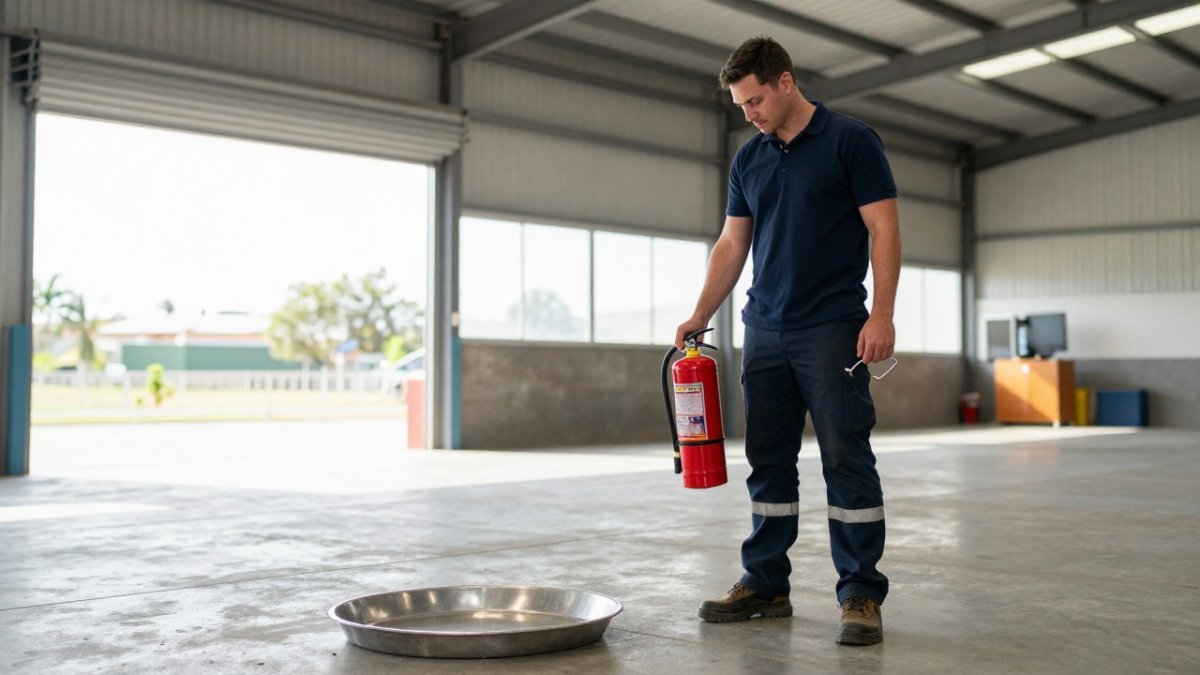
- Onsite practical sessions: staff practise on a live controlled fire with a trainer
- Classroom plus demonstration: theory first, then a demonstration
- Online induction: useful for awareness, but not a substitute for hands-on practice
- Drills and scenario exercises: build speed and confidence over time
Hands-on practice is the part that sticks. Watching a video is not the same as squeezing a real handle and sweeping a real fire.
For a broader look at structuring staff training, read our guide to fire safety training for employees.
Fire Extinguisher Training Checklist for Employers
A complete employer programme needs a repeatable lesson plan, defined learning objectives, supervised practice, a competency assessment and a refresher schedule. Use the structure below to build a session you can run again each intake, rather than a one-off briefing.
Learning objectives
By the end of the session, each employee should be able to:
- State the conditions under which they should attempt to fight a fire, and when to evacuate instead
- Identify the fire classes present in their work area and select the correct extinguisher for each
- Locate and operate the extinguisher’s safety pin, handle, gauge and nozzle
- Demonstrate the PASS sequence on a training extinguisher under supervision
- State the alarm-raising and emergency-call steps for their site
Session plan
A practical session for a small team typically runs one to two hours. A workable structure is:
- Theory (20-30 minutes): the fight-or-evacuate decision, fire classes, extinguisher selection and the PASS sequence.
- Demonstration (10-15 minutes): the trainer operates a training extinguisher on a controlled fire, narrating each step.
- Supervised practice (30-45 minutes): each employee operates the extinguisher on a controlled fire, one at a time, with the trainer correcting technique.
- Assessment (10-15 minutes): a practical demonstration against the checklist below, plus verbal questions on when to stop and evacuate.
- Close-out (5-10 minutes): confirm alarm and evacuation steps, record attendance and assessment outcomes, and set the refresher date.
Watch out: if the session is compressed into a classroom-only briefing, employees leave able to recite PASS but unable to pull a pin under pressure. Hands-on practice is the part that sticks.
Competency assessment checklist
Training is not complete until you can show each employee can actually operate an extinguisher. Assess through a practical demonstration, not a quiz alone. A simple pass checklist checks that the employee can:
- Select the correct extinguisher for a given fire class
- Pull the safety pin fully and break the tamper seal
- Aim at the base of the fire, not the flames
- Squeeze the handle and sweep side to side across the base
- Maintain a safe distance and keep an exit behind them
- State when to stop and evacuate instead
Record the outcome for each person. Keep attendance sheets, the trainer’s name and qualifications, the date, the content covered and the assessment result. These records are what hold up in an audit and what let you prove competence if a regulator or insurer asks.
Refresher schedule
A common pattern is to run a full practical session at induction and then refresh at least annually, with shorter toolbox talks in between. Review the schedule whenever the workplace changes, new equipment, new fire risks, new staff, or a change in the evacuation plan, because a refresher that ignores a changed risk profile is paperwork, not training. When a changed risk profile affects alarms, sprinklers, or other safeguards, coordinate employee refreshers with fire protection system testing so both people and equipment are prepared for the same conditions.
Rollout checklist
- Identify which staff are expected to attempt fire response, and which should evacuate only
- Confirm the fire classes present in the workplace and the extinguishers provided
- Book a trainer and schedule hands-on practice on a controlled fire
- Cover the decision to fight or evacuate before any technique
- Demonstrate the PASS method, then have each employee practise it
- Brief staff on raising the alarm and calling emergency services
Employers need to understand their mandatory obligations under Australian requirements, including AS 3745. Our guide to emergency fire safety training requirements covers warden roles and compliance standards.
Session plan time allocations for a practical fire extinguisher training session
Competency Assessment and Training Records
Training is not complete until you can show each employee can actually operate an extinguisher, and that you can prove it later. Assess through a practical demonstration, not a quiz alone, and record the outcome in a way that survives an audit.
What a practical assessment should test
A simple assessment checks that the employee can:
- Select the correct extinguisher for a given fire class
- Pull the pin, aim at the base and sweep correctly
- State when to stop and evacuate instead
- Name the alarm and emergency call steps
Set pass criteria before the session so every trainer applies the same standard. A workable rule is that the employee must complete every step unaided, in the correct order, and correctly answer the fight-or-evacuate questions. If they miss a step, correct and re-test on the day rather than recording a pass.
What to record
Keep a training record for each employee that captures:
- Name and role
- Date of training and trainer’s name and qualifications
- Content covered (theory, demonstration, supervised practice)
- Assessment outcome (pass or re-test required)
- Refresher due date
Attendance sheets, the trainer’s sign-off and the assessment result are the documents that hold up in an audit. Store them where you can retrieve them quickly, and keep them for the period your insurer or regulator expects.
Post-use actions and equipment readiness
Training does not end when the fire is out.
Watch out: training equipment and emergency-ready equipment must be kept separate. If staff practise on the extinguishers that are meant to protect the building, you can end up with discharged or partially used units in service.
Extinguishers themselves also need ongoing checks. Our guide on how often to test fire extinguishers explains the testing intervals that keep equipment ready.
Book Your Onsite Fire Extinguisher Training
Fyrepower offers onsite and offsite fire training services. Our team is QBSA-licensed and fully insured, and we can discuss a session suited to your workplace.
We also supply, install and maintain extinguishers, hydrants and suppression systems to Australian standards, so training and equipment stay in step. If you run a venue and want a session tailored to your staff, see our fire extinguisher training for hospitality staff.
A fire extinguisher only works if the person holding it knows what to do. Book a practical session with Fyrepower and give your team the confidence to act safely, backed by compliant equipment and clear records.
Frequently Asked Questions
How often should employees receive fire extinguisher training?
Most workplaces refresh fire extinguisher training at least annually, with new staff trained before they start work. High-risk sites such as hospitality kitchens or workshops may need more frequent sessions. Keep records of every session so you can show an auditor when each employee last demonstrated competency.
What is the PASS method for using a fire extinguisher?
PASS stands for Pull, Aim, Squeeze, Sweep. Pull the safety pin, aim the nozzle at the base of the fire, squeeze the lever to discharge, and sweep side to side across the burning material. Teach staff to stand at a safe distance with a clear retreat route behind them. The PASS method is easy to remember under stress, which is why it forms the core of most practical fire extinguisher training sessions.
Should employees practise using a real fire extinguisher?
Yes. Hands-on training with a live or simulated fire builds the confidence staff need in an emergency. Supervised practice lets employees feel the weight, discharge time and recoil of a portable extinguisher, which a video or slide deck cannot replicate. Always run practical sessions outdoors or in a controlled area with a trained instructor present.
When should employees avoid trying to fight a fire?
Employees should never attempt to fight a fire that is larger than a small incipient-stage fire, is spreading quickly, or is producing thick smoke. Evacuate immediately if the fire blocks your exit, if you do not have the correct extinguisher for the fire class, or if you are unsure how to use it. Raise the alarm, call emergency services on 000, and follow the evacuation route. Life safety always comes before property protection.