Table of Contents
- Emergency Exit Light Testing Requirements at a Glance
- Why AS/NZS 2293.2 Sets the Testing Rules
- How to Conduct Your Six-Monthly Emergency Light Inspection
- Meeting Annual Discharge Test Requirements
- Who Is Qualified to Perform Exit Light Testing
- Keeping Your Emergency Lighting Maintenance Logbook
- Troubleshooting Common Test Failures
- Conclusion
- Frequently Asked Questions
Last Updated: September 5, 2026
Emergency Exit Light Testing Requirements at a Glance
Emergency exit light testing requirements in Australia are defined by AS/NZS 2293.2, which mandates six-monthly inspections and annual discharge tests for all emergency luminaires and exit signs (standards.org.au). At Fyrepower, we handle these checks for commercial properties across the Gold Coast, South Brisbane, and Northern New South Wales.
Building owners and facility managers must ensure emergency escape lighting is tested, maintained, and logged. Failure to meet these obligations risks occupant safety, exposes the owner to liability, and can void insurance coverage or trigger penalties under state fire safety legislation.
Below, we break down what the standard demands, how to perform each test, and who is legally permitted to carry them out.
Why AS/NZS 2293.2 Sets the Testing Rules
AS/NZS 2293.2 is the Australian standard governing the inspection and maintenance of emergency lighting systems. It is referenced by the National Construction Code (NCC) as a Deemed-to-Satisfy (DTS) provision, meaning following its requirements is the accepted pathway to meeting the building code’s performance obligations for emergency egress lighting.
What the Standard Covers
The standard addresses every component of the emergency lighting system, including the emergency luminaires that illuminate escape routes, the exit signs that mark doorways, and the battery capacity or central emergency power supply that keeps these units operational during a mains failure.
Compliance under AS/NZS 2293.2 is not a single event. It is an ongoing maintenance schedule that requires documented evidence of inspection, testing, and any corrective action taken. The standard is closely aligned with the broader fire safety requirements of AS1851, which covers routine service of fire protection systems. For a detailed overview of how these standards interact, the Australian Standards overview of emergency lighting maintenance provides the authoritative scope of each document.
A visual inspection confirms the fitting is clean, undamaged, and correctly mounted. A functional test simulates a power failure to verify the battery and lamp operate for the required duration. Both are mandatory but occur on different schedules.
How to Conduct Your Six-Monthly Emergency Light Inspection
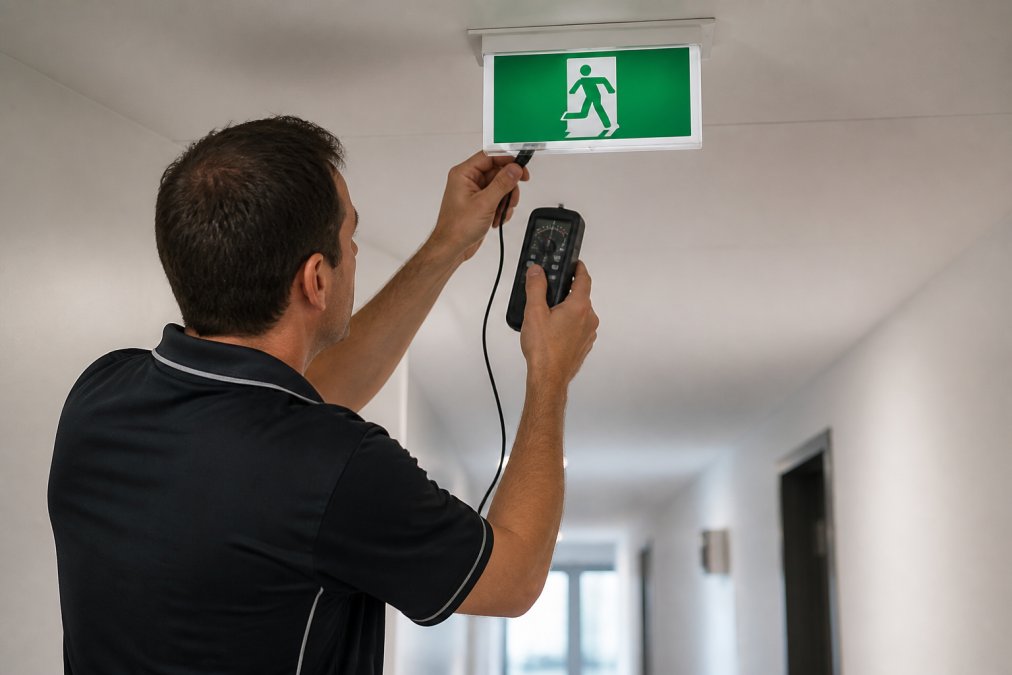
The six-monthly emergency light inspection is a functional test verifying each emergency luminaire and exit sign operates correctly when switched to battery power. It must be completed every six months and requires simulating a mains power failure to confirm the emergency power supply engages.
Most fittings include a test key or isolator switch that allows the technician to interrupt the mains supply without turning off power to the entire circuit. Here is the standard procedure:
- Isolate the circuit or use the test key to cut mains power to the emergency fitting, simulating a power failure.
- Observe the luminaire or sign to confirm the lamp illuminates using battery power.
- Check the illumination level to ensure the light output is sufficient to light the escape path to the required lux level.
- Record the result in the logbook, noting the date, the fitting tested, and whether it passed or failed.
- Restore mains power and verify the battery recharging circuit activates correctly.
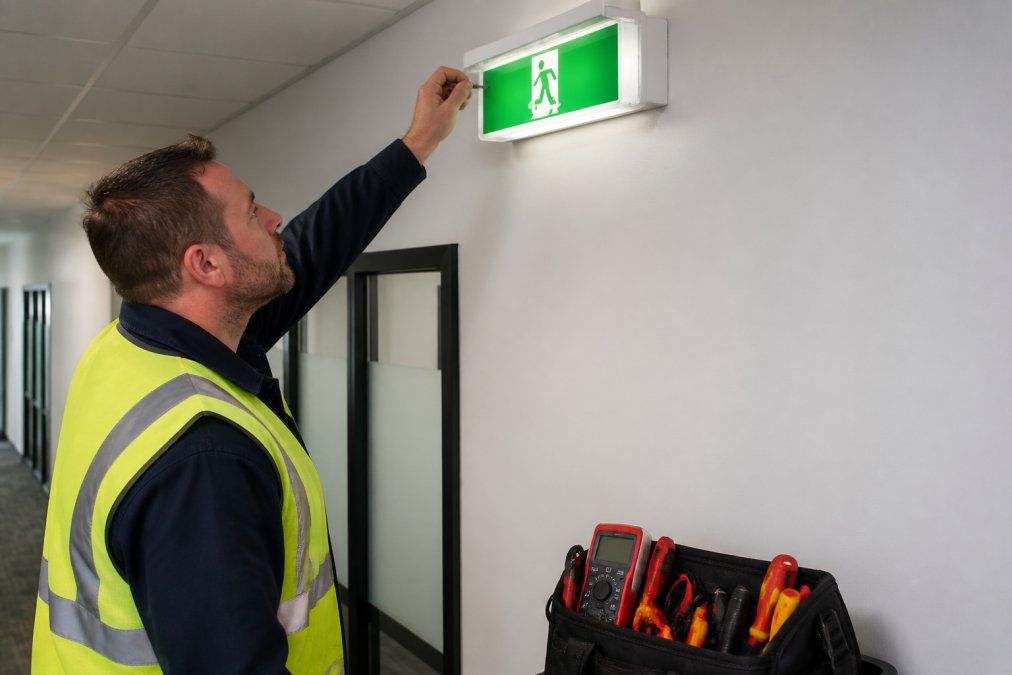
Do not skip the visual inspection during this visit. Corrosion, dust build-up, or physical damage to the fitting can prevent the emergency luminaire from operating correctly even if the battery is healthy. A functional test on a damaged fitting gives false confidence.
A common mistake is assuming the six-monthly test requires the battery to run for its full rated duration. It does not; the full capacity test is reserved for the annual discharge test.
Meeting Annual Discharge Test Requirements
The annual discharge test is the more demanding of the two mandatory checks. Under AS/NZS 2293.2, it requires the emergency luminaire to operate on battery power for its full rated duration, typically 90 minutes, to verify battery capacity has not degraded.
The battery must power the lamp continuously for the entire 90-minute discharge to prove it can meet emergency egress requirements during a real power outage. If the fitting fails before the 90-minute mark, the battery has deteriorated and must be replaced before the fitting can be certified as compliant.
The annual discharge test is not a task for a general maintenance worker. It requires isolating the fitting from the mains, monitoring the output over the full 90 minutes, and then confirming the battery recharges correctly afterwards. This is why the standard requires a qualified technician to perform and certify the test. The [NCC performance requirements for emergency lighting(/fire-safety-logbook-documentation-tips/) | ncc.abcb.gov.au] outline why this level of verification is necessary for building occupancy safety.
If a fitting fails the annual discharge test, the battery replacement is not optional. The unit cannot be returned to service until it passes a full 90-minute discharge test with the new battery installed.
Skipping the annual test is the fastest route to a failed compliance audit and, more importantly, leaves occupants without verified emergency lighting.
Who Is Qualified to Perform Exit Light Testing
Exit light testing and emergency lighting maintenance must be carried out by a competent person with the training and knowledge to perform the work safely and certify the results. While AS/NZS 2293.2 does not mandate a specific licence for the testing itself, the work involves electrical circuits and requires an understanding of the standard’s acceptance criteria.
The Role of the Licensed Electrician
A licensed electrician is required for any work that involves opening the fitting, accessing live terminals, or replacing batteries and lamps, as this falls under electrical work regulations. However, holding an electrical licence alone does not make someone competent in AS/NZS 2293.2 testing; the standard requires an understanding of illumination levels, battery discharge characteristics, and the specific acceptance criteria for emergency egress lighting.
The Competent Person Distinction
The standard refers to a ‘competent person’, someone with the training, knowledge, and experience to perform the task. In the emergency lighting industry, this is typically a fire protection technician who holds an electrical licence and has completed specific training modules on AS/NZS 2293.2. Some states, such as Queensland, require fire protection technicians to hold a QBCC licence in the relevant class.
What a General Maintenance Worker Can and Cannot Do
For facility managers, the practical implication is this: do not assign the six-monthly test to a general handyperson or a security guard. The test involves isolating circuits and making a judgement on illumination levels and battery performance. If the person performing the test is not qualified, the logbook entry is worthless in an audit.
A general maintenance worker can perform a visual inspection, checking that fittings are clean, undamaged, and correctly mounted, but they cannot perform the functional test that requires isolating the circuit and assessing battery performance.
Verifying Your Testing Provider
When engaging a provider, verify their technicians hold the relevant electrical licence and can demonstrate recent experience with AS/NZS 2293.2 testing. Ask to see a sample of their logbook entries to confirm the detail level of their reporting.
The Insurance and Liability Dimension
If an incident occurs and the emergency lighting fails to operate, the building owner’s insurance policy may be void if the testing was performed by an unqualified person. Insurers routinely request maintenance logbooks during claims assessment; a logbook signed by someone without the appropriate qualifications can lead to a claim being denied.
A Decision Framework for Facility Managers
| Task | Who Can Perform It | Who Should Perform It |
|---|---|---|
| Visual inspection (cleanliness, damage, mounting) | General maintenance staff | General maintenance staff with a simple checklist |
| Six-monthly functional test (isolate circuit, observe operation) | Licensed electrician or trained fire technician | Fire technician with AS/NZS 2293.2 training |
| Annual 90-minute discharge test | Licensed electrician or trained fire technician | Fire technician with AS/NZS 2293.2 training and discharge testing equipment |
| Battery or lamp replacement | Licensed electrician | Licensed electrician (electrical work is regulated) |
| Logbook certification | The person who performed the test | The person who performed the test, with their licence number recorded |
When engaging a provider, verify their technicians hold the relevant electrical licence and can demonstrate recent experience with AS/NZS 2293.2 testing. Ask to see a sample of their logbook entries to confirm the detail level of their reporting. Also confirm their public liability insurance covers the specific testing work they will perform on your site.
The cost of engaging a qualified provider is modest compared with the potential liability of a failed audit or emergency response. The qualification of the person holding the test key is the foundation of your compliance defence.
Keeping Your Emergency Lighting Maintenance Logbook
The emergency lighting maintenance logbook is the official record that proves your building meets its compliance obligations. Without it, an auditor has no way to verify that testing has occurred, and the building can be deemed non-compliant even if the fittings are in perfect working order.
Each logbook entry must document the date of the test, the specific fittings tested, the type of test performed (six-monthly or annual discharge), the result, and any corrective action taken. The entry should also record the name and signature of the technician who performed the work.
The logbook is the primary evidence used by fire safety auditors, insurance assessors, and building certifiers to confirm compliance. Vague entries that lack detail are a common reason for audit failures. When engaging a testing provider, insist on detailed reporting that identifies each fitting and its test result.
| Test Type | Frequency | Duration | Key Requirement |
|---|---|---|---|
| Six-Monthly Functional Test | Every 6 months | Momentary | Confirms switch to battery and lamp operation |
| Annual Discharge Test | Every 12 months | Full rated duration (typically 90 minutes) | Verifies battery capacity under full load |
| Visual Inspection | With each test | Immediate | Checks for damage, dirt, and correct mounting |
Troubleshooting Common Test Failures
When an emergency luminaire or exit sign fails its test, the cause is usually one of a limited set of issues. Identifying the root cause quickly saves downtime and keeps the compliance schedule on track.
Battery Degradation: The Usual Suspect
The most common failure is battery degradation. Sealed lead-acid and Ni-Cd batteries lose capacity over time, particularly in warm ceiling cavities or where the fitting is subject to frequent, shallow discharges. If a fitting fails the annual 90-minute discharge test, the battery is almost always the culprit.
Diagnostic mechanism: A battery that fails at, say, the 45-minute mark is not necessarily dead. It has simply lost capacity. The test result tells you the battery can no longer meet the full rated duration. The only remedy is replacement.
Replacement specifics: When replacing a battery, match the voltage and capacity (Ah) exactly to the original specification. A higher-capacity battery can cause the charger circuit to overheat; a lower-capacity battery will fail the next annual test. After replacement, the fitting must undergo a full 90-minute discharge test to verify the new battery performs correctly.
A fitting that fails its test must be tagged out of service immediately, and the fault must be reported to the building owner or facility manager. Operating a building with a known faulty emergency light creates a significant liability gap.
Lamp Failures: Fluorescent vs. LED
Another frequent issue is lamp failure, particularly in older fittings using fluorescent tubes rather than modern LED units. A flickering lamp or one that fails to reach full brightness after switching to battery indicates the lamp is nearing the end of its life.
Fluorescent fittings: The starter and the tube are both wear items. A tube that blackens at the ends or takes several seconds to strike is failing. In many cases, it is more cost-effective to replace the entire self-contained fitting than to source a replacement tube and starter for an ageing unit.
LED fittings: LED lamps have a much longer rated life, but they are not immune to failure. The LED driver (the power supply that converts mains to the low-voltage DC the LEDs require) is the most common point of failure. A fitting that is completely dead but has a healthy battery often points to a failed driver. These are typically not user-serviceable and require a replacement fitting or a compatible driver from the manufacturer.
Circuit-Level Faults: When an Entire Zone Fails
Fault finding also extends to the circuit level. A failure across an entire zone of fittings often points to a problem with the central emergency power supply or the wiring that feeds the emergency circuit. This requires a licensed electrician to diagnose.
Common causes: A tripped circuit breaker on the emergency supply, a loose connection in the distribution board, or a failed charger in a central battery system. If your six-monthly test reveals a whole bank of lights is dark, do not assume every battery has failed simultaneously, check the supply first.
The ‘No-Fault’ Failure: Dirty Fittings and Poor Light Output
A less obvious failure mode is when the fitting operates but fails to deliver the required illumination level. This is not a battery or lamp failure; it is a maintenance failure. Dust and grime on the diffuser or reflector can reduce light output by 30% or more. If a fitting’s light output is marginal, cleaning the diffuser and reflector can often bring it back within specification without replacing any components.
A Structured Approach to Fault Finding
When a fitting fails, follow this sequence to isolate the cause:
- Check the supply: Is mains power present? Is the test switch in the correct position?
- Check the lamp: Does it illuminate at all? Is it flickering or dim?
- Check the battery: If the lamp is fine on mains but fails on battery, the battery or the changeover relay is suspect.
- Check the charger: After restoring mains, does the ‘charging’ indicator light up? If not, the charger circuit has failed.
- Check the fitting condition: Is the diffuser dirty or damaged? Is there corrosion on the terminals?
Documenting the specific failure mode in your logbook, not just ‘failed’, provides valuable data for spotting patterns and planning proactive replacements before they become critical.
Conclusion
Meeting emergency exit light testing requirements is a non-negotiable obligation for any building owner or facility manager. The six-monthly functional check and the annual 90-minute discharge test, documented in a compliant logbook, form the backbone of emergency lighting maintenance under AS/NZS 2293.2.
Managing this schedule across multiple properties or a large facility is where compliance often breaks down. The Fyrepower team provides professional testing and inspection services that keep your emergency lighting compliant, with detailed reporting that holds up under audit. Our fully insured and QBSA-licensed technicians handle the six-monthly inspections and annual discharge tests, and our on and offsite fire training ensures your staff know how to respond in an emergency.
Get in touch with us now to schedule your next exit light testing cycle and secure the safety of your building occupants.
Frequently Asked Questions
How often should emergency exit lights be tested?
Under AS/NZS 2293.2, emergency exit lights require a visual inspection and brief functional test every six months. This is in addition to the annual 90-minute discharge test. The six-monthly check confirms the luminaire is clean, undamaged, and the battery is charging. The annual test verifies the emergency power supply can sustain illumination for the full rated duration. Both tests must be recorded in your maintenance logbook.
What is the difference between a six-monthly and annual emergency light test?
The six-monthly test is a short functional check that simulates a power failure for a few minutes to confirm the lamp operates on battery. The annual discharge test, per AS/NZS 2293.2, runs the emergency luminaire for its full rated duration, typically 90 minutes, to verify battery capacity under load. Only the annual test confirms the fitting will work for the required period during a real blackout.
Who is qualified to perform emergency exit light testing?
AS/NZS 2293.2 requires testing to be carried out by a qualified technician with the relevant competencies. This generally means an electrician or a fire safety technician trained in emergency lighting systems. They must understand the standard, use calibrated test equipment, and know how to safely isolate circuits. Using an unqualified person can lead to incorrect results and non-compliance.
What records must be kept for emergency lighting maintenance?
You must maintain an emergency lighting maintenance logbook that records every inspection and test. For each event, note the date, the technician’s name, the specific fittings tested, the test type (six-monthly or annual discharge), and the outcome. Any faults found and the corrective action taken must also be documented. These records must be available for review by authorities to demonstrate compliance.
This article was written using GrandRanker