Last Updated: October 26, 2026
Quick Summary
Inert gas vs water mist comes down to what you are protecting: inert gas displaces oxygen and leaves no residue, while water mist cools with fine droplets and uses up to 90% less water than sprinklers. Choose inert gas for sealed rooms with sensitive electronics, and water mist for machinery spaces, cables and plastics.
- Inert gas works only if the room holds its design concentration for the required hold time, typically ten minutes.
- Room integrity testing pressurises the enclosure, commonly to 50 Pa, and measures leakage area.
- Water mist can use up to 90% less water than conventional sprinklers.
- Inert gas carries a higher capital cost but lower post-discharge cost than water mist.
- Match the system to the hazard: inert gas for server rooms, water mist for machinery and plant spaces.
Table of Contents
- Inert Gas vs Water Mist: The Comparison at a Glance
- How an Inert Gas Fire Suppression System Works
- How a Water Mist Fire Suppression System Works
- Room Integrity, Pressure Relief and Enclosure Requirements
- Fire Suppression Systems for Server Rooms and Sensitive Assets
- Inert Gas vs Water Mist Cost and Total Cost of Ownership
- Choosing the Right System for Your Hazard and Occupancy
- Book a Suppression System Assessment with Fyrepower
- Frequently Asked Questions
Inert Gas vs Water Mist: The Comparison at a Glance
Choosing between inert gas and water mist comes down to one question: what are you protecting? Inert gas removes the oxygen a fire needs, leaving no residue.
The stakes are real. According to Future Market Insights’ 2026 water mist market report, high-pressure water mist holds 47.0% of the water-mist system-type category, and machinery spaces account for 39.5% of application demand.
Here is the short version, before we get into the detail:
| Factor | Inert Gas | Water Mist |
|---|---|---|
| How it suppresses fire | Oxygen displacement | Cooling and local oxygen displacement |
| Residue after discharge | None | Moisture, possible water damage |
| Best for | Enclosed rooms with sensitive electronics | Machinery spaces, cable and plastic hazards |
| Enclosure demands | High: room integrity and pressure relief | Moderate, but ventilation matters |
| Water consumption | None | Up to 90% less than sprinklers |
Below, we compare inert gas vs water mist on mechanism, enclosure requirements, cost and hazard suitability, so you can shortlist with confidence.
How an Inert Gas Fire Suppression System Works
An inert gas fire suppression system extinguishes fire by lowering the oxygen concentration in a protected enclosure to a level where combustion cannot continue.
The mechanism is oxygen displacement, not cooling. Marioff’s comparison of water mist and gas suppression explains that inert gases reduce oxygen concentration below the threshold that sustains combustion. Because the agent is a gas, it leaves no residue on sensitive equipment.
Agent Types and Design Concentrations
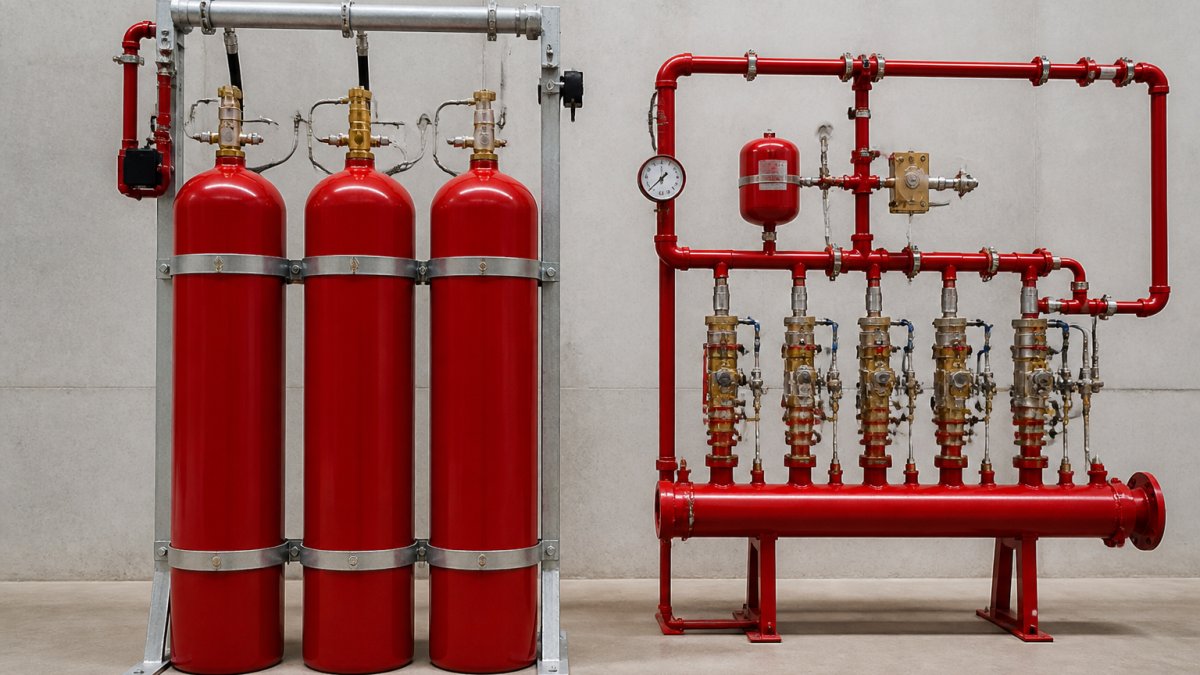
The main inert agents are nitrogen, argon, carbon dioxide and proprietary blends such as IG-55 and IG-541. Each has a design concentration calculated for the hazard being protected, and each must hold that concentration across the whole room for the required hold time. That is why room integrity testing matters so much for gas systems: a leaky enclosure lets the agent escape before the fire is out.
How a Water Mist Fire Suppression System Works
A water mist fire suppression system extinguishes fire using fine water droplets that evaporate on contact with heat, absorbing energy and cooling the fire while displacing oxygen locally. It uses far less water than a conventional sprinkler system.
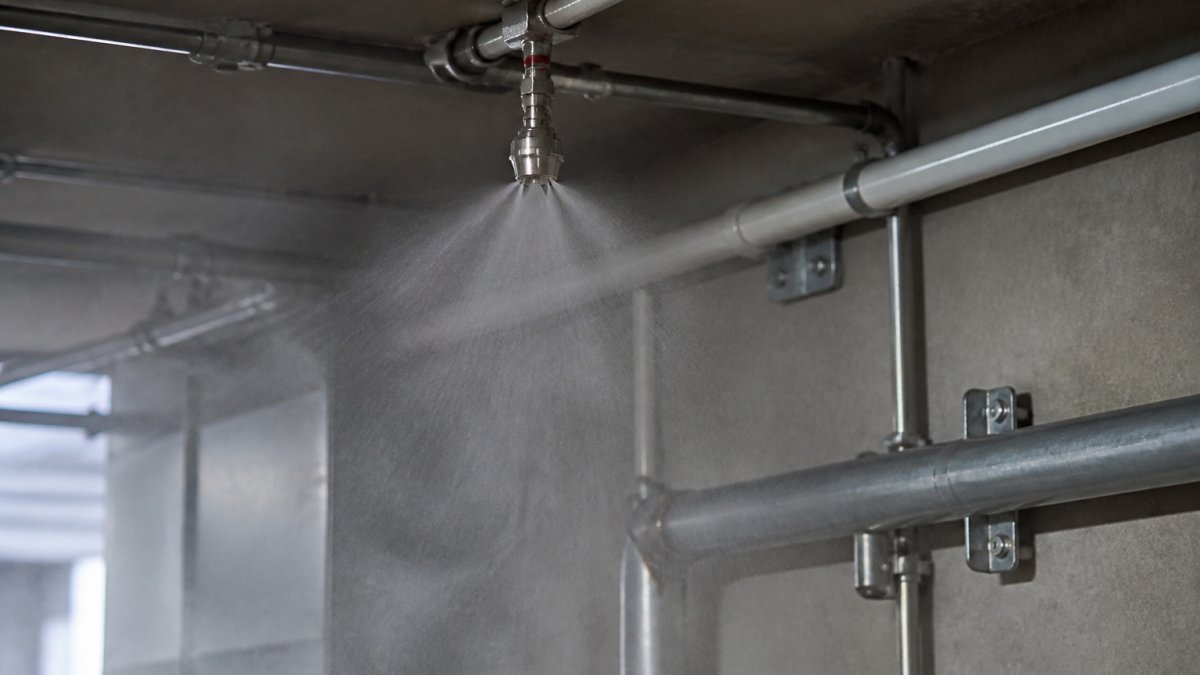
The cooling effect is the headline. AFX Fireblocker’s 2026 comparison of suppression types notes that water mist can use up to 90% less water than conventional sprinklers. A 2023 review in Fire journal on water mist for building protection also reports that water can cool hot cable fires and help prevent reignition of plastics, which is where gas systems sometimes struggle.
High-Pressure vs Low-Pressure Delivery
High-pressure systems force water through very fine nozzles, producing smaller droplets and using less water. Low-pressure systems use larger droplets and simpler pipework. High-pressure dominates the market, but low-pressure suits some industrial applications where supply pressure is limited.
If you want to weigh water mist against other non-water options first, our guide to alternatives to water-based fire suppression systems covers the field.
Room Integrity, Pressure Relief and Enclosure Requirements
Room integrity is the single most common reason an inert gas project fails at commissioning, and the factor most guides gloss over. Inert gas works only if the design concentration is held across the whole protected enclosure for the required hold time, typically ten minutes for occupied spaces under AS ISO 14520 and the equivalent methodology adopted in Australian practice.
What room integrity testing actually measures
A room integrity test (also called a door fan or enclosure integrity test) pressurises the room to a defined differential, commonly 50 Pa, and measures the leakage area. The result is expressed as an equivalent leakage area (ELA) or as a predicted hold time using the enclosure volume and the agent design concentration. Most practitioners find that a room with unsealed cable penetrations, shared ceiling voids, open door undercuts or unsealed service risers will fail the predicted hold time even when it looks airtight.
A gas system designed for a room with open doors, unsealed cable penetrations or a shared ceiling void will not hold its design concentration. Room integrity testing is required before commissioning and again after any building works, cable additions or fit-out changes that alter the enclosure.
Pressure relief and venting
Discharging a large volume of inert gas into a sealed room creates a pressure pulse. Without adequate pressure relief venting, the enclosure can be damaged, doors can be forced open, and the agent can be lost through the very openings the vent was meant to protect. Pressure relief vents are sized to the enclosure volume, the agent quantity and the discharge rate, and they must be positioned so that relief does not short-circuit the agent away from the hazard.
How water mist differs on enclosure demands
Water mist tolerates more leakage than inert gas because the agent is delivered as droplets rather than a room-filling gas, but it still performs best in a controlled enclosed environment. Airflow can carry droplets away from the fire, and ventilation or extraction systems can disrupt the mist cone. Water mist also needs drainage planning and a reliable water supply, so the enclosure requirements shift from airtightness to water management and nozzle placement.
The practical feasibility test
Before shortlisting either system, ask three questions: Can the room be sealed and tested to hold an inert gas concentration for the required hold time? Can pressure relief be installed without compromising the enclosure? And will the room stay sealed after future fit-out works? If the answer to any of these is no, water mist or another option may be the more realistic path, not because inert gas is inferior, but because the enclosure cannot support it.
Fire Suppression Systems for Server Rooms and Sensitive Assets
For server rooms and sensitive assets, inert gas is usually the first choice because it leaves zero residue. Electronics, tape storage and switchgear come out of a gas discharge dry and ready to restart.
The trade-off is enclosure discipline. For a deeper comparison of suppression options for these environments, see our guide to the best fire suppression system for data centers.
Inert Gas vs Water Mist Cost and Total Cost of Ownership
Inert gas vs water mist cost is rarely decided by the sticker price. The two systems have different cost structures, and the lifecycle picture often reverses the upfront comparison. Most practitioners find that inert gas carries a higher capital cost but a lower post-discharge cost, while water mist is cheaper to install but carries more cleanup and water-management overhead.
Capital cost drivers
Inert gas capital cost is driven by cylinder storage, room sealing, pressure relief, and more complex design and commissioning. Cylinders are heavy and occupy floor space, and the enclosure must be integrity-tested and sealed before the system can be signed off. Water mist capital cost is driven by pump sets, high-pressure pipework, nozzles and water supply. High-pressure systems use smaller droplets and less water but demand more expensive pipework and pumps; low-pressure systems use simpler pipework but larger droplets and more water.
Maintenance and inspection
Both systems require routine inspection and testing, but the tasks differ. Inert gas maintenance includes cylinder hydrostatic testing at the intervals set by the relevant standard, container weight and pressure checks, discharge nozzle inspection, and control panel testing. Water mist maintenance includes pump set servicing, nozzle checks for blockage or corrosion, water quality testing, and pipework inspection. Under AS 1851, routine servicing of fire protection systems is a compliance obligation, not an optional extra, and the cost of that servicing should be built into the lifecycle budget from day one.
Recharge and post-discharge cost
This is where the comparison often flips. An inert gas discharge leaves no residue, so the room, equipment and assets are ready to restart once the agent is recharged. Recharge means refilling or replacing cylinders, which is a real cost but a predictable one. A water mist discharge introduces moisture, so post-discharge cost can include drying, cleaning, replacing damaged assets and investigating water damage to electronics or stored goods.
Business interruption and downtime
Downtime after a discharge is part of total cost of ownership. Gas leaves no cleanup, so restart can be quick once the agent is recharged. Water mist may mean drying and replacing damaged assets, which extends downtime. For a data room or control room, that difference can outweigh the installation saving.
Compare the two systems on total cost of ownership, not sticker price: capital cost, maintenance and inspection, recharge, post-discharge cleanup, and business interruption. The cheaper system to install is not always the cheaper system to own.
For a breakdown of installation pricing factors, read our fire suppression system installation costs guide.
Choosing the Right System for Your Hazard and Occupancy
Match the system to the hazard, not the brochure. Use inert gas where the room is sealed, the assets are moisture-sensitive and a clean discharge matters. Choose water mist where the hazard involves machinery, cables or plastics, where water supply is reliable and where some moisture is acceptable.
- Server rooms and control rooms: inert gas, for a residue-free discharge.
- Machinery and plant spaces: water mist, for cooling and reignition control.
- Archive and gallery spaces: inert gas, to protect paper and artefacts.
Whichever you choose, ongoing maintenance is not optional. Our article on why fire suppression maintenance is critical explains the inspection obligations that follow installation.
Book a Suppression System Assessment with Fyrepower
The right system is the one designed for your room, your hazard and your compliance obligations. At Fyrepower, our QBSA-licensed, fully insured team provides fire safety equipment, installation and professional testing services, backed by a 55-month warranty.
Get in touch with Fyrepower today. Fire suppression systems such as agent gas, water mist, and wet chemical systems are available to control, prevent, and extinguish fires.
Frequently Asked Questions
What is the difference between an inert gas and a water mist fire suppression system?
An inert gas fire suppression system floods a sealed room with gases such as nitrogen, argon or carbon dioxide blends, lowering oxygen concentration until combustion cannot continue. A water mist fire suppression system discharges very fine droplets that cool the flame, absorb heat and displace oxygen locally. Inert gas leaves no residue and needs a well-sealed enclosure, while water mist uses far less water than a sprinkler system but still introduces moisture. The right choice depends on the hazard, the room’s airtightness and what you are protecting.
Which system is better for server rooms and sensitive electrical equipment?
Fire suppression systems for server rooms usually favour inert gas because it discharges no moisture and leaves no residue, so servers and cabling are unaffected. Water mist can damage exposed electronics and is not moisture-free, though research published in Fire in 2023 notes water’s ability to cool hot cable fires and reduce plastic reignition. If the room is well sealed, inert gas is the safer default. If the enclosure leaks badly or the fire load is heavy, water mist may hold an advantage. A site assessment settles it.
Can water mist systems damage electrical equipment?
They can. Water mist still introduces moisture into the protected space, and a 2026 comparison from AFX Fireblocker notes that it is not moisture-free, so it is unsuitable wherever any water exposure is unacceptable. The risk depends on discharge duration, nozzle placement and whether equipment is energised. For switch rooms and data halls, many operators prefer a waterless agent. Where water mist is chosen, isolate power on discharge and inspect electronics before restarting.
How does inert gas vs water mist cost compare over the life of the system?
Pricing depends on the project. Ask Fyrepower for a quote.
Are inert gas fire suppression systems safe for people?
Inert gas agents are non-toxic, but they work by reducing oxygen concentration, so anyone inside the protected enclosure during discharge faces a breathing hazard. Design concentrations are set so the atmosphere remains breathable for a short egress period, and discharge alarms, warning signs and pre-discharge delays are required so occupants leave first. Carbon dioxide systems are the exception and are not used in occupied spaces. Confirm the design concentration and egress provisions with your installer before commissioning.