Table of Contents
- Commercial Fire Protection vs Residential Systems: What Actually Changes
- National Construction Code Fire Safety Requirements for Each Building Class
- AS 1851 Maintenance of Fire Protection Systems: Commercial vs Residential Schedules
- Commercial Fire Alarm System Testing Frequency: Why It Differs From Home Alarms
- Fire Extinguishers and Suppression: What Differs Between the Two
- Insurance Premium Impact: How System Type Affects Your Cover
- Retrofitting Challenges: When a Residential Building Needs Commercial-Grade Protection
- Frequently Asked Questions
Last Updated: September 21, 2026
Commercial Fire Protection vs Residential Systems: What Actually Changes
Commercial fire protection vs residential systems is not a difference of degree. It is a difference of legal category, and that distinction drives everything from how many detectors you need to how often they must be tested. This guide from Fyrepower breaks down where the line sits and what it means for property owners and managers.
The split starts with how a building is classified under the National Construction Code (NCC). A residential dwelling and a commercial tenancy can look similar from the street, yet they sit under different performance requirements, different maintenance schedules, and different regulatory oversight. Getting the classification wrong is one of the most common compliance mistakes we see.
Below, we’ll show you exactly what changes between the two, where the rules come from, and how to tell which side your property falls on.
How the National Construction Code Draws the Line
The NCC draws the line through building classification, not through whether people sleep there. Each building class carries its own fire safety requirements, and that classification determines which systems you must install and maintain.
A Class 1 building is a single dwelling, such as a detached house. Class 2 covers apartment buildings where people live. Commercial and industrial buildings fall into Classes 3 through 9, covering everything from offices to retail to warehouses.
The practical consequence is that a residential building and a commercial one can share a wall and still need entirely different levels of protection. Occupant load, egress paths, and fire hazard classification all feed into the decision.
The NCC classification of your building, not its size or appearance, is what determines your fire safety obligations. Confirm your class before you buy or install anything.
National Construction Code Fire Safety Requirements for Each Building Class
NCC fire safety requirements scale with building class, occupant load, and the fire hazard classification of what happens inside. A small office and a warehouse can both be commercial, yet carry different requirements because their contents burn differently.
For residential buildings, the emphasis sits on early warning and safe escape. For commercial buildings, the requirements extend to property protection, system scalability, and often active suppression such as sprinklers.
The NCC is given legal force through state and territory legislation and applied by local regulators and fire authorities. Australian Building Codes Board guidance on the NCC sets out how the code is structured and updated.
Key differences in requirements include:
- Detection sensitivity: commercial spaces often need faster, more sensitive detection
- Notification appliances: audible and visual alarms sized to the building
- Egress paths: protected exits sized to the occupant load
- Suppression: sprinklers and hose reels become mandatory in many commercial classes
- Documentation: commercial sites need maintenance logs and compliance records
For a commercial property, the NCC requirements rarely stop at detection. They shape the whole integrated fire strategy for the building.
AS 1851 Maintenance of Fire Protection Systems: Commercial vs Residential Schedules
AS 1851 maintenance of fire protection systems sets the testing and servicing intervals that keep equipment compliant after installation. The standard applies across both residential and commercial buildings, but the scope and frequency of what must be serviced is far greater on the commercial side.
AS 1851 is the Australian Standard for routine servicing of fire protection systems and equipment. It defines what gets checked, how often, and what records must be kept. Standards Australia overview of AS 1851 explains how the standard is maintained and revised.
A residential property typically has a limited set of equipment: smoke alarms, perhaps a fire extinguisher, and a fire blanket. A commercial building may carry dozens of items, each with its own service interval.
A common mistake is assuming a six-monthly inspection covers everything. In practice, different equipment has different intervals, and missing one can leave a gap in your compliance record.
| Property Type | Typical Equipment | Servicing Focus | Documentation |
|---|---|---|---|
| Residential | Smoke alarms, extinguishers, blankets | Alarms and basic equipment | Minimal, often self-managed |
| Commercial | Alarms, sprinklers, hydrants, extinguishers | Full system servicing | Detailed logs required |
Commercial Fire Alarm System Testing Frequency: Why It Differs From Home Alarms
Commercial fire alarm system testing frequency is driven by the consequences of failure, not by convenience. A home smoke alarm failing affects one household. A commercial alarm failing affects everyone in the building and can breach your compliance obligations.
Home alarms are generally tested by the occupant, with batteries replaced on a set schedule. Commercial systems are tested by qualified technicians under AS 1851, and the results are recorded for audit.
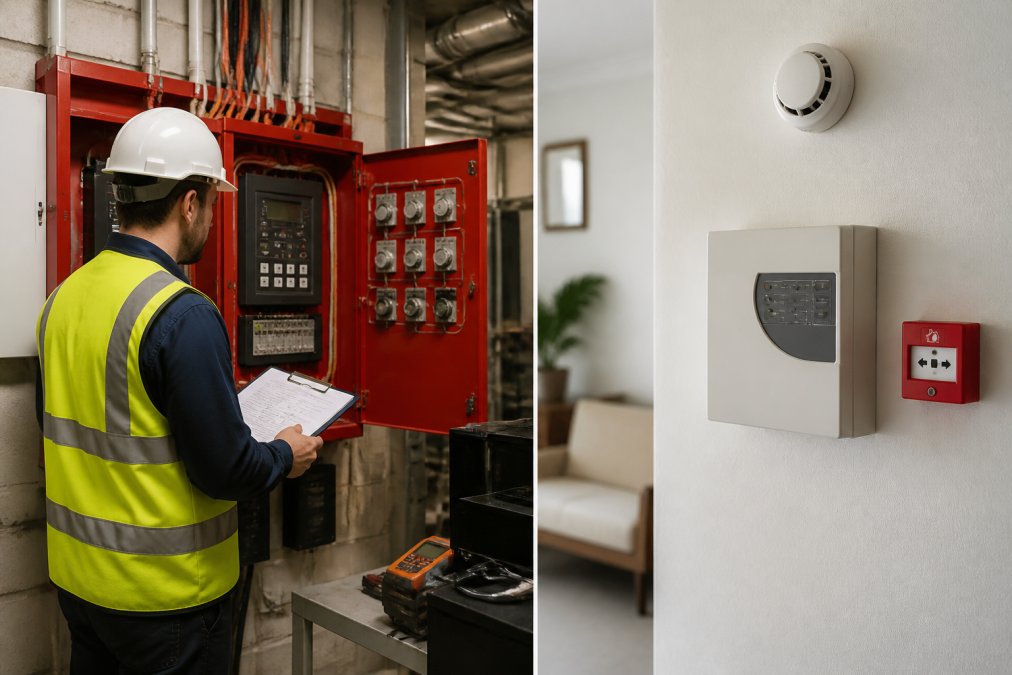
The reason for the difference comes down to system complexity. A commercial system may include addressable detectors, manual pull stations, heat detection, and notification appliances wired into a control panel. Each component needs its own check.
Skipping or delaying a scheduled commercial alarm test does not just risk a fine. If an incident occurs and your records show a missed service, your insurer may question your cover.
For commercial buildings, the testing schedule is not optional paperwork. It is the evidence that your life safety systems actually work.
Fire and Rescue NSW fire safety compliance information
Fire Extinguishers and Suppression: What Differs Between the Two
Fire extinguishers and suppression differ mainly in scale and intent. A home might hold one extinguisher for the kitchen. A commercial site needs extinguishers matched to the fire hazard classification of each area, plus suppression systems in many cases.
Fire extinguishers are classified by the type of fire they handle, and a commercial kitchen, a server room, and a warehouse each need different coverage. Choosing the wrong type leaves you exposed.
Suppression systems step in where extinguishers cannot.
Insurance Premium Impact: How System Type Affects Your Cover
- The current AS 1851 service records for every system on site, not just the alarm panel
- The fire safety schedule or equivalent issued by the local council or fire authority, where one applies
- Evidence that suppression systems are within their required test cycle
- Confirmation that the installed equipment matches what is recorded on the compliance documentation
- Any outstanding defects and the date they were rectified
Where residential and commercial diverge in practice:
A lapsed service record is not just a compliance breach. It is evidence an insurer can rely on when assessing a claim. Keep records current and keep them retrievable.
Before you renew, request your full service history from your fire protection provider and reconcile it against the equipment actually installed. Handing your broker a clean, complete record is the single easiest way to keep the conversation on your terms.
For commercial properties, the link between maintenance and cover is direct and documented. For residential properties, the stakes are lower but the principle is the same: the system only counts if you can prove it works.
Retrofitting Challenges: When a Residential Building Needs Commercial-Grade Protection
The classification mechanism behind the trigger
What actually goes wrong in a retrofit
- Water supply. Suppression systems need a supply with adequate pressure and flow. A dwelling’s incoming main is frequently insufficient, and upgrading it can mean new pipework, a dedicated fire water tank, or a pump set.
- Egress. Exit widths, travel distances and protected paths are sized to the new occupant load. A residential layout often has a single stair and a narrow hallway that cannot be made compliant without structural change.
- Detection and control. A residential smoke alarm is a standalone device. A commercial-grade system typically needs addressable detection, a control panel, and notification appliances wired back to it, which means cabling, containment and a plant space that may not exist.
- Compartmentation. Fire resistance ratings between floors and tenancies may need to be introduced or upgraded, which is invasive and disruptive.
- Documentation and approval. The change of use usually requires development approval and a fire safety schedule, and the works must be certified before occupation.
How this differs from a new build
A change of use is the most common retrofit trigger, and it is a classification change, not a construction change. Confirm the new class and the resulting requirements before you commit to a fit-out, because the building services, not the equipment, are usually what drive the cost.
Retrofitting is rarely cheap, but ignoring it is riskier. Unapproved changes can void insurance, breach compliance obligations, and leave the building unusable for its intended purpose.
Frequently Asked Questions
Is there a difference between residential and commercial fire extinguishers?
Yes. Commercial fire extinguishers must meet AS 2444 for location and signage, and are serviced every six months under AS 1851. Residential extinguishers often follow manufacturer recommendations only. Commercial units are typically larger, cover specific fire hazard classifications (A, B, C, E, F), and require documented maintenance logs. For a hospitality venue, a 4.5kg ABE extinguisher may suffice, while a commercial kitchen needs a wet chemical extinguisher for Class F fires.
How do testing frequencies differ for commercial and residential fire alarm systems?
Commercial fire alarm system testing frequency is generally every six months for full system inspection under AS 1851, with monthly checks of pumps and weekly tests of alarm functions in some buildings. Residential smoke alarms are tested monthly by the occupant and have their batteries replaced annually. Commercial systems also require professional documentation for each test, which is not typically needed for homes.
Are residential fire sprinkler systems mandatory under the National Construction Code?
The National Construction Code requires sprinklers in residential buildings of three storeys or more, and in some Class 2, 3, and 9c buildings depending on size and occupant load. Single detached homes (Class 1a) are generally not required to have sprinklers unless local council or bushfire zoning rules apply. Commercial buildings almost always require sprinklers based on floor area, height, and fire hazard classification.
What are the primary regulatory differences between residential and commercial fire safety in Australia?
Commercial properties must comply with AS 1851 maintenance schedules, keep detailed records, and meet National Construction Code fire safety requirements for their building class. Residential properties have fewer mandatory maintenance obligations, mainly smoke alarm regulations. Commercial buildings also require annual fire safety statements, evacuation diagrams, and training for occupants, while homes typically only need working smoke alarms and a basic escape plan.