Table of Contents
- Fire Safety Equipment Installation: Best Practices That Pass Audit
- Assessing Building Layout, Hazards and Fire Risk Before Installation
- Fire Extinguisher Installation Requirements for Australian Buildings
- Fire Alarm Installation Best Practices and Detection Coverage
- Sprinklers, Hose Reels, Hydrants and Pumps: Installation Essentials
- Commissioning Tests, Measurable Acceptance Criteria and Handover
- Fire Safety Equipment Maintenance Checklist and Ongoing Compliance
- How to Choose a Fire Protection Contractor for Installation Work
- Frequently Asked Questions
Last Updated: October 17, 2026
Fire Safety Equipment Installation: Best Practices That Pass Audit
Fire safety equipment installation best practices start with one rule: match the equipment to the risk, then prove it works.
Most building fires are survivable when warning and suppression systems work as designed. The gap between a compliant building and a dangerous one is rarely the equipment itself.
Below, we break the process into stages, from hazard assessment through to handover and maintenance, each with a checklist you can act on.
Assessing Building Layout, Hazards and Fire Risk Before Installation
Start with a walk-through, not a catalogue. Before buying a single extinguisher, map the building and list what could burn.
Walk every floor and note:
- Room use and occupancy loads
- Exits, hallways and stairways
- Hazardous chemicals and storage areas
A simple hazard assessment groups each area as low, moderate or high risk. High-risk zones need faster detection and closer equipment.
Document the findings against the building specifications. This record becomes the backbone of your installation plan and your audit trail.
Installing equipment before completing a hazard assessment often leads to badly placed devices. You end up paying twice: once for the wrong install, and again to relocate everything.
Fire Extinguisher Installation Requirements for Australian Buildings
Extinguishers must be the right type, the right size, and in the right place. Australian requirements are set out in AS 2444, which covers selection and location of portable fire extinguishers.
Match the extinguisher class to the fire risk:
- Class A (wood, paper, textiles): water or foam
- Class B (flammable liquids): foam, dry chemical or CO2
- Class C (flammable gases): dry chemical
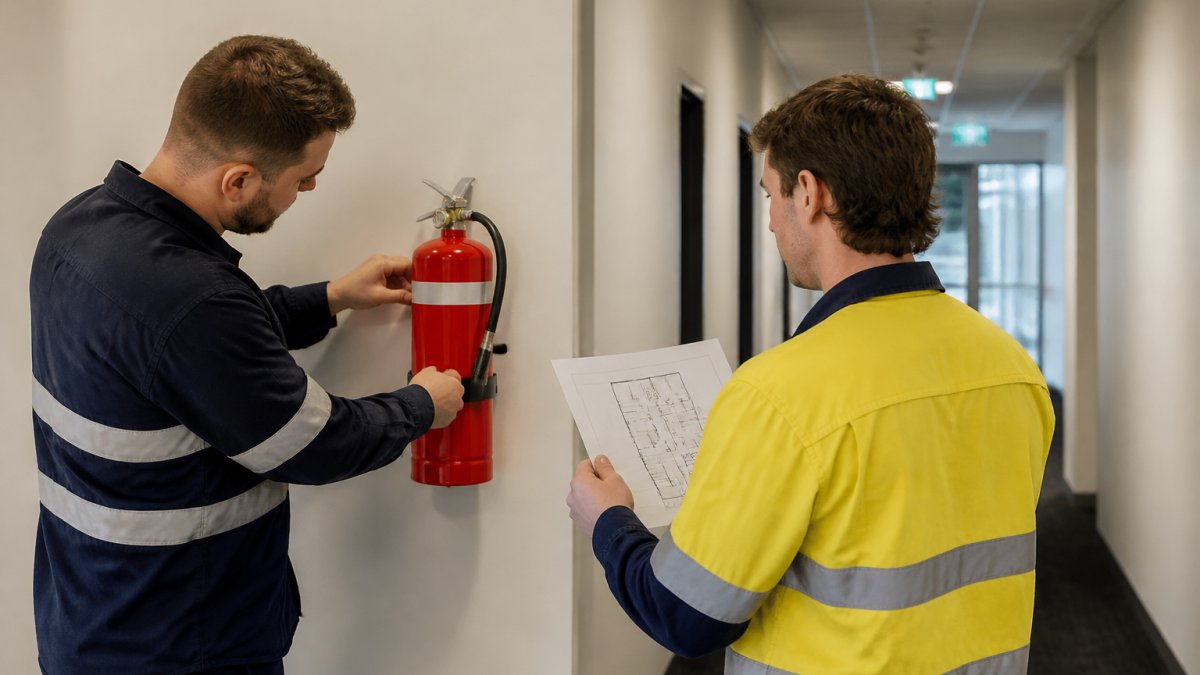
Placement follows a few firm rules. Mount extinguishers on brackets at a consistent height, with the top within reach for most adults. Keep them visible and clear of obstructions.
Every extinguisher needs a clear sign and a location marker. Check that the pressure gauge sits in the green zone before handover.
Fire Alarm Installation Best Practices and Detection Coverage
A fire alarm is only as good as its coverage. Detection must reach every area where a fire could start and spread before occupants can escape.
Plan coverage room by room:
- Smoke detectors in hallways, offices and sleeping areas
- Heat detectors in kitchens and plant rooms where smoke alarms would false-trigger
- Manual call points near every exit
The warning system should reach everyone, including people with hearing difficulties; visual alerts and an intercom help in larger or multi-storey buildings.
Keep detection wiring on a dedicated circuit with backup power. A detector that dies in a blackout is useless.
Locate manual call points at a consistent height and within easy reach of exit doors. During an emergency, people reach for what they expect. Consistency saves seconds, and seconds matter.
Sprinklers, Hose Reels, Hydrants and Pumps: Installation Essentials
Larger buildings need more than portable gear. Automatic sprinkler systems, fire hose reels, fire hydrants and stationary pumps form the fixed backbone of fire suppression, and unlike extinguishers, they cannot be relocated cheaply after the fact. Get the installation right the first time.
Automatic sprinkler systems
Sprinkler design is driven by the hazard classification of the occupancy, so first confirm the design basis against the actual use of each area, a storage area later converted to a workshop can fall outside its original design. Practical points:
- Keep sprinkler heads clear of storage. Most codes require a minimum clearance below deflectors (commonly around 450 mm, but confirm against the design and AS 2118 series). Stacking to the ceiling defeats the system.
- Protect the control valve assembly and ensure it is accessible, clearly labelled and locked in the open position.
- Keep the water supply and control equipment on a protected supply with backup where the design requires it.
Fire hose reels
Hose reels are a first-attack tool, not a substitute for hydrants. Installation essentials:
- Mount at accessible points along escape routes, typically near exits, so occupants pass them on the way out.
- Hose length must reach every part of the floor it serves, check the actual route, not the straight-line distance, and account for obstructions.
- Reels should be at a consistent, reachable height and swing freely through their full arc without fouling walls or racking.
Fire hydrants
Hydrants serve firefighters, so access and identification matter more than aesthetics:
- Position for firefighting access with a clear, unobstructed approach, never behind parked cars, bins or stored goods.
- Mark hydrants clearly and keep booster and hydrant connections visible from the street where practicable.
- Confirm the hydrant and booster assembly is compatible with the local fire service’s equipment and that caps and valves operate freely.
Stationary pumps
Pumps are the heart of a fixed system and the most common single point of failure:
- House pumps in a protected plant area, separated from the hazard they protect where the design requires it.
- Provide backup power and confirm automatic start on pressure drop.
- Commission with flow and pressure tests against the design figures, and record the results, a pump that starts is not the same as a pump that performs.
Coordination with building services and accessibility
This is where fixed-system installations most often go wrong. Sprinkler and hydrant pipework must not clash with electrical, plumbing, HVAC or structural elements.
Accessibility is part of installation, not an afterthought. Reels, hydrants and control valves must be reachable without climbing, squeezing past stored goods or moving furniture. If a responder or occupant cannot reach the equipment in seconds, the installation has failed regardless of what the drawings show.
Fixed-system changes after handover, new partitions, added storage, relocated racking, can silently invalidate the original design. Any fit-out that alters the protected space should trigger a review of sprinkler coverage and clearance.
Commissioning Tests, Measurable Acceptance Criteria and Handover
Commissioning is where installation proves itself. Every device gets tested, every result recorded, and nothing signed off on trust. The detail most guides leave open: what exactly is tested, what counts as a pass, and what paperwork an auditor will actually ask for.
Set acceptance criteria before you test
Agree pass/fail criteria with the installer and, where relevant, the building surveyor or certifier before commissioning begins. Criteria should be specific and measurable, a pump either meets its design pressure or it doesn’t; a detector either activates the alarm at the panel or it doesn’t. Vague reports fail audits; specific pass/fail results hold up.
Commissioning tests by equipment
- Portable extinguishers: check pressure gauge in the green zone, weight against the stamped charge, pin and tamper seal intact, and correct signage and location marker fitted.
- Detection: trigger each detector and confirm alarm activation at the panel, with the correct zone and device identified. Test manual call points separately.
- Warning system: confirm sounders and visual alerts are audible and visible in all occupied areas, including sleeping areas and areas of high ambient noise.
- Hose reels: flow test to confirm full reach at rated pressure, and check the stop valve and nozzle operate correctly.
- Hydrants and booster connections: confirm flow and pressure, and check caps, valves and couplings operate freely and match fire service equipment.
- Pumps: run flow and pressure tests against the design figures, confirm automatic start on pressure drop, and test backup power changeover.
- Sprinklers: confirm valve status (open and locked), test the alarm valve and flow switch, and verify heads are clear and undamaged.
| Equipment | Test | Pass criteria |
|---|---|---|
| Portable extinguisher | Pressure and seal check | Gauge in green, pin sealed, weight correct |
| Smoke detector | Trigger test | Alarm at panel within seconds, correct zone |
| Manual call point | Activation test | Alarm at panel, correct zone |
| Hose reel | Flow test | Full reach at rated pressure |
| Hydrant / booster | Flow and pressure test | Meets design figures, couplings compatible |
| Stationary pump | Flow, pressure and auto-start test | Meets design figures, starts on pressure drop |
| Sprinkler system | Valve and alarm test | Valve open and locked, alarm sounds |
Documentation and sign-off
Commissioning produces a file, not just a working system. The handover pack should include:
- As-built drawings reflecting what was actually installed, not the original design
- Test records for every device, with date, result and the name of the person who performed the test
- Equipment schedules and asset register entries
The approval and sign-off workflow
How you demonstrate compliance depends on the building’s location and type. The practical sequence:
- Identify the applicable requirements, the relevant Australian Standards for each system (for example the AS 2118 series for sprinklers, AS 1670 series for detection, AS 2444 for portable extinguishers, AS 1851 for maintenance) plus any state or local government requirements that apply to the building class and use.
- Confirm what approvals are needed, new installations and alterations often require approval from the local council or a private certifier, and some systems require notification to, or inspection by, the fire service.
- Commission and record, complete the tests above and assemble the documentation pack.
- Obtain sign-off, have the installation inspected and signed off by the appropriate authority before occupation or before the system is relied upon.
Because requirements vary by jurisdiction and building class, confirm the approval path with your local council or certifier early, before installation, not after. A system that works but lacks the right sign-off is a compliance problem waiting to surface. Proactive documentation and adherence to established standards remain the most effective ways to ensure long-term property safety compliance throughout the lifecycle of your building.
Photograph each test as it is performed and attach the images to the test record. It takes seconds on site and closes arguments later about whether a device was actually tested.
Fire Safety Equipment Maintenance Checklist and Ongoing Compliance
Installation is the start, not the finish. Fire safety equipment degrades, and compliance depends on regular inspection and testing.
AS 1851 sets the routine for maintaining fire protection systems. Use a maintenance checklist tied to it:
- Monthly: visual check of extinguishers, exits and signage
- Six-monthly: inspect and test extinguishers, alarms and hose reels
- Annually: full system inspection and flow testing
Keep a log for every device: date, test, result and who did the work. Detailed service reports prove the work was done when an audit lands.
Train building occupants too. Staff should know where equipment sits, how to raise the alarm and how to use an extinguisher.
The strongest compliance defence is a clean paper trail. Every test, every result, every signature. If it isn’t written down, an auditor will treat it as not done.
How to Choose a Fire Protection Contractor for Installation Work
Pick a contractor on evidence, not price alone. The right provider is licensed, insured and able to show documented work.
Ask these questions before signing:
- Are you licensed and fully insured, and can I verify both?
- Do your reports record specific test results, not vague summaries?
- Can you handle multiple sites and keep to six-monthly deadlines?
A contractor who answers these clearly is the safer choice; one who dodges them is a risk to your compliance.
At Fyrepower, we are QBSA-licensed and fully insured, and we back our equipment with a 55-month warranty. Our team works to AS 2444 and AS 1851, provides detailed service reports, and offers on and offsite fire training.
Frequently Asked Questions
What Australian standards apply to fire safety equipment installation?
Installation is governed by several standards. AS 2444 sets out the selection and location of portable fire extinguishers, while AS 1670 covers fire detection and alarm systems and AS 2118 addresses automatic sprinkler systems. Hose reels and hydrants fall under their own standards, and AS 1851 sets the routine servicing regime after handover. Your installer should be able to name the standard that applies to each device they fit, and your documentation should record it. Always confirm the current edition of each standard applies to your building type.
Who is qualified to install fire safety equipment?
Complex systems such as alarms, sprinklers, pumps and hydrants must be installed by licensed trades working under the relevant Australian Standards, often with separate electrical, plumbing and fire protection licensing. Portable extinguishers and blankets are simpler, but the placement still needs to follow AS 2444 and be recorded. Ask for the licence number, insurance certificate and examples of comparable work before signing. A contractor who cannot produce these documents on request is a risk to your compliance record.
How often should fire safety equipment be inspected and tested?
AS 1851 sets the routine servicing intervals. Portable extinguishers are typically inspected every six months, with pressure testing at longer intervals. Fire alarm systems, sprinklers, pumps and hydrants each have their own weekly, monthly, six-monthly or annual checks. The six-monthly cycle is the one most commercial property managers track closely because missed appointments are a common audit finding. Keep every service report with the date, technician name and test results so you can prove the work was done.
What should I ask a fire protection contractor before hiring them?
Ask for their licence number and insurance certificate, the standards they will work to, and a sample service report so you can judge how detailed it is. Confirm whether their quote includes commissioning, documentation and handover, or whether those are extras. Ask how they schedule recurring testing and what happens if an appointment is missed. Finally, request a written scope that lists every device, its location and the standard it complies with, so there are no surprise charges after the work begins.
Choosing the wrong fire protection partner can leave you exposed when an audit or a real emergency arrives. Fyrepower delivers licensed installation, testing and maintenance built around Australian standards, with detailed reporting and staff training that stand up to scrutiny. Get in touch with us now to book an assessment and keep your property compliant and protected.