Table of Contents
- The Building Fire Safety Regulation 2008 and Your Legal Duty
- Fire Protection Licensing and Professional Requirements
- AS 1851 Maintenance Standards for Fire Safety Equipment
- Commercial Evacuation Diagram Compliance and AS 3745
- Fire Safety Management Plan Requirements for Building Owners
- Fire Extinguisher Testing Frequency and Compliance Schedules
- Combustible Cladding Laws and Reporting Obligations
- Fire Hydrant and Vehicle Access Guidelines
- Frequently Asked Questions
Last Updated: September 28, 2026
The Building Fire Safety Regulation 2008 and Your Legal Duty
The Building Fire Safety Regulation 2008 establishes the mandatory framework governing fire safety in commercial buildings. Understanding Queensland fire safety regulations is a legal requirement that directly affects your liability as a building owner or manager, working alongside the Building Code of Australia and the Fire Safety Act 1990.
Your duty of care requires all fire safety systems to be installed, maintained, and tested according to Australian standards through regular inspections, documented maintenance schedules, and professional testing by licensed operators. Non-compliance exposes you to significant penalties and endangers lives.
The regulation applies to most commercial buildings including offices, retail spaces, hospitality venues, and multi-tenancy strata complexes. Specific requirements depend on building classification, occupancy type, and installed fire safety systems.
Fire Protection Licensing and Professional Requirements
Fire protection work must be carried out by licensed professionals holding appropriate qualifications under the Building and Construction Commission (QBCC). The law requires licensed specialists for critical fire safety work; in-house staff or unqualified contractors are not permitted.
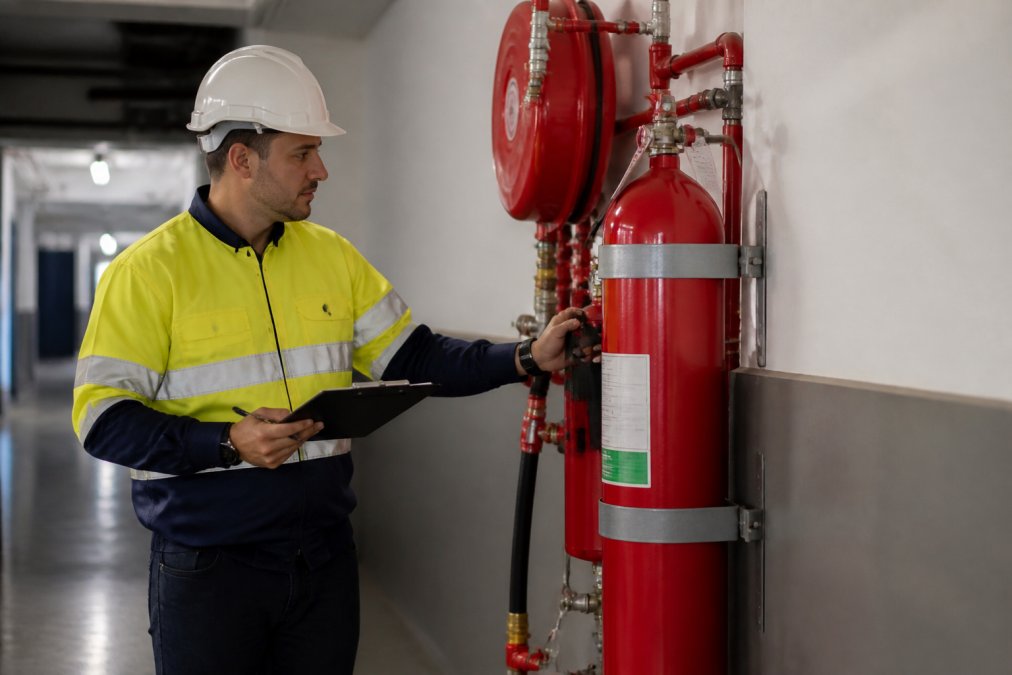
Verify your fire protection provider’s QBCC licence and professional indemnity insurance before work begins. They should issue detailed compliance reports documenting what was tested, what passed, and what requires attention.
Avoid choosing providers based on price alone; the cheapest quote often hides vague reporting and rushed work. Professional advisors invest time understanding your building layout, occupancy patterns, and equipment configuration, producing thorough reports that withstand audit scrutiny.
AS 1851 Maintenance Standards for Fire Safety Equipment
AS 1851 defines mandatory maintenance requirements for fire safety equipment including extinguishers, hydrants, hose reels, and suppression systems under Queensland fire safety regulations. The standard specifies testing frequencies, inspection intervals, and documentation requirements that vary by equipment type.
Fire extinguishers require monthly visual inspection and annual professional servicing. Hydrants and hose reels need annual testing with hydrostatic pressure testing every five years. Automatic suppression systems require quarterly inspections with annual professional servicing.
Every inspection and service must be recorded with dates, findings, and the technician’s signature. These records prove compliance during audits; poor documentation undermines your defence even if work was completed properly.
Commercial Evacuation Diagram Compliance and AS 3745
Evacuation diagrams are mandatory and must comply with AS 3745, showing all emergency exits, assembly points, and evacuation routes with clearly visible, accurate information that occupants can understand quickly under stress.
The diagram must match your actual building layout and be updated immediately after renovations, partitions, or exit changes. Outdated diagrams cause confusion and delay evacuation.
Diagrams must be professionally prepared to meet AS 3745 requirements and regularly reviewed for accuracy, with a schedule for updates whenever building changes occur.
Fire Safety Management Plan Requirements for Building Owners
A fire safety management plan is your documented strategy for preventing fires and protecting occupants. Queensland fire safety regulations require most commercial buildings to have a written plan addressing specific risks and control measures.
Your fire safety management plan must include these core components:
Hazard identification and risk assessment, Document all potential fire hazards in your building: electrical equipment, flammable storage, high-occupancy areas, and construction materials. For each hazard, assess the likelihood and consequence of a fire. This isn’t guesswork; it should be based on your building’s actual layout, occupancy patterns, and equipment inventory.
Fire prevention measures, Outline the specific controls you’ve implemented to reduce fire risk. Examples include regular electrical inspections, restricted smoking areas, proper storage of flammable materials, and maintenance of fire safety systems. Link each control directly to the hazards you’ve identified.
Emergency procedures and evacuation routes, Detail your evacuation process, including assembly points, communication methods, and roles during an emergency. This section must reference your AS 3745 evacuation diagrams and explain how occupants will be informed of the evacuation route (alarm systems, staff direction, signage).
Fire safety system maintenance schedules, Include the testing and inspection frequencies for all fire safety equipment: extinguishers, hydrants, hose reels, suppression systems, and emergency lighting. Cross-reference these with AS 1851 requirements and your service provider’s schedule.
Training and awareness programs, Document how and when staff receive fire safety training. This should include induction training for new employees, annual refresher training, and specific role-based training for fire wardens or emergency coordinators. Keep records of who attended and when.
Roles and responsibilities, Clearly assign accountability. Who is responsible for ordering extinguisher services? Who conducts monthly visual inspections? Who updates the evacuation diagram after building changes? Vague responsibility leads to gaps in compliance.
Review and update schedule, Commit to reviewing your plan annually and updating it whenever circumstances change. Building modifications, staff turnover, new equipment, or changes in occupancy patterns all trigger updates. Document each review with the date and any changes made.
Audit preparation checklist, Gather service records and test certificates for the past two years, staff training records, photographs of evacuation diagrams and signage, maintenance logs, and your current fire safety management plan. Organise these in a folder so you can produce them immediately if audited. Maintaining these documents ensures that your facility remains compliant with evolving industrial fire safety standards as you prepare for the upcoming requirements.
The plan’s format matters less than its completeness and accuracy. What matters is that the plan reflects your actual building, systems, and procedures; a plan that doesn’t match reality creates false compliance.
Fire Extinguisher Testing Frequency and Compliance Schedules
Fire extinguisher testing frequency follows a strict schedule defined by AS 1851 and Queensland fire safety regulations. Visual inspections must occur monthly, with professional servicing required annually. Every five years, extinguishers undergo hydrostatic pressure testing to ensure the cylinder remains safe under pressure. Failing to meet these schedules puts you in breach of your legal obligations.
The testing schedule isn’t flexible; it’s based on the calendar month of installation or last service. If an extinguisher was installed in March, its annual service is due in March. Missing the deadline by even a few days technically puts you out of compliance. Many building managers maintain a simple spreadsheet or calendar system to track due dates across all extinguishers.
Monthly visual inspections, These require no specialist qualifications and can be performed by in-house staff. Check that the extinguisher is in its designated location, the pressure gauge shows green (not red or yellow), the pin and tamper seal are intact, and there’s no visible damage or corrosion. Document the date and inspector name on the inspection tag or in a log. Missing even one month creates a compliance gap.
Annual professional servicing, Licensed fire protection providers conduct this service, which includes internal inspection, recharging if needed, and replacement of seals and gaskets. The provider issues a service tag showing the date, technician details, and next due date. Keep these tags attached to the extinguisher and file copies in your compliance records.
Five-yearly hydrostatic pressure testing, Extinguisher cylinders are pressurised vessels and must be tested to ensure they won’t rupture under pressure. This testing is mandatory and cannot be skipped or delayed. Cylinders that fail hydrostatic testing must be replaced. The cost of replacement is significantly higher than routine servicing, making preventive maintenance cost-effective.
Financial and insurance consequences of non-compliance, Many building owners focus only on the regulatory penalty (which can exceed $10,000 for individuals and $50,000 for corporations under the Fire Safety Act 1990), but the real financial impact extends further. If a fire occurs and your extinguishers are not compliant or not maintained, your building insurance may deny a claim or reduce payout. Insurance underwriters routinely audit fire safety compliance; buildings with poor maintenance records face premium increases of 10-25% or policy cancellation. Additionally, if a fire causes injury or death and your extinguishers were not properly maintained, you face civil liability claims from injured parties or families.
Combustible Cladding Laws and Reporting Obligations
Combustible cladding restrictions have tightened significantly under Queensland fire safety regulations. Buildings over 10 metres tall cannot use combustible materials in external walls, with limited exceptions for certain materials. If your building has combustible cladding installed before the regulations changed, you have reporting obligations to notify the relevant authorities and develop a remediation plan.
Fire Hydrant and Vehicle Access Guidelines
Fire hydrants must be accessible to emergency services vehicles at all times. Queensland fire safety regulations specify that hydrants require clear access with adequate turning space for fire trucks. Parked vehicles, landscaping, or building materials cannot obstruct hydrant access. Emergency services need to reach and connect to hydrants within seconds, obstructions can cost lives.
Frequently Asked Questions
What are the main fire regulations for commercial buildings in Queensland?
Commercial buildings in Queensland must comply with the Building Fire Safety Regulation 2008, which establishes the legal framework for fire safety. Building owners have a duty of care to maintain life-safety systems, conduct regular fire safety audits, and produce an annual fire safety statement. Compliance includes maintaining fire protection equipment to AS 1851 standards, providing compliant evacuation diagrams under AS 3745, and ensuring emergency egress paths remain clear and functional. The specific requirements depend on building classification, occupancy type, and size.
How often must fire safety equipment be tested under AS 1851 maintenance standards?
AS 1851 maintenance standards require fire extinguishers to be inspected and tested annually. Fire hydrants must be tested annually for water pressure and flow. Suppression systems, sprinklers, and alarm systems have their own schedules defined within AS 1851. A qualified fire safety advisor or licensed fire protection company should conduct these tests to ensure compliance and maintain detailed records for audits.
What must be included in a fire safety management plan?
A fire safety management plan outlines how your building will manage fire risks and respond to emergencies. It must include the building’s fire safety strategy, details of all fire protection systems and equipment, maintenance and testing schedules, emergency evacuation procedures, roles and responsibilities of staff, training schedules, and records of all fire safety audits and inspections. The plan should also identify high-risk areas and document how the building owner meets their duty of care obligations under the Building Fire Safety Regulation 2008.
What are the penalties for non-compliance with Queensland fire safety regulations?
Non-compliance with fire safety regulations can result in significant financial penalties, prosecution, and reputational damage. Building owners may face special fire service fees, civil penalties, and court orders to remediate breaches. Beyond fines, non-compliance creates liability exposure if a fire occurs and injuries or property damage result. Failure to maintain required records, conduct audits, or keep equipment tested can lead to enforcement action by the regulator. The financial and legal impact extends beyond penalty amounts to potential loss of occupancy permits, insurance complications, and business interruption.