Table of Contents
- What Strata Fire Safety Inspection Services Involve
- Legal Obligations for Owners Corporations Under Australian Fire Safety Law
- Understanding AS 1851 Fire Safety Inspection Standards
- Annual Fire Safety Statement Requirements for Strata Schemes
- Building Your Strata Fire Safety Compliance Checklist
- How to Select and Engage a Fire Safety Contractor
- Budgeting and Cost Forecasting for Fire Safety Compliance
- Communicating Fire Safety Compliance to Tenants and Occupants
- Frequently Asked Questions
Last Updated: August 25, 2026
What Strata Fire Safety Inspection Services Involve
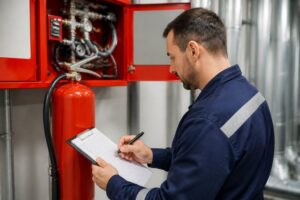
Strata fire safety inspection services encompass the systematic testing, maintenance, and certification of all fire protection systems within a building, from extinguishers and emergency lighting to fire doors and alarm systems. At Fyrepower, we understand that strata fire safety inspection is an ongoing program, not a single task.
A comprehensive strata fire safety inspection covers multiple equipment types on overlapping schedules: fire extinguishers require six-monthly servicing, emergency lighting systems need annual testing, fire doors demand inspection every six months, and sprinkler systems, hydrants, and alarm panels each have their own testing intervals. What separates a well-run strata scheme from a chaotic one is documentation. Every inspection generates a record, every test produces a certificate, and every defect triggers a remediation action. These documents form your audit trail, the evidence that you’ve met your statutory obligations.
The role of a competent fire safety practitioner is central here. This isn’t someone with a general maintenance background. A competent practitioner holds specific qualifications, understands Australian Standards (particularly AS 1851), and can interpret building codes.
Legal Obligations for Owners Corporations Under Australian Fire Safety Law
Owners corporations carry non-negotiable legal responsibilities for fire safety stemming from the Building Act 1993, the Fire Safety Act 2021, and various Australian Standards. Your owners corporation must ensure that all common property fire safety systems are installed, maintained, and tested in accordance with mandatory standards (legislation.vic.gov.au). If a fire occurs and your inspection records are incomplete, your organisation faces potential liability.
The statutory obligation extends to appointing someone responsible for fire safety compliance. For larger or higher-risk buildings, you may need to appoint a qualified Fire Safety Adviser. For smaller schemes, the responsibility typically falls to the body corporate committee or a delegated strata manager.
Your owners corporation must maintain a maintenance logbook, a detailed record of all fire safety work performed on the property. This logbook documents what was tested, when, by whom, and what defects were found. Another critical obligation involves the Annual Fire Safety Statement (AFSS). For certain buildings, particularly those with multiple occupancies or above a certain height, you must lodge an AFSS with the relevant authority. Submitting a false statement carries serious penalties.
Understanding AS 1851 Fire Safety Inspection Standards
AS 1851 is the Australian Standard that defines how fire protection systems must be inspected and maintained. It’s not optional guidance; it’s the benchmark that regulators use to assess compliance. The standard specifies exactly what must be tested, how often, and what constitutes a pass or fail.
Fire extinguishers must be serviced every six months according to AS 1851 (standards.org.au). A certified technician must examine the pressure gauge, verify the seal, check for physical damage, and ensure the pin and tamper seal are intact. Emergency lighting systems must function during a power failure for at least 90 minutes and require annual testing (standards.org.au). Fire doors must close properly, seal correctly, and show no signs of damage, with six-monthly inspection required.
Routine Testing Intervals: Monthly, Six-Monthly and Annual Requirements
The testing schedule for strata fire safety systems is tiered. Monthly checks are typically visual inspections: fire extinguishers should be examined to confirm they’re accessible and showing correct pressure, emergency lighting should be visually inspected, and smoke alarms in common areas require a monthly test. These checks don’t require a certified technician.
Six-monthly servicing requires certified professionals. Fire extinguishers must be fully serviced, fire doors must be inspected, and hose reels and hydrants require testing. These services generate formal certification and must be recorded in your maintenance logbook.
Annual testing covers systems needing deeper examination. Emergency lighting systems undergo full functional testing, sprinkler systems require annual inspection and testing, and fire alarm systems need annual service by a certified technician. The challenge for strata managers is coordinating these overlapping schedules.
Role of a Competent Fire Safety Practitioner
A competent fire safety practitioner holds the qualifications, knowledge, and experience to assess fire safety systems against Australian Standards and building codes. When they sign off on an inspection, they’re putting their professional reputation behind that certification.
Finding a competent practitioner means verifying credentials. Look for practitioners who hold relevant qualifications in fire safety, have completed training in AS 1851, and maintain current professional memberships. A competent practitioner will communicate clearly about findings and explain why defects matter and what remediation costs.
Annual Fire Safety Statement Requirements for Strata Schemes
The Annual Fire Safety Statement is a critical compliance document for certain buildings. The AFSS is required for buildings that fall into specific categories, typically multi-unit residential buildings above a certain height or buildings with certain uses. The exact threshold varies by jurisdiction.
The AFSS certifies that the building complies with applicable fire safety standards. A qualified Fire Safety Adviser or the building owner must sign the statement, which carries legal weight. Preparing an AFSS requires a comprehensive audit of all fire safety systems to verify that all required equipment is installed, all mandatory testing has been completed, maintenance records are current, and any defects have been remediated. Missing the annual deadline is a compliance breach.
Building Your Strata Fire Safety Compliance Checklist
A strata fire safety compliance checklist is your operational roadmap. Start by identifying every fire safety system in your building: fire extinguishers (how many, where), emergency lighting (which areas, how many units), fire doors (which rooms, how many), sprinkler systems, hydrants, alarm panels, smoke alarms, and hose reels.
Next, assign testing intervals to each item based on AS 1851 and relevant building codes. Create a master calendar showing all testing dates for the next 12 months. Assign responsibility: who will conduct monthly visual checks, who will book the six-monthly extinguisher service, who will coordinate the annual emergency lighting test. Make these assignments explicit.
Document every action taken. When the extinguisher service is completed, file the service tag and certificate. When a fire door inspection is done, record the findings. When a defect is identified, create a remediation action with a target completion date.
Fire Safety Equipment Essentials to Inspect
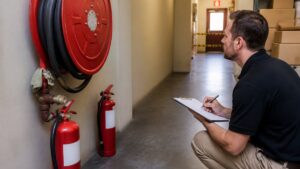
Fire extinguishers must be appropriate for the hazards in each area and serviced every six months. Look for pressure gauge readings in the green zone, intact tamper seals, and accessible placement. If an extinguisher has been used, even partially, it must be refilled immediately.
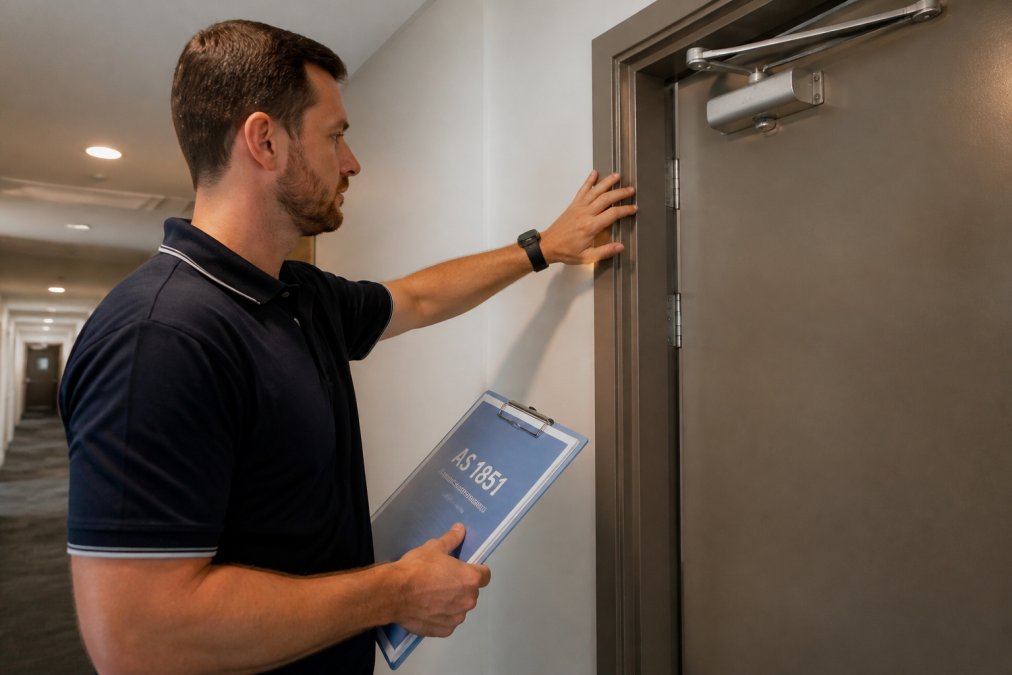
Emergency lighting systems must illuminate exit routes and maintain brightness for at least 90 minutes during power loss. Each unit must be tested annually. Fire doors must close automatically, seal tightly against the frame, and be free from damage. Six-monthly inspections catch issues early.
Sprinkler systems require annual inspection and testing to ensure water supply is adequate and the system activates properly. Fire hydrants must be accessible, clearly marked, and tested annually to confirm water pressure and flow are adequate.
Common Property Safety Rules and Documentation
Common property fire safety rules protect all occupants and typically address behaviour, maintenance, and emergency procedures. Rules might include prohibitions on blocking fire exits, storing combustible materials in stairwells, or obstructing fire safety equipment.
An evacuation plan is a critical document identifying all exits, assembly points, and procedures for people with disabilities. It assigns roles and must be reviewed annually. A maintenance logbook documents all fire safety work with dates, findings, and who performed the work. This logbook is your primary compliance evidence.
How to Select and Engage a Fire Safety Contractor
Start by defining your needs. Do you need only extinguisher servicing, or a comprehensive fire safety program covering all systems? Request quotes from multiple providers. A good quote includes a detailed scope of work, timelines, pricing, and what’s included.
Ask for references and contact other strata schemes or building managers that use the contractor. Check whether the contractor is willing to work with your existing systems or whether they insist on replacing equipment unnecessarily.
Verifying Qualifications and Licensing
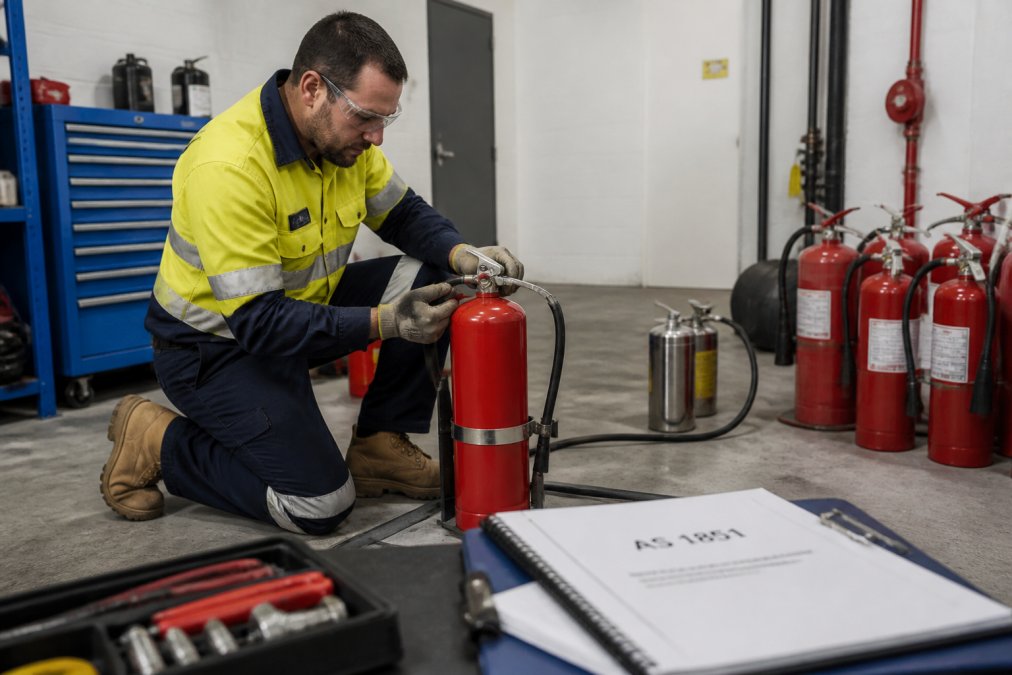
Ask for evidence of relevant qualifications. A fire safety contractor should hold qualifications in fire protection systems, have completed training in AS 1851, and maintain professional memberships. Verify these credentials independently if possible.
Check whether the contractor is licensed or registered in your jurisdiction. Insurance is another verification point. A reputable contractor carries comprehensive public liability insurance and professional indemnity insurance. Request proof of current insurance.
Ask about their experience. How long have they been operating? How many properties do they service? What types of buildings do they work with?
Managing Inspection Schedules Across Multiple Properties
Create a master compliance calendar covering all your properties, listing every fire safety system with its testing interval. Colour-code by property or system type for visibility. Include buffer dates, scheduling services a week or two before the deadline.
Assign a primary contact for each property to coordinate with the contractor and ensure defects are remediated. Establish a process for receiving and filing reports systematically. Set up a defect tracking system, logging each defect with a description, severity, and target remediation date. Communicate with your contractor regularly through monthly check-ins or quarterly reviews.
Budgeting and Cost Forecasting for Fire Safety Compliance
Fire safety costs fall into two categories: routine servicing and remediation. Routine servicing includes six-monthly extinguisher servicing and annual emergency lighting testing. These costs are predictable based on contractor quotes.
Remediation costs are less predictable and depend on the nature of defects identified. To forecast costs, start with your routine servicing budget by getting quotes from contractors for all scheduled services. For remediation, estimate based on your building’s age and condition. Older buildings typically have higher remediation costs. Budget for periodic equipment replacement, not just servicing.
Present this budget to your body corporate or building owner, explaining that fire safety compliance is a statutory obligation and that cutting corners creates regulatory and liability risks far outweighing cost savings.
Communicating Fire Safety Compliance to Tenants and Occupants
Start with an annual letter explaining your building’s fire safety program, describing what systems are in place, what testing is required, and why. Explain that testing may cause temporary disruptions.
Provide copies of key documents. Every occupant should receive a copy of the building’s evacuation plan and know where exits are, where to assemble, and what to do if an alarm sounds. Include fire safety information in building newsletters and consider annual fire safety training for larger buildings.
Address concerns promptly. If an occupant reports a fire safety issue, investigate and remedy it quickly. Demonstrating that you take fire safety seriously encourages occupants to report problems.
Fire safety compliance is an ongoing program. The systems and processes you put in place today determine whether your building remains compliant in the future. Fyrepower specialises in helping strata schemes build and maintain comprehensive fire safety programs. Our fully insured and QBSA-licensed team handles everything from routine extinguisher servicing to emergency lighting testing to fire door inspections, all aligned with AS 1851 standards. We provide detailed compliance reporting and documentation that holds up under audit, and we work with strata managers across multiple properties to keep all compliance deadlines on track. Get in touch with us now to discuss your building’s fire safety needs.
Frequently Asked Questions
What is the difference between an Annual Fire Safety Statement and a routine strata fire safety inspection?
An Annual Fire Safety Statement (AFSS) is a formal document that strata schemes must lodge with the Queensland Fire and Emergency Services, confirming the building meets fire safety requirements. A routine strata fire safety inspection is the practical testing and maintenance work, such as checking extinguishers, emergency lighting, and fire doors, that supports compliance. Inspections typically occur every six months under AS 1851 standards, while the AFSS is submitted once annually. Both are mandatory for strata schemes.
How often must fire safety equipment be tested under AS 1851 fire safety inspection standards?
AS 1851 specifies different intervals depending on the equipment. Fire extinguishers require six-monthly servicing. Emergency and exit lighting must be tested monthly (visual check) and six-monthly (full functional test). Fire doors need six-monthly inspections. Sprinkler systems and fire hydrants require annual testing. A competent fire safety practitioner will maintain a maintenance logbook documenting all tests and any remediation work needed to keep your strata scheme compliant.
Who is qualified to conduct strata fire safety inspections?
A competent fire safety practitioner must hold relevant qualifications and experience in fire protection systems. In Queensland, many practitioners hold QBSA (Queensland Building and Construction Commission) licensing or equivalent certification in fire safety. They should be fully insured and familiar with AS 1851 and building code requirements. When selecting a contractor, verify their credentials, ask for references, and confirm they provide detailed compliance reports that will satisfy regulatory audits and body corporate requirements.
What happens if a strata building fails a fire safety inspection?
If defects are identified during inspection, the competent fire safety practitioner will document them in a maintenance logbook and provide a remediation plan. Common issues include faulty extinguishers, non-compliant fire doors, or failed emergency lighting. The owners corporation must arrange repairs or replacements promptly to restore compliance. Unresolved defects can affect your Annual Fire Safety Statement and expose the strata scheme to liability. Budget for remediation costs and prioritise critical safety items, a reliable contractor will help you sequence repairs cost-effectively.
This article was written using GrandRanker