Table of Contents
- Why a Fire Safety Maintenance Schedule Matters for Strata Managers
- Prerequisites: What You Need Before You Start Scheduling
- Step 1: Map Every Fire Safety System on the Common Property
- Step 2: Build Your Strata Fire Safety Inspection Checklist
- Step 3: Set Fire Extinguisher Inspection Frequency and Other Intervals
- Step 4: Schedule Fire Door Inspection and Maintenance
- Step 5: Use a Fire Safety Maintenance Log Template to Track Everything
- Common Mistakes Strata Managers Make With Fire Safety Maintenance
- Frequently Asked Questions
Last Updated: October 18, 2026
Why a Fire Safety Maintenance Schedule Matters for Strata Managers
A fire safety maintenance schedule is a written plan that sets out what fire equipment on common property gets checked, by whom, and how often. For strata managers, it is the difference between a clean audit and a liability nightmare.
Here is the part most people get wrong: owning compliant equipment is not the same as keeping it compliant. An extinguisher that passed inspection two years ago tells an auditor nothing about today.
Every state and territory has its own rules for strata fire safety. The Australasian Fire and Emergency Service Authorities Council publishes guidance that underpins much of the national approach, while Standards Australia maintains the AS 1851 series on maintenance of fire protection systems. At Fyrepower, we audit these schedules for strata complexes across the Gold Coast, South Brisbane and northern New South Wales, and the same gaps show up again and again.
A working schedule protects three things: residents, the committee’s legal position, and the building’s insurance standing.
The most common failure we see is a schedule that exists on paper but has no named owner. When nobody is accountable for booking the next inspection, deadlines slip quietly, and you usually find out during an audit or an insurance claim.
Prerequisites: What You Need Before You Start Scheduling
Before you build anything, gather five things. Skipping this step is why so many schedules collapse in month three.
- The current fire safety documentation for the building, including any previous service reports
- A full common property plan, so you know exactly which assets are the body corporate’s responsibility
- The relevant standard for each system, since different equipment follows different maintenance rules
- A budget line approved by the committee for recurring servicing
- A single accountable person, either a strata manager, building manager or committee delegate
You also need to know what your insurer expects. Some policies require documented maintenance at set intervals, and a gap can affect a claim.
Get the committee to formally note the schedule in meeting minutes. That one line turns a good intention into a governance record.
Step 1: Map Every Fire Safety System on the Common Property
Start with a physical walk-through and list every asset, room by room. Do not rely on old plans alone, because equipment gets added, moved and removed without documentation.
Your register should capture:
- Portable extinguishers and fire blankets, with location and type
- Fire hose reels and hydrants
- Smoke and heat alarms, plus any detection panel
- Exit and emergency lighting
- Fire doors and their hardware
- Fire pumps, sprinkler systems and suppression where fitted
- Signage and evacuation diagrams
Record each item with a unique ID, its location, its install date and its last service date. A simple spreadsheet works fine at this stage.
Photograph every asset as you register it, and date the photo. When a contractor or auditor disputes what was installed and when, a dated photo settles the question faster than any paperwork.
Step 2: Build Your Strata Fire Safety Inspection Checklist
A strata fire safety inspection checklist turns your asset register into something a person can actually work through. It should be practical enough that a building manager can complete the visual checks and specific enough that a contractor’s report can be matched against it.
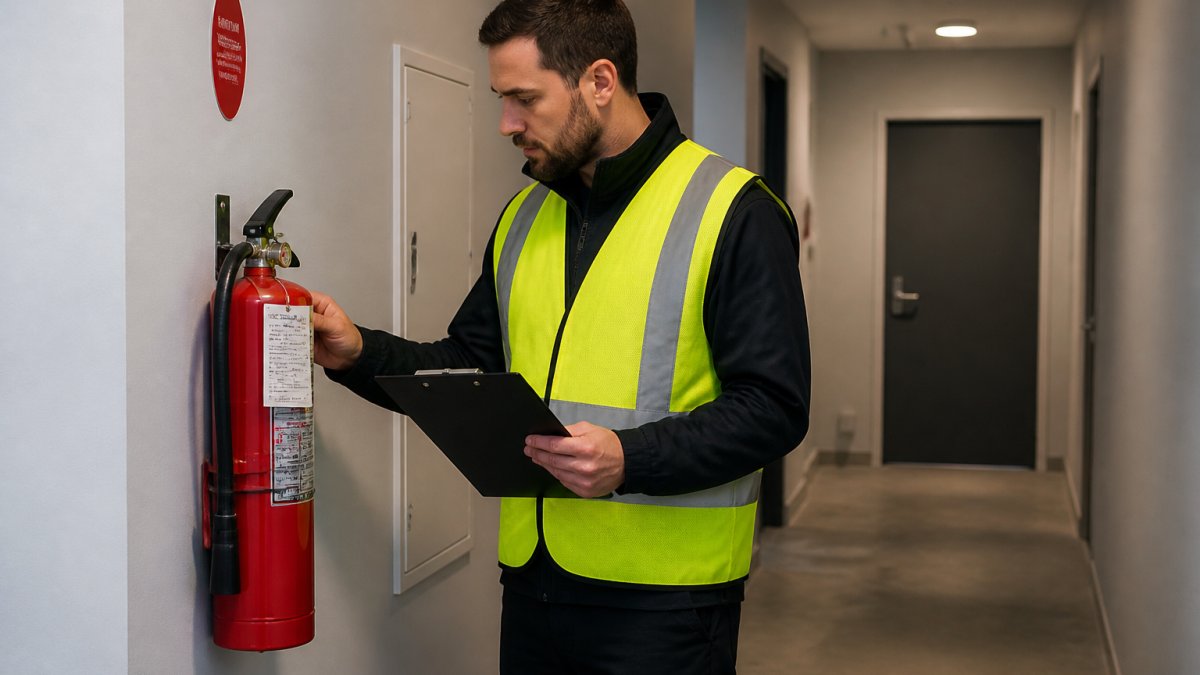
Documenting these routine checks ensures that every safety measure remains functional and aligns with the broader requirements of strata committee compliance.
Split your checklist into two tracks:
Monthly visual checks (in-house):
- Extinguishers in place, unobstructed and undamaged
- Seals and gauges showing normal readings
- Exit signs lit and clearly visible
- Fire doors closing fully and latching
- Escape routes clear of storage
Contractor checks (scheduled):
- Full system testing against the relevant standard
- Pressure and flow testing for hydrants and hose reels
- Detection system testing and log review
Keep the checklist version-controlled. When the standard changes, the checklist changes with it.
Step 3: Set Fire Extinguisher Inspection Frequency and Other Intervals
Fire extinguisher inspection frequency splits into two levels, and confusing them causes most compliance gaps. A visual check happens monthly, in-house. Formal servicing happens at set intervals by a competent person, in line with AS 1851.
Set your intervals by system:
| System | Visual check | Formal service | Who does it |
|---|---|---|---|
| Extinguishers | Monthly | Set intervals per AS 1851 | Competent contractor |
| Fire hose reels | Monthly | Set intervals per AS 1851 | Competent contractor |
| Smoke alarms | Monthly test | Annual service | Contractor or tester |
| Exit and emergency lighting | Monthly | Set intervals per AS 1851 | Competent contractor |
| Fire doors | Monthly | Periodic detailed check | Contractor or trained staff |
Build the intervals into a calendar with reminder dates set well ahead. A reminder that fires two weeks before the due date gives you room to book.
The single most useful habit is booking the next service the day the current one is completed. It removes the gap where deadlines quietly disappear.
Step 4: Schedule Fire Door Inspection and Maintenance
Fire door inspection and maintenance is the item strata managers most often overlook. Fire doors are passive protection, so nothing fails loudly. A door propped open or a damaged seal looks harmless until it matters.
Your fire door routine should cover:
- Monthly: confirm each door closes fully, latches, and is not wedged or obstructed
- Periodic detailed check: inspect seals, hinges, closers and glazing for damage
- After any building work: re-check doors near the work, since trades often remove hardware
Log every defect with a photo and a date raised. A defect that is recorded and scheduled for repair shows an auditor you are managing the building. A defect nobody wrote down shows the opposite.
Fyrepower’s QBSA-licensed team handles extinguisher and hydrant servicing, so one visit covers several items on the schedule.
Step 5: Use a Fire Safety Maintenance Log Template to Track Everything
A fire safety maintenance log template is the record that proves the work happened. If an auditor or insurer asks for evidence, this document is your answer.
Your log should hold, for every asset:
- Asset ID and location
- Date of last service
- Name and licence of the contractor
- What was tested and the result
- Any defects found and the action taken
- Date of next scheduled service
Keep digital copies with dated backups. Paper logs get lost in building handovers, and a missing log reads as a missing service.
Ask contractors for reports that name each asset individually rather than a single line saying “systems tested.” Vague reports are the reason strata managers fail audits they should have passed.
Common Mistakes Strata Managers Make With Fire Safety Maintenance
The same five mistakes account for most failed audits. Each one is fixable, and most cost nothing but attention.
- No named owner. A schedule without an accountable person drifts within a quarter.
- Confusing install with maintenance. New equipment still needs scheduled servicing from day one.
- Vague service reports. Reports that do not name each asset cannot prove the work was done.
- Missing the passive systems. Fire doors, signage and evacuation diagrams get forgotten because they never “fail.”
- No backup plan. If a contractor cancels, the deadline does not move with them.
That last one deserves attention. When you appoint a provider, ask what happens if an appointment is missed. A provider that cannot answer clearly is a risk to your compliance dates.
Never let a contractor’s missed appointment become your missed deadline. Build a buffer into the calendar and confirm bookings in writing, so the responsibility for the date is shared and documented.
At Fyrepower, we structure maintenance programs around fixed intervals with advance booking, so strata portfolios with multiple properties do not end up chasing appointments. Our reports name each asset, and our team is fully insured and QBSA-licensed, which you can verify before appointing us.
Frequently Asked Questions
How often should fire safety equipment be inspected in a strata building?
Most fire safety systems in strata buildings need servicing every six months, with some items tested monthly and others annually. Extinguishers, hydrants, hose reels and smoke alarms all carry different intervals under AS1851, so your fire safety maintenance schedule should map each system to its own testing frequency. Monthly checks cover visual items like exit signs and extinguisher pressure gauges, while annual or five-yearly tests cover more involved servicing. A qualified fire protection provider can confirm the exact intervals for your building’s systems and record them in your maintenance log.
What should a strata fire safety maintenance log include?
A useful fire safety maintenance log template records the date of each inspection, the system or item tested, the technician’s name and licence details, the result, and any defects found with the action taken. Include the next scheduled service date so nothing slips. Detailed reports matter because a vague entry will not prove the work was done if you are audited. Keep logs for the full retention period and store them where committee members and auditors can access them. Photos of defects and repairs add a layer of evidence that written notes alone often miss.
Who is responsible for fire safety maintenance in a strata scheme?
The owners corporation is generally responsible for fire safety systems on common property, and it delegates the day-to-day coordination to the strata manager. That means arranging inspections, keeping records, acting on defects and reporting to the committee. Individual lot owners remain responsible for smoke alarms inside their own units in most schemes. Clear allocation of duties in your schedule prevents the gaps that show up in audits, where nobody is sure who booked the last service or whether a defect was ever fixed.
How do strata managers keep track of fire safety defects and repairs?
Log every defect the moment it is identified, with the date, location, description and who is responsible for fixing it. Assign a target repair date and follow up until the work is signed off. Group defects by risk so urgent items, such as a faulty exit sign or a blocked fire door, get fixed first. Review the open defects list at each committee meeting and keep the closed items in your fire safety maintenance log template. This trail shows auditors and insurers that defects were identified and resolved, not just noted and forgotten.
Fire safety maintenance only works when it runs on a schedule someone owns, with records that hold up under scrutiny. If your current program relies on memory or a contractor’s goodwill, that is the gap to close first. Fyrepower provides scheduled testing, detailed per-asset reporting, and servicing for extinguishers, hydrants and suppression systems across the region. Get in touch with us now to book an assessment and put your strata schedule on a firm footing.