Table of Contents
- Why Fire Safety for Hospitality Venues Demands a Different Approach
- Conducting a Fire Risk Assessment for Your Venue
- Fire Detection, Alarm Systems, and Suppression Equipment
- AS 1851 Maintenance Standards: What Venue Managers Must Know
- Fire Safety Training for Hospitality Staff
- Emergency Evacuation Plan Template for Hospitality Venues
- Legal Compliance, Digital Records, and Post-Fire Business Continuity
- Frequently Asked Questions
Last Updated: August 13, 2026
Why Fire Safety for Hospitality Venues Demands a Different Approach
Fire safety for hospitality venues is not a one-size-fits-all discipline. Restaurants, bars, function centres, and hotels present hazards most commercial buildings do not: high-occupancy public spaces, industrial cooking equipment, alcohol storage, and guests unfamiliar with the layout. This combination makes fire risk both more likely and more difficult to manage than in standard office or warehouse settings.
At Fyrepower, we work with venue operators across South East Queensland and Northern New South Wales, and the pattern is consistent: venues treating fire safety as a compliance checkbox get caught out during audits or actual emergencies.
Under the National Construction Code fire safety requirements, Class 6 and Class 9b buildings (restaurants, bars, and entertainment venues) face specific fire protection requirements beyond standard commercial provisions. Getting this right requires more than a fire extinguisher on the wall.
Boutique Venues vs. Large-Scale Venues: Different Risks, Same Obligations
Small venue operators often assume their risk profile is simpler than larger venues. It is not simpler, it is different.
A boutique restaurant with 40 covers has a compact kitchen producing the same grease-laden air as a venue three times its size, with narrower escape routes and higher staff turnover requiring more frequent fire safety training. Large-scale venues face different pressures: multiple exit points requiring coordinated evacuation planning, larger occupancy limits demanding crowd management, and kitchen operations across multiple service areas each needing separate suppression system inspections.
The legal obligations are identical regardless of size. What changes is how you meet them.
Conducting a Fire Risk Assessment for Your Venue
A fire risk assessment identifies fire hazards, evaluates likelihood and consequence, and documents controls to reduce risk to acceptable levels. It is the foundation of every fire safety activity in your venue.
Many managers treat the annual audit as formality. A risk assessment should be a living document, updated whenever layout changes, new equipment is installed, or occupancy patterns shift significantly.
Hazard Identification in High-Risk Zones
The highest-risk zones in hospitality venues are predictable: the kitchen, bar, storage areas for cleaning chemicals, and areas where electrical equipment runs continuously.
Start in the kitchen. Look for grease accumulation on extraction hoods and ductwork, combustible materials near cooking surfaces, gas connection condition, and electrical equipment left on overnight or near water sources.
At the bar, assess storage of spirits and flammable liquids, confirming quantities comply with relevant dangerous goods thresholds. In storage areas, confirm fire doors are not propped open, stock does not obstruct emergency exits, and electrical switchboards have clear access.
A common mistake is conducting hazard identification only in the kitchen. Many venue fires originate in storage areas, electrical switchboards, or outdoor areas where waste accumulates. Include the whole site in your assessment.
Documenting and Reviewing Your Fire Safety Audit
Every hazard identified needs written record including the hazard, location, control measure, and review date. This documentation is not optional. Auditors will ask to see it.
Review your fire safety audit at minimum every 12 months, and immediately after any incident, near-miss, or significant venue change.
Fire Detection, Alarm Systems, and Suppression Equipment
Reliable fire detection is the difference between a contained incident and catastrophic loss. Every hospitality venue must have a fire detection and alarm system appropriate to its size, occupancy, and use.
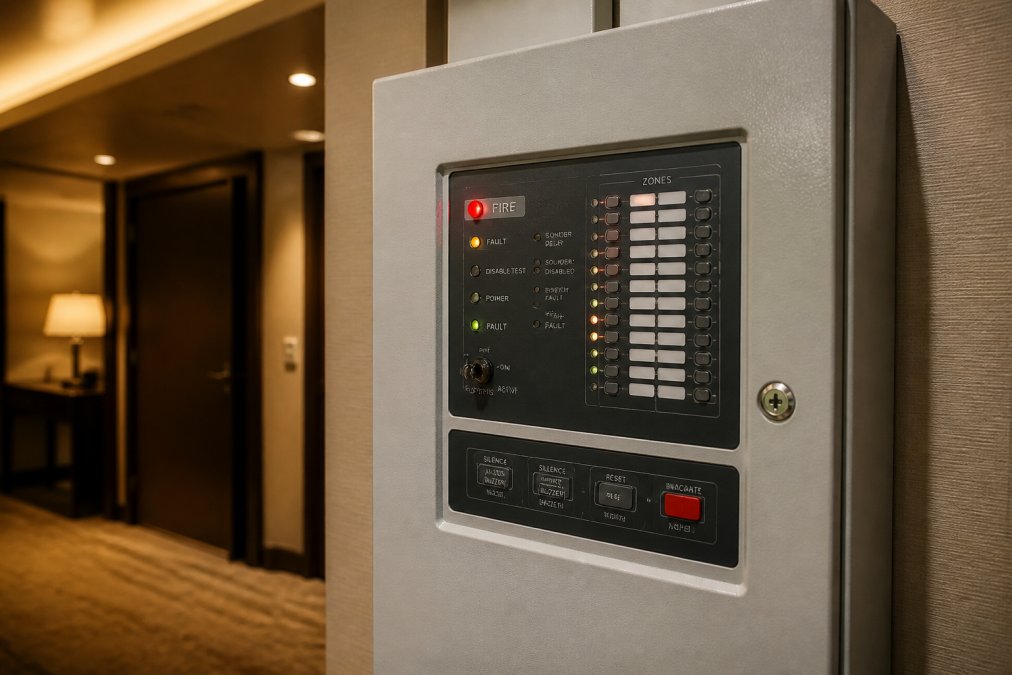
Smoke detectors respond early to slow-burning fires and suit dining rooms, function spaces, and corridors. Heat detectors suit commercial kitchens where cooking fumes trigger smoke detectors constantly. Using the wrong type leads to either nuisance alarms or dangerous detection delays.
Sprinkler systems are required in many venues above certain floor area or occupancy thresholds. Where installed, they must be maintained and tested in accordance with AS 1851 Maintenance of Fire Protection Systems and Equipment, which sets inspection frequencies and testing protocols.
Kitchen Hood Extinguishers and Suppression Systems
Most hospitality venue fires start in the kitchen. A kitchen hood suppression system is a fixed, automatic fire suppression system installed within the exhaust canopy above cooking equipment. When fire is detected, it discharges a wet chemical agent directly onto the cooking surface, suppressing the fire before it spreads into ductwork.
This differs from a portable fire extinguisher mounted nearby. Both are required: the fixed system handles the initial event automatically; the portable extinguisher gives staff means to address residual fire or secondary ignition.
Kitchen hood suppression systems must be inspected every six months by a qualified technician. Grease filters must be cleaned regularly, with frequency depending on cooking volume.
Many operators do not realise that a kitchen suppression system inspection also requires the gas supply to be isolated and tested. Schedule these inspections during quiet trading periods, not peak service.
AS 1851 Maintenance Standards: What Venue Managers Must Know
AS 1851 governs routine service, inspection, and testing of fire protection systems and equipment. For venue managers, it is the single most important document shaping maintenance obligations.
The standard covers sprinkler systems, fire hydrant systems, fire hose reels, portable fire extinguishers, fire detection and alarm systems, emergency warning systems, and fixed suppression systems. Each category has its own inspection frequency, ranging from monthly visual checks to five-yearly major inspections.
What catches many managers off guard is the documentation requirement. AS 1851 requires that every inspection is recorded in a logbook with the date, technician details, findings, and remedial actions. Vague service reports saying “checked and tested” without specifics will not satisfy an auditor.
Choose a fire protection service provider who issues detailed, itemised service reports listing every extinguisher by location and condition, documenting test results for each alarm zone, and recording any defects found.
Fire Safety Training for Hospitality Staff
The most technically advanced fire protection system does not help if staff freeze during an emergency. Fire safety training for hospitality staff is where compliance meets genuine life-safety outcomes.

Training must cover more than fire extinguisher operation. Staff need to understand the venue’s emergency evacuation plan, know their assigned evacuation role, understand when to fight a fire versus evacuate immediately, and know how to assist guests needing help exiting.
The hardest part is getting staff to override the instinct to keep serving guests, protect stock, or wait to see if the alarm is real.
Fire Warden Roles and Evacuation Drills
Every venue should designate at least one fire warden per floor or zone, with a deputy for absences. Fire warden responsibilities include confirming an alarm is genuine and initiating evacuation, sweeping their zone to ensure all have exited, accounting for all persons at the assembly point, liaising with emergency services, and completing a post-evacuation report.
Evacuation drills should be conducted at least annually with results documented. Larger venues or those with high staff turnover benefit from more frequent drills, simulating realistic conditions including specific fire origin points, partial exit obstruction, and guests needing direction.
A fire warden who has never physically walked an evacuation route under time pressure will hesitate in a real emergency. Drills are not formality. They are the only way to find what breaks down before it matters.
Emergency Evacuation Plan Template for Hospitality Venues
An emergency evacuation plan is a documented, site-specific set of procedures telling staff and patrons exactly what to do when a fire alarm activates. Every hospitality venue must have one, displayed prominently.
A complete emergency evacuation plan should include:
| Component | What to Include | Review Frequency |
|---|---|---|
| Floor plan with exits | All exit doors, assembly point, fire equipment locations | After any layout change |
| Alarm response procedure | Steps from alarm activation to evacuation | Annually |
| Warden contact list | Names, zones, deputy contacts | Every six months |
| Assembly point details | Location, how to account for all persons | After venue changes |
| Procedures for guests with mobility needs | Evacuation chairs, designated assist zones | Annually |
| Emergency services contact | Local fire brigade number, venue address | Annually |
| Post-evacuation re-entry procedure | Who authorises re-entry, how it is communicated | Annually |
The plan must be site-specific. A generic template printed without modification is not compliant. The floor plan must reflect your actual layout, exits must be correctly labelled, and the warden list must contain real names.
Display the evacuation plan at every staffed station, in the kitchen, and at each main exit.
Legal Compliance, Digital Records, and Post-Fire Business Continuity
Regulatory Obligations Under the NCC and State Fire Safety Codes
Fire safety compliance sits across multiple regulatory layers. The National Construction Code sets baseline requirements for fire protection systems based on building class and size. State legislation adds operational obligations applying once the venue trades.
In Queensland, the Queensland Development Code and Fire and Emergency Services Act require venue operators to maintain fire safety installations in accordance with relevant Australian Standards and produce records on demand. In New South Wales, similar obligations apply, with annual fire safety statements required for many Class 6 and 9b buildings.
Exceeding approved occupancy limits is not just a safety risk. It breaches development approval conditions and can void insurance coverage in an incident.
Digital Fire Safety Management and Post-Fire Recovery Planning
Digital fire safety management tools allow venue operators to store inspection records, track maintenance schedules, receive automated reminders for upcoming service dates, and produce audit-ready reports on demand.
When a fire safety auditor arrives unannounced, you can produce a complete, timestamped service history for every piece of equipment on site within minutes.
Post-fire recovery planning is often ignored. If your venue experiences a fire, you need a documented plan covering how to notify your insurer and what documentation they require, which fire protection equipment needs re-inspection before trading resumes, how to communicate with staff and guests during closure, what your business interruption insurance covers, and who authorises re-opening.
According to the Insurance Council of Australia’s guidance on business recovery, businesses with documented recovery plans resume trading significantly faster than those without. For hospitality venues where every closed day represents direct revenue loss, this planning is essential.
Build your post-fire recovery plan into your overall fire safety policy document and review it annually alongside your risk assessment and evacuation plan.
Managing fire safety for hospitality venues is genuinely complex, and the consequences of getting it wrong run from failed audits to unrecoverable business losses. Fyrepower’s QBSA-licensed team provides comprehensive fire protection services across the Gold Coast, South Brisbane, and Northern New South Wales, including AS 1851-compliant maintenance, kitchen suppression system inspections, staff training, and detailed service reporting that holds up under audit. Get in touch with us now to arrange a site assessment and put your venue’s fire safety on a defensible footing.
Frequently Asked Questions
What are the mandatory fire safety requirements for hospitality venues?
Hospitality venues must maintain compliant fire detection and alarm systems, portable fire extinguishers, emergency lighting, fire safety signage, and clear escape routes. Venues classified as places of assembly under the National Construction Code must also hold a current fire safety certificate, conduct regular fire safety audits, and keep maintenance records in line with AS 1851. State-specific legislation, such as Queensland’s Fire and Emergency Services Act 1990, sets additional obligations for venue operators.
How often should fire safety equipment be tested in a commercial venue?
Under AS 1851, most fire safety systems in commercial venues require inspection and testing at least every six months, with some components requiring annual or quarterly attention. Fire extinguishers must be inspected every six months and pressure-tested (hydrostatic testing) every five years. Alarm systems, sprinkler systems, and emergency lighting each have their own maintenance schedules defined in AS 1851. Keeping accurate service records is essential to demonstrate compliance during a fire safety audit.
What is the role of a fire warden in a hospitality setting?
A fire warden is responsible for coordinating the safe evacuation of guests and staff during an emergency. In a hospitality venue, this means directing people to escape routes, checking areas are clear, communicating with the fire marshal, and accounting for all occupants at the assembly point. Fire wardens should be identified on the emergency evacuation plan and receive formal fire safety training, including regular evacuation drills, to ensure they can act decisively under pressure.
How do I conduct a fire risk assessment for a hotel or restaurant?
A fire risk assessment for a hospitality venue involves five steps: identify fire hazards (ignition sources, fuel loads, and oxygen sources); identify people at risk, including guests unfamiliar with the layout; evaluate and reduce risks by improving fire protection measures; document findings in a fire safety policy; and review the assessment regularly or after any significant change to the venue. Engaging a licensed fire protection specialist ensures the assessment meets Australian fire safety standards and supports ongoing compliance.
This article was written using GrandRanker